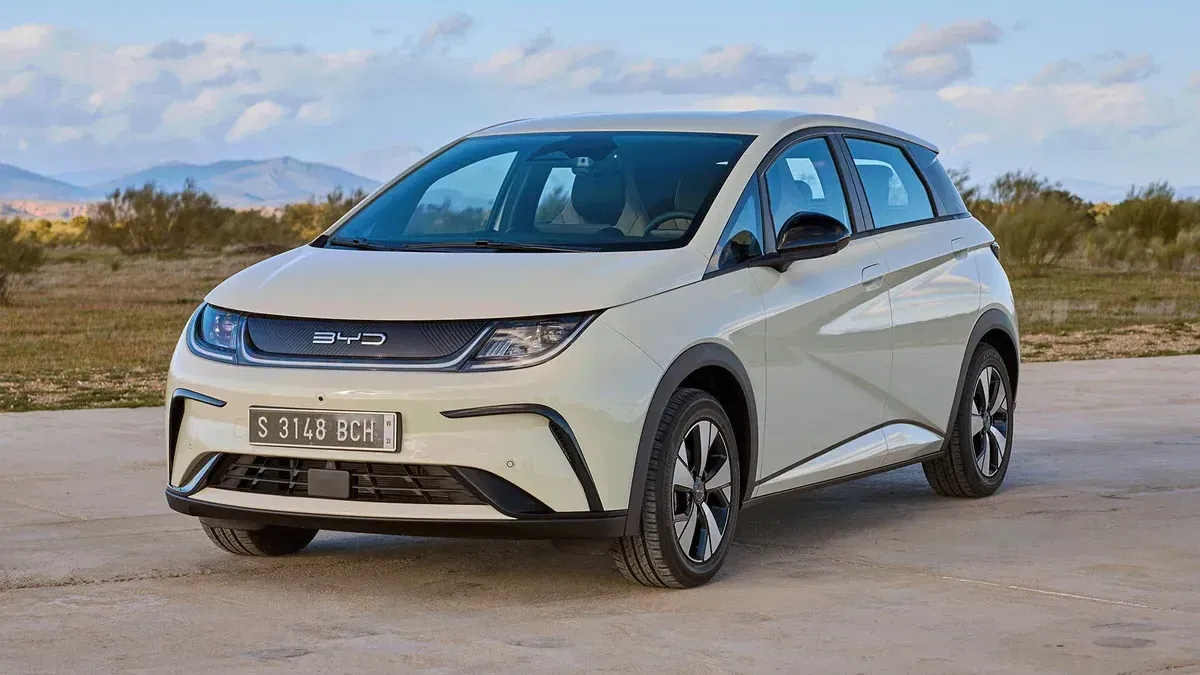
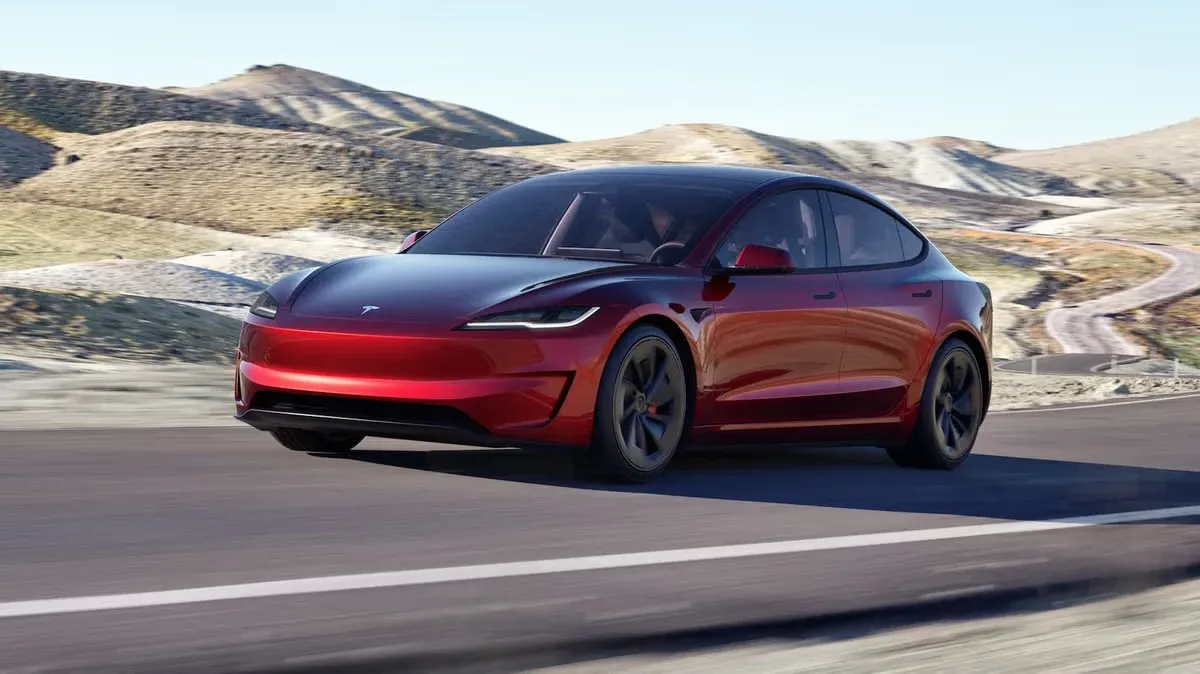
BYD Dolphin vs Tesla Model 3
$29,990 vs $54,900. Is the Tesla actually worth nearly double the price?
Data checked: specs 3 Oct 2026, price 4 Oct 2026
Comparison snapshot
Prices, scores and edges below update from our car data.
Cheaper by $24,910, 1 more year of warranty
Uses 1.4 kWh/100km less, 337L more boot
Written 7 April 2026. The snapshot, tables, scores and verdict on this page update from our car data; figures quoted in the text are as at that date.
Price
$24,910 apart. That is not a small gap. You could buy a decent used car with the difference. The Dolphin Essential at $29,990 is one of the cheapest EVs on sale in Australia. The Model 3 Standard Range RWD at $54,900 is a mid-range EV by current pricing standards.
Running costs are nearly identical since both are battery electric vehicles with similar efficiency (13.2-13.3 kWh/100km). Charging at home on off-peak electricity (roughly $0.15/kWh) costs about $3 per 100km for either car. There is essentially zero difference in energy costs between the two.
5-Year Cost Estimate
| Cost | Dolphin Essential | Model 3 SR RWD |
|---|---|---|
| Driveaway (est. VIC) | ~$32,500 | ~$58,000 |
| 5yr Energy | $1,498 | $1,485 |
| 5yr Insurance | $5,800 | $8,200 |
| 5yr Servicing | $1,200 | $1,800 |
| Resale (est. 5yr) | -$14,995 (50%) | -$24,405 (42%) |
| Registration & CTP (5yr) | $3,500 | $4,000 |
| True 5yr Cost | $29,503 | $49,080 |
The Dolphin Essential is far cheaper to buy, and that purchase gap is the bulk of the difference over five years. Both are EVs with light service schedules and similar energy costs, so running costs will not move it much. We do not hold insurance or resale figures for either car. What is worth saying on resale is that Tesla has repriced the Model 3 new more than once, and every price cut resets used values behind it, while BYD simply has not been here long enough for a settled used market. The Dolphin's lower buy-in means less capital exposed to either outcome.
Safety
Both carry 5-star ANCAP ratings, so the baseline safety is strong in either car. The Model 3 scored among the highest ever recorded for safety assist technology, thanks to Tesla's Autopilot system which includes advanced lane centring, adaptive cruise, and automatic emergency braking at highway speeds.
The Dolphin Essential has basic lane keep assist and adaptive cruise control. It does the job, but the system is not as refined or capable as Tesla's. Both cars have front and side airbags, AEB with pedestrian detection, and electronic stability control.
If active safety technology matters to you, the Tesla is clearly ahead. If you just want a car that will protect you in a crash and keep you between the lines, both are excellent. The Dolphin's LFP Blade Battery is also worth mentioning for passive safety, as the blade cell design is extremely resistant to thermal runaway in crash scenarios.
Features
Tesla's 15.4-inch central screen controls everything. No physical buttons, no instrument cluster behind the steering wheel. It is a polarising approach. Some people love the minimalism. Others find it frustrating to adjust the air conditioning through a touchscreen while driving.
The Dolphin Essential gets a 12.8-inch rotating screen (it swivels between portrait and landscape) and a smaller driver display. It feels less futuristic but more conventional and easier to navigate. Physical climate controls are a genuine usability advantage in daily driving.
Tesla gets over-the-air software updates, Sentry Mode (dashcam-style security recording), Camp Mode, and Dog Mode. BYD gets Vehicle-to-Load (V2L) capability, which lets you run appliances from the car's battery. If you camp or need emergency backup power, V2L is genuinely practical and something Tesla does not offer.
Wireless Apple CarPlay and Android Auto are available on the Dolphin. Tesla does not support CarPlay at all, relying on its own built-in software for everything. If you are deeply invested in the Apple or Google ecosystem, the Dolphin plays nicer with your phone.
Drivetrain
The performance gap here is massive. The Model 3 produces 208kW and 340Nm versus the Dolphin Essential's 70kW and 180Nm. That is three times the power. In practice, the Model 3 hits 100km/h in 6.1 seconds. The Dolphin Essential takes 12.3 seconds. If you have ever driven a modern turbo hatchback, the Dolphin feels about as quick as a base model Corolla. The Model 3 feels like a sports car.
| Drivetrain | Dolphin Essential | Model 3 SR RWD |
|---|---|---|
| Motor Output | 70kW / 180Nm | 208kW / 340Nm |
| 0-100 km/h | 12.3s | 6.1s |
| Range (WLTP) | 340km | 520km |
| Battery Chemistry | LFP Blade | LFP |
| Drive | FWD | RWD |
| Kerb Weight | 1,506kg | 1,761kg |
| Towing | Not rated | 1,000kg |
Both cars use LFP (lithium iron phosphate) battery chemistry, which means you can charge to 100% daily without worrying about accelerated degradation. This is a genuine ownership advantage over NMC-based EVs where manufacturers recommend capping daily charging at 80%. Both benefit from simple, low-maintenance single-motor drivetrains with no gearbox to service.
Space and comfort
Boot space is a landslide for the Tesla. The Model 3 offers 682 litres, which is frankly enormous for a sedan and beats most mid-size SUVs. The Dolphin Essential manages just 308 litres, which is tight even by hatchback standards. If you regularly carry luggage, prams, or sports gear, this difference matters every single week.
The Dolphin makes up for it with a more upright seating position and a hatchback tailgate that makes loading bulky items easier than the Tesla's sedan boot opening. The Tesla's boot is deep but the opening is smaller, so getting large items in requires more maneuvering.
Rear seat space is adequate in both, though the Model 3's longer wheelbase gives rear passengers noticeably more legroom. Neither car has a frunk worth talking about for daily use.
The $24,910 Question
Nearly twenty-five grand difference. That is the real story here. On paper, the Tesla Model 3 wins almost every spec comparison, and it is not close. Triple the power. 180km more range. More than double the boot space. It can tow a small trailer. It charges faster on DC. The Supercharger network is more reliable than most CCS alternatives.
But here is the thing: none of that matters if you do not need it. And most urban EV buyers in Australia genuinely do not. If you drive 40km to work and back, charge in your garage overnight, and your biggest cargo challenge is a weekly Woolies shop, the Dolphin Essential does everything you need. It just does it for $24,910 less.
Range in the Real World
The Dolphin Essential claims 340km WLTP. In real-world Australian conditions (air conditioning on, highway stretches, hills), expect roughly 280-300km. The Model 3 claims 520km and delivers approximately 430-460km in practice. Both numbers are perfectly liveable for daily commuting. The gap only becomes meaningful on road trips.
If you regularly drive Melbourne to Sydney, Adelaide to the Barossa, or Brisbane to Byron, the Model 3's extra range and faster DC charging (170kW peak vs roughly 88kW for the Dolphin) makes those journeys materially less stressful. If your longest regular drive is across the suburbs, it is irrelevant.
Charging: Supercharger vs CCS
Tesla's Supercharger network remains the most reliable fast-charging network in Australia. Stations are well-maintained, consistently available, and the in-car navigation routes you to them automatically with preconditioning. The Dolphin uses the CCS universal standard and can charge at any CCS-compatible station, including the growing number of Tesla Superchargers now open to non-Tesla vehicles.
At home, both charge identically via a wall box. A 7kW home charger will fill the Dolphin from 10-100% in roughly 8 hours overnight. The Model 3 takes about 10 hours for the same. Both are set-and-forget if you plug in when you get home. Home charging is where most EV owners do 90% of their charging, and at off-peak rates it costs a few dollars a night.
The Towing Issue
The Dolphin Essential cannot tow. Zero kilograms rated capacity. If you need to pull even a small box trailer to the tip, you cannot do it with this car. The Model 3 is rated to 1,000kg braked, which handles a small camper trailer, a box trailer, or a jet ski. It is not a tow vehicle by any stretch, but at least it has the option.
Warranty and Long-Term Ownership
BYD offers 6 years and 150,000km. Tesla offers 5 years and 80,000km. For the vehicle warranty, that is a meaningful gap. If you drive 25,000km per year, you will exceed Tesla's warranty kilometre limit in just over three years. BYD gives you six years of coverage at that pace. Both brands offer 8-year battery warranties separately.
BYD's Australian service network is still growing and is nowhere near as established as Tesla's. Finding a BYD service centre outside capital cities can be challenging. Tesla's mobile service fleet is excellent and covers regional areas better. This is worth considering if you live outside a major city.
Who Should Buy Which?
Buy the Dolphin Essential if: you want an affordable EV for city commuting, you charge at home, you rarely road trip long distances, and you would rather spend $24,910 on something other than a car. It is a sensible, practical, no-frills electric hatchback that does exactly what it says on the box.
Buy the Model 3 if: you road trip between cities, you value the Supercharger network and Tesla's tech ecosystem, you want a quick car with a huge boot, and you can comfortably afford the premium. The Model 3 is the better car by every objective measure except price and warranty.
See also: MG4 vs Dolphin, Model 3 vs Ioniq 6, and our Best Electric Cars Australia 2026 guide.
Key details
A tick marks the better figure only where both cars have one and the gap is meaningful (3% or more; a whole star or year).
| Detail | BYD Dolphin | Tesla Model 3 |
|---|---|---|
| Price | From $29,990 RRP | From $54,900 RRP |
| Drive-away estimate | $28,888 drive away (VIC, advertised) | Calculating... |
| Body | Hatch | Sedan |
| Powertrain | Electric, Electric motor | Electric, Electric motor |
| Power / torque | 70kW / 180Nm | 208kW / 340Nm |
| Energy use | 15.2 kWh/100km | 13.8 kWh/100km |
| 0-100km/h | 12.3s | 6.1s |
| Boot | 345L seats up | 682L seats up |
| Towing (braked) | No data | 1,000kg |
| ANCAP | 5 stars (2023) | 5 stars (2025) |
| Warranty | 6yr / 150,000 km | 5yr |
At a glance
- Seats
- 5
- Boot
- 345L seats up
- Length x width x height
- 4,290 x 1,770 x 1,570mm
- Wheelbase
- 2,700mm
- Engine
- Electric motor
- Power
- 70kW
- Torque
- 180Nm
- Drive
- FWD
- Transmission
- Auto
- Power-to-weight
- 46 kW/tonne
- Kerb weight
- 1,506kg
- Spare wheel
- None
- Payload
- 410kg
- Towing braked / unbraked
- No data
- Turning circle
- 10.4m
- Seats
- 5
- Boot
- 682L seats up
- Length x width x height
- 4,720 x 1,933 x 1,440mm
- Wheelbase
- 2,875mm
- Engine
- Electric motor
- Power
- 208kW
- Torque
- 340Nm
- Drive
- RWD
- Transmission
- Automatic
- Power-to-weight
- 118 kW/tonne
- Kerb weight
- 1,761kg
- Spare wheel
- Tyre repair kit
- Payload
- 471kg
- Towing braked / unbraked
- 1,000kg / 750kg
- Turning circle
- 11.6m
CarSorted Score breakdown
The CarSorted Score is algorithmic: it is calculated from each car's data, not from a road test. How it works.
Safety
Energy Efficiency
Value
Practicality
Technology
Performance
Reliability
The verdict
Tesla Model 3 comes out ahead on the CarSorted Score (72 vs 64)
The deciding gaps
- Performance:BYD Dolphin 23, Tesla Model 3 67, Tesla Model 3 ahead by 44
- Practicality:BYD Dolphin 40, Tesla Model 3 63, Tesla Model 3 ahead by 23
- Safety:BYD Dolphin 69, Tesla Model 3 87, Tesla Model 3 ahead by 18
The Tesla Model 3 wins on the score; the BYD Dolphin is the cheaper of the two, and price is already part of the Value axis.
Same scorer as the live comparison of these two exact cars.
Our take (written 7 April 2026)
The Tesla wins on nearly every measurable spec: triple the power, 180km more range, double the boot space, and it can tow. But the Dolphin Essential costs $24,910 less. That is an extraordinary amount of money. For urban commuters who charge at home and rarely road trip, the Dolphin does everything you need at barely more than half the price. For road trippers, anyone who values the Supercharger network, or buyers who want a genuinely quick car, the Model 3 justifies its premium. Neither is the wrong choice. They serve different buyers at wildly different price points.
Prices on this page move. Want the next verdict?
One short email when prices shift or a new comparison lands. No spam, unsubscribe anytime.
Questions buyers ask
Can the BYD Dolphin tow?
Braked towing capacity: the Tesla Model 3 is listed at 1,000kg. We have no braked towing figure on record for the BYD Dolphin.
Is 340km range enough?
Electric range (WLTP where published): the Tesla Model 3 at 520km, against 340km for the BYD Dolphin.
Which EV has the better warranty?
The BYD Dolphin comes with a 6yr / 150,000 km warranty; the Tesla Model 3 with a 5yr warranty.
Which is cheaper, the BYD Dolphin or the Tesla Model 3?
The BYD Dolphin Essential is from $29,990 RRP; the Tesla Model 3 Premium Rear-Wheel Drive is from $54,900 RRP. That makes the BYD Dolphin $24,910 cheaper.
Which is cheaper to run, the BYD Dolphin or the Tesla Model 3?
On the official combined cycle, the BYD Dolphin uses 15.2 kWh/100km and the Tesla Model 3 uses 13.8 kWh/100km.
What are the ANCAP ratings for the BYD Dolphin and Tesla Model 3?
The BYD Dolphin holds 5 stars (rated 2023), and the Tesla Model 3 holds 5 stars (rated 2025).
Which has the bigger boot?
Boot space with the seats up: the Tesla Model 3 at 682L, against 345L for the BYD Dolphin.
Which comes out ahead overall?
On the CarSorted Score the Tesla Model 3 comes out ahead (BYD Dolphin 64/100, Tesla Model 3 72/100), mainly on performance, practicality, safety. The score is algorithmic; the editorial above says who each car suits.
Related
Compare
In the news
- BYD Dolphin Essential Cut to $28,888 Driveaway in Australia From 15 September
- 2026 GAC Aion UT: Affordable Electric Hatch Lands From $31,990
- BYD Rolls Out $4,000 Cashback Across 16 Variants in Australia: Sealion, Seal 6 and Shark 6 Until 21 December
- IM Presented by MG Formally Launches IM5 and IM6 in Australia: $60,990 to $80,990 Driveaway, September Deliveries
How to read this page. Prices, specs, ANCAP ratings, warranty, scores and the computed verdict come from our records for the two variants shown, sourced from manufacturer Australian documents, and update when those records change. RRP excludes on-road costs. Drive-away figures are estimates for the state you have selected unless marked as advertised. The editorial text was written on 7 April 2026. Always confirm price and specification with the manufacturer or dealer before you buy. CarSorted does not accept payment for recommendations.
Comments (0)
Sign in to join the conversation
No comments yet. Be the first!