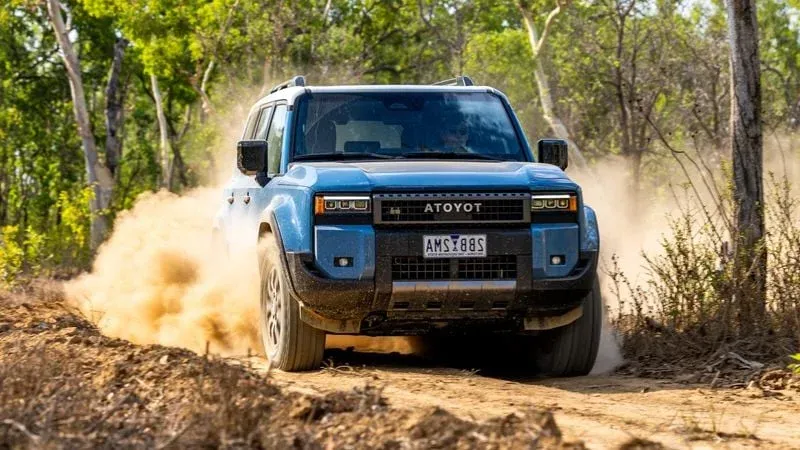
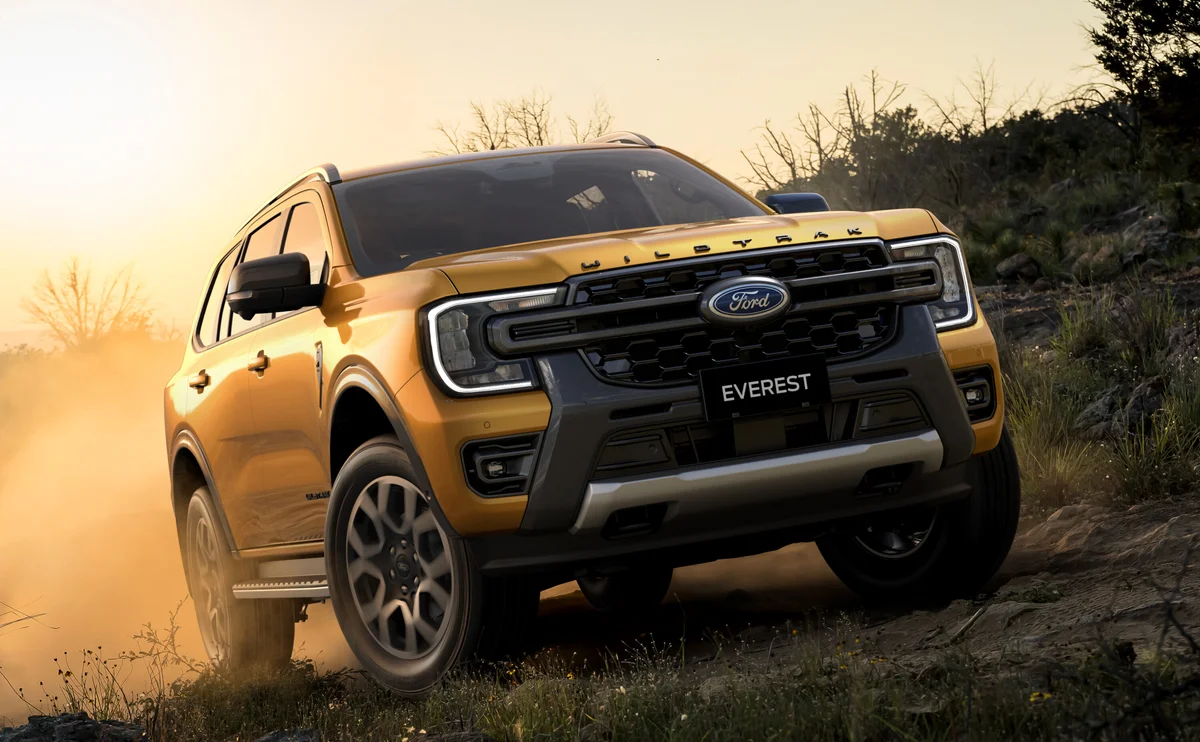
Toyota Prado vs Ford Everest
$73,200 for Australia's most iconic 4WD vs $68,990 for Ford's seriously capable alternative. A $4,210 price gap that tells a bigger story.
Data checked: specs 4 Aug 2026, price 6 Sep 2026
Comparison snapshot
Prices, scores and edges below update from our car data.
Lighter on fuel by 0.9 L/100km, 149L more boot
Cheaper by $3,510, 34kW more power
Written 7 April 2026. The snapshot, tables, scores and verdict on this page update from our car data; figures quoted in the text are as at that date.
Price
The $4,210 price gap is the headline here. The Everest Ambiente at $68,990 undercuts the base Prado GX at $73,200, and on a $70,000 car that is close enough that it will not decide the argument on its own. At face value the Everest still looks like the value pick.
But let's look at the full picture. Fuel costs at $2.10/L for diesel and 15,000km per year: the Prado costs approximately $2,394 annually, the Everest $2,268. The Prado uses $126 more per year in fuel. Over 5 years, that is $630. Not a meaningful gap.
Servicing is comparable. Both brands offer capped-price servicing for their 4WD range. Expect $400-$500 per service for either vehicle. Toyota's service intervals are every 10,000km; Ford's are every 12 months or 15,000km. Over 5 years at 15,000km/year, you will complete slightly more services in the Prado, adding roughly $400-$500 to the total servicing cost.
Now the big one: resale. Used Prados command premium prices because demand comes from export markets as well as domestic buyers, and Toyota discounts the model lightly. We do not hold used sale prices, so we are not going to publish a retention percentage for either car. Directionally this narrows the $4,210 gap rather than closing it, and how far depends on how long you hold the car. If it is the deciding factor, ask both dealers for a written trade-in projection.
Safety
Both are 5-star ANCAP rated with comprehensive safety suites. For large 4WDs at this price, the safety equipment is excellent. Both come with AEB, lane-keep assist, adaptive cruise control, and multiple airbags including curtain airbags for all three rows.
The Prado GX includes Toyota Safety Sense with pre-collision system, lane tracing assist, dynamic radar cruise control, road sign assist, and automatic high beam. Toyota's system is well-calibrated and unobtrusive. The lane tracing assist works particularly well on long highway stretches, which is exactly where you will be using a car like this.
The Everest Ambiente gets Ford's Pre-Collision Assist with AEB, lane-keeping system, adaptive cruise, and a rear-view camera. Both vehicles have trailer sway control, which is essential for a 3,500kg-rated tow vehicle. Neither car skimps on the safety tech that matters for family and touring use.
Both are built on ladder-frame chassis (the Prado on its own platform, the Everest sharing the Ranger's T6.2 platform). Ladder frames are inherently stronger in off-road impacts and provide excellent structural rigidity for towing. Both vehicles have full-time or part-time 4WD with low range for serious off-road use. For families heading bush, both offer peace of mind on the safety front.
Features
The Prado GX at $73,200 is well-equipped for a base model. You get a 12.3-inch touchscreen with wireless Apple CarPlay and Android Auto, a 12.3-inch digital instrument cluster, tri-zone climate control, leather-accented steering wheel, and Toyota Connected Services. The interior feels robust and well-built, with the kind of solidity that says "this will still be running in 300,000km." The design is conservative but functional, with everything placed where you expect it.
The Everest Ambiente at $68,990 is more modest on features, which is fair given the price gap. You get an 8-inch touchscreen with SYNC 4, Apple CarPlay and Android Auto (wired), cloth seats, dual-zone climate control, and a smaller instrument cluster display. The cabin is well-designed and feels robust, but the materials and tech are clearly a step below the Prado GX. The SYNC 4 system is responsive and easy to use, even if the screen is smaller.
If you step up to the Everest Trend ($68,990), you get a 12-inch portrait screen, wireless connectivity, and a more premium interior that closes the gap with the Prado. At $68,990 vs $73,200, the Trend is a compelling alternative that offers a similar feature set for $4,210 less. But at the base-trim comparison here, the Prado justifies its higher price with noticeably better tech and cabin quality.
Creature comforts aside, both cars have 7 seats as standard. The third row in both is best suited for kids rather than adults, which is typical for vehicles in this class. The Prado's third row is slightly more accessible and has a touch more legroom.
Drivetrain
The Prado GX runs Toyota's 2.8-litre four-cylinder turbo diesel making 150kW at 3,400rpm and 500Nm at 1,600-2,800rpm. This is the same engine family that has been in the Prado and HiLux for years, refined and improved over multiple generations. It is not the most powerful engine in the class, but it is one of the most proven. Toyota diesels have a reputation for lasting extraordinarily long distances with basic maintenance, and the 2.8 is no exception.
The Everest Ambiente gets Ford's 2.0-litre single turbo diesel producing 154kW at 3,750rpm and 500Nm at 1,750-2,000rpm. This is a smaller, more technologically modern engine that achieves the same torque as the Prado's larger unit while using less fuel (7.2L vs 7.6L/100km). The trade-off is that the smaller engine works slightly harder at altitude and under sustained heavy loads. Ford pairs this engine with a 6-speed automatic in the Ambiente (the bi-turbo V6 with 10-speed auto is available in higher trims).
Both engines produce 500Nm, which is the number that matters most for towing. With a 3,500kg braked towing capacity, both can handle a large caravan, horse float, or boat with confidence. In practice, the Prado's larger-capacity engine feels more relaxed when towing at highway speeds, while the Everest's smaller engine revs slightly higher to maintain the same pace. Over a long day of towing, that difference in refinement is noticeable.
The Prado is heavier at 2,495kg vs the Everest at 2,369kg. That 126kg difference comes from the Prado's more heavily built chassis and body. The extra weight hurts acceleration slightly but contributes to the Prado's planted, unflappable highway feel. When loaded with a full family and gear, the Prado feels like it could drive forever. The Everest feels lighter on its feet and slightly more agile in suburban driving.
Space and comfort
Boot space with the third row folded is where the Prado has a genuine advantage: 390 litres vs 259 litres for the Everest Ambiente. When you are packing for a family camping trip or heading to the airport with four people's luggage, that 131-litre difference matters. The Prado's boot is also a more usable shape with a lower load floor.
With the third row up, both cars have minimal cargo space. This is the reality of 7-seat wagons at this price: you get people or luggage, rarely both. If you regularly carry 7 passengers AND luggage, you need a roof box, trailer, or a bigger vehicle. For occasional third-row use (picking up the kids' friends, airport runs), both are fine.
Second-row space is generous in both. Adults sit comfortably with good legroom, headroom, and outboard armrests. Both have rear air conditioning vents (tri-zone in the Prado, dual-zone in the Everest), which matters in Australian summers. Kids in car seats are well-catered for with ISOFIX on both outboard positions in the second row.
The driving position in both is excellent: high, commanding, with good visibility in all directions. The Prado's seating position feels slightly more elevated, which is a Prado trademark. Mirrors are large and well-positioned for towing. Both vehicles have a sturdy, confidence-inspiring feel from the driver's seat that smaller SUVs cannot replicate.
Cost to own
Both come with 5-year, unlimited-kilometre warranties. Both include roadside assistance for the warranty period. On warranty alone, there is no difference.
Dealer networks are excellent for both brands across Australia. Toyota has the largest dealer network in the country, with strong representation in regional and remote areas. This matters if you take your 4WD where 4WDs are meant to go. Ford's dealer network is comprehensive but not quite as extensive in remote Australia. If you are the kind of buyer who drives the Tanami Track or heads to Cape York, Toyota's parts availability in remote communities is a genuine consideration.
Aftermarket support is massive for both vehicles. Bull bars, snorkels, drawer systems, suspension lifts, long-range fuel tanks: you can kit out either vehicle exactly how you want it. The Prado has a slightly more established aftermarket because it has been around in various forms for decades. The Everest's aftermarket has grown quickly thanks to its shared platform with the Ranger.
Insurance costs are similar for both. Large 4WDs are not cheap to insure, so expect to pay between $1,800 and $3,000 annually depending on your circumstances. The Prado tends to attract slightly higher premiums because of its higher purchase price, but the difference is marginal.
The elephant in the room is the export market. Used Prados are in enormous demand across Southeast Asia, the Middle East, and Africa. This export demand is a significant driver of the Prado's strong resale value. The Everest has some export demand but nowhere near the Prado's level. This means that even if both cars depreciate at the same percentage rate domestically, the Prado benefits from an additional floor of international demand that the Everest does not have.
The Resale Value Story
Resale is the factor most buyers underestimate in this comparison, and it is also the one we can say the least about with a number. We do not hold used sale prices, so any retention percentage we printed here would be invented, and on a $70,000-plus vehicle that is not a small thing to get wrong.
What we can point at is the demand side, which is a matter of record: the Prado has export demand from Southeast Asia and the Middle East sitting underneath the domestic market, and Toyota has historically run thin discounting on it, which supports used prices. The Everest is a domestic-market car with more frequent campaign pricing. That is a real structural difference and it plausibly favours the Prado, but if resale is central to your decision, get a written trade-in projection from both dealers rather than taking a percentage from us or anyone else.
Off-Road Credibility
Both cars are genuinely capable off-road. Both have ladder-frame construction, 4WD with low range, hill descent control, and generous ground clearance. You can take either vehicle on corrugated dirt roads, through shallow water crossings, and up moderately steep tracks without drama.
The Prado has something the Everest does not: decades of outback credibility. If you break down on the Gibb River Road, local mechanics know the Prado inside out. Parts are available in towns where other brands are not stocked. The Toyota dealer network in remote Australia is genuinely a safety net. The Everest is mechanically sound and perfectly capable in the same conditions, but it does not have the same depth of remote-area support.
For the 95% of 4WD owners who use their vehicle on sealed roads, gravel tracks, and the occasional beach, both cars are more than enough. The off-road credibility argument only matters if you genuinely travel to remote areas where support infrastructure becomes relevant.
The $4,210 Question
Here is the honest answer: the Everest Ambiente is the better-value car right now. It gives you similar performance, equal towing, 7 seats, 5-star safety, and 4WD capability for $4,210 less. The Prado GX is the better long-term proposition because of its resale value, parts availability, and bush reputation. Your choice should depend on how long you plan to keep it and where you plan to take it.
Who Should Buy Which?
Buy the Prado GX if: you value resale above all else, you plan to keep it 5+ years, you travel to remote Australia regularly, and you want the Toyota ownership experience with the largest dealer network in the country. You are buying not just a car but a long-term asset.
Buy the Everest Ambiente if: you want a capable 7-seat 4WD diesel for the lowest possible buy-in. You care about power-per-dollar, better fuel economy, and saving $4,210 upfront. You are comfortable with Ford's dealer network and do not need the Prado's export-driven resale premium.
Compare both on CarSorted. See also: Santa Fe vs Kluger and Ranger vs HiLux vs D-Max.
Key details
A tick marks the better figure only where both cars have one and the gap is meaningful (3% or more; a whole star or year).
| Detail | Toyota Prado | Ford Everest |
|---|---|---|
| Price | From $72,500 RRP | From $68,990 RRP |
| Drive-away estimate | Calculating... | Calculating... |
| Body | SUV | SUV |
| Powertrain | Diesel, 2.8L 4-cyl turbo | Diesel, 3L 6-cyl turbo |
| Power / torque | 150kW / 500Nm | 184kW / 600Nm |
| Fuel use | 7.6 L/100km | 8.5 L/100km |
| Measured consumption (AAA) | 8.2 L/100kmAAA test: the 2024 Toyota Land Cruiser Prado GXL, same engine, drivetrain and gearbox, a different grade | 9.2 L/100kmAAA test: this grade, 2024 model year |
| 0-100km/h | 9.6s | No data |
| Boot | 408L seats up | 259L seats up · 1,818L seats folded |
| Towing (braked) | 3,500kg | 3,500kg |
| ANCAP | 5 stars (2024) | 5 stars (2022) |
| Warranty | 5yr / unlimited km | 5yr / unlimited km |
Measured rows: Australian Automobile Association Real-World Testing Program (realworld.org.au), the on-road result for the vehicle each test names, beside the maker's figure above rather than in place of it. Test pages: Toyota Prado, Ford Everest.
At a glance
- Seats
- 5
- Boot
- 408L seats up
- Length x width x height
- 4,990 x 1,980 x 1,925mm
- Wheelbase
- 2,850mm
- Engine
- 2.8L 4-cyl turbo
- Power
- 150kW
- Torque
- 500Nm
- Drive
- 4WD
- Transmission
- Automatic
- Power-to-weight
- 60 kW/tonne
- Kerb weight
- 2,495kg
- Spare wheel
- Full-size spare
- Payload
- 605kg
- Towing braked / unbraked
- 3,500kg / 750kg
- Turning circle
- 12m
- Seats
- 7
- Boot
- 259L seats up · 1,818L seats folded
- Length x width x height
- 4,978 x 1,923 x 1,876mm
- Wheelbase
- 2,900mm
- Engine
- 3L 6-cyl turbo
- Power
- 184kW
- Torque
- 600Nm
- Drive
- 4WD
- Transmission
- Automatic
- Power-to-weight
- 75 kW/tonne
- Kerb weight
- 2,455kg
- Spare wheel
- Full size
- Payload
- 703kg
- Towing braked / unbraked
- 3,500kg / 750kg
- Turning circle
- 11.8m
CarSorted Score breakdown
The CarSorted Score is algorithmic: it is calculated from each car's data, not from a road test. How it works.
Safety
Fuel Economy
Value
Practicality
Technology
Performance
Reliability
The verdict
Ford Everest comes out ahead on the CarSorted Score (69 vs 67)
The deciding gaps
- Technology:Toyota Prado 46, Ford Everest 59, Ford Everest ahead by 13
- Safety:Toyota Prado 76, Ford Everest 86, Ford Everest ahead by 10
- Performance:Toyota Prado 51, Ford Everest 61, Ford Everest ahead by 10
The Ford Everest is also the cheaper of the two.
Same scorer as the live comparison of these two exact cars.
Our take (written 7 April 2026)
On paper, the Everest Ambiente is the rational choice: $4,210 cheaper, slightly more powerful, better fuel economy, lighter, and it matches the Prado on towing and seats. But the Prado has something the Everest cannot replicate: export demand from Southeast Asia and the Middle East sitting under its used values, on top of historically thin discounting. We do not hold used sale prices so we will not put a percentage on it, but it is a real structural advantage and it narrows the gap the sticker price suggests. Buy the Prado if you value resale, bush credibility, and the Toyota ownership experience. Buy the Everest if you want more car for less money right now.
Prices on this page move. Want the next verdict?
One short email when prices shift or a new comparison lands. No spam, unsubscribe anytime.
Questions buyers ask
Is the Prado worth $4,210 more than the Everest?
The Toyota Prado GX Diesel is from $72,500 RRP; the Ford Everest Sport is from $68,990 RRP. That makes the Ford Everest $3,510 cheaper.
Which tows better?
Braked towing capacity: both are listed at 3,500kg.
Which is better off-road?
On the CarSorted Score the Ford Everest comes out ahead (Toyota Prado 67/100, Ford Everest 69/100), mainly on technology, safety, performance. The score is algorithmic; the editorial above says who each car suits.
Which has more boot space?
Boot space with the seats up: the Toyota Prado at 408L, against 259L for the Ford Everest.
Which holds value better?
Most likely the Prado, because export demand from Southeast Asia and the Middle East puts a floor under used prices that the Everest does not have, and Toyota discounts it lightly new. We do not hold used sale prices, so we cannot give you a retention percentage for either.
Which is cheaper to run, the Toyota Prado or the Ford Everest?
On the official combined cycle, the Toyota Prado uses 7.6 L/100km and the Ford Everest uses 8.5 L/100km.
What are the ANCAP ratings for the Toyota Prado and Ford Everest?
The Toyota Prado holds 5 stars (rated 2024), and the Ford Everest holds 5 stars (rated 2022).
Which has the better warranty?
The Toyota Prado comes with a 5yr / unlimited km warranty; the Ford Everest with a 5yr / unlimited km warranty.
Related
In the news
- The Ford Bronco Headed for Australia Is Built in China, Seats Five, and Has No Ladder-Frame Chassis
- 2026 Hyundai Palisade XRT Pro Priced for Australia: $79,900 Turbo Petrol Off-Roader, In Dealers From September
- New Mitsubishi Pajero vs Toyota Prado vs Ford Everest vs Isuzu MU-X: How It Stacks Up on Paper
How to read this page. Prices, specs, ANCAP ratings, warranty, scores and the computed verdict come from our records for the two variants shown, sourced from manufacturer Australian documents, and update when those records change. RRP excludes on-road costs. Drive-away figures are estimates for the state you have selected unless marked as advertised. The editorial text was written on 7 April 2026. Always confirm price and specification with the manufacturer or dealer before you buy. CarSorted does not accept payment for recommendations.
Comments (0)
Sign in to join the conversation
No comments yet. Be the first!