Hyundai Staria vs Kia Carnival
$54,300 vs $54,560. Corporate cousins from the same Korean parent company. Which people mover deserves your family's money?
Data checked: specs 30 Sep 2026, price 23 Sep 2026
Comparison snapshot
Prices, scores and edges below update from our car data.
204L more boot, tows 500kg more
Lighter on fuel by 4 L/100km, 2 more years of warranty
Written 7 April 2026. The snapshot, tables, scores and verdict on this page update from our car data; figures quoted in the text are as at that date.
Price
The small price gap between these two is much closer than most people expect given they come from the same parent company (Hyundai Motor Group). Both the Staria and Carnival share a platform and are built in the same South Korean factories, but they are positioned differently in the market.
The Staria Petrol starts at $54,300 before on-road costs. Driveaway in Victoria you are looking at around $59,000 to $60,000. The entry Carnival is now the S Diesel at $54,560, since Kia dropped the petrol V6 from the range, and it pushes driveaway to a similar $59,500 to $61,000. That is a $260 gap on paper, which is effectively nothing when you are already spending north of $54k on a family vehicle.
Fuel costs are where the real money moves. The Staria's petrol V6 uses 10.5L/100km combined, which at current unleaded prices (around $1.90/L) and 15,000km a year works out to approximately $2,993 per year. The Carnival S Diesel uses just 6.5L/100km, and even with diesel at around $1.95/L that is roughly $1,901 annually. That is a saving of about $1,092 per year for the Carnival, or roughly $5,460 over five years.
That changes the maths completely from the old petrol-vs-petrol contest. The Staria's $260 purchase price advantage is wiped out within the first few months of ownership, and by year five the Carnival Diesel is thousands of dollars ahead on total cost.
The Carnival then piles on its 7-year warranty versus the Staria's 5-year coverage. Two extra years of warranty protection on a complex vehicle is worth something, particularly as these big people movers rack up the kilometres on school runs, sport drop-offs, and family road trips.
Safety
Both people movers score 5 stars from ANCAP (both rated 2021), and both come well-equipped with active safety tech. When you are transporting a full load of kids, that is exactly what you need to hear.
The Staria gets Hyundai SmartSense safety, which includes forward collision-avoidance assist with pedestrian and cyclist detection, lane keeping assist, lane following assist, driver attention warning, high beam assist, blind spot collision-avoidance assist, rear cross-traffic collision-avoidance assist, and smart cruise control with stop-and-go. That is a comprehensive suite for a vehicle at this price point.
The Carnival S gets a very similar set of Kia Drive Wise features: forward collision-avoidance with pedestrian and cyclist detection, lane keeping assist, lane following assist, driver attention warning, high beam assist, blind spot collision-avoidance, rear cross-traffic collision-avoidance, and smart cruise control. Kia adds rear occupant alert, which uses ultrasonic sensors to detect movement in the rear seats after you lock the car. Given these are family vehicles, that is a genuinely important feature.
Child seat fitment is a real point of difference. The Staria has ISOFIX on the second-row outer seats only, with top tethers across the second row. The current Carnival has ISOFIX on both the second-row outer seats and the third-row outer seats, plus five top tether points across both rows. If you need to run child seats in the third row, the Carnival is the one built for it.
Passive safety is strong in both, with multiple airbags including curtain airbags that extend to the third row. Both vehicles are large and heavy (2,142kg and 2,245kg respectively), which gives them a structural advantage in crashes against smaller vehicles.
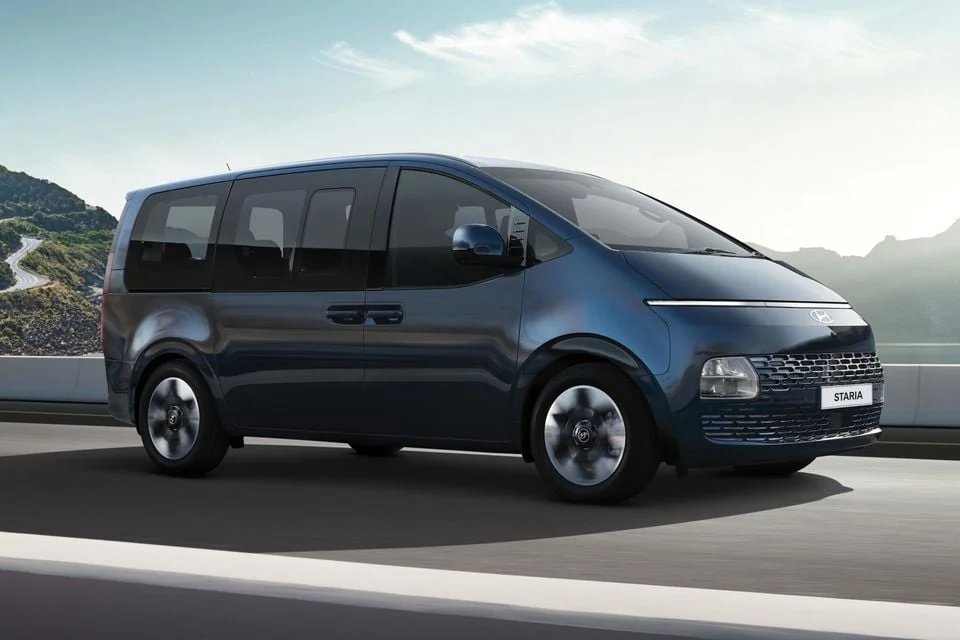
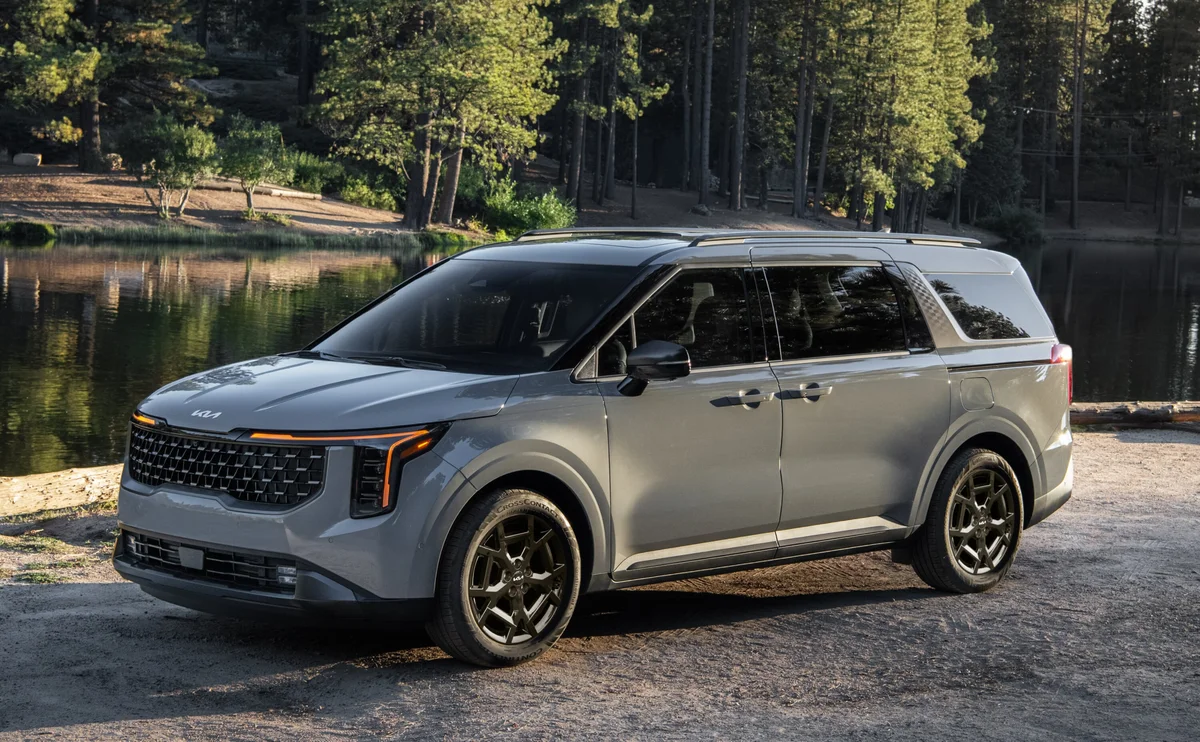
One area to note: visibility. The Staria's futuristic van-like design means the A-pillars are quite thick, which can create blind spots at intersections. The Carnival's more conventional SUV-style design provides slightly better forward visibility. Both have cameras to compensate, but it is worth a test drive to see which sightlines you are more comfortable with.
Features
The Staria and Carnival take different design philosophies despite sharing a corporate parent, and it is most obvious inside the cabin.
The Staria base goes for a clean, modern aesthetic. You get a 10.25-inch touchscreen infotainment system with wireless Apple CarPlay and Android Auto, an 8-inch digital instrument cluster, dual-zone climate control, push-button start, a leather-wrapped steering wheel, LED headlights and daytime running lights, and rear parking sensors with a reversing camera. The interior is functional but not flashy. Hyundai has kept the materials honest at this price point: hard plastics in some areas, but the overall design feels spacious and airy thanks to the Staria's tall, van-like roofline.
The Carnival S steps things up. You get dual 12.3-inch screens (touchscreen and digital instrument cluster), tri-zone climate control (so third-row passengers get their own controls), powered sliding side doors, a smart key with push-button start, leather-look seat trim, alloy wheels, a surround-view monitor, and Kia's latest connected car services. The powered sliding doors alone are worth the money for families. Kids can open and close them without slamming them into the car parked next to you in the Woolies car park.
The big practical difference is boot space. The Staria offers 831 litres behind the third row, which is enormous. That is enough for a double pram, a week's worth of groceries, and the kids' sports bags simultaneously. The Carnival S manages 627 litres, which is still deep and usable but 204 litres less. When you are hauling gear for a family of five or six, those extra litres matter on every trip.
Both can fold or stow the rear seating to create a massive cargo area. The Staria opens up to around 1,300 litres with the third row folded, while the Carnival's deep well and flat-folding rows give it a van-like load bay measured at up to 2,827 litres to the roof with everything down. The measuring points differ, but the practical answer is the same: both will swallow flat-pack furniture or a full set of camping gear.
Drivetrain
This used to be a petrol-vs-petrol contest between two versions of the same 3.5-litre V6. Not anymore. Kia dropped the petrol Carnival, so the entry Carnival is now the 2.2-litre four-cylinder turbo diesel, and the two cousins now take completely different approaches to moving 2.1 tonnes of family bus.
The Staria's 3.5-litre V6 makes 200kW and 331Nm through an 8-speed automatic. It is smooth, quiet at a cruise, and has a 52kW power advantage on paper. But peak torque arrives at 5,000rpm, which means you have to work it: loaded up with passengers and luggage, the V6 spends a lot of time downshifting and revving to keep pace.
The Carnival S Diesel makes 148kW and 440Nm, with that torque arriving from just 1,750rpm. In day-to-day family driving, that low-down shove is worth more than the Staria's headline power figure. The Carnival pulls away from lights and up hills with less effort and less noise from under the bonnet, even with eight aboard.
Fuel economy is the diesel's knockout punch: 6.5L/100km combined versus 10.5L for the Staria. On a 72-litre tank, the Carnival will run well past 1,000km between fills; the Staria's 75-litre tank is good for roughly 700km. If you do serious country kilometres, that range difference alone might decide it.
Both are front-wheel drive, which is fine for suburban and highway use but limits their off-road capability. Neither of these is going to tackle a fire trail or a muddy campsite with confidence. For that, you need an SUV or a 4WD.
Towing is where the Staria has a genuine advantage. It is rated for 2,500kg braked, versus the Carnival S's 2,000kg. That 500kg difference opens up the possibility of towing larger caravans, box trailers, or tandem-axle boat trailers. If your family holidays involve hooking up a van, the Staria gives you more headroom. Both have an unbraked towing capacity of 750kg.
Space and comfort
Space is the whole point of a people mover, and both deliver in spades. But there are differences worth knowing about.
The Staria's van-like body shape gives it a genuinely cavernous interior. The flat floor and high roofline mean second and third-row passengers have excellent headroom. Adults can sit upright in the third row without their heads touching the ceiling, which is not something every people mover can claim. The step-in height is also quite low, making it easier for kids and elderly passengers to climb in and out.
The Carnival S takes a more SUV-like approach. The seating position is slightly raised, the roofline tapers more towards the rear, and the third row headroom is a touch tighter than the Staria's. It is still acceptable for adults on shorter trips, but the Staria is more comfortable for taller third-row passengers over longer distances.
Second-row legroom is generous in both. Both offer configurable second rows with slide and recline functions, so you can adjust the balance between second-row legroom and third-row access. The Carnival S gets second-row sunblinds, which is a nice touch for keeping the kids comfortable on sunny days.
The driving position in both is comfortable and van-like, with a high seating position and good visibility. The Staria feels more like driving a proper van, while the Carnival drives more like a large SUV. Neither is what you would call sporty, and that is perfectly fine. These are family haulers, not canyon carvers.
Cup holder and storage count is important in family vehicles, and both deliver. The Staria has 12 cup holders scattered throughout the cabin. The Carnival matches with a similar count. Both have ample door bins, centre console storage, and seatback pockets.
Cost to own
Warranty is a big differentiator in the ownership experience. The Carnival S comes with Kia's 7-year unlimited-kilometre warranty versus 5 years for the Staria. On a complex vehicle with powered sliding doors and lots of family-focused tech, those extra two years of coverage provide genuine peace of mind.
Kia also offers 7-year capped-price servicing, while Hyundai's capped-price servicing runs for 5 years. Service intervals are 12 months or 15,000km for both. Diesel services typically cost a little more per visit than petrol, but the gap is modest, with both in the $350 to $550 range.
Running costs are dominated by fuel, and here the Carnival Diesel simply wins. At 10.5L/100km and $1.90/L, the Staria costs roughly $143 to fill from empty (75L tank) and returns about 700km per tank. The Carnival at 6.5L/100km with its 72L tank goes well over 1,000km per fill. Over a year of typical family driving (20,000km is realistic for people movers), you are looking at roughly $3,990 in fuel for the Staria versus about $2,535 for the Carnival. That $1,455 a year is real money.
Insurance costs are similar for both, typically in the $1,800 to $2,500 range depending on your age, location, and claims history. Both are in the same insurance category and neither is particularly cheap to insure.
Tyre costs are worth mentioning. Both run large alloy wheels with tyres in the $200 to $300 per corner range. Budget for a full set every 40,000 to 50,000km.
Depreciation is the biggest cost for any new vehicle, and both Korean people movers depreciate at similar rates: roughly 45-50% over five years. With purchase prices this close, neither has a meaningful depreciation edge, and diesel Carnivals have historically held their value well in the used market thanks to steady family-buyer demand.
The People Mover Decision
People movers are having a genuine resurgence in Australia. As families grow tired of cramped third rows in SUVs and the impracticality of fitting three child seats across a standard back row, purpose-built people movers like the Staria and Carnival are making a lot of sense again.
Both of these vehicles do the core job brilliantly: move a lot of people and their stuff in comfort and safety. The question is really about priorities.
Who Should Buy Which?
Buy the Staria if: you want the most space and the most towing. The 831L boot is enormous, the 2,500kg towing capacity is the best in class, and at $54,300 it is still (just) the cheaper of the two. If you tow a caravan or trailer regularly, the Staria is the clear pick. It is also arguably the better-looking of the two, with its futuristic design that stands out in the school pickup line.
Buy the Carnival S if: you want the lower running costs, and for most families that should carry the day. The diesel's 6.5L/100km saves around $1,100 a year over the Staria's thirsty V6, the 7-year warranty outlasts Hyundai's by two years, the third row has proper ISOFIX points, and the powered sliding doors and dual 12.3-inch screens make it feel a class above inside. The Carnival has been the benchmark people mover in Australia for years, and in diesel form the value case is stronger than ever.
Compare both on CarSorted. If you are looking at 7-seat SUVs instead, check out our Santa Fe vs Kluger or Sorento vs CX-80 comparisons.
Key details
A tick marks the better figure only where both cars have one and the gap is meaningful (3% or more; a whole star or year).
| Detail | Hyundai Staria | Kia Carnival |
|---|---|---|
| Price | From $54,300 RRP | From $54,560 RRP |
| Drive-away estimate | Calculating... | Calculating... |
| Body | People Mover | People Mover |
| Powertrain | Petrol, 3.5L 6-cyl | Diesel, 2.2L 4-cyl turbo |
| Power / torque | 200kW / 331Nm | 148kW / 440Nm |
| Fuel use | 10.5 L/100km | 6.5 L/100km |
| Measured consumption (AAA) | 10.6 L/100kmAAA test: the 2024 Hyundai Staria Elite, same engine, drivetrain and gearbox, a different grade | 6 L/100kmAAA test: this grade, 2023 model year |
| 0-100km/h | No data | 9.1s |
| Boot | 831L seats up | 627L seats up |
| Towing (braked) | 2,500kg | 2,000kg |
| ANCAP | 5 stars (2021) | 5 stars (2021) |
| Warranty | 5yr / unlimited km | 7yr / unlimited km |
Measured rows: Australian Automobile Association Real-World Testing Program (realworld.org.au), the on-road result for the vehicle each test names, beside the maker's figure above rather than in place of it. Test pages: Hyundai Staria, Kia Carnival.
At a glance
- Seats
- 8
- Boot
- 831L seats up
- Length x width x height
- 5,253 x 1,997 x 1,990mm
- Wheelbase
- 3,273mm
- Engine
- 3.5L 6-cyl
- Power
- 200kW
- Torque
- 331Nm
- Drive
- FWD
- Transmission
- Automatic
- Power-to-weight
- 93 kW/tonne
- Kerb weight
- 2,142kg
- Spare wheel
- Full size alloy
- Payload
- 778kg
- Towing braked / unbraked
- 2,500kg / 750kg
- Turning circle
- 11.94m
- Seats
- 8
- Boot
- 627L seats up
- Length x width x height
- 5,155 x 1,995 x 1,775mm
- Wheelbase
- 3,090mm
- Engine
- 2.2L 4-cyl turbo
- Power
- 148kW
- Torque
- 440Nm
- Drive
- FWD
- Transmission
- Automatic
- Power-to-weight
- 66 kW/tonne
- Kerb weight
- 2,245kg
- Spare wheel
- Space saver
- Payload
- No data
- Towing braked / unbraked
- 2,000kg / 750kg
- Turning circle
- 11.7m
CarSorted Score breakdown
The CarSorted Score is algorithmic: it is calculated from each car's data, not from a road test. How it works.
Safety
Fuel Economy
Value
Practicality
Technology
Performance
Reliability
The verdict
Kia Carnival comes out ahead on the CarSorted Score (80 vs 71)
The deciding gaps
- Fuel Economy:Hyundai Staria 41, Kia Carnival 77, Kia Carnival ahead by 36
- Value:Hyundai Staria 71, Kia Carnival 83, Kia Carnival ahead by 12
- Practicality:Hyundai Staria 86, Kia Carnival 75, Hyundai Staria ahead by 11
Same scorer as the live comparison of these two exact cars.
Our take (written 7 April 2026)
Since Kia dropped the petrol Carnival, this contest has changed. The prices are now $260 apart, which is nothing on a $54k vehicle, so the real question is petrol V6 versus turbo diesel. The Carnival S Diesel uses 6.5L/100km against the Staria's thirsty 10.5, saving around $1,100 a year in fuel, and backs it with 440Nm of torque, a 7-year warranty and third-row ISOFIX. The Staria counters with a bigger boot (831L vs 627L) and 500kg more towing. If you tow a decent caravan, buy the Staria. For everyone else, the Carnival's running costs and warranty win the day.
Prices on this page move. Want the next verdict?
One short email when prices shift or a new comparison lands. No spam, unsubscribe anytime.
Questions buyers ask
Are the Hyundai Staria and Kia Carnival the same car?
They share a platform and are made by the same parent company (Hyundai Motor Group), but they are different vehicles with different engines, tuning, styling, and feature sets. Think of them like cousins rather than twins.
Which people mover has more boot space?
Boot space with the seats up: the Hyundai Staria at 831L, against 627L for the Kia Carnival.
Which is better for towing a caravan?
Braked towing capacity: the Hyundai Staria at 2,500kg, against 2,000kg for the Kia Carnival.
Which has the better warranty?
The Hyundai Staria comes with a 5yr / unlimited km warranty; the Kia Carnival with a 7yr / unlimited km warranty.
How much fuel do these people movers use?
On the official combined cycle, the Hyundai Staria uses 10.5 L/100km and the Kia Carnival uses 6.5 L/100km.
Which is cheaper, the Hyundai Staria or the Kia Carnival?
The Hyundai Staria Petrol is from $54,300 RRP; the Kia Carnival S Diesel is from $54,560 RRP. That makes the Hyundai Staria $260 cheaper.
What are the ANCAP ratings for the Hyundai Staria and Kia Carnival?
The Hyundai Staria holds 5 stars (rated 2021), and the Kia Carnival holds 5 stars (rated 2021).
Which comes out ahead overall?
On the CarSorted Score the Kia Carnival comes out ahead (Hyundai Staria 71/100, Kia Carnival 80/100), mainly on fuel economy, value. The score is algorithmic; the editorial above says who each car suits.
Related
The cars
In the news
- Everything Electric Sydney 2026: iCaur's V25 Lands, Chery Debuts Lepas, and the Zeekr 7GT Finally Breaks Cover
- 2026 Hyundai Staria Hybrid Priced for Australia: Lounge People Mover $73,740, Load Van From $53,490
- 2027 Hyundai Inster Price Cut: $37,500 Start, Extended Range Gone, and the Heat Pump Off the List
- Kia Unveils the PV7 Electric Van, and Australia Is Said to Be Getting It in Late 2027
How to read this page. Prices, specs, ANCAP ratings, warranty, scores and the computed verdict come from our records for the two variants shown, sourced from manufacturer Australian documents, and update when those records change. RRP excludes on-road costs. Drive-away figures are estimates for the state you have selected unless marked as advertised. The editorial text was written on 7 April 2026. Always confirm price and specification with the manufacturer or dealer before you buy. CarSorted does not accept payment for recommendations.
Comments (0)
Sign in to join the conversation
No comments yet. Be the first!