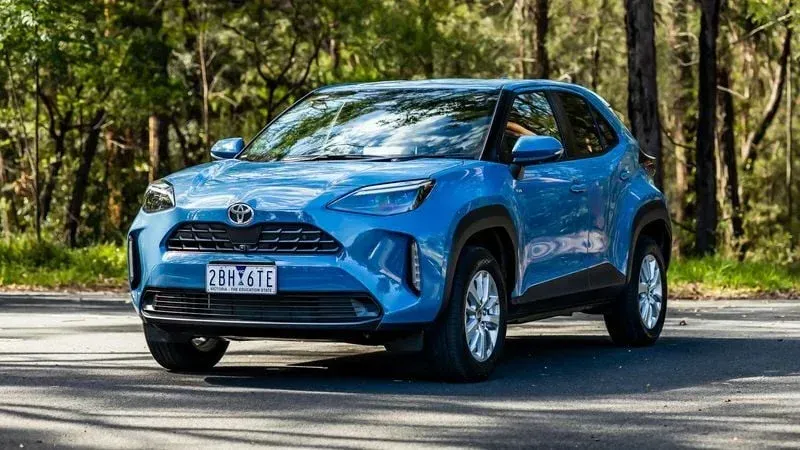
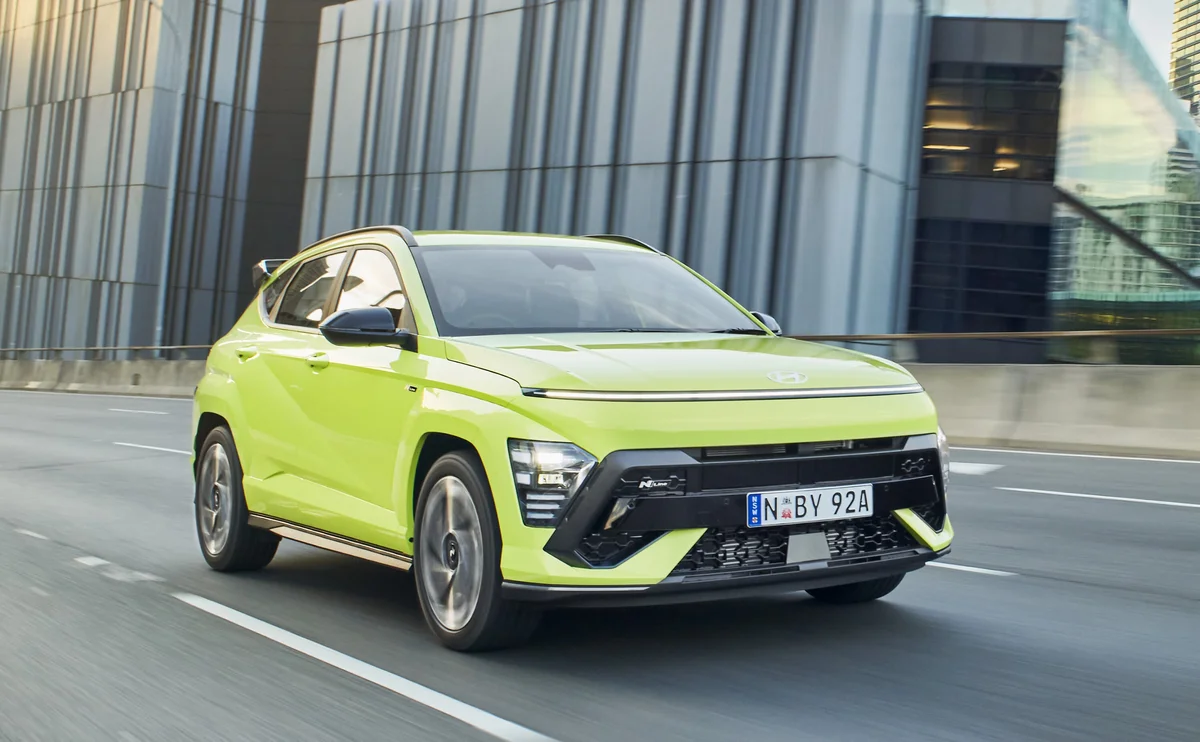
Toyota Yaris Cross vs Hyundai Kona
$31,790 for Toyota's hybrid sales juggernaut vs $32,500 for Hyundai's well-rounded small SUV. The most popular segment in Australia.
Data checked: specs 7 Sep 2026, price 4 Oct 2026
Comparison snapshot
Prices, scores and edges below update from our car data.
Cheaper by $1,910, lighter on fuel by 2.8 L/100km
Tows 900kg more, 25kW more power
Written 7 April 2026. The snapshot, tables, scores and verdict on this page update from our car data; figures quoted in the text are as at that date.
Price
The $710 purchase price difference is negligible. Forget the sticker price; the real savings are in what happens after you drive off the lot.
Fuel is where the Yaris Cross absolutely dominates. At $1.90/L for 91 unleaded and 15,000km per year, the Yaris Cross Hybrid costs roughly $1,083 to fuel. The Kona 2.0 costs roughly $1,881. That is a $798 saving per year. Over 5 years, the Yaris Cross saves you $3,990 in fuel alone. That is not a small number. It is roughly the cost of a decent holiday.
Servicing is competitive. Toyota's capped-price servicing for the Yaris Cross averages around $200-$250 per visit. Hyundai's iCare program for the Kona sits around $250-$300. Both are cheap to service, which is what you want from a small SUV. Over 5 years, the Toyota might save you $300-$400 in total servicing. Nothing dramatic, but it adds to the overall cost advantage.
Resale is the Yaris Cross's secret weapon. Toyota hybrids hold value phenomenally well in Australia. A 3-year-old Yaris Cross Hybrid typically retains 65-70% of its purchase price. The Kona retains closer to 58-62%. On a $32k car, that 5-8% resale gap translates to $1,600-$2,560 more in your pocket when you sell. Combined with the fuel savings, the Yaris Cross's total 5-year cost advantage is in the ballpark of $5,000-$6,000.
Safety
The star counts are not the same. The Yaris Cross was tested in 2021 and holds 5 stars. The Kona was tested in 2023 under tougher protocols and came away with 4 stars, scoring 80% adult occupant protection, 84% child occupant protection, 64% vulnerable road user and 62% safety assist. Both cars do carry comprehensive active safety suites, with autonomous emergency braking (AEB), lane-keep assist, adaptive cruise control, and automatic high beams standard.
The Yaris Cross GX includes Toyota Safety Sense, which bundles pre-collision system (AEB with pedestrian and cyclist detection), lane tracing assist, dynamic radar cruise control, road sign assist, and automatic high beam. It is a thorough system that works well in real-world driving. The lane tracing assist is particularly good on the highway, keeping the car centred in its lane with minimal driver input.
The Kona 2.0 gets Hyundai SmartSense with forward collision avoidance, lane following assist, driver attention warning, and leading vehicle departure alert. Both systems perform similarly in practice. Neither is annoyingly intrusive, and both do a solid job of keeping you safe without making you feel like the car is fighting you.
One area where the Yaris Cross has a slight edge: it comes with a rear cross-traffic alert as standard on the GX Hybrid, which is invaluable for reversing out of angled parking spots in busy car parks. The base Kona 2.0 does not include this; you need to step up to the Elite for that feature.
Features
The Yaris Cross GX Hybrid gets a 7-inch touchscreen with wireless Apple CarPlay and Android Auto, a 4.2-inch multi-information display, Toyota Connected Services, satellite navigation, and cloth seat trim. The screen is small by 2026 standards, and the infotainment system is functional rather than impressive. It does what you need but it will not wow anyone.
The Kona 2.0 comes with an 8-inch touchscreen with wireless Apple CarPlay and Android Auto, a 4.2-inch driver display, and cloth seats. Hyundai's infotainment is slightly more polished than Toyota's, with better graphics and a more intuitive menu structure. The bigger screen makes a noticeable difference for navigation and CarPlay use.
Neither car gets heated seats, leather, a sunroof, or any of the premium touches at these base trims. Both are honestly equipped for their price point. If you want more kit, both brands offer well-specced mid-range trims (GX Hybrid Urban for the Yaris Cross at around $35k, Active for the Kona at around $35k) that add the creature comforts without breaking the bank.
One feature the Yaris Cross GX has that the base Kona does not: a digital rear-view mirror option. It is not standard, but it is available as an accessory. Useful if you regularly load the boot to the roof.
Drivetrain
The Yaris Cross GX Hybrid uses Toyota's 1.5-litre three-cylinder petrol engine paired with an electric motor for a combined system output of 85kW and 120Nm. The hybrid system is self-charging (no plug-in required), and the transition between electric and petrol power is seamless. In stop-start city traffic, the car spends a significant amount of time running on electric power alone, which is how it achieves that remarkable 3.8L/100km figure. On the highway, the petrol engine does most of the work and fuel economy climbs to around 5.0-5.5L/100km. Still excellent.
The Kona 2.0 runs Hyundai's 2.0-litre Smartstream four-cylinder petrol making 110kW and 180Nm through an IVT (intelligent variable transmission, Hyundai's name for their CVT). It is a conventional petrol powertrain with no hybrid assistance. The engine is smooth and willing, with noticeably more outright power than the Yaris Cross. In daily driving, the Kona feels quicker and more responsive, particularly at highway speeds and when merging.
The power gap matters in practice. The Yaris Cross's 85kW is adequate for suburban driving, but it struggles on highway on-ramps and when overtaking on country roads. You need to plan overtaking manoeuvres well in advance. The Kona's 110kW provides a genuine step up in confidence. If your commute involves lots of highway merging or you frequently drive on 100-110km/h roads, the Kona is the better-feeling car.
Both use CVT-style transmissions, which are not enthusiast favourites but are well-suited to these cars. The Yaris Cross's eCVT is optimised for hybrid efficiency and rarely draws attention to itself. The Kona's IVT can get a bit drone-y under hard acceleration, simulating gear changes to mask the rubber-band CVT feel. Neither transmission is exciting, but both are perfectly fine for the intended use case.
Space and comfort
Boot space goes to the Yaris Cross with 390 litres versus 361 litres for the Kona. The Yaris Cross's boot is also a slightly more practical shape with a flatter floor, making it easier to load shopping bags without them sliding around. Both fold the rear seats 60/40, and both create a reasonably flat extended load area when folded. For a weekly grocery shop and the occasional IKEA run, both are fine. For a family of four with a pram, the Yaris Cross's extra 29 litres is noticeable.
Rear seat space is tight in both. These are small SUVs built on supermini platforms, and rear legroom reflects that. Adults can sit in the back of both, but long journeys will be uncomfortable for anyone over about 180cm. For kids in car seats, both are perfectly adequate. ISOFIX points are standard on both for the outboard rear seats.
The Kona has a slight edge in rear headroom because of its more upright roofline. The Yaris Cross's sportier roof profile eats into headroom for taller rear passengers. It is a minor difference, but worth checking if your regular passengers are tall.
Front seat comfort is good in both. Seats are well-shaped and supportive enough for a 2-3 hour drive without complaint. Neither has lumbar adjustment at this price level, which is a minor omission. The Kona's front seats feel slightly wider and more accommodating for larger drivers.
Cost to own
Both come with 5-year, unlimited-kilometre warranties. Both include roadside assistance for the warranty period. On paper, ownership promises are identical.
The Yaris Cross Hybrid's battery is covered by Toyota's hybrid battery warranty, which extends to 10 years in some markets. Check with your local dealer for the current Australian terms. Toyota's track record with hybrid batteries is exceptional; their hybrid systems have been running since 1997 and battery failures are extremely rare.
Towing is a critical differentiator. The Yaris Cross is rated to just 400kg braked. That rules out almost everything except a tiny box trailer with light cargo. No jet ski, no camper, no car trailer. The Kona's 1,300kg braked towing capacity opens up jet skis, small camper trailers, and loaded box trailers. If you tow anything at all, the Kona is the only option here. This alone might be the deciding factor for some buyers.
Dealer network is a strong point for both. Toyota has the largest dealer network in Australia, and parts availability is unmatched. Hyundai is not far behind with strong metropolitan and regional coverage. Both have broad metropolitan and regional coverage, so service access is unlikely to be the thing that decides this one.
The Fuel Economy Conversation
3.8L/100km is genuinely remarkable for a small SUV. To put it in perspective, that is less fuel than most motorcycles use. In real-world city driving, the Yaris Cross Hybrid can dip below 4L/100km regularly. Real-world figures regularly land around 3.5-4.2L/100km in stop-start suburban driving. The hybrid system works best in exactly the driving that most small SUV owners do: low-speed, stop-start suburban trips.
The Kona's 6.6L/100km is respectable for a non-hybrid small SUV, but it is nearly double the Yaris Cross. In real-world driving, expect 7.0-7.5L/100km in mixed conditions. That is fine, and it is competitive with other non-hybrid small SUVs, but the contrast with the Yaris Cross is stark. Every time you fill up, you are reminded of the gap.
The Towing Dealbreaker
If you own a jet ski, a small camper trailer, a boat, or even a decent-sized box trailer, the Yaris Cross is out of the conversation. At 400kg braked towing, it can barely pull anything. This is the hybrid system's biggest weakness: the eCVT and relatively low power output limit towing capacity severely.
The Kona at 1,300kg opens up a whole world of weekend possibilities. Jet skis, small camper trailers (under 1,300kg loaded), loaded box trailers for tip runs, or a small boat. For a lot of Australian buyers, this towing flexibility is non-negotiable. If you are in this camp, stop reading and buy the Kona. The fuel savings are irrelevant if the car cannot do what you need.
Toyota vs Hyundai: The Brand Factor
Toyota is the most trusted car brand in Australia, and the Yaris Cross has become one of their biggest sellers. The brand carries enormous weight at resale, with service, and with buyer confidence. Hyundai has made massive strides in quality and reputation over the past decade, and the Kona is a well-respected vehicle. But in terms of brand equity and resale value in the Australian market, Toyota still has the edge. That is worth real money when it comes time to sell or trade in.
Who Should Buy Which?
Buy the Yaris Cross GX Hybrid if: you want among the lowest running costs in a small SUV. You do mostly city and suburban driving. You do not need to tow anything meaningful. You value Toyota's resale value and dealer network. The 5-year cost savings of $5,000+ are hard to argue with.
Buy the Kona 2.0 if: you need to tow (jet ski, camper, box trailer). You want more power and a more confident highway experience. You do not mind spending $798 more per year on fuel for a car that feels quicker and more capable. The 1,300kg towing capacity alone justifies the Kona for active Australian lifestyles.
Compare both on CarSorted. See also: Kona vs Seltos and CX-3 vs Yaris Cross.
Key details
A tick marks the better figure only where both cars have one and the gap is meaningful (3% or more; a whole star or year).
| Detail | Toyota Yaris Cross | Hyundai Kona |
|---|---|---|
| Price | From $31,790 RRP | From $33,700 RRP |
| Drive-away estimate | Calculating... | Calculating... |
| Body | SUV | SUV |
| Powertrain | Hybrid, 1.5L 3-cyl | Petrol, 2L 4-cyl |
| Power / torque | 85kW / 120Nm | 110kW / 180Nm |
| Fuel use | 3.8 L/100km | 6.6 L/100km |
| 0-100km/h | 9.8s | 9.9s |
| Boot | 390L seats up | 361L seats up |
| Towing (braked) | 400kg | 1,300kg |
| ANCAP | 5 stars (2021) | 4 stars (2023) |
| Warranty | 5yr / unlimited km | 5yr / unlimited km |
At a glance
- Seats
- 5
- Boot
- 390L seats up
- Length x width x height
- 4,180 x 1,765 x 1,590mm
- Wheelbase
- 2,560mm
- Engine
- 1.5L 3-cyl
- Power
- 85kW
- Torque
- 120Nm
- Drive
- FWD
- Transmission
- CVT
- Power-to-weight
- 69 kW/tonne
- Kerb weight
- 1,235kg
- Spare wheel
- Temporary spare
- Payload
- 415kg
- Towing braked / unbraked
- 400kg / 400kg
- Turning circle
- 9.8m
- Seats
- 5
- Boot
- 361L seats up
- Length x width x height
- 4,350 x 1,825 x 1,585mm
- Wheelbase
- 2,660mm
- Engine
- 2L 4-cyl
- Power
- 110kW
- Torque
- 180Nm
- Drive
- FWD
- Transmission
- Automatic
- Power-to-weight
- 82 kW/tonne
- Kerb weight
- 1,335kg
- Spare wheel
- Space saver
- Payload
- 550kg
- Towing braked / unbraked
- 1,300kg / 600kg
- Turning circle
- 10.6m
CarSorted Score breakdown
The CarSorted Score is algorithmic: it is calculated from each car's data, not from a road test. How it works.
Safety
Fuel Economy
Value
Practicality
Technology
Performance
Reliability
The verdict
Toyota Yaris Cross comes out ahead on the CarSorted Score (72 vs 63)
The deciding gaps
- Fuel Economy:Toyota Yaris Cross 100, Hyundai Kona 76, Toyota Yaris Cross ahead by 24
- Safety:Toyota Yaris Cross 84, Hyundai Kona 64, Toyota Yaris Cross ahead by 20
- Technology:Toyota Yaris Cross 46, Hyundai Kona 30, Toyota Yaris Cross ahead by 16
The Toyota Yaris Cross is also the cheaper of the two.
Same scorer as the live comparison of these two exact cars.
Our take (written 7 April 2026)
The Yaris Cross GX Hybrid is the smarter buy for most Australians. It is $710 cheaper, uses almost half the fuel (3.8L vs 6.6L/100km), saves roughly $798 per year at the bowser, has a bigger boot (390L vs 361L), and comes with Toyota's legendary resale value. Over 5 years, the total saving is close to $5,000. The Kona fights back with more power (110kW vs 85kW), substantially better towing (1,300kg vs 400kg), and a more engaging driving experience. If you need to tow anything heavier than a small box trailer, the Kona wins by default because the Yaris Cross's 400kg limit rules it out. But for pure daily driving and running costs, the Yaris Cross Hybrid is hard to beat.
Prices on this page move. Want the next verdict?
One short email when prices shift or a new comparison lands. No spam, unsubscribe anytime.
Questions buyers ask
How much fuel does the Yaris Cross Hybrid actually save?
On the official combined cycle, the Toyota Yaris Cross uses 3.8 L/100km and the Hyundai Kona uses 6.6 L/100km.
Is the Yaris Cross too slow?
Peak power: the Hyundai Kona at 110kW, against 85kW for the Toyota Yaris Cross. The Toyota Yaris Cross is quicker to 100km/h (9.8s vs 9.9s).
Can the Yaris Cross tow a trailer?
Braked towing capacity: the Hyundai Kona at 1,300kg, against 400kg for the Toyota Yaris Cross.
Which is cheaper, the Toyota Yaris Cross or the Hyundai Kona?
The Toyota Yaris Cross GX Hybrid 2WD is from $31,790 RRP; the Hyundai Kona 2.0 FWD is from $33,700 RRP. That makes the Toyota Yaris Cross $1,910 cheaper.
What are the ANCAP ratings for the Toyota Yaris Cross and Hyundai Kona?
The Toyota Yaris Cross holds 5 stars (rated 2021), and the Hyundai Kona holds 4 stars (rated 2023).
Which has the bigger boot?
Boot space with the seats up: the Toyota Yaris Cross at 390L, against 361L for the Hyundai Kona.
Which has the better warranty?
The Toyota Yaris Cross comes with a 5yr / unlimited km warranty; the Hyundai Kona with a 5yr / unlimited km warranty.
Which comes out ahead overall?
On the CarSorted Score the Toyota Yaris Cross comes out ahead (Toyota Yaris Cross 72/100, Hyundai Kona 63/100), mainly on fuel economy, safety, technology. The score is algorithmic; the editorial above says who each car suits.
Related
Compare
The cars
In the news
- 2027 Kia Seltos Hybrid Priced for Australia From $39,990 Drive-Away, In Showrooms This Month
- Toyota Kluger Recall Expanded in Australia: 46,467 Cars on REC-006562 Over Second-Row Seat Recliner
- 2027 Toyota RAV4 GXL PHEV 2WD Confirmed for Australia: Q1 2027, 201kW, 121km of Electric Range, No Price Yet
- Hyundai Kona (SX2) Rear Seat Belt Recall Australia: 14,551 Petrol and Hybrid Cars Called Back on REC-006734
How to read this page. Prices, specs, ANCAP ratings, warranty, scores and the computed verdict come from our records for the two variants shown, sourced from manufacturer Australian documents, and update when those records change. RRP excludes on-road costs. Drive-away figures are estimates for the state you have selected unless marked as advertised. The editorial text was written on 7 April 2026. Always confirm price and specification with the manufacturer or dealer before you buy. CarSorted does not accept payment for recommendations.
Comments (0)
Sign in to join the conversation
No comments yet. Be the first!