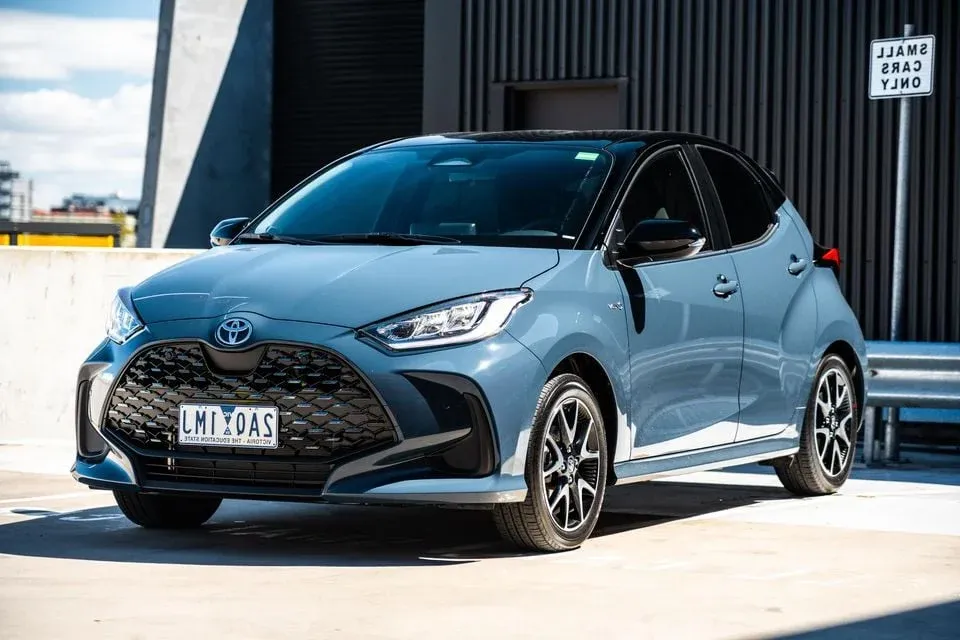
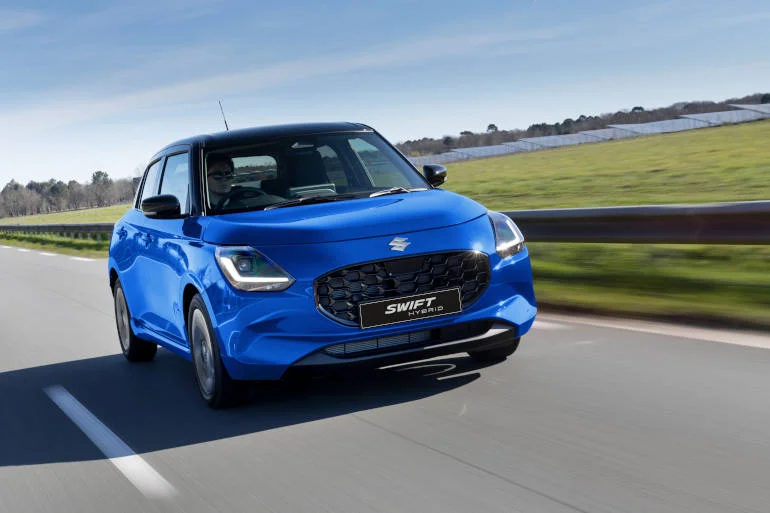
Toyota Yaris vs Suzuki Swift
$28,990 vs $23,990. The Swift is $5,000 cheaper. The Yaris is a hybrid with two more ANCAP stars. Which way does that fall?
Data checked: specs 30 Aug 2026, price 4 Oct 2026
Comparison snapshot
Prices, scores and edges below update from our car data.
Lighter on fuel by 0.5 L/100km, 25kW more power
Cheaper by $5,000
Written 7 April 2026. The snapshot, tables, scores and verdict on this page update from our car data; figures quoted in the text are as at that date.
Price
The Swift GL at $23,990 is $5,000 less than the Yaris Ascent Sport at $28,990, both recommended retail before on-road costs. If you have seen an older version of this comparison saying the Yaris was the cheaper of the two, that is no longer the case. The Yaris moved to a hybrid-only line-up and the price went with it.
Running costs go the other way. At 3.5L/100km the hybrid Yaris is one of the most fuel-efficient cars on sale in Australia at any price. At $1.90 a litre and 15,000km a year that is about $998 annually. The Swift at 4.0L/100km costs roughly $1,140 a year. That is $142 in the Yaris's favour every year, or under $3 a week.
Do the arithmetic on that and it is sobering for the Toyota. Over five years the fuel saving totals about $710, which recovers 14 per cent of the $5,000 price gap. On fuel alone the Yaris would need roughly 35 years to catch up. So do not buy the Yaris expecting the pump to pay for it. Buy it for the safety rating, the warranty and the resale.
On warranty, Toyota gives five years and unlimited kilometres. Suzuki offers three years or 100,000km, whichever comes first. If you drive 30,000km a year you could be out of Suzuki warranty inside four years, and in year four and five you are carrying all the repair risk yourself.
Insurance tends to be slightly cheaper on the Swift due to its lower value, but the difference is typically only $100–$200 per year. Servicing costs are comparable. Both are cheap to maintain, with services running $200–$350. Toyota's capped-price servicing program gives you predictability, while Suzuki's servicing is generally affordable but not formally capped at every dealer.
Safety
This is the section that has changed most, and it is the most important one on the page. The two cars do not have the same safety rating. The Yaris holds five stars from ANCAP, tested in 2020. The current Swift holds three stars, tested in 2024 under the stricter present-day protocols.
Some of that gap is protocol drift, because 2024 criteria are harder to satisfy than 2020 criteria. But three stars is a published result, and a two-star difference is not something to wave away. If you are buying for a P-plater, a family member or anyone whose safety you feel responsible for, this should probably decide the comparison on its own.
Standard safety kit on the Yaris includes autonomous emergency braking with pedestrian and cyclist detection, lane departure alert, adaptive cruise control, and a pre-collision system. Toyota Safety Sense is one of the most proven safety suites in the industry, and you get the full package even on this entry-level trim.
The Swift GL gets autonomous emergency braking, lane departure warning and adaptive cruise control. It is a reasonable list but not as comprehensive as the Toyota's, and the assistance and vulnerable-road-user scores are part of why its overall rating landed where it did. The Yaris adds blind-spot monitoring at this trim, which the Swift lacks.
Both cars are built on modern platforms with good structural rigidity for their size. The Yaris rides on the TNGA-B platform shared with the GR Yaris, which is one of the stiffest small car platforms available. The new-generation Swift uses Suzuki's HEARTECT platform, which is lightweight but well engineered for crash protection.
One thing worth noting: the Yaris at 1,045kg is heavier than the Swift at 957kg. In a collision with a larger vehicle, additional mass can be a passive safety advantage. It is not something ANCAP tests for, but in real-world multi-vehicle crashes the heavier car tends to fare better.
Features
The Yaris Ascent Sport gets a 7-inch touchscreen with wireless Apple CarPlay and Android Auto, a reversing camera, push-button start, automatic headlights, and rain-sensing wipers. It's not loaded with gadgets, but everything you need for daily driving is present. Toyota's infotainment system is straightforward and responsive, if not particularly exciting.
The Swift GL comes with a 9-inch touchscreen, noticeably bigger than the Yaris, with wireless Apple CarPlay and Android Auto, a reversing camera, and climate control. The larger screen is genuinely nice to use and makes the Swift feel more modern inside than its price suggests.
Interior quality is a wash. Both use hard plastics in places and cloth seats. Neither feels cheap, but neither feels premium either. They're honest small cars that don't pretend to be something they're not. The Swift has a slightly more playful interior design with a floating centre console, while the Yaris is more conservative and Toyota-like.
Boot space is virtually identical: 270L in the Yaris versus 267L in the Swift. Neither is generous, a weekly shop for two fits fine, but a family of four with luggage will be playing Tetris. Fold the rear seats and both open up to around 750L, which is adequate for IKEA runs and airport trips.
Drivetrain
The Yaris runs a 1.5-litre three-cylinder hybrid rated at 67kW and 120Nm. The Swift uses a 1.2-litre three-cylinder making 61kW and 112Nm. That is a 6kW and 8Nm advantage to the Toyota, which is a much narrower gap than the old figures on this page suggested, and it comes with the hybrid system's electric assist off the line.
The 0-100km/h claims: roughly 10.2 seconds for the Yaris against about 12.4 for the Swift. Neither is fast in absolute terms, and two seconds over that distance is the difference between adequate and slow rather than between quick and slow.
The Swift uses a CVT. The Yaris uses Toyota's hybrid transaxle, which behaves like a CVT but blends in electric drive at low speeds. Neither is a conventional stepped automatic.
Fuel efficiency is the Yaris's headline number. At 3.5L/100km it is one of the leanest cars on sale in Australia. The Swift at 4.0L/100km is genuinely good for a non-hybrid, which is precisely why the running-cost gap between them is smaller than you would expect from a hybrid-versus-petrol matchup. A 36-litre tank at 3.5L/100km puts the Yaris over 1,000km between fills on the claimed figure.
Neither car is rated for towing. If you need to pull even a small box trailer, you'll need to look at something larger.
CarSorted Data Insight
The Yaris's 3.5L/100km makes it one of the most fuel-efficient cars of any kind in our database, and among petrol vehicles only other hybrids get close. The Swift at $23,990 is one of the most affordable new cars on the market full stop, but it is worth being precise about what that money buys: a three-star ANCAP rating from 2024, not a five-star one.
Looking across the light car segment in our data, both the Yaris and Swift sit well below the segment average for fuel consumption, which hovers around 5.5 to 6.0L/100km. The Yaris is far enough below it to be almost in a class of its own.
Who Are These Cars Actually For?
Both are city-focused daily drivers. They're ideal for commuters, students, downsizers, and anyone who wants a reliable new car without taking on a massive loan. They excel in tight parking spots, narrow inner-city streets, and stop-start traffic where their light weight and small dimensions make life easier.
The Yaris suits the buyer who wants the lowest running costs, the better safety rating and the reassurance of Toyota's dealer network, resale values and warranty. The Swift suits the buyer for whom $5,000 is the number that matters, or who wants the lightest, smallest thing in the segment at 957kg. Just go in knowing what its ANCAP result is.
The Verdict
Buy the Yaris if: the five-star ANCAP rating matters to you, and you want the lowest running costs, a hybrid drivetrain, the longer warranty and stronger resale. It wins on nearly every measurable metric except the one on the windscreen.
Buy the Swift if: the $5,000 saving is what decides your budget, you want the lightest car in the segment at 957kg, and you have looked at the three-star ANCAP result and are comfortable with it. It is a lot of new car for the money, but the rating is part of what you are buying.
Compare both on CarSorted. See also: Corolla vs Mazda3.
Key details
A tick marks the better figure only where both cars have one and the gap is meaningful (3% or more; a whole star or year).
| Detail | Toyota Yaris | Suzuki Swift |
|---|---|---|
| Price | From $28,990 RRP | From about $23,990 est. RRP |
| Drive-away estimate | Calculating... | Calculating... |
| Body | Hatch | Hatch |
| Powertrain | Hybrid, 1.5L 3-cyl | Mild-hybrid petrol, 1.2L 3-cyl |
| Power / torque | 85kW / 120Nm | 59.6kW / 109Nm |
| Fuel use | 3.5 L/100km | 4 L/100km |
| 0-100km/h | 10.2s | 12.4s |
| Boot | 270L seats up | 267L seats up |
| Towing (braked) | No data | No data |
| ANCAP | 5 stars (2020) | 3 stars (2024) |
| Warranty | 5yr / unlimited km | 3yr / 100,000 km |
At a glance
- Seats
- 5
- Boot
- 270L seats up
- Length x width x height
- 3,950 x 1,695 x 1,495mm
- Wheelbase
- 2,550mm
- Engine
- 1.5L 3-cyl
- Power
- 85kW combined (engine 67kW)
- Torque
- 120Nm
- Drive
- FWD
- Transmission
- Automatic
- Power-to-weight
- 75 kW/tonne
- Kerb weight
- 1,130kg
- Spare wheel
- Space saver
- Payload
- No data
- Towing braked / unbraked
- No data
- Turning circle
- 10.2m
- Seats
- 5
- Boot
- 267L seats up
- Length x width x height
- 3,860 x 1,735 x 1,520mm
- Wheelbase
- 2,450mm
- Engine
- 1.2L 3-cyl
- Power
- 59.6kW
- Torque
- 109Nm
- Drive
- FWD
- Transmission
- CVT
- Power-to-weight
- 62 kW/tonne
- Kerb weight
- 957kg
- Spare wheel
- Temporary spare
- Payload
- No data
- Towing braked / unbraked
- No data
- Turning circle
- 9.8m
CarSorted Score breakdown
The CarSorted Score is algorithmic: it is calculated from each car's data, not from a road test. How it works.
Safety
Fuel Economy
Value
Practicality
Technology
Performance
Reliability
The verdict
Toyota Yaris comes out ahead on the CarSorted Score (68 vs 58)
The deciding gaps
- Safety:Toyota Yaris 74, Suzuki Swift 48, Toyota Yaris ahead by 26
- Reliability:Toyota Yaris 67, Suzuki Swift 53, Toyota Yaris ahead by 14
- Performance:Toyota Yaris 31, Suzuki Swift 19, Toyota Yaris ahead by 12
The Toyota Yaris wins on the score; the Suzuki Swift is the cheaper of the two, and price is already part of the Value axis.
Same scorer as the live comparison of these two exact cars.
Our take (written 7 April 2026)
The price positions have swapped since we first wrote this. The Yaris Ascent Sport is now $28,990 and the Swift GL $23,990, so the Suzuki is the cheap one by $5,000. That is a lot in this segment and it is the Swift's best argument by a distance. Everything else still points the other way. The Yaris is a hybrid rated at 3.5L/100km against 4.0, it has a little more power and torque, it is two seconds quicker to 100km/h, and Toyota covers it for five years and unlimited kilometres against Suzuki's three years or 100,000km. The one that should stop you, though, is safety: the Swift GL carries a three-star ANCAP rating from 2024 while the Yaris holds five stars from 2020. Two stars is not a rounding difference. Unless the $5,000 is the deciding factor in your budget, the Yaris is still the car to buy, and now for safety and running costs rather than price.
Prices on this page move. Want the next verdict?
One short email when prices shift or a new comparison lands. No spam, unsubscribe anytime.
Questions buyers ask
Is the Toyota Yaris cheaper than the Suzuki Swift in 2026?
The Toyota Yaris Ascent Sport is from $28,990 RRP; the Suzuki Swift GL is from about $23,990 est. RRP. That makes the Suzuki Swift $5,000 cheaper.
Which small car is cheapest to run in Australia?
The Toyota Yaris Ascent Sport is from $28,990 RRP; the Suzuki Swift GL is from about $23,990 est. RRP. That makes the Suzuki Swift $5,000 cheaper.
Can the Yaris or Swift tow a trailer?
Neither has an official braked towing capacity. If you need to tow even a small box trailer, consider a slightly larger car like a Corolla or Mazda2.
Which is better for a learner driver, Yaris or Swift?
On the CarSorted Score the Toyota Yaris comes out ahead (Toyota Yaris 68/100, Suzuki Swift 58/100), mainly on safety, reliability, performance. The score is algorithmic; the editorial above says who each car suits.
Why does the Yaris have a 5-year warranty but the Swift only 3 years?
The Toyota Yaris comes with a 5yr / unlimited km warranty; the Suzuki Swift with a 3yr / 100,000 km warranty.
Which is cheaper to run, the Toyota Yaris or the Suzuki Swift?
On the official combined cycle, the Toyota Yaris uses 3.5 L/100km and the Suzuki Swift uses 4 L/100km.
What are the ANCAP ratings for the Toyota Yaris and Suzuki Swift?
The Toyota Yaris holds 5 stars (rated 2020), and the Suzuki Swift holds 3 stars (rated 2024).
Which has the bigger boot?
Boot space with the seats up: the Toyota Yaris at 270L, against 267L for the Suzuki Swift.
Related
Compare
The cars
In the news
- 2026 MINI Cooper S Oxford Edition Confirmed for Australia: Just 40 Cars, 20 Red, 20 Blue, Q4 Landing
- Honda Civic Type R Orders Reopen: 98 Cars for Australia at $85,000 Driveaway, Carbon Wing Left Off
- 2026 Toyota GR Yaris Lands in June: Sharper Steering, Race-Spec Tyres, Same Price From $55,490
- Suzuki Jimny Rhino Confirmed for Australia: $44,990 RRP, 250 Units, Deliveries Now
How to read this page. Prices, specs, ANCAP ratings, warranty, scores and the computed verdict come from our records for the two variants shown, sourced from manufacturer Australian documents, and update when those records change. RRP excludes on-road costs. Drive-away figures are estimates for the state you have selected unless marked as advertised. The editorial text was written on 7 April 2026. Always confirm price and specification with the manufacturer or dealer before you buy. CarSorted does not accept payment for recommendations.
Comments (0)
Sign in to join the conversation
No comments yet. Be the first!