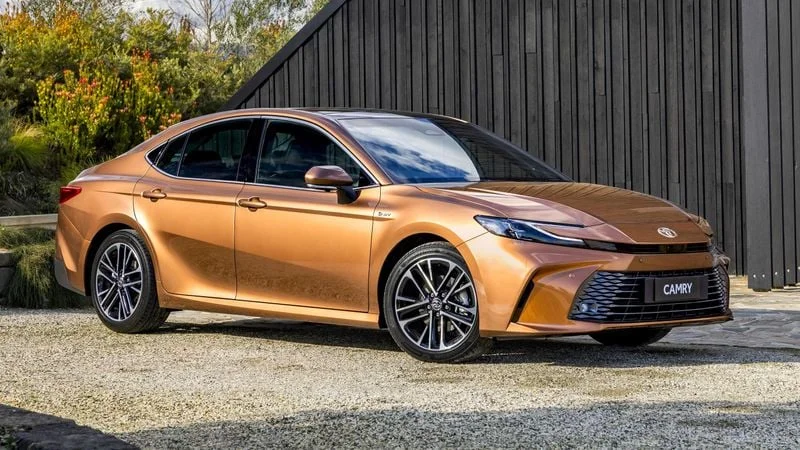
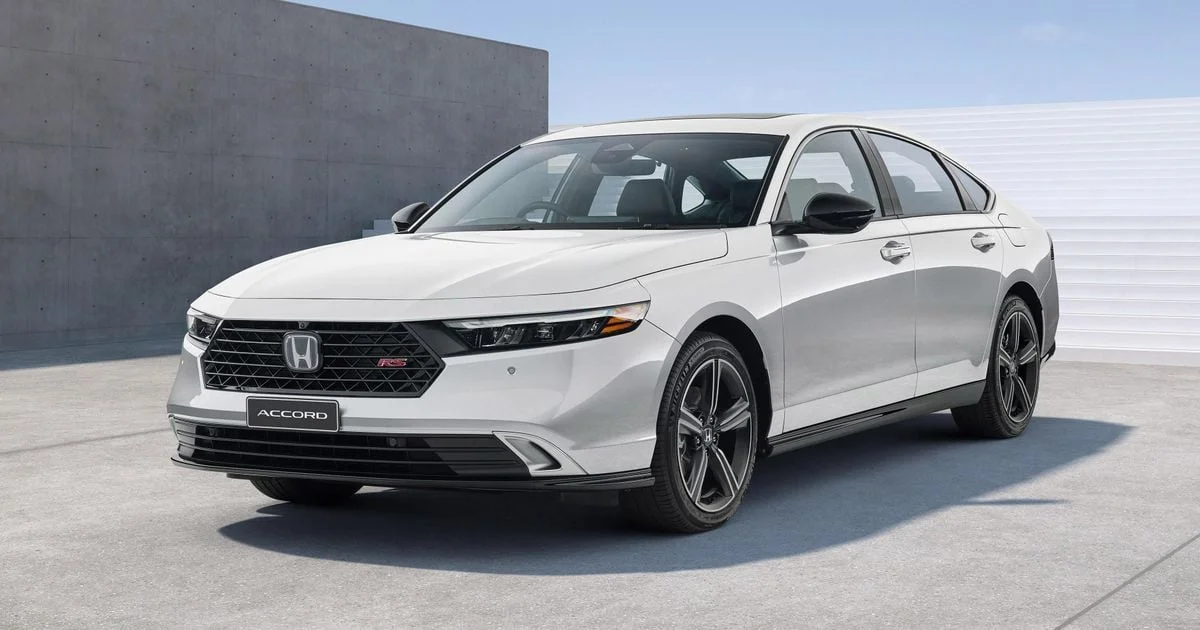
Toyota Camry vs Honda Accord
$39,990 vs $57,900. Australia's two most trusted sedan nameplates, separated by nearly $18,000.
Data checked: specs 4 Aug 2026, price 6 Sep 2026
Comparison snapshot
Prices, scores and edges below update from our car data.
Cheaper by $14,260, lighter on fuel by 0.3 L/100km
From about $54,250 est. RRP
Estimated RRP: this brand lists drive-away prices only.
46L more boot
Written 7 April 2026. The snapshot, tables, scores and verdict on this page update from our car data; figures quoted in the text are as at that date.
Price
Read the pricing basis carefully on this pair, because the two brands quote differently. The Camry Ascent Hybrid is $39,990 recommended retail before on-road costs, which puts it somewhere around $43,000 to $44,500 drive-away in most states once stamp duty and CTP are added. The Accord e:HEV RS is $54,250 drive-away, with all of that already included.
So the honest gap is roughly $10,000 on a registered, like-for-like basis. Not the $17,910 that comes from comparing a Toyota list price with a Honda drive-away price, and not the $58,000 figure still floating around for the Accord. It is still a lot of money, and at 6.5% over five years it is about $165 a month in repayments, but it is a different conversation to the one this page used to have.
On fuel the Camry's 4.0L/100km against the Accord's 4.3 saves roughly $85 a year at $1.90 a litre and 15,000km. Over five years that is about $425. Effectively a rounding error against the purchase gap, and much smaller than the 0.9L/100km difference previously quoted here.
Resale is another area where Toyota pulls ahead. The Camry Hybrid has been one of the strongest depreciators (or rather, non-depreciators) in the mid-size sedan segment. Expect to retain around 55-60% of the purchase price after five years. The Accord, while solid, typically sits closer to 48-52%. On a $57,900 car, that difference in resale percentage translates to thousands of dollars at trade-in time.
Adding it up, the five-year total cost of ownership gap now lands somewhere in the $13,000 to $16,000 range once you factor in the roughly $10,000 purchase difference, a small fuel advantage, slightly cheaper insurance and the resale spread. Still meaningful, but well under half the $25,000-plus previously claimed here.
Safety
On published ratings the two are not level. The Camry holds a five-star ANCAP rating from 2024, tested against the current protocols. The Accord has no ANCAP rating on record, so we will not attach a star count to it. That is not a claim the Honda is unsafe, and its equipment list below is comprehensive, but if a published rating is part of your shortlist the Camry is the one that has it.
The Camry Ascent Hybrid gets Toyota Safety Sense 3.0, which includes pre-collision safety with pedestrian and cyclist detection (daytime and night), dynamic radar cruise control with stop-and-go, lane departure alert, lane tracing assist, automatic high beam, and road sign assist. Toyota also includes a blind spot monitor with rear cross-traffic alert and safe exit assist, which warns you if a car or cyclist is approaching before you open the door.
The Accord e:HEV RS comes with Honda SENSING, featuring collision mitigation braking, adaptive cruise control with low-speed follow, lane keeping assist, road departure mitigation, and blind spot information. The RS trim adds front and rear parking sensors and a multi-angle rearview camera. Honda also includes traffic jam assist, which can handle steering in stop-start traffic on well-marked roads.
Both have full suites of airbags including front, side, curtain, and knee airbags for the driver. ISOFIX anchor points are available on the outer rear seats in both cars with top tether points across the back row.
On equipment the two are closely matched, and the Honda's traffic jam assist is a genuinely useful inclusion for anyone who spends their mornings crawling on the M1. The difference is documentation: one car has a current five-star result you can look up, the other has not been tested.
Features
Here is where the Accord tries to justify its roughly $10,000 premium, and to its credit, the cabin is noticeably more upmarket.
The Accord e:HEV RS comes with a 12.3-inch touchscreen with wireless Apple CarPlay and Android Auto, a 10.2-inch digital instrument cluster, Google built-in infotainment (so you get Google Maps, Google Assistant, and Google Play apps natively), wireless phone charging, a 12-speaker Bose premium sound system, heads-up display, leather-trimmed seats with power adjustment and heating, ambient interior lighting, and a power sunroof.
The Camry Ascent Hybrid gets an 8-inch touchscreen (smaller, and it shows), wired Apple CarPlay and Android Auto, a 7-inch multi-information display, cloth seats, manual air conditioning for the rear, and a decent 6-speaker audio system. It feels like a $40,000 car, which is fine because that is exactly what it is.
The feature gap is real. The Accord genuinely feels like a car from a segment above. The materials, the tech, the fit and finish inside the cabin are all superior. If you spend a lot of time in your car and interior quality matters to you, the Accord makes a compelling case.
So is a bigger screen, leather seats, a sunroof, better speakers and 46 litres more boot worth around $10,000? For a lot of buyers the honest answer is still no, but it is a much closer call than it used to be. Worth knowing: the Camry SL Hybrid at $53,990 RRP closes most of the equipment gap, though once on-road costs are added it lands above the Accord's drive-away price rather than below it.
Drivetrain
Both cars are hybrids, but they take different engineering approaches and it shows in how they drive.
The Camry Ascent Hybrid uses Toyota's latest fifth-generation 2.5-litre hybrid system producing a combined 170kW. That is a meaningful bump over the previous model and makes this Camry genuinely brisk for a mid-size sedan. The system uses an Atkinson-cycle four-cylinder paired with an electric motor and a nickel-metal hydride battery. The CVT keeps the engine in its sweet spot and, while it is not exciting, it is effective. Toyota has had decades to refine this powertrain and it shows in the smoothness and reliability.
The Accord e:HEV RS uses Honda's 2.0-litre e:HEV system. This is a series-hybrid setup similar to Nissan's e-POWER, where the petrol engine primarily acts as a generator for the electric motor. The electric motor makes 135kW and 335Nm, giving the Accord a large torque advantage and instant delivery from a standstill.
The output figures split neatly. The Camry makes more combined power (170kW against 135kW), but the Accord carries 335Nm against the Camry's 221Nm, a 114Nm advantage, and it is the quicker car on the claimed 0-100 figures: 7.8 seconds against 8.1. Torque is what does the work in everyday overtaking, and the Honda has a lot more of it.
Fuel economy still goes to the Camry, at 4.0L/100km against 4.3, but the margin is now small enough that it should not decide anything. Both are excellent by any standard. Expect both to sit somewhat above these official figures in practice, depending on how much freeway work you do.
Space and comfort
The boot result has flipped since this page was first written. The Accord is the bigger of the two at 570 litres against the Camry's 524, a 46-litre advantage, which is roughly a carry-on suitcase. Both boots are wide and flat with low load lips.
Rear seat legroom is generous in both. These are proper mid-size sedans and adults will be comfortable in the back for long trips. The Accord feels slightly wider across the back seat, while the Camry has a touch more headroom. Neither is cramped.
The Accord's leather-trimmed seats have more adjustment range than the Camry's cloth items, which is what you would expect given the price difference. Just note that difference is now around $10,000 rather than the $18,000 headline the list prices imply.
On paper the Accord is the better-insulated cabin, with acoustic glass and additional NVH measures Honda details in its specification for the RS. We have not driven either car, so take that as what the spec sheet says rather than a verdict from us.
Cost to own
Both offer 5-year unlimited-kilometre warranties with capped-price servicing programs. Neither has a clear advantage on warranty length, though Toyota's reputation for long-term reliability gives it an edge in buyer confidence.
Toyota has consistently topped reliability surveys in Australia. The Camry Hybrid in particular has been bulletproof, with the hybrid battery warranted separately for 10 years or 240,000km in some markets. Honda's reliability has been strong historically, though the e:HEV system is newer and does not have the same decades-long track record as Toyota's hybrid tech.
Service intervals are 12 months or 15,000km for the Camry and 12 months or 10,000km for the Accord. The shorter Accord interval means more frequent dealer visits, though individual service costs are comparable at roughly $250 to $400 per visit under capped-price servicing.
Insurance is slightly cheaper on the Camry due to its lower value and strong safety record. Expect to pay roughly $1,100 to $1,600 for the Camry and $1,400 to $2,000 for the Accord, depending on your demographics and location.
The Camry also wins on towing at 1,200kg versus 1,000kg for the Accord. Neither is a towing machine, but the Camry gives you a touch more flexibility for a small box trailer or jet ski.
The Sedan Still Makes Sense
Before we get to who should buy which, let's address the elephant in the room: are sedans still relevant in 2026? In Australia, SUV sales continue to dwarf sedans, but that does not mean a sedan is the wrong choice. For highway commuters, rideshare drivers, retirees, and anyone who values ride comfort over ground clearance, a well-sorted mid-size sedan is still the most comfortable and efficient way to eat up kilometres.
Both the Camry and Accord are built for exactly this: long sealed-road kilometres, with official fuel figures that make SUV owners weep. If your daily driving is mostly sealed roads and you do not need to haul mountain bikes or navigate dirt tracks, a sedan makes a lot of financial sense.
Who Should Buy Which?
Buy the Camry Ascent Hybrid if: you want the most rational purchase in the mid-size sedan segment. It is around $10,000 cheaper once both are registered, makes 35kW more combined power, uses marginally less fuel, tows 200kg more, holds a published five-star ANCAP rating from 2024 and will retain more of its price. This is still the smart-money pick for most buyers.
Buy the Accord e:HEV RS if: you value interior quality and technology, want the bigger 570-litre boot, and want the quicker car with 114Nm more torque. At $54,250 drive-away it is a much more defensible buy than the old $57,900 list price made it look. Just note it has no ANCAP rating on record and weaker resale.
Compare both on CarSorted. Also worth reading: Civic vs Corolla if you are looking at smaller sedans.
Key details
A tick marks the better figure only where both cars have one and the gap is meaningful (3% or more; a whole star or year).
| Detail | Toyota Camry | Honda Accord |
|---|---|---|
| Price | From $39,990 RRP | From about $54,250 est. RRP |
| Drive-away estimate | Calculating... | $64,900 drive away (VIC, advertised) |
| Body | Sedan | Sedan |
| Powertrain | Hybrid, 2.5L 4-cyl | Hybrid, 2L 4-cyl turbo |
| Power / torque | 170kW / 221Nm | 135kW / 335Nm |
| Fuel use | 4 L/100km | 4.3 L/100km |
| 0-100km/h | 8.1s | 7.8s |
| Boot | 524L seats up | 570L seats up |
| Towing (braked) | 1,200kg | 1,000kg |
| ANCAP | 5 stars (2024) | No data |
| Warranty | 5yr / unlimited km | 5yr / unlimited km |
At a glance
- Seats
- 5
- Boot
- 524L seats up
- Length x width x height
- 4,920 x 1,840 x 1,445mm
- Wheelbase
- 2,825mm
- Engine
- 2.5L 4-cyl
- Power
- 170kW
- Torque
- 221Nm
- Drive
- FWD
- Transmission
- CVT
- Power-to-weight
- 109 kW/tonne
- Kerb weight
- 1,565kg
- Spare wheel
- Temporary spare
- Payload
- 535kg
- Towing braked / unbraked
- 1,200kg / 750kg
- Turning circle
- 11.2m
- Seats
- 5
- Boot
- 570L seats up
- Length x width x height
- 4,975 x 1,862 x 1,449mm
- Wheelbase
- 2,830mm
- Engine
- 2L 4-cyl turbo
- Power
- 135kW
- Torque
- 335Nm
- Drive
- FWD
- Transmission
- Automatic
- Power-to-weight
- 84 kW/tonne
- Kerb weight
- 1,609kg
- Spare wheel
- Tyre repair kit
- Payload
- 341kg
- Towing braked / unbraked
- 1,000kg / 750kg
- Turning circle
- 11.4m
CarSorted Score breakdown
The CarSorted Score is algorithmic: it is calculated from each car's data, not from a road test. How it works.
Safety
Fuel Economy
Value
Practicality
Technology
Performance
Reliability
The verdict
Toyota Camry comes out ahead on the CarSorted Score (75 vs 72)
The deciding gaps
- Technology:Toyota Camry 46, Honda Accord 69, Honda Accord ahead by 23
- Safety:Toyota Camry 84, Honda Accord 68, Toyota Camry ahead by 16
- Reliability:Toyota Camry 67, Honda Accord 63, Toyota Camry ahead by 4
The Toyota Camry is also the cheaper of the two.
Same scorer as the live comparison of these two exact cars.
Our take (written 7 April 2026)
The Camry still wins, but the margin is nothing like it was and two of the old talking points have flipped. Honda quotes the Accord e:HEV RS at $54,250 drive-away, while Toyota quotes the Camry Ascent Hybrid at $39,990 before on-road costs. Level those up and the real gap is around $10,000, not the $17,910 this comparison used to claim. The Accord also has the bigger boot at 570 litres against 524, and its fuel figure is 4.3L/100km rather than 4.9, so the Camry's efficiency lead is down to 0.3L/100km, worth about $85 a year. What is left in the Toyota's favour is a $10,000 lower price, 35kW more combined power, 200kg more towing, a published five-star ANCAP rating from 2024 where the Accord has none on record, and materially stronger resale. The Accord's case is 114Nm more torque, a quicker 7.8-second 0-100, 46 litres more boot and a much more upmarket cabin. Most buyers should still take the Camry, but the Accord is no longer the indulgence it looked like.
Prices on this page move. Want the next verdict?
One short email when prices shift or a new comparison lands. No spam, unsubscribe anytime.
Questions buyers ask
Is the Camry Hybrid faster than the Accord Hybrid?
Peak power: the Toyota Camry at 170kW, against 135kW for the Honda Accord. The Honda Accord is quicker to 100km/h (7.8s vs 8.1s).
Which sedan has better fuel economy?
On the official combined cycle, the Toyota Camry uses 4 L/100km and the Honda Accord uses 4.3 L/100km.
Is the Honda Accord worth the extra money?
The Toyota Camry Ascent Hybrid is from $39,990 RRP; the Honda Accord e:HEV RS is from about $54,250 est. RRP. That makes the Toyota Camry $14,260 cheaper.
Which holds its value better in Australia?
The Toyota Camry Ascent Hybrid is from $39,990 RRP; the Honda Accord e:HEV RS is from about $54,250 est. RRP. That makes the Toyota Camry $14,260 cheaper.
Are sedans still worth buying in 2026?
Absolutely. Sedans offer lower running costs, better fuel economy, and a more comfortable highway ride than equivalent SUVs. For commuters, highway drivers, and anyone not needing ground clearance, a mid-size sedan is still the most efficient way to travel.
Which is better for Uber or rideshare?
On the CarSorted Score the Toyota Camry comes out ahead (Toyota Camry 75/100, Honda Accord 72/100), mainly on safety, reliability. The score is algorithmic; the editorial above says who each car suits.
What are the ANCAP ratings for the Toyota Camry and Honda Accord?
The Toyota Camry holds 5 stars (rated 2024), and we have no ANCAP rating on record for the Honda Accord.
Which has the bigger boot?
Boot space with the seats up: the Honda Accord at 570L, against 524L for the Toyota Camry.
Which tows more?
Braked towing capacity: the Toyota Camry at 1,200kg, against 1,000kg for the Honda Accord.
Which has the better warranty?
The Toyota Camry comes with a 5yr / unlimited km warranty; the Honda Accord with a 5yr / unlimited km warranty.
Related
In the news
- 2026 Toyota Camry Hybrid Price Australia: All 3 Variants Confirmed From $39,990
- Toyota Recalls 16,238 Camry Ascent and Ascent Sport in Australia Over a Cluster That Can Go Blank at Start-Up
- Fuel Excise Cut Ends 3 August 2026: Petrol and Diesel Jump About 17c a Litre, and What It Means for Aussie Car Buyers
- Honda Recalls 554 Civic, Accord and ZR-V in Australia Over a Seatback Frame Edge That Fails ADR 3/04
How to read this page. Prices, specs, ANCAP ratings, warranty, scores and the computed verdict come from our records for the two variants shown, sourced from manufacturer Australian documents, and update when those records change. RRP excludes on-road costs. Drive-away figures are estimates for the state you have selected unless marked as advertised. The editorial text was written on 7 April 2026. Always confirm price and specification with the manufacturer or dealer before you buy. CarSorted does not accept payment for recommendations.
Comments (0)
Sign in to join the conversation
No comments yet. Be the first!