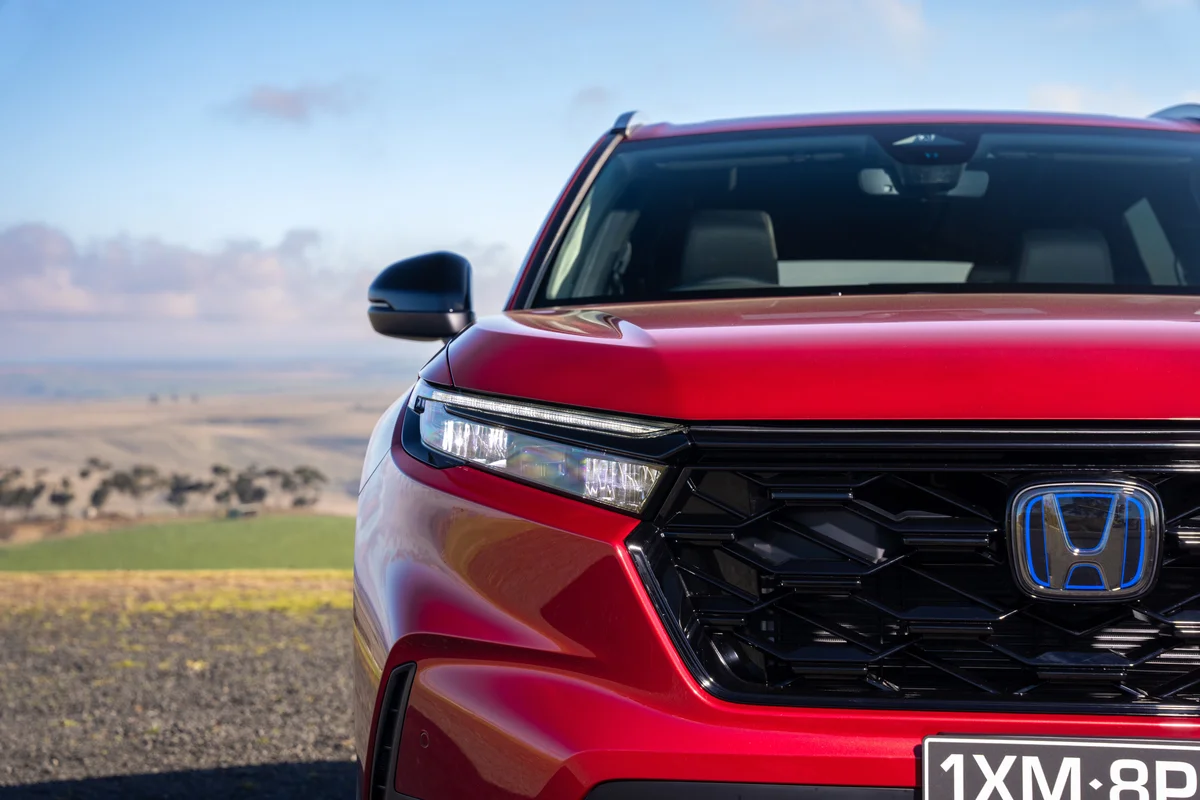
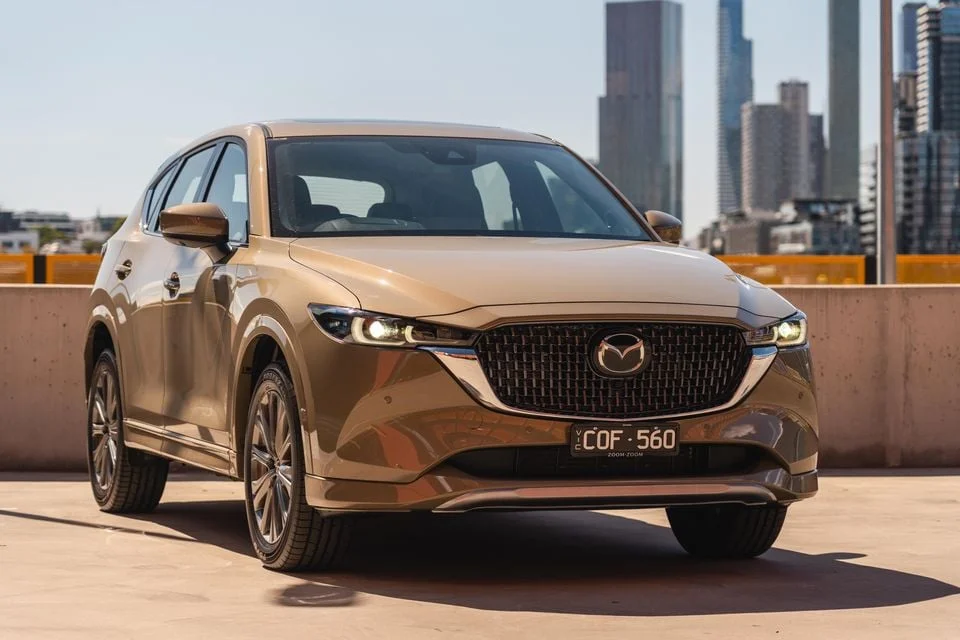
Honda CR-V vs Mazda CX-5
Two of Australia's favourite mid-size SUVs, now both AWD at these grades, and the Mazda is around $5,000 cheaper. Not so close anywhere else either.
Data checked: specs 28 Aug 2026, price 7 Oct 2026
Comparison snapshot
Prices, scores and edges below update from our car data.
From about $45,250 est. RRP
Estimated RRP: this brand lists drive-away prices only.
123L more boot, 8kW more power
Cheaper by $5,260, tows 300kg more
Written 7 April 2026. The snapshot, tables, scores and verdict on this page update from our car data; figures quoted in the text are as at that date.
Price
The price gap here is real, and it runs the Mazda's way. Check the basis first: Honda quotes drive-away, so the CR-V VTi L AWD is $49,800 on the road (about $45,250 as an estimated RRP). The CX-5 G25 Pure AWD lists at $39,990 before on-road costs, which lands around $44,000 registered in VIC. Level those up and the Mazda is roughly $5,800 cheaper on the road for the same all-wheel-drive layout.
Fuel is a dead heat. Both the all-wheel-drive CR-V and the all-wheel-drive CX-5 are rated at 7.4L/100km combined, about $2,109 per year each at $1.90/L and 15,000km. Whatever decides this comparison, it will not be the fuel bill.
Both come with 5-year unlimited-kilometre warranties, so you're covered equally. Servicing costs are comparable too. Honda's capped-price servicing runs around $250–$400 per visit. Mazda is similar, typically $300–$400. Parts costs are roughly equivalent for both Japanese manufacturers.
Insurance premiums sit in a similar bracket, though the CR-V can sometimes be $100–$200 more per year due to its slightly higher value. Over a 5-year ownership period, the CX-5 will cost approximately $2,500–$3,000 less in total. Not a massive difference, but the CX-5 has the edge on pure cost.
Resale is interesting. Both hold value well in the Australian market. The CX-5 benefits from massive sales volumes, which creates a deep used market and buyer confidence. The CR-V has Honda's reliability reputation propping up its residuals. Expect roughly similar resale percentages after 5 years.
Safety
The CR-V carries a 4-star ANCAP rating from 2024, with 88% adult occupant protection, 88% child occupant protection, 76% vulnerable road user and 68% safety assist. The new-generation CX-5 was rated in 2025 and holds 5 stars. Both carry full suites of active safety technology. The CR-V VTi L comes with Honda Sensing, which includes autonomous emergency braking with pedestrian and cyclist detection, adaptive cruise control, lane keeping assist, road departure mitigation, and blind spot monitoring. Honda also adds a driver attention monitor and traffic sign recognition.
The CX-5 G25 Pure gets Mazda's i-Activsense suite with autonomous emergency braking, lane departure warning, lane keeping assist, adaptive cruise control, and rear cross-traffic alert. Blind spot monitoring is included at this trim level, matching the Honda.
The CR-V has a slight edge in passive safety design. Its taller, wider body creates more crumple zone around the cabin, and the 1,623kg kerb weight gives it a small mass advantage in multi-vehicle crashes. The CX-5 at 1,588kg is a little lighter, which helps with handling but is marginally less advantageous in a crash with a heavier vehicle.
For families with young kids, both offer ISOFIX anchor points and top tether points in the rear. Neither has a particular advantage for child seat installation. Both are excellent choices if safety is your primary concern.
Features
The CR-V VTi L sits one trim above Honda's base model, so it comes nicely equipped. You get a 9-inch touchscreen with wireless Apple CarPlay and Android Auto, a reversing camera with guidelines, dual-zone climate control, push-button start, auto LED headlights, and 18-inch alloy wheels. The interior design is clean and modern, with a simple button layout for the climate controls that Honda reintroduced after the touchscreen-everything era. Good call.
The CX-5 G25 Pure is the entry-level CX-5, and the new generation moves the game on considerably. You get a 15.6-inch touchscreen, a far bigger unit than the outgoing car's rotary-controlled display (which many people prefer to a touchscreen while driving), Apple CarPlay and Android Auto (wired), dual-zone climate control, cloth seats, auto headlights, and 17-inch alloys. The Mazda interior is well designed with a driver-focused cockpit feel.
The CR-V's bigger screen and wireless phone mirroring give it a tech edge. Mazda's wired-only connectivity feels a touch dated in 2026, though the rotary controller is arguably safer to use while driving than a touchscreen. Honda also gives you a wireless phone charger on the VTi L, which the G25 Pure CX-5 lacks.
Boot space is where the CR-V pulls ahead decisively. At 561L versus 438L, that's 123 litres more. A serious gap, though the CX-5 opens out to 1,594L with the rear seats folded. The CR-V's boot is also wider and squarer, making it easier to load bulky items. Fold the rear seats and the CR-V opens up to a cavern. Honda has always been clever with interior packaging, and it shows here.
Drivetrain
The CR-V VTi L uses a 1.5-litre turbocharged four-cylinder producing 140kW and 243Nm of torque. The CX-5 G25 Pure runs a naturally aspirated 2.5-litre four making 132kW and 242Nm. On paper, the Honda has a clear advantage: 25kW more power and 43Nm more torque from a smaller, turbocharged engine. In practice, the CR-V feels noticeably more energetic, especially when overtaking on country roads or merging onto highways.
The CR-V hits 100km/h in about 9.4 seconds versus 8.7 for the CX-5, so the Mazda is now the quicker of the two. Neither is going to win drag races, but the CR-V's turbo gives it a more relaxed, effortless feel in everyday driving. The Mazda needs to be revved harder to extract its performance, which the 6-speed auto handles well but the engine note becomes noticeable.
The CX-5's 6-speed automatic is one of the highlights of the car. It's responsive, smooth, and always seems to find the right gear. The CR-V's CVT is fine, Honda has done a decent job calibrating it, but CVTs inherently lack the crispness of a traditional torque-converter auto. Under hard acceleration, the CR-V's CVT drones more than the CX-5's auto.
Towing is where the CX-5 strikes back. At 1,800kg braked versus 1,500kg for the CR-V, the Mazda can tow 300kg more. The CX-5 can handle most single-axle caravans, medium boats, and loaded trailers. The CR-V's 1,500kg limit means you need to be more careful about what you hitch up. A loaded box trailer and camping gear could push you close to the limit. If you tow regularly, the CX-5 is the safer bet.
Both cars compared here drive all four wheels, but the entry points differ sharply. The CX-5 range offers AWD from $39,990 RRP at the G25 Pure. Honda's cheapest all-wheel-drive CR-V is the VTi L AWD at $49,800 drive-away, so the Mazda gives you driven rear wheels roughly $6,000 earlier on the road.
CarSorted Data Insight
Both rank in the top 15 mid-size SUVs in our database of over Australian vehicles. The CR-V's 561L boot is the third largest in the mid-size segment, behind the Mitsubishi Outlander (574L) and Nissan X-Trail (585L). The CX-5's 1,800kg towing capacity still leads the CR-V by 300kg, though the new generation gave up 200kg against the model it replaced.
At their respective price points, both represent solid value in the mid-size segment. The CR-V VTi L AWD at $49,800 drive-away offers more boot space than most competitors, at a price that now asks a real premium. The CX-5 G25 Pure AWD at $39,990 is one of the most affordable ways into an all-wheel-drive mid-size SUV with a 5-year unlimited-kilometre warranty and 1,800kg of towing. ANCAP rated the new generation 5 stars in 2025.
Space and Comfort
The CR-V has always been an interior packaging champion. Honda's engineers squeeze more usable space from the CR-V's dimensions than almost anyone else in the segment. The rear seats offer generous legroom, the boot floor is flat and easy to load, and the magic seats (on higher trims) fold in ways that make carrying tall or awkwardly shaped items surprisingly easy.
The CX-5's interior is more driver-focused. The seating position is lower and more car-like, which many drivers prefer. Rear legroom is adequate but tighter than the CR-V, particularly for taller passengers. The boot is well shaped but the 438L doesn't stretch as far as the Honda's 561L when you're trying to fit a pram, shopping bags, and a dog crate simultaneously.
The Verdict
Buy the CX-5 if: you want better value, stronger towing capacity, an engaging driving experience, and Mazda's proven reliability. It's the smarter financial choice and handles better.
Buy the CR-V if: you need the most boot space possible, want the punchier turbo engine, and might consider the 7-seat option in higher trims for a growing family.
Compare both on CarSorted. See also: RAV4 vs CX-5 | Forester vs RAV4.
Key details
A tick marks the better figure only where both cars have one and the gap is meaningful (3% or more; a whole star or year).
| Detail | Honda CR-V | Mazda CX-5 |
|---|---|---|
| Price | From about $45,250 est. RRP | From $39,990 RRP |
| Drive-away estimate | $49,800 drive away (VIC, advertised) | Calculating... |
| Body | SUV | SUV |
| Powertrain | Petrol, 1.5L 4-cyl turbo | Petrol, 2.5L 4-cyl |
| Power / torque | 140kW / 240Nm | 132kW / 242Nm |
| Fuel use | 7.4 L/100km | 7.4 L/100km |
| 0-100km/h | No data | 8.7s |
| Boot | 589L seats up | 466L seats up · 1,594L seats folded |
| Towing (braked) | 1,500kg | 1,800kg |
| ANCAP | 4 stars (2024) | 5 stars (2025) |
| Warranty | 5yr / unlimited km | 5yr / unlimited km |
At a glance
- Seats
- 5
- Boot
- 589L seats up
- Length x width x height
- 4,704 x 1,866 x 1,691mm
- Wheelbase
- 2,700mm
- Engine
- 1.5L 4-cyl turbo
- Power
- 140kW
- Torque
- 240Nm
- Drive
- AWD
- Transmission
- CVT
- Power-to-weight
- 84 kW/tonne
- Kerb weight
- 1,669kg
- Spare wheel
- Space saver
- Payload
- 589kg
- Towing braked / unbraked
- 1,500kg / 600kg
- Turning circle
- 12m
- Seats
- 5
- Boot
- 466L seats up · 1,594L seats folded
- Length x width x height
- 4,690 x 1,860 x 1,695mm
- Wheelbase
- 2,815mm
- Engine
- 2.5L 4-cyl
- Power
- 132kW
- Torque
- 242Nm
- Drive
- AWD
- Transmission
- Automatic
- Power-to-weight
- 77 kW/tonne
- Kerb weight
- 1,720kg
- Spare wheel
- T155/80R17 temporary
- Payload
- 517kg
- Towing braked / unbraked
- 1,800kg / 750kg
- Turning circle
- 11.2m
CarSorted Score breakdown
The CarSorted Score is algorithmic: it is calculated from each car's data, not from a road test. How it works.
Safety
Fuel Economy
Value
Practicality
Technology
Performance
Reliability
The verdict
Honda CR-V comes out ahead on the CarSorted Score (76 vs 75)
The deciding gaps
- Safety:Honda CR-V 92, Mazda CX-5 88, Honda CR-V ahead by 4
- Practicality:Honda CR-V 68, Mazda CX-5 64, Honda CR-V ahead by 4
The Honda CR-V wins on the score; the Mazda CX-5 is the cheaper of the two, and price is already part of the Value axis.
Same scorer as the live comparison of these two exact cars.
Our take (written 7 April 2026)
Honda's pricing has moved this one firmly the Mazda's way. Matched as AWD against AWD, the CX-5 G25 Pure at $39,990 RRP lands roughly $5,000 to $6,000 under the CR-V VTi L AWD, which Honda quotes at $49,800 drive-away. The CR-V keeps far more boot space (589L vs 466L) and a slight power edge (140kW vs 132kW); fuel use is now identical at 7.4L/100km. The CX-5 tows 300kg more (1,800kg vs 1,500kg) and holds a 5-star ANCAP rating from 2025 against the CR-V's 4 stars from 2024, with the same warranty. Buy the CR-V for cargo space and cabin practicality. Buy the CX-5 for the price, the towing and the stronger safety result, which is a lot of column wins for the cheaper car.
Prices on this page move. Want the next verdict?
One short email when prices shift or a new comparison lands. No spam, unsubscribe anytime.
Questions buyers ask
Is the CR-V bigger than the CX-5?
Overall length: the Honda CR-V at 4,704mm, against 4,690mm for the Mazda CX-5.
Which tows more, CR-V or CX-5?
Braked towing capacity: the Mazda CX-5 at 1,800kg, against 1,500kg for the Honda CR-V.
Which is cheaper to run, CR-V or CX-5?
On the official combined cycle, the Honda CR-V uses 7.4 L/100km and the Mazda CX-5 uses 7.4 L/100km.
Should I buy the CR-V or CX-5 in 2026?
On the CarSorted Score the Honda CR-V comes out ahead (Honda CR-V 76/100, Mazda CX-5 75/100), mainly on safety, practicality. The score is algorithmic; the editorial above says who each car suits.
Is the Honda CR-V reliable?
Honda has a strong reliability track record in Australia. The 1.5T engine in the CR-V has been refined over several generations. Both Honda and Mazda are considered among the most reliable mainstream brands.
Which is cheaper, the Honda CR-V or the Mazda CX-5?
The Honda CR-V VTi L AWD is from about $45,250 est. RRP; the Mazda CX-5 G25 Pure AWD is from $39,990 RRP. That makes the Mazda CX-5 $5,260 cheaper.
What are the ANCAP ratings for the Honda CR-V and Mazda CX-5?
The Honda CR-V holds 4 stars (rated 2024), and the Mazda CX-5 holds 5 stars (rated 2025).
Which has the bigger boot?
Boot space with the seats up: the Honda CR-V at 589L, against 466L for the Mazda CX-5.
Which has the better warranty?
The Honda CR-V comes with a 5yr / unlimited km warranty; the Mazda CX-5 with a 5yr / unlimited km warranty.
Related
Compare
In the news
- Honda Recalls 554 Civic, Accord and ZR-V in Australia Over a Seatback Frame Edge That Fails ADR 3/04
- 2026 Nissan Z Priced for Australia: First Manual NISMO Joins the Range, GT-R Brakes, Orders Open
- Honda Super-ONE Priced for Australia From $36,900 Driveaway: Honda's First EV Lands With Under 130 Cars for 2026
- Mazda CX-5, BMW X3, MG S6 EV and Cupra Formentor All Score Five Stars With ANCAP
How to read this page. Prices, specs, ANCAP ratings, warranty, scores and the computed verdict come from our records for the two variants shown, sourced from manufacturer Australian documents, and update when those records change. RRP excludes on-road costs. Drive-away figures are estimates for the state you have selected unless marked as advertised. The editorial text was written on 7 April 2026. Always confirm price and specification with the manufacturer or dealer before you buy. CarSorted does not accept payment for recommendations.
Comments (0)
Sign in to join the conversation
No comments yet. Be the first!