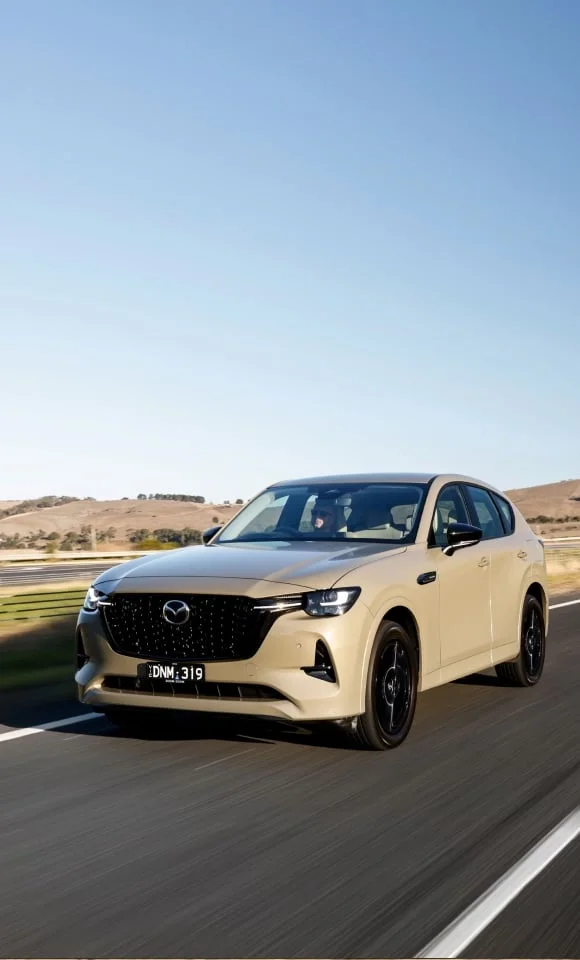
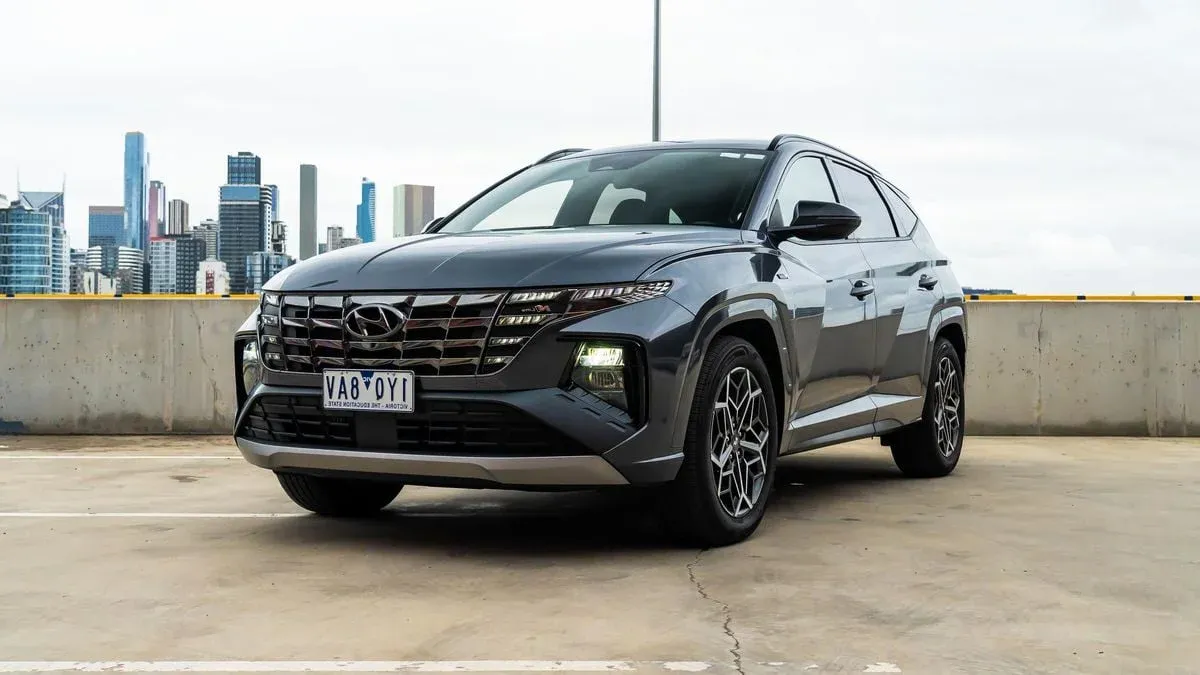
Mazda CX-60 vs Hyundai Tucson
Mazda's $44,240 premium push against Hyundai's $38,900 value champion. Two very different approaches to the mid-size SUV.
Data checked: specs 31 Aug 2026, price 1 Oct 2026
Comparison snapshot
Prices, scores and edges below update from our car data.
Lighter on fuel by 0.6 L/100km, 31L more boot
Cheaper by $6,290
Written 7 April 2026. The snapshot, tables, scores and verdict on this page update from our car data; figures quoted in the text are as at that date.
Price
The $5,340 price gap is significant at this end of the market. For context, that is roughly 12 months of fuel costs for either car. The Tucson Active at $38,900 is one of the cheapest ways into a properly sized mid-size SUV from a major brand, and it does not feel stripped-out at that price.
Fuel costs are almost identical here. At $1.90/L for 91 unleaded and 15,000km per year, the CX-60 G25 costs around $2,166 annually and the Tucson about $2,223. That is just $57 per year difference, which is nothing. Neither car demands premium fuel at these base trims, which keeps things simple.
Servicing is where things get interesting. Mazda's capped-price servicing for the CX-60 averages around $350 per service, while Hyundai's iCare program for the Tucson sits closer to $300. Over 5 years of ownership at 15,000km intervals, you are looking at roughly $250 more for the Mazda in total servicing. Not a dealbreaker, but worth knowing.
Insurance tends to be comparable for both. Expect to pay between $1,200 and $1,800 annually depending on your age, location, and driving history. Neither car sits in a particularly expensive insurance bracket.
Safety
Both cars hold 5-star ANCAP ratings, and both come loaded with the active safety gear that matters most: autonomous emergency braking, lane-keep assist, adaptive cruise control, and rear cross-traffic alert. At this price point, neither manufacturer is cutting corners on safety.
The CX-60 adds a couple of extras worth noting. It gets a driver monitoring system that watches for fatigue and distraction, plus a front cross-traffic alert for pulling out of driveways and tight car parks. These are genuinely useful in daily driving, particularly the front cross-traffic alert if you regularly reverse out of angled parking bays.
The Tucson Active counters with forward collision avoidance that works at intersections (not just straight-line scenarios) and a leading vehicle departure alert, which nudges you when the car in front moves off at traffic lights. Handy for those of us who check our phones at the lights. Both are safe, modern SUVs. No concerns either way.
Features
This is where the CX-60 starts to justify its higher price tag. The G25 Pure comes standard with a 12.3-inch infotainment display, a 12.3-inch digital instrument cluster, wireless Apple CarPlay and Android Auto, dual-zone climate control, and Mazda's excellent rotary controller for the infotainment. The materials inside feel premium: soft-touch plastics, real stitching on the dash, and an overall design language that is restrained but classy. Mazda is genuinely trying to compete with European brands here, and in terms of cabin ambience, they are getting close.
The Tucson Active at $38,900 is more modest but not embarrassing. You get an 8-inch touchscreen with wired Apple CarPlay and Android Auto, cloth seats, a 4.2-inch instrument cluster display, and manual air conditioning. It is a base model and it feels like one, but everything works well and the ergonomics are sound. Hyundai's infotainment is responsive and logically laid out.
If you step up to the Tucson Elite, you get the dual 10.25-inch screens, Bose audio, and leather-appointed seats. At that point you are much closer to the CX-60 and the feature comparison is much closer. But at the base-trim comparison we are making here, the CX-60 is in a different league inside.
Drivetrain
The CX-60 G25 uses Mazda's 2.5-litre naturally aspirated four-cylinder making 138kW and 250Nm. Crucially, this is a rear-wheel drive car with a longitudinal engine layout, which is unusual for this price bracket. Most competitors, including the Tucson, are transverse-engine front-drivers. The rear-drive layout gives the CX-60 a noticeably different steering feel: lighter, more natural, and more communicative. It feels like a proper driver's car in a way the Tucson simply does not.
The Tucson Active runs Hyundai's 2.0-litre Smartstream petrol engine producing 115kW and 192Nm through a 6-speed automatic to the front wheels. It is adequate but not inspiring. The 6-speed auto is smooth enough in normal driving but can hunt for gears on hills or when you need a burst of overtaking power. In pure straight-line terms, neither of these base models is quick. Both feel comfortable up to highway speeds but neither will pin you to the seat.
The CX-60's 8-speed torque converter automatic is a better gearbox than the Tucson's 6-speed unit. Shifts are smoother, there are more ratios to play with for optimal cruising, and it responds better to manual override via the paddle shifters. If you do a lot of highway cruising, the extra ratios help keep revs lower and the cabin quieter.
Towing is a meaningful difference: 2,000kg for the CX-60 vs 1,650kg for the Tucson. If you tow a small camper trailer, jet ski, or box trailer, the CX-60 gives you more headroom. The Tucson's 1,650kg limit is fine for a single-axle box trailer but gets tight with anything heavier.
Space and comfort
Boot space is close but the CX-60 wins with 570 litres to the Tucson's 539 litres (both seats up). The CX-60's boot is also a more usable shape with a lower load lip, which makes loading heavy items easier. Both fold the rear seats 60/40 to open up a flat-ish cargo area.
Rear seat space is where the Tucson fights back. Despite being the cheaper car, it has slightly more rear legroom and headroom. The CX-60's rear seat is adequate for adults but not as generous as you might expect from a car this size. The sloping roofline eats into headroom for taller passengers. If you regularly carry adults in the back, test-drive the CX-60 specifically for rear-seat comfort.
Front seat comfort is excellent in both. The CX-60's seats are a highlight: well-bolstered, supportive on long drives, and with a low seating position that feels more car-like than SUV-like. The Tucson's seats are more typically SUV: upright, good visibility, comfortable but not as sculpted.
Cost to own
Both come with 5-year, unlimited-kilometre warranties, which is now the standard for mainstream brands in Australia. Roadside assistance is included for the warranty period on both.
Resale is where things get interesting. Historically, the Tucson holds value well in Australia because of sheer volume: everyone knows what a Tucson is, dealers are everywhere, and parts are cheap. The CX-60 is newer to the market and does not have the same resale track record yet. Early signs suggest it holds value reasonably well, but it does not have the Tucson's established secondhand market.
Running a quick 5-year cost estimate: the Tucson will cost approximately $5,340 less to purchase, roughly $285 less in fuel over 5 years, and around $250 less in servicing. Total 5-year saving for the Tucson: approximately $5,875. Whether the CX-60's superior interior, bigger boot, better towing, and rear-drive handling are worth that premium is a personal call.
The Rear-Wheel Drive Factor
Let's talk about the elephant in the room. The CX-60 G25 is rear-wheel drive. In a segment where literally everything else is front-wheel drive or all-wheel drive, Mazda has gone a completely different direction. And honestly, it works. The steering is lighter and more natural than any FWD SUV in this class. Turn-in is sharper. The car rotates more willingly. If you enjoy driving (and not just commuting), you will notice the difference within the first five minutes of a test drive.
The downside? In heavy rain or on loose gravel, FWD is more predictable for most drivers. The Tucson's front-wheel drive layout will pull you through slippery situations more intuitively. The CX-60's stability control is well-calibrated and will keep you safe, but if you live somewhere that gets regular heavy rain, it is worth being aware of the difference. For the vast majority of Australian driving conditions, both layouts are perfectly fine.
Real-World Fuel Economy
The official figures are close: 7.6L/100km for the CX-60 and 7.8L/100km for the Tucson. In real-world driving, expect both to sit closer to 8.5-9.0L/100km in mixed conditions. Neither of these base petrol models is particularly frugal by 2026 standards. If fuel economy is a genuine priority, look at the Tucson Hybrid (5.6L/100km) or the CX-60 PHEV (1.5L/100km when charged). The base petrol models compared here are fine, but they are not the fuel-sipping champions of their respective ranges.
Highway cruising is where the CX-60's 8-speed auto helps. At 110km/h, the engine sits lower in the rev range than the Tucson's 6-speed, which translates to a quieter, more relaxed cruise and slightly better highway fuel economy. For city driving, the difference is negligible.
The Mazda Premium Play
Mazda has been very open about wanting to move upmarket. The CX-60 is a big part of that strategy. The interior quality, the rear-drive platform, the straight-six engine options (in higher trims) are all designed to compete with entry-level European luxury SUVs. At $44,240, the G25 Pure is the entry point to that experience. You get the platform and the interior quality, just not the powerful engines.
The Tucson makes no pretence about being premium. It is a well-executed, well-priced, well-featured mid-size SUV that does everything competently. There is no attempt to be something it is not. For a lot of buyers, that honesty is actually more appealing than Mazda's premium aspirations.
Who Should Buy Which?
Buy the CX-60 G25 Pure if: you care about how a car drives and feels inside. You want the bigger boot (570L), the stronger towing (2,000kg), and the unusual rear-drive handling. You are willing to pay $5,340 more for an interior that genuinely feels a class above. You are not in a rush and you enjoy the driving experience.
Buy the Tucson Active if: you want the lowest possible entry price into a good mid-size SUV. You prioritise value and do not need to tow more than 1,650kg. You want proven Hyundai reliability, cheap servicing, and a straightforward ownership experience. The $38,900 price tag is hard to beat.
Compare both on CarSorted. See also: RAV4 vs Tucson and X-Trail vs Tucson.
Key details
A tick marks the better figure only where both cars have one and the gap is meaningful (3% or more; a whole star or year).
| Detail | Mazda CX-60 | Hyundai Tucson |
|---|---|---|
| Price | From $45,640 RRP | From $39,350 RRP |
| Drive-away estimate | $47,990 drive away (VIC, advertised) | Calculating... |
| Body | SUV | SUV |
| Powertrain | Petrol, 2.5L 4-cyl | Petrol, 2L 4-cyl |
| Power / torque | 138kW / 250Nm | 115kW / 192Nm |
| Fuel use | 7.5 L/100km | 8.1 L/100km |
| 0-100km/h | 7.4s | No data |
| Boot | 570L seats up | 539L seats up |
| Towing (braked) | 1,800kg | 1,650kg |
| ANCAP | 5 stars (2022) | 5 stars (2021) |
| Warranty | 5yr / unlimited km | 5yr / unlimited km |
At a glance
- Seats
- 5
- Boot
- 570L seats up
- Length x width x height
- 4,740 x 1,890 x 1,675mm
- Wheelbase
- 2,870mm
- Engine
- 2.5L 4-cyl
- Power
- 138kW
- Torque
- 250Nm
- Drive
- RWD
- Transmission
- Automatic
- Power-to-weight
- 75 kW/tonne
- Kerb weight
- 1,847kg
- Spare wheel
- Space saver
- Payload
- 425kg
- Towing braked / unbraked
- 1,800kg / 750kg
- Turning circle
- 10.8m
- Seats
- 5
- Boot
- 539L seats up
- Length x width x height
- 4,640 x 1,865 x 1,665mm
- Wheelbase
- 2,755mm
- Engine
- 2L 4-cyl
- Power
- 115kW
- Torque
- 192Nm
- Drive
- FWD
- Transmission
- Automatic
- Power-to-weight
- 77 kW/tonne
- Kerb weight
- 1,495kg
- Spare wheel
- Space saver
- Payload
- No data
- Towing braked / unbraked
- 1,650kg / 750kg
- Turning circle
- 11.8m
CarSorted Score breakdown
The CarSorted Score is algorithmic: it is calculated from each car's data, not from a road test. How it works.
Safety
Fuel Economy
Value
Practicality
Technology
Performance
Reliability
The verdict
Mazda CX-60 comes out ahead on the CarSorted Score (67 vs 60)
The deciding gaps
- Safety:Mazda CX-60 76, Hyundai Tucson 60, Mazda CX-60 ahead by 16
- Technology:Mazda CX-60 42, Hyundai Tucson 30, Mazda CX-60 ahead by 12
- Performance:Mazda CX-60 53, Hyundai Tucson 43, Mazda CX-60 ahead by 10
The Mazda CX-60 wins on the score; the Hyundai Tucson is the cheaper of the two, and price is already part of the Value axis.
Same scorer as the live comparison of these two exact cars.
Our take (written 7 April 2026)
These are fundamentally different propositions. The Tucson Active is $5,340 cheaper, lighter, and barely uses more fuel. It is the rational, budget-friendly pick for families who want a reliable mid-sizer without overthinking it. The CX-60 G25 Pure costs more but gives you a bigger boot, stronger towing, rear-wheel drive handling, and an interior that genuinely feels a class above. If you can stretch to $44k and you care about the driving experience, the CX-60 rewards you. If your priority is value and keeping costs low, the Tucson is hard to argue against.
Prices on this page move. Want the next verdict?
One short email when prices shift or a new comparison lands. No spam, unsubscribe anytime.
Questions buyers ask
Is the Mazda CX-60 G25 rear-wheel drive?
Yes. The CX-60 G25 Pure is rear-wheel drive, which is unusual for a mid-size SUV at this price. It uses a longitudinal engine layout similar to BMW or Mercedes SUVs.
Which is cheaper to run, the CX-60 or Tucson?
On the official combined cycle, the Mazda CX-60 uses 7.5 L/100km and the Hyundai Tucson uses 8.1 L/100km.
Which has more boot space?
Boot space with the seats up: the Mazda CX-60 at 570L, against 539L for the Hyundai Tucson.
Which SUV tows more?
Braked towing capacity: the Mazda CX-60 at 1,800kg, against 1,650kg for the Hyundai Tucson.
Which is cheaper, the Mazda CX-60 or the Hyundai Tucson?
The Mazda CX-60 G25 Pure is from $45,640 RRP; the Hyundai Tucson Petrol is from $39,350 RRP. That makes the Hyundai Tucson $6,290 cheaper.
What are the ANCAP ratings for the Mazda CX-60 and Hyundai Tucson?
The Mazda CX-60 holds 5 stars (rated 2022), and the Hyundai Tucson holds 5 stars (rated 2021).
Which has the better warranty?
The Mazda CX-60 comes with a 5yr / unlimited km warranty; the Hyundai Tucson with a 5yr / unlimited km warranty.
Which comes out ahead overall?
On the CarSorted Score the Mazda CX-60 comes out ahead (Mazda CX-60 67/100, Hyundai Tucson 60/100), mainly on safety, technology, performance. The score is algorithmic; the editorial above says who each car suits.
Related
The cars
In the news
- 2026 Mazda CX-60 Update: PHEV Premium Collapses to $5,000, Diesel Matches Petrol, New $44,240 G25 Pure Entry
- VFACTS August 2026: EVs Outsell Petrol, Diesel and Hybrid for the First Time in Australian History
- Hyundai Palisade LX3 Recall: Interim Over-the-Air Software Rolls Out for 2,304 Cars in Australia, New Deliveries Still Paused
- New Hyundai Tucson Revealed: Fifth-Gen NX5 Goes Boxy, Due in Australia Mid-2027
How to read this page. Prices, specs, ANCAP ratings, warranty, scores and the computed verdict come from our records for the two variants shown, sourced from manufacturer Australian documents, and update when those records change. RRP excludes on-road costs. Drive-away figures are estimates for the state you have selected unless marked as advertised. The editorial text was written on 7 April 2026. Always confirm price and specification with the manufacturer or dealer before you buy. CarSorted does not accept payment for recommendations.
Comments (0)
Sign in to join the conversation
No comments yet. Be the first!