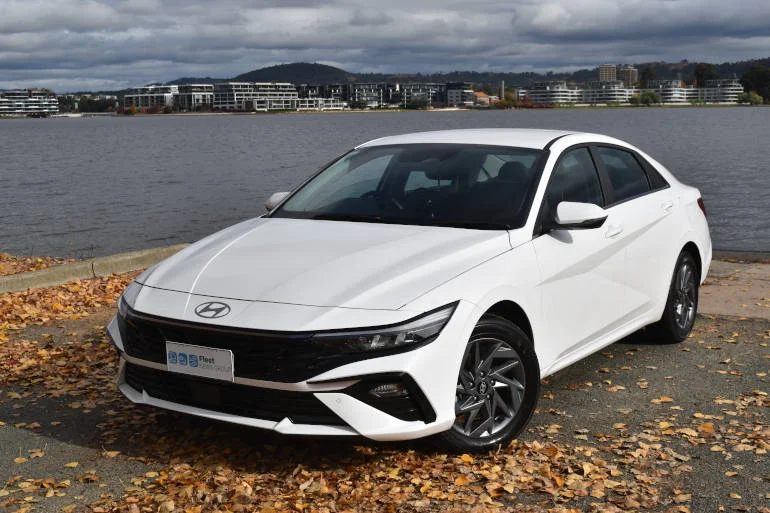

Hyundai i30 vs Mazda3
$29,250 vs $26,490. One has 179 litres more boot. The other is cheaper, quicker on paper and does not carry a three-star crash rating.
Data checked: specs 12 Sep 2026, price 24 Jun 2026
Comparison snapshot
Prices, scores and edges below update from our car data.
Price when new $29,250 RRP
No longer sold new. Not a current offer or a used value.
179L more boot
Lighter on fuel by 1.1 L/100km
Written 7 April 2026. The snapshot, tables, scores and verdict on this page update from our car data; figures quoted in the text are as at that date.
Price
The Mazda3 G20 Pure at $26,490 is $2,760 less than the i30 Sedan Active at $29,250, both recommended retail before on-road costs. The Mazda also costs slightly less to fuel: at 15,000km a year and $1.90 a litre it runs about $1,682 annually against $1,738 for the i30. That is only $56 a year, so this is nothing like the fuel gap this comparison used to describe. The two are effectively level at the bowser.
One note on the i30 range while we are on price. The i30 hatch is no longer sold in base Active trim in Australia; the hatch now starts at N Line, $36,000. If you specifically want an i30 hatchback you are shopping $9,510 above the Mazda3 G20 Pure, and the fair Mazda rival becomes the G25 Evolve SP at $36,490.
5-Year Cost Estimate
| Cost | i30 Active | Mazda3 G20 Pure |
|---|---|---|
| List price (RRP, before on-roads) | $29,250 | $26,490 |
| 5yr Fuel (est.) | $8,692 | $8,408 |
| 5yr Insurance (est.) | $6,200 | $6,500 |
| 5yr Servicing (est.) | $2,400 | $2,400 |
| Resale (est. 5yr, 47%/50%) | -$13,748 | -$13,245 |
| True 5yr Cost | $32,794 | $30,553 |
The Mazda3 saves roughly $2,241 over five years, and almost all of it is the purchase price. Fuel is now close to a wash between the two, and the i30's higher starting price means it hands back more dollars at trade-in even on a lower retention rate. If long-term cost of ownership is your primary concern, the Mazda3 still wins, just for different reasons than it used to.
Safety
This section has changed direction, so read it carefully if you have seen an older version of this comparison.
The i30 Sedan holds a three-star ANCAP rating from 2024, not five. The current Mazda3 has no ANCAP rating on record, so we will not put a star count on it in either direction. That is not the same as saying the Mazda is safer; it means one car has a published rating that is below the class norm and the other has not been rated. If a published five-star result is a hard requirement, neither of these two gives you one.
On equipment, the earlier claim that the Mazda3 G20 Pure lacks blind-spot monitoring was wrong. Both cars list blind-spot monitoring as standard, and the Mazda3 also lists rear cross-traffic alert, which the i30 Sedan Active does not. So the active-safety advantage at this trim now sits with the Mazda, not the Hyundai.
Both come with autonomous emergency braking, lane keep assist, adaptive cruise control and a reversing camera as standard, plus front, side and curtain airbags, stability control and traction control.
Features
The i30 Sedan Active gets an 8-inch touchscreen with wireless Apple CarPlay and Android Auto. Wireless connectivity is a genuine convenience advantage on a daily basis: no cable, no fumbling, the phone connects on its own.
The Mazda3 G20 Pure gets an 8.8-inch widescreen display controlled by a rotary dial on the centre console. Apple CarPlay is wired only. The screen is positioned higher on the dashboard, closer to the driver's line of sight, which Mazda argues is safer. The rotary controller takes a few days to learn but becomes intuitive quickly.
The Mazda3's interior quality is the standout. Even at the base G20 Pure spec, the cabin materials feel a class above. Soft-touch surfaces, tight panel gaps, and a minimalist design that punches well above its price point. The i30 Active is perfectly fine, but the plastics feel harder and the overall ambience is more budget-oriented.
Both have cloth seats, manual air conditioning, a reversing camera and blind-spot monitoring. The i30 adds wireless phone mirroring. The Mazda3 counters with a larger screen, rear cross-traffic alert and a more premium-feeling cabin. It depends what you value more.
Drivetrain
Both use naturally aspirated 2.0-litre four-cylinder engines driving the front wheels, but they are not matched on transmission: the i30 Sedan uses a CVT, the Mazda3 a conventional six-speed torque-converter automatic.
| Drivetrain | i30 Active | Mazda3 G20 Pure |
|---|---|---|
| Engine | 2.0L 4cyl | 2.0L 4cyl (Skyactiv-G) |
| Power | 110kW | 114kW |
| Torque | 180Nm | 200Nm |
| Transmission | CVT | 6-speed Auto |
| Fuel Economy | 6.1L/100km | 5.9L/100km |
| Kerb Weight | 1,260kg | 1,418kg |
The Mazda3 has 4kW and 20Nm on the i30, and the fuel figures are now within 0.2L/100km of each other, so the Skyactiv-G efficiency argument is much narrower than it once was. What is left is the transmission. The Mazda3's six-speed torque-converter auto steps through fixed ratios; the i30 Sedan's CVT holds revs under load in the way CVTs do. Which you prefer is a matter of taste, but they are not the same kind of drivetrain and the specification sheet should say so.
The i30 is 158kg lighter, which counts for something against its lower output. Neither maker publishes a 0-100 claim for the i30 Sedan Active; the Mazda3 is quoted at 9.7 seconds.
On towing the positions have swapped: the Mazda3 is rated to 1,200kg braked, the i30 Sedan to 1,100kg. Neither is a natural tow car, and 100kg is not a reason to choose either one.
Space and comfort
Boot space is the i30's one decisive win, and it is a big one. At 474 litres against 295, the Hyundai sedan has 179 litres more cargo room. That is the difference between fitting the pram and the shopping, or choosing one or the other. The Mazda3's 295-litre boot is one of the smallest in the class and remains its biggest practical weakness.
Both are sedans, so neither gives you the wide hatch aperture that makes loading bulky items easy. If you need that, the Mazda3 is also sold as a hatch at the same money, and the i30 hatch starts at $36,000 in N Line trim with a 395-litre boot.
Rear seat space is acceptable in both, though the i30 has slightly more legroom thanks to its more upright rear seat design. The Mazda3's rear seat is lower and more reclined, which feels sportier but sacrifices a bit of headroom for taller passengers. Children will be comfortable in both.
The Mazda3's interior design and materials quality, though, is genuinely a class above. The dashboard layout, the feel of the switchgear, and the overall cabin ambience are closer to a $40,000 car than a $26,490 one. If you spend a lot of time in your car and care about the tactile quality of what you touch every day, the Mazda3 makes a strong case despite its smaller boot.
Cost to own
Both offer 5-year unlimited kilometre warranties. Both include roadside assist for the warranty period. There is no differentiation here.
Servicing costs are virtually identical. Both brands offer capped-price servicing programmes with annual or 15,000km intervals. Each service runs approximately $200-280 depending on the specific items required. Over five years, expect to spend roughly $2,400 on scheduled servicing for either car.
The Mazda3 holds a slightly higher percentage of its value. Mazda3 resale has been consistently strong in Australia, with expected retention of around 50% after five years against roughly 47% for the i30. In dollar terms the i30 actually hands back a bit more because it started $2,760 higher, but it started $2,760 higher to do it.
Both run on standard 91-octane unleaded. Both are front-wheel-drive sedans with proven, naturally aspirated engines and no turbocharger, dual-clutch gearbox or hybrid system to worry about. The one drivetrain difference to be aware of is the i30's CVT against the Mazda3's conventional automatic. These are mechanically straightforward cars either way.
Parts availability is excellent for both. Hyundai and Mazda both have extensive dealer and service networks across Australia, including regional areas. You will not struggle to find a workshop regardless of where you live.
The Drivetrain Difference
On the specification sheet the Mazda3 is the more conventionally engineered of the two. It pairs its 114kW/200Nm Skyactiv-G engine with a six-speed torque-converter automatic, which steps through fixed ratios and holds a gear when you ask it to. The i30 Sedan Active runs 110kW/180Nm through a CVT, which is the more efficient layout in theory but behaves differently under load. Mazda quotes 9.7 seconds to 100km/h; Hyundai does not publish a figure for this variant.
Mazda has a long-standing reputation for chassis tuning in this class, and the Mazda3 is regularly picked out for it. We have not driven either of these cars, so take that as a market reputation rather than a verdict from us. What the numbers do say is that the Mazda is lighter on fuel, stronger on output and cheaper, and the i30 is 158kg lighter overall.
The Practicality Gap
The i30 Sedan's 179-litre boot advantage is the most one-sided number in this comparison. In a segment where every litre counts, 474 litres against 295 is the difference between fitting the pram and the shopping, or choosing one or the other. If you have kids, if you regularly carry gear, if practicality is in your top three requirements, the i30 is the more capable daily car by a wide margin.
Towing no longer favours the Hyundai. The Mazda3 is rated to 1,200kg braked against the i30 Sedan's 1,100kg. Both handle a small box trailer or a light load; neither is a serious tow car.
Who Should Buy Which?
Buy the i30 Sedan Active if: boot space is what decides it. 474 litres is a lot of car for the money and it is the one area where the Hyundai is clearly ahead. Be aware you are buying a three-star ANCAP car, and check whether that sits comfortably with you before you sign.
Buy the Mazda3 G20 Pure if: you want the cheaper car ($2,760 less), the stronger engine, the conventional automatic, blind-spot monitoring plus rear cross-traffic alert, and a cabin that feels a class above its price. You give up 179 litres of boot to get all of that.
If you want an i30 hatch: the range now starts at the N Line, $36,000, with a 395-litre boot and 117kW/253Nm. At that money the Mazda comparison shifts to the G25 Evolve SP at $36,490.
See also: Corolla vs Mazda3, Golf vs Mazda3, and our Best Small Cars Australia 2026 guide.
Key details
A tick marks the better figure only where both cars have one and the gap is meaningful (3% or more; a whole star or year).
| Detail | Hyundai i30 Sedan | Mazda Mazda3 |
|---|---|---|
| Price | Price when new $29,250 RRP | From $26,490 RRP |
| Drive-away estimate | Not sold new | Calculating... |
| Body | Sedan | Hatch |
| Powertrain | Petrol, 2L 4-cyl | Petrol, 2L 4-cyl |
| Power / torque | 117kW / 191Nm | 114kW / 200Nm |
| Fuel use | 7 L/100km | 5.9 L/100km |
| Boot | 474L seats up | 295L seats up |
| Towing (braked) | 1,200kg | 1,200kg |
| ANCAP | 3 stars (2024) | No data |
| Warranty | 5yr / unlimited km | 5yr / unlimited km |
At a glance
- Seats
- 5
- Boot
- 474L seats up
- Length x width x height
- 4,710 x 1,825 x 1,420mm
- Wheelbase
- 2,720mm
- Engine
- 2L 4-cyl
- Power
- 117kW
- Torque
- 191Nm
- Drive
- FWD
- Transmission
- 6-speed manual
- Power-to-weight
- 93 kW/tonne
- Kerb weight
- 1,260kg
- Spare wheel
- Full size alloy
- Payload
- No data
- Towing braked / unbraked
- 1,200kg / 610kg
- Turning circle
- 10.8m
- Seats
- 5
- Boot
- 295L seats up
- Length x width x height
- 4,460 x 1,795 x 1,435mm
- Wheelbase
- 2,725mm
- Engine
- 2L 4-cyl
- Power
- 114kW
- Torque
- 200Nm
- Drive
- FWD
- Transmission
- 6-speed Automatic (Skyactiv-Drive)
- Power-to-weight
- 80 kW/tonne
- Kerb weight
- 1,418kg
- Spare wheel
- Temporary (steel)
- Payload
- No data
- Towing braked / unbraked
- 1,200kg / 600kg
- Turning circle
- 10.6m
CarSorted Score breakdown
The CarSorted Score is algorithmic: it is calculated from each car's data, not from a road test. How it works.
Safety
Fuel Economy
Value
Practicality
Technology
Performance
Reliability
The verdict
Mazda Mazda3 comes out ahead on the CarSorted Score (66 vs 62)
The deciding gaps
- Technology:Hyundai i30 Sedan 31, Mazda Mazda3 49, Mazda Mazda3 ahead by 18
- Fuel Economy:Hyundai i30 Sedan 73, Mazda Mazda3 83, Mazda Mazda3 ahead by 10
- Practicality:Hyundai i30 Sedan 56, Mazda Mazda3 49, Hyundai i30 Sedan ahead by 7
Same scorer as the live comparison of these two exact cars.
Our take (written 7 April 2026)
The Mazda3 G20 Pure is $2,760 cheaper, marginally leaner on fuel at 5.9L/100km against 6.1, makes more power and torque (114kW/200Nm to 110kW/180Nm), tows 100kg more, and uses a conventional six-speed automatic rather than the i30's CVT. It also has blind-spot monitoring and rear cross-traffic alert as standard, which is worth stating plainly because this comparison used to claim it did not. The i30 Sedan Active's answer is space: a 474-litre boot against 295, which is a 179-litre gap and a genuinely big deal in this class. One caution before you weigh that up. The i30 Sedan carries a three-star ANCAP rating from 2024, not five. The Mazda3 has no rating on record for the current car, so we cannot claim it does better, but a published three stars is a published three stars. On price, running costs and drivetrain the Mazda3 is the better buy. Choose the i30 if the boot decides it and the three-star rating does not bother you.
Prices on this page move. Want the next verdict?
One short email when prices shift or a new comparison lands. No spam, unsubscribe anytime.
Questions buyers ask
Is the i30 or Mazda3 better value in 2026?
The Hyundai i30 Sedan Active is listed at $29,250 RRP when new (no longer sold new); the Mazda Mazda3 G20 Pure is from $26,490 RRP. The two prices are not on the same basis, so we do not set one against the other.
Which has the bigger boot, i30 or Mazda3?
Boot space with the seats up: the Hyundai i30 Sedan at 474L, against 295L for the Mazda Mazda3.
What ANCAP rating does the i30 have?
The Hyundai i30 Sedan holds 3 stars (rated 2024), and we have no ANCAP rating on record for the Mazda Mazda3.
Does the Mazda3 G20 Pure have blind-spot monitoring?
Yes. Blind-spot monitoring is standard on the G20 Pure, and so is rear cross-traffic alert. An earlier version of this comparison said otherwise, which was wrong. The i30 Sedan Active has blind-spot monitoring but not rear cross-traffic alert.
Which small car is more fuel efficient?
On the official combined cycle, the Hyundai i30 Sedan uses 7 L/100km and the Mazda Mazda3 uses 5.9 L/100km.
Is the i30 still sold as a hatchback?
The Hyundai i30 Sedan is no longer sold new in Australia, and the Mazda Mazda3 is on sale new in Australia.
Which tows more?
Braked towing capacity: both are listed at 1,200kg.
Which has the better warranty?
The Hyundai i30 Sedan comes with a 5yr / unlimited km warranty; the Mazda Mazda3 with a 5yr / unlimited km warranty.
Which comes out ahead overall?
On the CarSorted Score the Mazda Mazda3 comes out ahead (Hyundai i30 Sedan 62/100, Mazda Mazda3 66/100), mainly on technology, fuel economy. The score is algorithmic; the editorial above says who each car suits.
Related
The cars
In the news
- 2026 Hyundai Palisade XRT Pro Priced for Australia: $79,900 Turbo Petrol Off-Roader, In Dealers From September
- New Hyundai Tucson Revealed: Fifth-Gen NX5 Goes Boxy, Due in Australia Mid-2027
- Hyundai Ioniq 3 Cancelled for Australia: Electric Hatch Won't Be Imported
- VFACTS August 2026: EVs Outsell Petrol, Diesel and Hybrid for the First Time in Australian History
How to read this page. Prices, specs, ANCAP ratings, warranty, scores and the computed verdict come from our records for the two variants shown, sourced from manufacturer Australian documents, and update when those records change. RRP excludes on-road costs. Drive-away figures are estimates for the state you have selected unless marked as advertised. The editorial text was written on 7 April 2026. Always confirm price and specification with the manufacturer or dealer before you buy. CarSorted does not accept payment for recommendations.
Comments (0)
Sign in to join the conversation
No comments yet. Be the first!