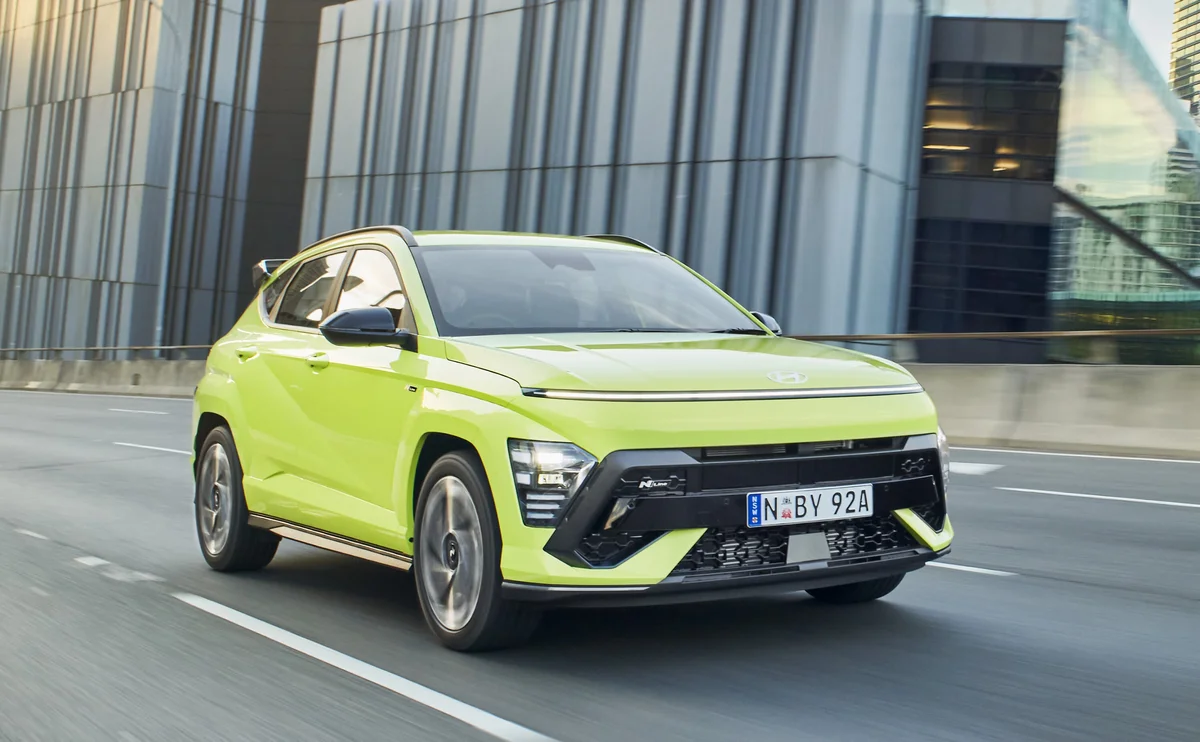
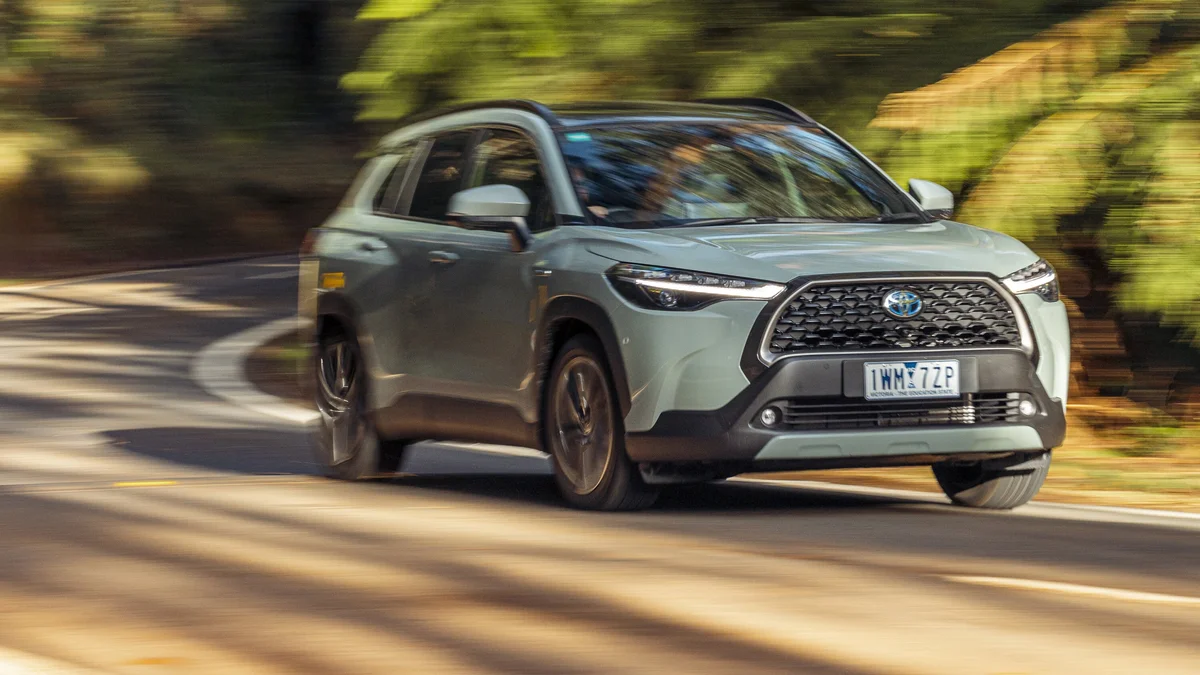
Hyundai Kona vs Toyota Corolla Cross
$32,500 vs $37,440. Two of Australia's popular small SUVs compared across all the metrics that matter.
Data checked: specs 7 Sep 2026, price 5 Oct 2026
Comparison snapshot
Prices, scores and edges below update from our car data.
Cheaper by $3,490, tows 550kg more
Lighter on fuel by 2.4 L/100km, 64L more boot
Written 7 April 2026. The snapshot, tables, scores and verdict on this page update from our car data; figures quoted in the text are as at that date.
Price
These two differ significantly on price. The Kona 2.0 FWD at $32,500 is the more affordable option compared to the Corolla Cross GX at $37,440. You are making this decision on both merit and budget.
Where the cost story gets interesting is fuel. At 15,000km per year and $1.90 per litre, the Kona costs about $1,881 annually in fuel versus $2,138 for the Corolla Cross. That is a $257-a-year advantage for the Hyundai. Not life-changing, but it adds up to $1,283 over five years.
5-Year Cost Estimate
| Cost | Kona 2.0 FWD | Corolla Cross GX |
|---|---|---|
| Driveaway (est. VIC) | ~$36,000 | ~$35,800 |
| 5yr Fuel | $9,405 | $10,688 |
| 5yr Insurance | $6,900 | $6,800 |
| 5yr Servicing | $2,400 | $2,200 |
| Resale (est. 5yr) | -$15,600 (48%) | -$17,442 (54%) |
| True 5yr Cost | $40,105 | $38,046 |
The Corolla Cross saves roughly $2,059 over five years despite using more fuel. Toyota's resale advantage does the heavy lifting here. That extra 6% at trade-in time is worth about $1,842 more in your pocket. Fuel savings from the Kona do not quite offset the resale gap.
Safety
The Corolla Cross earned 5 stars from ANCAP in 2022. The Kona was tested in 2023 under tougher protocols and came away with 4 stars, scoring 80% for adult occupant protection, 84% for child occupant protection, 64% for vulnerable road users and 62% for safety assist. Both come equipped with the full suite of modern safety technology: autonomous emergency braking, lane keep assist, adaptive cruise control, and a reversing camera are standard on both at this trim level.
The Kona adds blind spot monitoring as standard on the base model, which is a notable inclusion that the Corolla Cross GX does not offer. Blind spot monitoring is one of those features you do not think about until you need it, and having it as standard is a genuine selling point for the Hyundai.
Both have front, side, and curtain airbags. Both have electronic stability control, traction control, and hill start assist. On the published crash results the Corolla Cross is ahead, with the Kona's 4-star outcome pulled down mainly by its vulnerable road user and safety assist scores. The Kona's inclusion of blind spot monitoring at this price point is still a useful advantage for highway driving and lane changes.
Features
The Kona comes with a 12.3-inch touchscreen, which is genuinely large and easy to use. Wireless Apple CarPlay and Android Auto are standard. The interface is responsive and the screen resolution is sharp. Hyundai's infotainment system has improved enormously over recent years and is now among the best in the mainstream market.
The Corolla Cross GX gets a 10.5-inch touchscreen, also with wireless Apple CarPlay and Android Auto. It is slightly smaller than the Kona's screen but still perfectly adequate. Toyota's infotainment system is functional but feels less polished than Hyundai's.
Both cars have cloth seats, manual air conditioning at the base level, and single-zone climate control. Neither includes heated seats, a sunroof, or any premium luxury features at this trim. You are paying for the fundamentals, and both deliver them competently.
The Kona has a slight edge in tech features at this price point thanks to the larger screen and blind spot monitoring. The Corolla Cross counters with Toyota's perceived reliability advantage and a more established dealer network for aftermarket support.
Drivetrain
Both use naturally aspirated 2.0-litre four-cylinder engines with CVT automatic transmissions and front-wheel drive. The specs are remarkably close.
| Drivetrain | Kona 2.0 FWD | Corolla Cross GX |
|---|---|---|
| Engine | 2.0L 4cyl | 2.0L 4cyl |
| Power | 110kW | 112kW |
| Torque | 180Nm | 187Nm |
| Transmission | CVT Auto | CVT Auto |
| Fuel Economy | 6.6L/100km | 7.5L/100km |
| 0-100 km/h | 10.4s | 10.2s |
| Towing | 1,300kg | 1,200kg |
Performance is virtually identical. Both take over 10 seconds to hit 100km/h. They are not fast cars, and they are not trying to be. They are built for commuting, school runs, and weekend trips. Both have enough grunt to merge onto highways comfortably and overtake at reasonable speeds.
The Kona's fuel economy advantage (6.6L vs 7.5L per 100km) is worth noting. That is a 12% improvement, which is meaningful over the life of the car. The Kona is the lighter car at the kerb, which may contribute to its efficiency edge despite the two having near-identical power outputs.
Towing is marginally better in the Kona at 1,300kg braked versus 1,200kg for the Corolla Cross. Both will handle a small box trailer, a jet ski, or a mid-size camper without issue. If you are towing regularly at maximum weight, the 100kg difference is not going to matter in practice.
Space and comfort
Boot space is the Corolla Cross's clear advantage. At 440 litres versus the Kona's 361 litres, that is 79 litres more, roughly the equivalent of two large sports bags. If you have kids, regularly load up for weekend trips, or just want more room for shopping, the Toyota wins this one comfortably.
With the rear seats folded, both cars open up to over 1,000 litres of cargo space. The Corolla Cross maintains its advantage in maximum capacity too, thanks to its slightly longer body and flatter load floor.
Rear seat space is adequate in both. Adults will fit comfortably, though neither car offers class-leading legroom. The Kona has a slightly more snug feel in the rear due to its more coupe-like roofline, which trades headroom for a sportier exterior look. The Corolla Cross has a boxier shape that maximises interior volume.
Both have ISOFIX child seat anchor points, USB ports front and rear, and a 60/40 split-fold rear bench. For young families, both are entirely practical. The Corolla Cross just gives you more room to work with.
Cost to own
Warranties are matched at 5 years with unlimited kilometres. Neither brand gives you an advantage here. Both include roadside assist for the warranty period.
Servicing costs are marginally lower for the Corolla Cross. Toyota's capped-price servicing programme is well-established and competitive, with each scheduled service costing roughly $200-250. Hyundai's servicing is slightly more expensive at around $230-280 per visit, though the gap is not dramatic.
The big ownership cost differentiator is resale. Toyota consistently dominates resale value charts in Australia. The Corolla Cross is expected to retain approximately 54% of its value after five years, compared to around 48% for the Kona, giving Toyota strong resale credentials. At trade-in time that difference can translate to meaningful savings.
Both run on standard 91-octane unleaded fuel. Both are front-wheel drive with simple, proven powertrains that should deliver reliable service for years. Spare parts are readily available for both brands through extensive Australian dealer networks.
The Hybrid Question
Both brands offer hybrid versions of these cars. The Hyundai Kona Hybrid achieves an impressive 3.9L/100km. The Toyota Corolla Cross Hybrid manages 4.3L/100km. Both are among the most fuel-efficient numbers for small SUVs and represent meaningful fuel savings over the base petrol models reviewed here.
If fuel economy is your absolute top priority and you are willing to spend more upfront, both hybrid versions are worth considering. The Kona Hybrid is the more fuel-efficient of the two hybrids compared here, but it also costs more. The Corolla Cross Hybrid is a competitive value hybrid option while still dramatically cutting fuel bills.
Real-World Driving
Both of these cars are fundamentally commuter vehicles. They are built for stop-start traffic, school pick-ups, supermarket runs, and the occasional highway drive. Neither will excite you behind the wheel, and neither is trying to. The CVT transmissions in both are tuned for smoothness and efficiency rather than engagement.
The Kona feels slightly more agile in urban driving thanks to its more compact dimensions and lighter kerb weight. The Corolla Cross feels more planted and stable on the highway. Both have comfortable rides that soak up speed bumps and rough suburban roads without complaint. Steering in both is light and easy to manage in car parks.
Road noise is acceptable in both but not class-leading. At highway speeds, you will notice wind and tyre noise in either car. Published reviews generally put the Kona marginally ahead here, though the difference is subtle and may come down to tyre choice as much as anything else.
Who Should Buy Which?
Buy the Kona if: you want better fuel economy (6.6L vs 7.5L), a larger touchscreen (12.3-inch), blind spot monitoring as standard, and 100kg more towing capacity. The tech-forward choice.
Buy the Corolla Cross if: you want more boot space (440L vs 361L), the best resale value in the segment, and the option to upgrade to a hybrid powertrain. The practical, long-term value choice.
See also: Kona vs Seltos, Yaris Cross vs Kona, and our guide to the Best SUVs Under $50k.
Key details
A tick marks the better figure only where both cars have one and the gap is meaningful (3% or more; a whole star or year).
| Detail | Hyundai Kona | Toyota Corolla Cross |
|---|---|---|
| Price | From $33,950 RRP | From $37,440 RRP |
| Drive-away estimate | Calculating... | Calculating... |
| Body | SUV | SUV |
| Powertrain | Petrol, 2L 4-cyl | Hybrid, 2L 4-cyl |
| Power / torque | 110kW / 180Nm | 146kW / 188Nm |
| Fuel use | 6.6 L/100km | 4.2 L/100km |
| 0-100km/h | 9.9s | 9.4s |
| Boot | 361L seats up | 425L seats up |
| Towing (braked) | 1,300kg | 750kg |
| ANCAP | 4 stars (2023) | 5 stars (2022) |
| Warranty | 5yr / unlimited km | 5yr / unlimited km |
At a glance
- Seats
- 5
- Boot
- 361L seats up
- Length x width x height
- 4,350 x 1,825 x 1,585mm
- Wheelbase
- 2,660mm
- Engine
- 2L 4-cyl
- Power
- 110kW
- Torque
- 180Nm
- Drive
- FWD
- Transmission
- Automatic
- Power-to-weight
- 82 kW/tonne
- Kerb weight
- 1,335kg
- Spare wheel
- Space saver
- Payload
- 550kg
- Towing braked / unbraked
- 1,300kg / 600kg
- Turning circle
- 10.6m
- Seats
- 5
- Boot
- 425L seats up
- Length x width x height
- 4,460 x 1,825 x 1,620mm
- Wheelbase
- 2,640mm
- Engine
- 2L 4-cyl
- Power
- 146kW
- Torque
- 188Nm
- Drive
- FWD
- Transmission
- Automatic
- Power-to-weight
- 102 kW/tonne
- Kerb weight
- 1,435kg
- Spare wheel
- Space saver
- Payload
- No data
- Towing braked / unbraked
- 750kg / 750kg
- Turning circle
- 10.8m
CarSorted Score breakdown
The CarSorted Score is algorithmic: it is calculated from each car's data, not from a road test. How it works.
Safety
Fuel Economy
Value
Practicality
Technology
Performance
Reliability
The verdict
Toyota Corolla Cross comes out ahead on the CarSorted Score (72 vs 63)
The deciding gaps
- Fuel Economy:Hyundai Kona 76, Toyota Corolla Cross 98, Toyota Corolla Cross ahead by 22
- Safety:Hyundai Kona 64, Toyota Corolla Cross 81, Toyota Corolla Cross ahead by 17
- Technology:Hyundai Kona 30, Toyota Corolla Cross 42, Toyota Corolla Cross ahead by 12
The Toyota Corolla Cross wins on the score; the Hyundai Kona is the cheaper of the two, and price is already part of the Value axis.
Same scorer as the live comparison of these two exact cars.
Our take (written 7 April 2026)
These two trade blows across the key metrics. The Kona uses less fuel (6.6L vs 7.5L per 100km), saving about $257 a year, and tows 100kg more. The Corolla Cross has 79L more boot space and Toyota's strong resale value. Warranties are identical at 5 years unlimited. Neither is the wrong choice. If fuel costs and towing matter more, get the Kona. If boot space and resale matter more, get the Corolla Cross.
Prices on this page move. Want the next verdict?
One short email when prices shift or a new comparison lands. No spam, unsubscribe anytime.
Questions buyers ask
Which is more fuel efficient, the Kona or Corolla Cross?
On the official combined cycle, the Hyundai Kona uses 6.6 L/100km and the Toyota Corolla Cross uses 4.2 L/100km.
Which has the bigger boot?
Boot space with the seats up: the Toyota Corolla Cross at 425L, against 361L for the Hyundai Kona.
Is the Kona or Corolla Cross better value?
The Hyundai Kona 2.0 FWD is from $33,950 RRP; the Toyota Corolla Cross GX FWD is from $37,440 RRP. That makes the Hyundai Kona $3,490 cheaper.
What are the ANCAP ratings for the Hyundai Kona and Toyota Corolla Cross?
The Hyundai Kona holds 4 stars (rated 2023), and the Toyota Corolla Cross holds 5 stars (rated 2022).
Which tows more?
Braked towing capacity: the Hyundai Kona at 1,300kg, against 750kg for the Toyota Corolla Cross.
Which has the better warranty?
The Hyundai Kona comes with a 5yr / unlimited km warranty; the Toyota Corolla Cross with a 5yr / unlimited km warranty.
Which comes out ahead overall?
On the CarSorted Score the Toyota Corolla Cross comes out ahead (Hyundai Kona 63/100, Toyota Corolla Cross 72/100), mainly on fuel economy, safety, technology. The score is algorithmic; the editorial above says who each car suits.
Related
The cars
In the news
- 2026 Jaecoo J5 Hybrid Priced for Australia: Summit at $34,990 Driveaway, 165kW Combined
- Hyundai Drops Kona Electric and Ioniq 5 Pricing by Up to $8,000 for EOFY 2026
- New Hyundai Tucson Revealed: Fifth-Gen NX5 Goes Boxy, Due in Australia Mid-2027
- 2026 Toyota Corolla Cross GR Sport Priced for Australia: New Sporty Flagship at $50,990, Range Opens at $37,440
How to read this page. Prices, specs, ANCAP ratings, warranty, scores and the computed verdict come from our records for the two variants shown, sourced from manufacturer Australian documents, and update when those records change. RRP excludes on-road costs. Drive-away figures are estimates for the state you have selected unless marked as advertised. The editorial text was written on 7 April 2026. Always confirm price and specification with the manufacturer or dealer before you buy. CarSorted does not accept payment for recommendations.
Comments (0)
Sign in to join the conversation
No comments yet. Be the first!