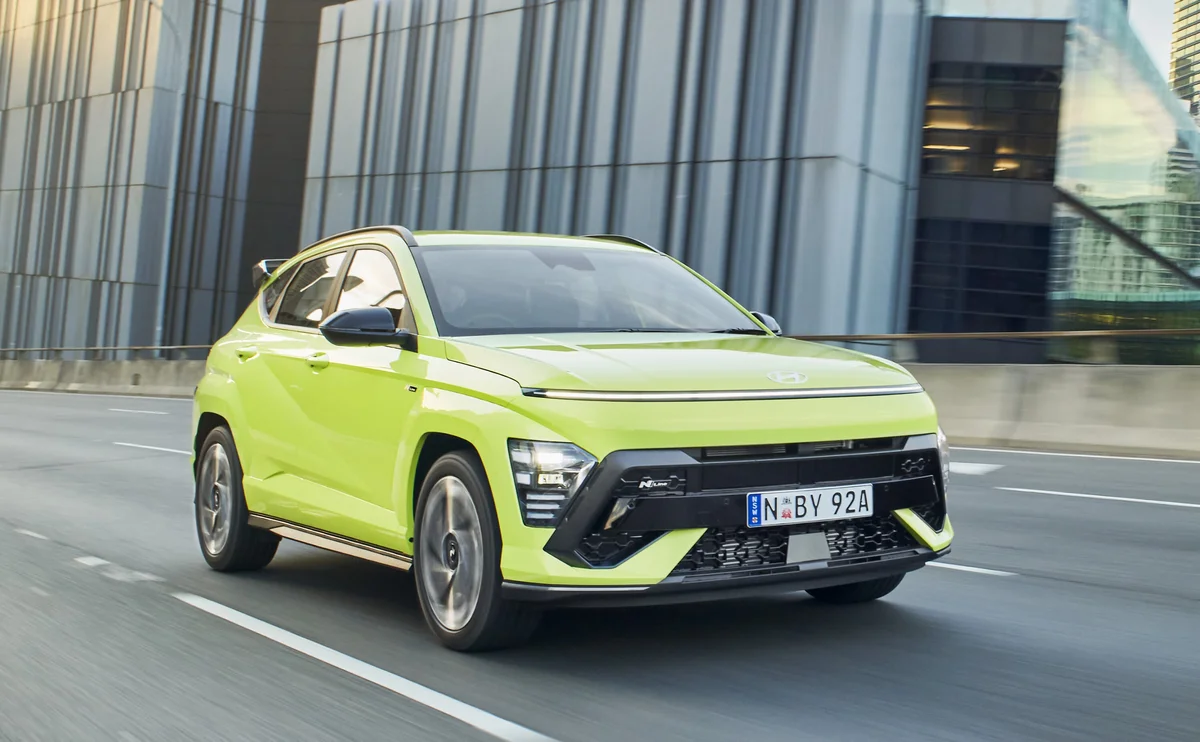
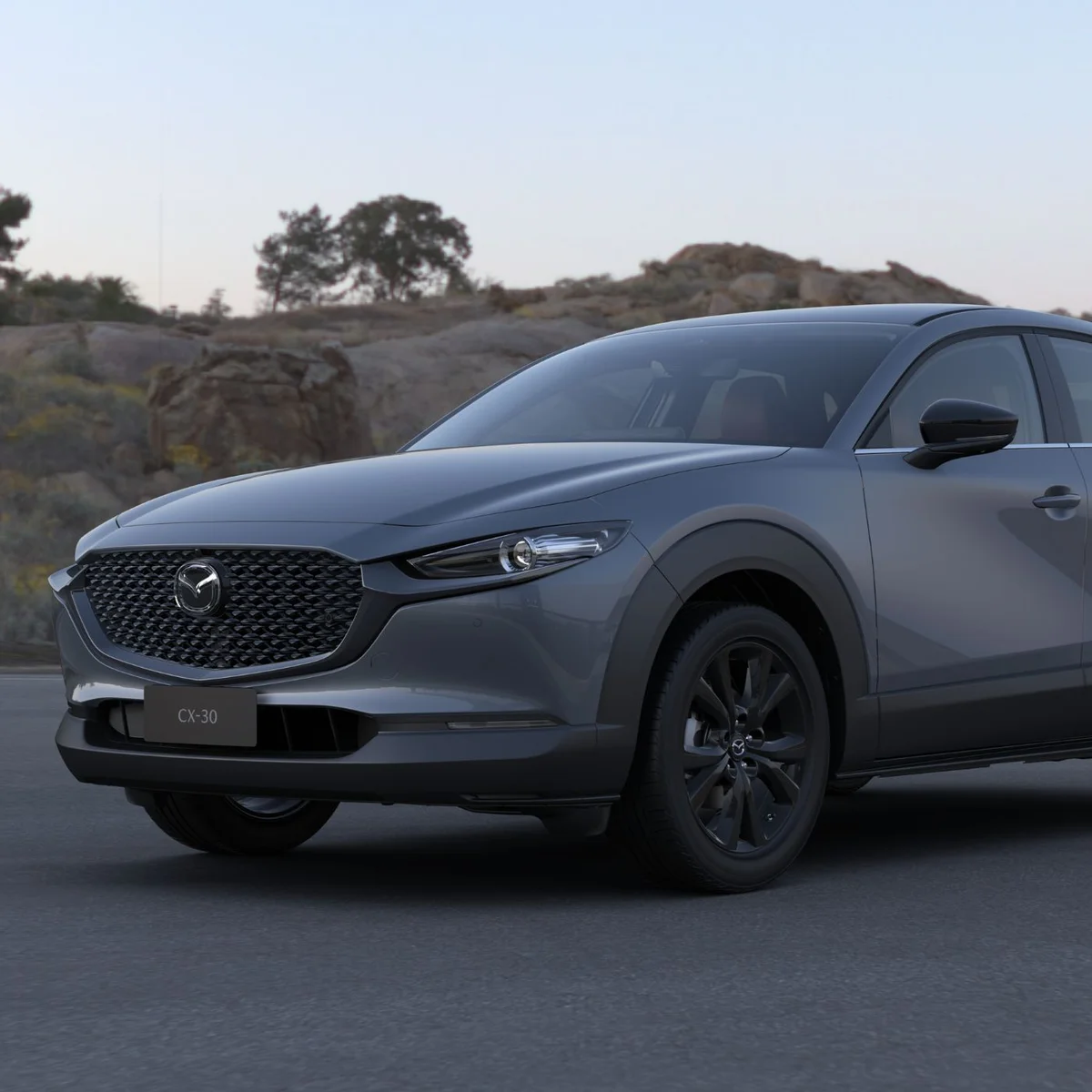
Hyundai Kona vs Mazda CX-30
$32,500 vs $29,990. Korea's best-seller vs Mazda's premium small SUV.
Data checked: specs 12 Sep 2026, price 5 Oct 2026
Comparison snapshot
Prices, scores and edges below update from our car data.
44L more boot, tows 100kg more
Cheaper by $3,960, lighter on fuel by 0.3 L/100km
Written 7 April 2026. The snapshot, tables, scores and verdict on this page update from our car data; figures quoted in the text are as at that date.
Price
The price gap here is $2,510, with the CX-30 G20 Pure starting at $29,990 versus $32,500 for the Kona 2.0 FWD. That is not a massive difference, but it is meaningful. In a segment where every dollar counts, $2,510 buys you a decent set of aftermarket accessories or covers several years of servicing.
Running costs slightly favour the CX-30 as well. At 6.3L/100km versus 6.6L for the Kona, the Mazda will save you about $90 per year based on 15,000km at $2.00/L. Over five years, that is roughly $450. Not life-changing, but it all adds up.
Both cars come with five-year, unlimited-kilometre warranties, so there is no advantage on coverage. Both brands offer capped-price servicing, and the costs per service are broadly comparable. Insurance premiums are similar too, with the lower-priced CX-30 having a marginal advantage.
Driveaway pricing depends on your state, but you are looking at roughly $33,000-34,000 for the CX-30 and $36,000-37,000 for the Kona. On a five-year loan, the CX-30 saves you around $50 per month in repayments. That adds up to about $3,000 over the life of the loan.
Resale is close. Both Mazda and Hyundai hold their value well in the Australian market, though Mazda has a slight edge historically. Expect to retain around 50-55 per cent of purchase price after five years for both cars. The CX-30's lower starting price means less absolute depreciation, which is another small win in its column.
Safety
The ANCAP picture is uneven here. The Kona was tested in 2023 and holds 4 stars, with 80% for adult occupant protection, 84% for child occupant protection, 64% for vulnerable road users and 62% for safety assist. The CX-30 has no ANCAP rating at all, so there is no published crash result to put beside it. Both do carry comprehensive active safety suites, but an equipment list is not a crash score.
The Kona comes with Hyundai's SmartSense safety package, which includes autonomous emergency braking with pedestrian and cyclist detection, lane keep assist, lane following assist, driver attention warning, and adaptive cruise control with stop-and-go capability. You also get a reversing camera and rear parking sensors. The Kona's safety tech feels modern and well integrated.
The CX-30 gets Mazda's i-Activsense suite with AEB, lane departure warning, lane keep assist, adaptive cruise control, and blind spot monitoring. Mazda's system is intuitive and not overly intrusive, which is a plus for drivers who find some safety systems too aggressive in their interventions. You also get a reversing camera and front and rear parking sensors.
One area where the Kona has a slight edge is forward collision avoidance with junction turning functionality, which can help prevent T-bone collisions at intersections. It is a niche feature but a good one. The CX-30 counters with its excellent driver visibility thanks to slim A-pillars and large windows, reducing the chance of an incident in the first place.
Bottom line: both are well equipped, but only the Kona has been independently crash tested, and it landed on 4 stars rather than 5. If a published ANCAP result is part of your decision, that is the one car here that has one. Our ANCAP safety ratings guide explains what goes into those star ratings if you want more detail.
Features
The Kona 2.0 FWD at this price point comes with an 8-inch touchscreen, wireless Apple CarPlay and Android Auto, cloth seats, air conditioning, LED headlights, and keyless entry with push-button start. It is a solid if unremarkable equipment list that covers the essentials.
The CX-30 G20 Pure gets an 8.8-inch display operated by Mazda's rotary controller rather than a touchscreen, Apple CarPlay and Android Auto (wired), cloth seats, air conditioning, LED headlights, and push-button start. On paper it looks similar, but the execution is different.
The Kona wins on tech connectivity with wireless CarPlay and a touch-operated screen. In 2026 that is a genuine convenience, especially if you jump in the car for short trips and do not want to faff about with cables. The CX-30's wired-only setup feels a step behind.
But the CX-30 absolutely dominates on interior quality. This is where Mazda punches above its weight like no other brand. Even at this entry-level spec, the cabin materials, the precise fit and finish, and the overall design feel like they belong in a car costing $10,000 more. Soft-touch surfaces where you actually touch, quality switchgear, and a refined colour palette. It genuinely feels premium.
The Kona's interior is perfectly fine. It is well assembled and everything works as it should. But the plastics are harder, the design is more overtly techy, and it does not have that same tactile richness. If you spend a lot of time in your car and interior ambience matters to you, the CX-30 is in a different class at this price point.
Drivetrain
Both cars run 2.0-litre naturally aspirated four-cylinder engines, but the outputs differ. The CX-30 produces 114kW and 200Nm, while the Kona makes 110kW and 180Nm. The CX-30 has 4kW and 20Nm more, and you can feel it. It is the more responsive car, particularly when accelerating from a standstill or overtaking on country roads.
The gearbox is a major differentiator. The Kona uses a CVT (continuously variable transmission), while the CX-30 gets a traditional six-speed torque converter automatic. CVTs divide opinion. They are efficient and smooth in gentle driving, but many enthusiasts find the rubber-band feeling under hard acceleration annoying. The Kona's CVT does its best to simulate gear changes, but it cannot fully mask the CVT character.
The CX-30's six-speed auto is a conventional unit that shifts crisply and predictably. It is well matched to the engine and responds promptly to throttle inputs. For buyers who care about driving engagement, the CX-30's powertrain is clearly the more enjoyable setup.
Mazda has also invested heavily in chassis tuning for the CX-30, and it shows. The steering is precise and communicative, the body control through corners is excellent, and it feels planted and confident. The Kona is competent but more comfort-oriented, with softer damping and lighter steering. Neither is a sports car, but the CX-30 is the one you would choose for a twisty road.
The Kona weighs slightly less at 1,335kg versus 1,370kg for the CX-30, but the weight difference is too small to offset the power and torque gap. In daily driving, the CX-30 feels like the quicker, more willing car.
For a broader look at fuel-efficient options in this segment, our most fuel-efficient SUVs guide covers the field.
Space and comfort
Boot space goes to the Kona at 361 litres versus 350 for the CX-30. It is an 11-litre difference, which is about one more shopping bag. Not enough to swing a decision on its own, but the Kona's boot is also slightly better shaped with a wider opening, making it easier to load bulky items.
Rear seat space is similar in both cars. These are small SUVs and neither offers limousine-like legroom in the back. Both are fine for average-sized adults on shorter trips, but anyone over six feet will start to notice the squeeze on a long drive. The Kona has a marginal edge in rear headroom, while the CX-30 offers a touch more rear legroom.
Towing is where the Kona gains a significant advantage. At 1,300kg braked, the Kona can handle small camper trailers, jet skis, box trailers, and even small boats. The CX-30 tops out at 1,000kg, which is fine for a bike rack or small box trailer but limits your options for heavier gear. If you occasionally need to tow, the Kona gives you 300kg of extra headroom. Our towing guide breaks down what you can realistically tow at these weights.
Both cars have split-folding rear seats for when you need to carry longer items. The CX-30's seats fold flatter, creating a more usable extended load area. The Kona has a false floor in the boot that can be adjusted for a flat load surface, which is a thoughtful touch.
Cabin storage is adequate in both cars but not exceptional. Cup holders, door pockets, a centre console bin, and a glovebox are standard fare. Neither car has any standout storage solutions, though the Kona's wireless charging pad (if you have a compatible phone) is a nice touch for reducing cable clutter.
Cost to own
Both the Kona and CX-30 come with five-year, unlimited-kilometre warranties. This is now the standard in the segment and it is good to see both brands stepping up. You are covered for the same period and with the same peace of mind.
Dealer networks favour Mazda slightly in Australia. Mazda is consistently a top-three seller, and dealers are well distributed across metro and regional areas. Hyundai is also well represented, though slightly less so in remote locations. For most buyers in capital cities and major regional centres, access to both brands is straightforward.
Servicing intervals are standard for both, and capped-price servicing gives you cost certainty. Hyundai and Mazda both run competitive servicing programs, with per-service costs in the same ballpark. Neither brand will sting you with unexpectedly high bills at scheduled intervals.
We do not hold model-level reliability data, so we are not going to rank these two on it. What is on the record is the cover: check the warranty term, the capped-price servicing schedule and the service interval for each, since those are the manufacturer's own commitments and they are what you can actually hold them to.
Parts availability is a non-issue for both. As top-selling brands in Australia, independent mechanics have plenty of experience with both, and aftermarket and OEM parts are widely stocked. If you are in a remote area, both brands can source parts within a few days at most.
For more on what it costs to own and run a car over time, check our running costs calculator for a personalised estimate.
The Verdict
This is one of the tighter comparisons in the small SUV segment, but the CX-30 G20 Pure edges it. It is cheaper, more powerful, more fuel efficient, and has a cabin that feels like it belongs in a much more expensive car. The driving experience is also clearly better, with Mazda's excellent chassis and conventional automatic outshining the Kona's CVT-equipped drivetrain.
Buy the Kona 2.0 FWD if: towing matters. At 1,300kg braked, it handles small camper trailers and jet skis that the CX-30 cannot. You also get wireless Apple CarPlay and a slightly bigger boot. If you occasionally tow or value wireless connectivity, the Kona is your car.
Buy the CX-30 G20 Pure if: you want the best-driving, best-feeling small SUV at this price point. The premium interior, sharp handling, and lower purchase price make it the pick for buyers who value quality and driving enjoyment. It also sips less fuel and has more power on tap.
For most buyers, the CX-30 is the one to have. But neither car is a bad choice, and both represent excellent value in the small SUV segment.
Compare both on CarSorted. See also: Kona vs Seltos, CX-30 vs Corolla Cross, and our best SUVs under $50k guide.
Key details
A tick marks the better figure only where both cars have one and the gap is meaningful (3% or more; a whole star or year).
| Detail | Hyundai Kona | Mazda CX-30 |
|---|---|---|
| Price | From $33,950 RRP | From $29,990 RRP |
| Drive-away estimate | Calculating... | Calculating... |
| Body | SUV | SUV |
| Powertrain | Petrol, 2L 4-cyl | Petrol, 2L 4-cyl |
| Power / torque | 110kW / 180Nm | 114kW / 200Nm |
| Fuel use | 6.6 L/100km | 6.3 L/100km |
| 0-100km/h | 9.9s | No data |
| Boot | 361L seats up | 317L seats up |
| Towing (braked) | 1,300kg | 1,200kg |
| ANCAP | 4 stars (2023) | No data |
| Warranty | 5yr / unlimited km | 5yr / unlimited km |
At a glance
- Seats
- 5
- Boot
- 361L seats up
- Length x width x height
- 4,350 x 1,825 x 1,585mm
- Wheelbase
- 2,660mm
- Engine
- 2L 4-cyl
- Power
- 110kW
- Torque
- 180Nm
- Drive
- FWD
- Transmission
- Automatic
- Power-to-weight
- 82 kW/tonne
- Kerb weight
- 1,335kg
- Spare wheel
- Space saver
- Payload
- 550kg
- Towing braked / unbraked
- 1,300kg / 600kg
- Turning circle
- 10.6m
- Seats
- 5
- Boot
- 317L seats up
- Length x width x height
- 4,395 x 1,795 x 1,540mm
- Wheelbase
- 2,655mm
- Engine
- 2L 4-cyl
- Power
- 114kW
- Torque
- 200Nm
- Drive
- FWD
- Transmission
- Automatic
- Power-to-weight
- 78 kW/tonne
- Kerb weight
- 1,468kg
- Spare wheel
- Temporary (steel)
- Payload
- No data
- Towing braked / unbraked
- 1,200kg / 600kg
- Turning circle
- 10.6m
CarSorted Score breakdown
The CarSorted Score is algorithmic: it is calculated from each car's data, not from a road test. How it works.
Safety
Fuel Economy
Value
Practicality
Technology
Performance
Reliability
The verdict
Hyundai Kona comes out ahead on the CarSorted Score (63 vs 62)
The deciding gaps
- Safety:Hyundai Kona 64, Mazda CX-30 52, Hyundai Kona ahead by 12
- Performance:Hyundai Kona 37, Mazda CX-30 43, Mazda CX-30 ahead by 6
- Fuel Economy:Hyundai Kona 76, Mazda CX-30 79, Mazda CX-30 ahead by 3
The Hyundai Kona wins on the score; the Mazda CX-30 is the cheaper of the two, and price is already part of the Value axis.
Same scorer as the live comparison of these two exact cars.
Our take (written 7 April 2026)
The CX-30 G20 Pure is $2,510 cheaper, more powerful, has more torque, and sips less fuel. The Kona fights back with more boot space (361L vs 350L) and significantly better towing (1,300kg vs 1,000kg). Both have five-year warranties. On safety the Kona holds a 4-star ANCAP rating from 2023 and the CX-30 has no ANCAP rating at all, so there is no published crash result for the Mazda. On balance, the CX-30 edges it thanks to its lower price, better driving dynamics, and premium interior quality. But the Kona is the pick if towing matters or if you want an independently tested safety result.
Our written take favoured the Mazda CX-30; on today's figures the score favours the Hyundai Kona.
Prices on this page move. Want the next verdict?
One short email when prices shift or a new comparison lands. No spam, unsubscribe anytime.
Questions buyers ask
Is the CX-30 worth choosing over the cheaper Kona?
The Hyundai Kona 2.0 FWD is from $33,950 RRP; the Mazda CX-30 G20 Pure is from $29,990 RRP. That makes the Mazda CX-30 $3,960 cheaper.
Which small SUV has the better fuel economy?
On the official combined cycle, the Hyundai Kona uses 6.6 L/100km and the Mazda CX-30 uses 6.3 L/100km.
Which tows more, the Kona or CX-30?
Braked towing capacity: the Hyundai Kona at 1,300kg, against 1,200kg for the Mazda CX-30.
Which is better for families?
On the CarSorted Score the Hyundai Kona comes out ahead (Hyundai Kona 63/100, Mazda CX-30 62/100), mainly on safety. The score is algorithmic; the editorial above says who each car suits.
Which has a CVT?
The Kona uses a CVT. The CX-30 has a conventional six-speed automatic. If you dislike the CVT driving feel, the CX-30 is the better choice.
Which interior feels more premium?
The CX-30, and it is not close. Even at the G20 Pure entry level, Mazda's cabin materials and build quality feel a class above. The Kona is well assembled but uses harder plastics and has a more utilitarian feel.
What are the ANCAP ratings for the Hyundai Kona and Mazda CX-30?
The Hyundai Kona holds 4 stars (rated 2023), and we have no ANCAP rating on record for the Mazda CX-30.
Which has the bigger boot?
Boot space with the seats up: the Hyundai Kona at 361L, against 317L for the Mazda CX-30.
Which has the better warranty?
The Hyundai Kona comes with a 5yr / unlimited km warranty; the Mazda CX-30 with a 5yr / unlimited km warranty.
Related
In the news
- 2026 Jaecoo J5 Hybrid Priced for Australia: Summit at $34,990 Driveaway, 165kW Combined
- Hyundai Drops Kona Electric and Ioniq 5 Pricing by Up to $8,000 for EOFY 2026
- New Hyundai Tucson Revealed: Fifth-Gen NX5 Goes Boxy, Due in Australia Mid-2027
- VFACTS August 2026: EVs Outsell Petrol, Diesel and Hybrid for the First Time in Australian History
How to read this page. Prices, specs, ANCAP ratings, warranty, scores and the computed verdict come from our records for the two variants shown, sourced from manufacturer Australian documents, and update when those records change. RRP excludes on-road costs. Drive-away figures are estimates for the state you have selected unless marked as advertised. The editorial text was written on 7 April 2026. Always confirm price and specification with the manufacturer or dealer before you buy. CarSorted does not accept payment for recommendations.
Comments (0)
Sign in to join the conversation
No comments yet. Be the first!