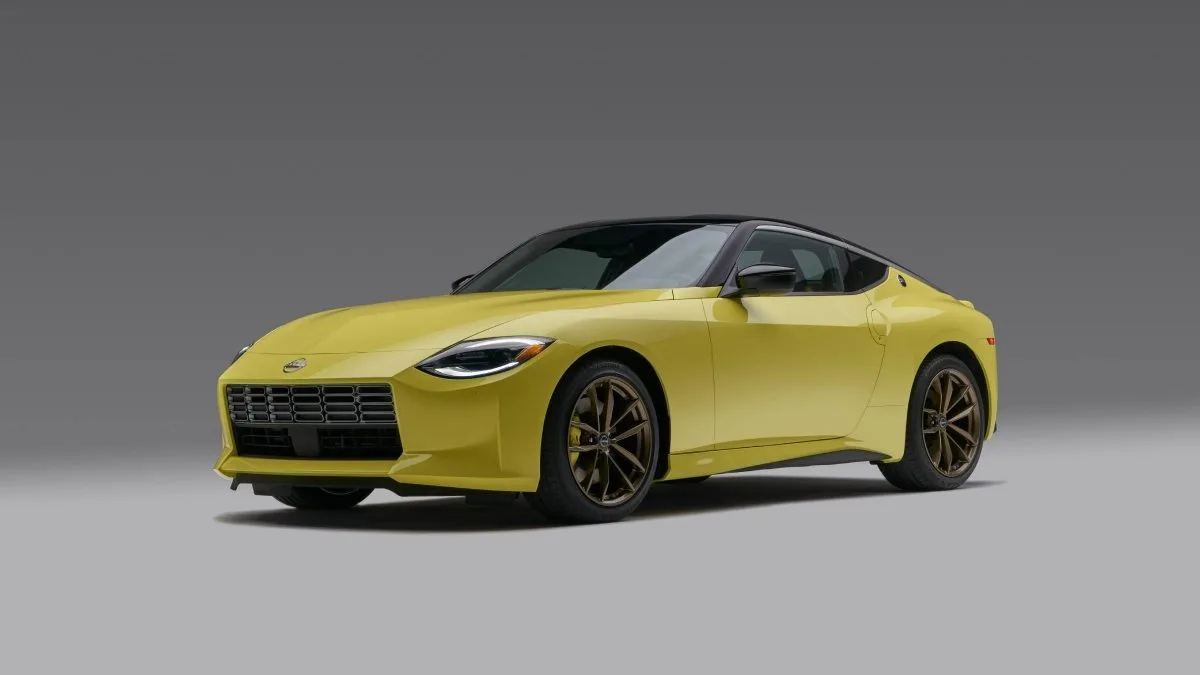
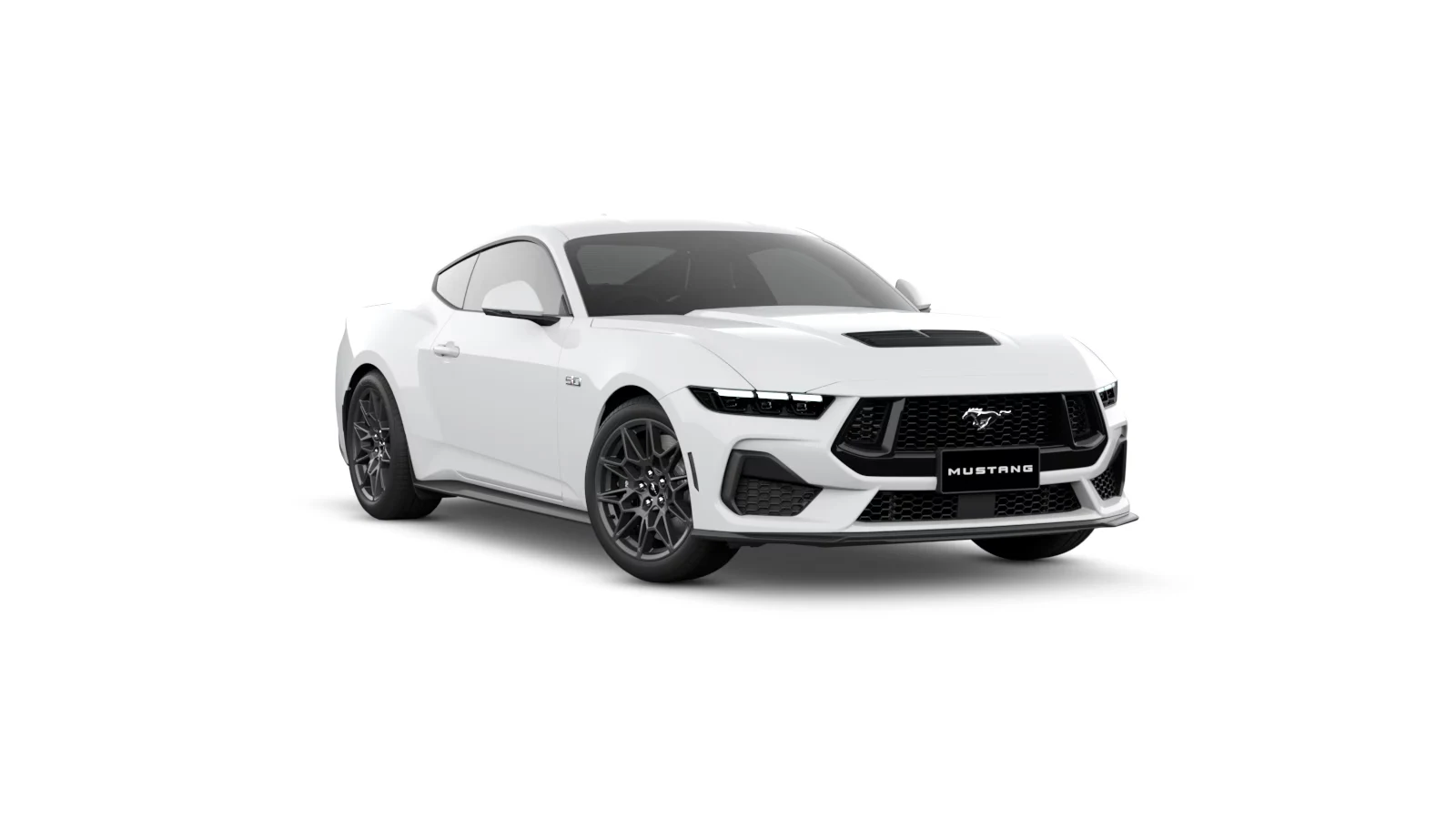
Nissan Z vs Ford Mustang GT
The GR Supra has been withdrawn from sale in Australia, so the Z's natural rival is now the V8 Mustang. $76,160 vs $87,990.
Data checked: specs 25 Jun 2026, price 4 Oct 2026
Comparison snapshot
Prices, scores and edges below update from our car data.
Lighter on fuel by 3.1 L/100km
Price when new $87,990 RRP
No longer sold new. Not a current offer or a used value.
167L more boot, 49kW more power
Written 7 June 2026. The snapshot, tables, scores and verdict on this page update from our car data; figures quoted in the text are as at that date.
Price
Before the numbers: the Toyota GR Supra is no longer sold new in Australia. The GT, GTS and Track Edition are all off the price list. If you want one you are shopping used. What follows compares the Z against the closest thing still on sale at similar money, the Ford Mustang GT Fastback.
The Nissan Z opens at $76,160 before on-road costs for either the 6-speed manual or 9-speed automatic, with the hardcore Z Nismo at $94,065. The Ford Mustang GT Fastback is $87,990 with the 10-speed automatic or $84,990 with the manual, and the range starts lower with the four-cylinder EcoBoost Fastback at $72,990.
| Variant | Engine | RRP |
|---|---|---|
| Ford Mustang EcoBoost Fastback | 2.3L turbo four | $72,990 |
| Nissan Z Coupe (manual or auto) | 3.0L twin-turbo V6 | $76,160 |
| Ford Mustang GT Fastback Manual | 5.0L V8 | $84,990 |
| Ford Mustang GT Fastback Auto | 5.0L V8 | $87,990 |
| Nissan Z Nismo | 3.0L twin-turbo V6 | $94,065 |
| Ford Mustang Dark Horse Manual | 5.0L V8 | $102,990 |
Like for like on automatics, the Z undercuts the Mustang GT by $11,830. If you want a manual the gap narrows to $8,830. And if the Mustang badge is what you are after but the V8 is not essential, the EcoBoost Fastback at $72,990 actually undercuts the Z by $3,170, though it gives up 66kW and 1.3 seconds to 100km/h.
Running costs favour the Nissan for once. The Z automatic uses 9.8L/100km (10.8L for the manual) against 12.8L for the Mustang GT auto. At 12,000km a year and $2.20 a litre for premium that is roughly $792 a year in the Z's favour. Both take premium unleaded.
Resale is the Mustang's quiet advantage. V8 Mustangs have held values strongly in Australia, helped by scarcity as the segment shrinks, while the Z is more of a value play up front than a resale star.
Safety
Neither car has an ANCAP rating on record, which is normal for low-volume sports coupes that are not submitted for testing. That does not mean they are unsafe, but it does mean there is no independent star score to lean on for either.
The Nissan Z comes with Nissan's Safety Shield suite: autonomous emergency braking with pedestrian detection, blind-spot warning, rear cross-traffic alert, intelligent (adaptive) cruise control, lane-departure warning and a reversing camera with rear sensors.
The Mustang includes Ford Co-Pilot360 with AEB, adaptive cruise, lane-keeping, blind-spot monitoring, rear cross-traffic alert and a reversing camera. The two are closely matched on active-safety equipment; both have the essentials covered for a modern performance car.
One practical difference: the Nissan Z is a strict two-seater with no rear seats or ISOFIX points. The Mustang is a 2+2 with a rear bench, which is tight for adults but useful for kids or extra luggage. If you occasionally need to carry more than one passenger, that decides it.
Features
The Nissan Z leans into retro charm. Standard kit includes a 12.3-inch fully digital driver display, an 8-inch central touchscreen with wireless Apple CarPlay and Android Auto, an 8-speaker Bose sound system, heated front seats, a frameless digital rear-view mirror and Z-specific analogue-style turbo gauges atop the dash that nod to Zs of the past.
The Mustang GT runs Ford's big 13.2-inch SYNC 4 touchscreen alongside a 12.4-inch configurable digital cluster, with wireless Apple CarPlay and Android Auto, a B&O audio system, heated and cooled front seats and selectable drive modes including an electronic drift brake on some builds.
Tech-wise the Mustang has the bigger screens and the more configurable interface, while the Z leans on retro detailing and its analogue-style turbo gauges. Both offer wireless smartphone mirroring as standard.
Drivetrain
This is the heart of the matchup. The Nissan Z uses a 3.0-litre twin-turbo V6 (the VR30DDTT, shared with Infiniti) making 298kW and 475Nm. It is muscular, free-revving and sounds purposeful, with strong, linear thrust and the theatre of two turbos spooling. Drive goes to the rear wheels via a 6-speed manual or 9-speed automatic, both with a mechanical limited-slip differential and launch control.
The Mustang GT runs a naturally aspirated 5.0-litre Coyote V8 producing 347kW and 550Nm, with a 6-speed manual or a 10-speed automatic. It is the bigger, louder engine, with 49kW and 75Nm on the Nissan and a character no turbocharged six can imitate.
On the claimed numbers, though, the smaller car wins the sprint. The Z automatic is quoted at 4.3 seconds to 100km/h against 4.9 for the Mustang GT auto (5.3 for the manual). Turbocharging and a lower kerb weight do the work there. The Mustang's advantage is on the long straight and in the noise.
Fuel use favours the Nissan clearly: 9.8L/100km for the Z automatic against 12.8 for the Mustang GT auto, and 10.8 against 13.6 if you compare the manuals. That is a 3L/100km gap either way, which is real money if you cover distance.
Space and comfort
This is the Mustang's strongest section. It holds 408 litres of boot against the Z's 241, and it has rear seats where the Z has none. For a car in this class that combination is genuinely useful: a weekend away for two with luggage, or a school run at a pinch.
The Z is the smaller, tighter, more single-minded cabin. Two seats, a driver-canted dash and 241 litres behind them, which is enough for a couple of soft bags and not much else.
Front-seat space and comfort are good in both for average-height adults. The Z's more upright glasshouse makes it marginally easier to see out of; the Mustang is the physically larger car in every direction, which matters in a city car park.
Cost to own
Both come with a 5-year/unlimited-kilometre warranty. Nissan will extend its cover year-by-year up to 10 years/300,000km if you service on schedule at a Nissan dealer, which is a genuine ownership perk.
Fuel favours the Nissan by roughly 3L/100km, worth about $792 a year at 12,000km and $2.20 a litre for premium. Servicing is broadly comparable, and both brands run capped-price programs with wide dealer networks.
The Z is cheaper to buy, quicker on the claimed figures and cheaper to fuel. The Mustang is likely to hold its value better, particularly the V8, which is increasingly scarce in this market. Over five years the Mustang's stronger resale narrows the Z's $11,830 head start but does not erase it once you add the fuel difference.
The Supra has left the building
This comparison used to be Nissan Z against Toyota GR Supra, and it was one of the better matchups in the segment. That car is gone: Toyota has withdrawn the GR Supra from sale in Australia and every variant is now a used-market proposition. If you are cross-shopping a used one, the old numbers still describe it accurately, but you cannot order a new one.
That leaves the Nissan Z with a different sort of rival. As the market pivots to turbo-four hot hatches and electric performance cars, the Z and the Ford Mustang are two of the very last affordable, rear-drive, multi-cylinder sports coupes you can buy new here. Both chase the same buyer: someone who wants a proper driver's car with a manual option and genuine character, without stepping up to six-figure German metal.
Who should buy which?
Buy the Nissan Z if: you want value and pace. It is $11,830 cheaper than the Mustang GT automatic, it is quicker to 100km/h on the claimed figures, and it uses 3L/100km less fuel. The twin-turbo V6 and retro styling give it a personality of its own. It is the cheaper pick and the quicker one.
Buy the Ford Mustang GT if: you want the 5.0-litre V8, the extra 49kW and 75Nm, 167 litres more boot, rear seats, and the stronger resale that comes with an increasingly rare naturally aspirated eight. If you need to carry more than one passenger, the Z is not an option at all.
Consider the Mustang EcoBoost Fastback if: you want the Mustang shape for less. At $72,990 it undercuts the Z by $3,170, though at 232kW and a claimed 5.6 seconds it gives up a lot to both cars here.
Compare both side by side on CarSorted, or see how the Z stacks up against the rest of the affordable performance set in our comparisons hub. Also worth a look: the full Nissan Z specs and Ford Mustang specs.
Key details
A tick marks the better figure only where both cars have one and the gap is meaningful (3% or more; a whole star or year).
| Detail | Nissan Z | Ford Mustang |
|---|---|---|
| Price | From $76,800 RRP | Price when new $87,990 RRP |
| Drive-away estimate | Calculating... | Not sold new |
| Body | Coupe | Fastback |
| Powertrain | Petrol, 3L 6-cyl | Petrol, 5L 8-cyl |
| Power / torque | 298kW / 475Nm | 347kW / 550Nm |
| Fuel use | 9.8 L/100km | 12.9 L/100km |
| 0-100km/h | 4.3s | 4.9s |
| Boot | 241L seats up | 408L seats up |
| Towing (braked) | No data | No data |
| ANCAP | No data | No data |
| Warranty | 5yr / unlimited km | 5yr |
At a glance
- Seats
- 2
- Boot
- 241L seats up
- Length x width x height
- 4,380 x 1,845 x 1,315mm
- Wheelbase
- 2,550mm
- Engine
- 3L 6-cyl
- Power
- 298kW
- Torque
- 475Nm
- Drive
- RWD
- Transmission
- 9-speed automatic
- Power-to-weight
- 182 kW/tonne
- Kerb weight
- 1,633kg
- Spare wheel
- No data
- Payload
- No data
- Towing braked / unbraked
- No data
- Turning circle
- 11m
- Seats
- 4
- Boot
- 408L seats up
- Length x width x height
- 4,811 x 2,097 x 1,414mm
- Wheelbase
- 2,719mm
- Engine
- 5L 8-cyl
- Power
- 347kW
- Torque
- 550Nm
- Drive
- RWD
- Transmission
- 10-Speed Automatic
- Power-to-weight
- 188 kW/tonne
- Kerb weight
- 1,841kg
- Spare wheel
- No data
- Payload
- No data
- Towing braked / unbraked
- No data
- Turning circle
- 11.5m
CarSorted Score breakdown
The CarSorted Score is algorithmic: it is calculated from each car's data, not from a road test. How it works.
Safety
Fuel Economy
Value
Practicality
Technology
Performance
Reliability
The verdict
Nissan Z comes out ahead on the CarSorted Score (61 vs 57)
The deciding gaps
- Fuel Economy:Nissan Z 47, Ford Mustang 19, Nissan Z ahead by 28
- Performance:Nissan Z 78, Ford Mustang 93, Ford Mustang ahead by 15
- Practicality:Nissan Z 36, Ford Mustang 47, Ford Mustang ahead by 11
Same scorer as the live comparison of these two exact cars.
Our take (written 7 June 2026)
Housekeeping first: the Toyota GR Supra this comparison used to feature has been discontinued in Australia. Every variant is off sale, so it is a used buy now. The Nissan Z's closest current rival at this money is the Ford Mustang GT Fastback, and the shape of the argument survives the swap. The Z is $11,830 cheaper at $76,160 against $87,990, it is the quicker car on the claimed 0-100 at 4.3 seconds to 4.9, and it uses 3.0L/100km less fuel at 9.8 against 12.8. The Mustang answers with 49kW and 75Nm more from its 5.0-litre V8, 167 litres more boot at 408L to 241L, and rear seats the two-seat Z does not have. Neither has an ANCAP rating on record, which is normal for low-volume coupes. For value, pace and running costs the Z is the pick. Buy the Mustang for the V8, the practicality and the badge.
Prices on this page move. Want the next verdict?
One short email when prices shift or a new comparison lands. No spam, unsubscribe anytime.
Questions buyers ask
Is the Toyota GR Supra still on sale in Australia?
The Nissan Z is on sale new in Australia, and the Ford Mustang is no longer sold new in Australia.
Is the Nissan Z faster than the Ford Mustang GT?
Peak power: the Ford Mustang at 347kW, against 298kW for the Nissan Z. The Nissan Z is quicker to 100km/h (4.3s vs 4.9s).
Which is cheaper, the Nissan Z or Mustang GT?
The Nissan Z Coupe Automatic is from $76,800 RRP; the Ford Mustang GT Fastback Auto is listed at $87,990 RRP when new (no longer sold new). The two prices are not on the same basis, so we do not set one against the other.
Do the Nissan Z and Mustang GT come with a manual?
Yes, both offer a 6-speed manual. The Nissan Z also offers a 9-speed automatic and the Mustang GT a 10-speed automatic, both with paddle shifters.
Which is more practical?
The Ford Mustang, comfortably. It has 408 litres of boot against the Z's 241, and it is a 2+2 with rear seats where the Z is a strict two-seater.
Which is better value, the Nissan Z or Mustang GT?
The Nissan Z Coupe Automatic is from $76,800 RRP; the Ford Mustang GT Fastback Auto is listed at $87,990 RRP when new (no longer sold new). The two prices are not on the same basis, so we do not set one against the other.
Which is cheaper to run, the Nissan Z or the Ford Mustang?
On the official combined cycle, the Nissan Z uses 9.8 L/100km and the Ford Mustang uses 12.9 L/100km.
What are the ANCAP ratings for the Nissan Z and Ford Mustang?
We have no ANCAP rating on record for the Nissan Z, and we have no ANCAP rating on record for the Ford Mustang.
Which has the bigger boot?
Boot space with the seats up: the Ford Mustang at 408L, against 241L for the Nissan Z.
Which has the better warranty?
The Nissan Z comes with a 5yr / unlimited km warranty; the Ford Mustang with a 5yr warranty.
Which comes out ahead overall?
On the CarSorted Score the Nissan Z comes out ahead (Nissan Z 61/100, Ford Mustang 57/100), mainly on fuel economy. The score is algorithmic; the editorial above says who each car suits.
Related
In the news
- 2026 Nissan Z Priced for Australia: First Manual NISMO Joins the Range, GT-R Brakes, Orders Open
- Mahindra Scorpio Z8+ Now $39,990 Drive-Away: $4,000 Off 2025-Built Stock Until 31 December
- 2026 Mazda MX-5 Update: Lane-Keep Assist, Recaro Seats for the GT RS, Zinc Green Paint and New Prices From $44,590
- Ford Mustang Recall Australia: 7,724 Cars Called Back on REC-006723 Over an Engine Bay Wiring Harness Ground
How to read this page. Prices, specs, ANCAP ratings, warranty, scores and the computed verdict come from our records for the two variants shown, sourced from manufacturer Australian documents, and update when those records change. RRP excludes on-road costs. Drive-away figures are estimates for the state you have selected unless marked as advertised. The editorial text was written on 7 June 2026. Always confirm price and specification with the manufacturer or dealer before you buy. CarSorted does not accept payment for recommendations.
Comments (0)
Sign in to join the conversation
No comments yet. Be the first!