Key Takeaways
- GR Sport Performance Hybrid $156,060, Sahara ZX Performance Hybrid $156,810 (before on-roads)
- $8,900 above the equivalent 3.3-litre V6 diesel grades
- i-FORCE MAX: 3.5-litre twin-turbo V6 petrol, single electric motor, 10-speed auto, 1.8kWh NiMH battery
- Combined 341kW / 790Nm: the most powerful LandCruiser Toyota has ever sold in Australia
- 3,500kg braked tow retained, five seats only, GR Sport keeps three locking diffs
- ANCAP: existing five-star rating on the LC300 (2022 protocol) carries across
- On sale mid-2026, five-year unlimited-km warranty, $450 capped-price servicing to 100,000km
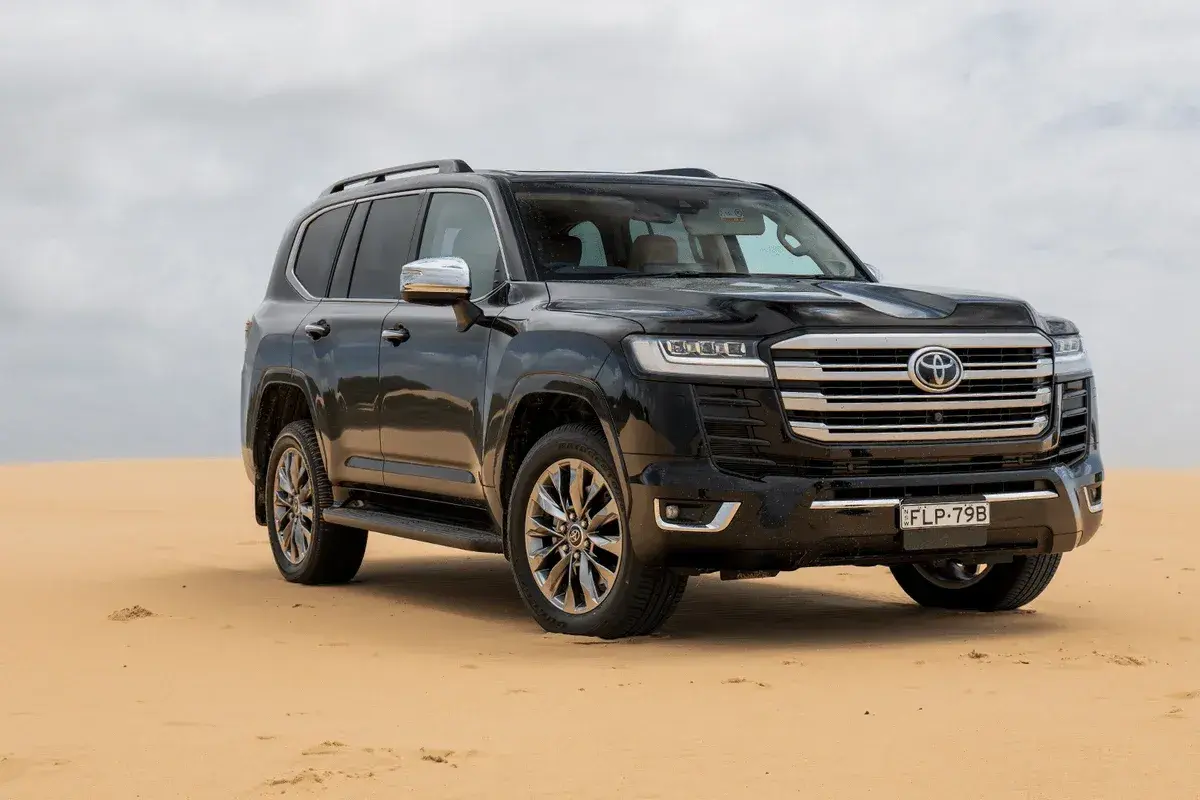
Image credit: Toyota Australia
Toyota Australia has locked in local pricing on the first-ever petrol-electric LandCruiser 300 Series, and the headline for anyone shopping big off-road SUVs this year is not the sticker, it is the shape of the deal. Two grades only, both over $156,000 before on-roads, both keeping the full 3,500kg braked-tow rating, both sacrificing the seventh row for the sake of a hybrid battery under the boot floor. If you have been sitting on a deposit and waiting to see whether Toyota was serious about a petrol-electric 300, this is the week the answer went firm.
Deliveries land in Australia during mid-2026, which means first customer cars are showing up at dealers now. Everything below is drawn from Toyota Australia's confirmed pricing, the LandCruiser 300 spec table on toyota.com.au and the official Toyota Australia press release announcing the flagship Performance Hybrid variants. We have used our own CarSorted directory to run the cross-shop against Nissan Patrol, Lexus LX and the incoming GWM Tank 700 V8.
Pricing
| Variant | Powertrain | MLP before on-roads | Walk over diesel |
|---|---|---|---|
| LandCruiser 300 GR Sport | 3.3L V6 turbo-diesel | $147,160 | baseline |
| LandCruiser 300 GR Sport Performance Hybrid | 3.5L twin-turbo V6 petrol + e-motor | $156,060 | +$8,900 |
| LandCruiser 300 Sahara ZX | 3.3L V6 turbo-diesel | $147,910 | baseline |
| LandCruiser 300 Sahara ZX Performance Hybrid | 3.5L twin-turbo V6 petrol + e-motor | $156,810 | +$8,900 |
Current price on CarSorted: Toyota LandCruiser 300 GX $97,990 RRP, as at 6 Sep 2026; Lexus LX LX600 Luxury $167,700 RRP, as at 25 Jun 2026.
A note on the on-road number. Because Toyota's combined-cycle claim on the i-FORCE MAX lands north of the 3.5 L/100km fuel-efficient trigger, neither hybrid qualifies for the higher $91,661 threshold, so both are judged against the $80,809 one that applies to other vehicles. At $156,060 and $156,810 they clear it by a long way and buyers cop full LCT on the value over it. Ballpark, expect $18,000 to $25,000 of LCT on top of the sticker depending on how heavily you option the car, before stamp duty and rego. Real Melbourne driveaway lands around $180,000 to $185,000. Sydney is close. Brisbane and Perth run marginally under Sydney thanks to lower stamp duty.
Diesel GR Sport and Sahara ZX pricing does not change with the hybrid launch. The petrol i-FORCE MAX sits alongside the diesel, not in place of it, and buyers can order either engine in either grade. Toyota Australia will build to order across both powertrains through the second half of 2026, though the hybrid queue is running longer than the diesel queue in most metro dealer catchments as of this week.
What the i-FORCE MAX actually is
The petrol side of the powertrain is Toyota's V35A-FTS, a 3.5-litre twin-turbo V6 with 60-degree bank angle, 24 valves, dual VVT-i, chain-driven cams and an 86.0 x 96.0mm bore and stroke. Actual displacement is 3,445cc, which is why some sources round it down to 3.4-litre and Toyota Australia rounds it up to 3.5. Peak petrol-engine outputs are 305kW at 5,200rpm and 650Nm from 2,000 to 3,600rpm. Redline sits high enough that the engine does not feel breathless past 5,500rpm, which is unusual for a big turbo V6 in an SUV body.
Electric assist comes from a single motor-generator sandwiched between the crankshaft and the 10-speed automatic torque converter. That layout is a parallel hybrid, not a series hybrid: the engine still drives the wheels through the gearbox on its own, and the motor either helps or takes over when it makes sense to. Total combined system output is 341kW and 790Nm, and Toyota has published those numbers as SAE-certified peaks rather than best-of-three-conditions marketing claims.
The battery is a 1.8kWh nickel-metal-hydride pack under the rear cargo area. Not a lithium-ion pack, and deliberately not one big enough to give real EV range. i-FORCE MAX is a torque-and-response system, not a fuel-economy system. It exists so the LC300 can pull harder off idle, respond faster to throttle inputs at highway speed and put a taller passing gear over a low-range grunt gear on the diesel. On the road, the payoff is a claimed 6.9 to 7.2 second 0 to 100km/h sprint depending on grade, compared to about 9.0 seconds for the diesel.
Fuel-economy figures on the combined ADR test cycle land around 8.9 to 9.4 L/100km. That is a marginal number against the diesel's 8.9 L/100km, so the maths does not work as a fuel-saver play. It works as a performance play. If you were going to buy a diesel GR Sport at $147,160 and were happy with 227kW, the hybrid asks you for another $8,900 sticker plus a heavier LCT hit for 114kW more power and 90Nm more torque, at the cost of no seven-seat option and a marginally worse fuel bill. That is a real trade, not a slam dunk in either direction.
Specs
| Spec | GR Sport Performance Hybrid | Sahara ZX Performance Hybrid |
|---|---|---|
| Engine | 3.5L twin-turbo V6 petrol | 3.5L twin-turbo V6 petrol |
| Electric motor | Single, between engine and gearbox | Single, between engine and gearbox |
| Petrol outputs | 305kW / 650Nm | 305kW / 650Nm |
| Combined outputs | 341kW / 790Nm | 341kW / 790Nm |
| Transmission | 10-speed automatic | 10-speed automatic |
| Battery | 1.8kWh NiMH | 1.8kWh NiMH |
| Drive | Full-time 4WD, low range | Full-time 4WD, low range |
| Diff locks | Front, centre, rear (three) | Centre only |
| Suspension | Adaptive variable, five-mode MTS | Adaptive variable, five-mode MTS |
| Steering | Electric power assist | Electric power assist |
| Seats | Five | Five |
| Braked tow | 3,500kg | 3,500kg |
| Fuel use (combined) | Around 9.4 L/100km | Around 9.4 L/100km |
| 0 to 100km/h | Around 6.9 seconds | Around 7.2 seconds |
Wheelbase, body length, ground clearance and 700mm wading depth all carry over from the diesel LC300. Fuel-tank capacity is 110 litres across the range, which pairs to about 1,170km of theoretical touring range on the combined-cycle claim before you tick over into the reserve.
Equipment
GR Sport Performance Hybrid keeps the black-accent exterior, GR-embossed synthetic leather seats, red-stitched sport steering wheel, off-road-biased front bumper, matte-black over-fenders and 18-inch black alloys on all-terrain tyres. Roof rails, tow bar, alloy underbody protection and the Toyota Multi-Terrain Monitor with underbody transparent view are standard. Front and rear diff locks join the centre lock as GR Sport exclusives. Inside, the layout matches the diesel: 12.3-inch touchscreen, dual 7-inch driver displays either side of the head-up unit, JBL 14-speaker premium audio, wireless Apple CarPlay and Android Auto, wireless phone charging, four-zone climate, heated and ventilated leather-accent front seats.
Sahara ZX Performance Hybrid runs the comfort spec: quilted Nappa leather trim, 20-inch two-tone alloys on highway-terrain rubber, colour-matched exterior treatment, semi-aniline seat inserts, illuminated tread plates, Toyota Multi-Terrain Monitor, four-zone climate, JBL 14-speaker audio, panoramic view monitor, digital rear-view mirror, and the same 12.3-inch touchscreen and 7-inch driver displays. Adaptive variable suspension and Multi-Terrain Select are shared with GR Sport, but the front and rear diff locks are deleted and replaced by the electronic torque vectoring stack that already ships on the current diesel Sahara ZX.
Safety kit on both hybrid variants matches the wider MY26 300 Series update. That means Toyota Safety Sense 3.0 with intersection turn assist, cyclist detection in low light, front and rear cross-traffic assist, blind spot monitor, 360-degree camera, adaptive cruise with lane trace, driver monitor camera and 10 airbags including a centre airbag and a rear-seat torso airbag stack.
Safety and ANCAP
The LandCruiser 300 Series carries a five-star ANCAP result from its 2022 assessment under the 2020-2022 protocol, and that rating covers the MY26 update including both petrol Performance Hybrid variants. ANCAP has not scheduled a fresh crash test for the hybrid powertrain, which is standard practice when a new drivetrain drops into an already-rated body without body-structure changes. Adult occupant protection sat at 89 per cent, child occupant at 88 per cent, vulnerable road users at 81 per cent and safety assist at 80 per cent on the original test. Those pillar scores carry across.
How it compares on our data
Looking at the CarSorted directory, the big-SUV shortlist for a $150,000-plus buyer this quarter is genuinely narrow. The Nissan Patrol Warrior at $105,660 before on-roads gets close on off-road capability but leaves 91kW and 190Nm on the table against the i-FORCE MAX, and the current Y62 body still runs a naturally aspirated 5.6-litre V8 that pulls 14.4 L/100km on the claim. The all-new Y63 Patrol lands in Australia later in 2026 with a 3.5-litre twin-turbo V6 and prices tipped to open around $95,000, but volume through the second half of 2026 is thin.
The Lexus LX is the closest actual twin. Same TNGA-F platform, same body length, same 3.4-litre twin-turbo V6 in the LX600 at $148,800 and the same i-FORCE MAX in the LX700h at $199,800. Step up to seven seats on the LX700h and you are $43,000 north of a Sahara ZX Performance Hybrid, which is real money for what is fundamentally the same drivetrain plus a leather refit and a lighter dashboard tune. If you want the seventh row and the hybrid together, Lexus is currently the only way to get it.
The incoming GWM Tank 700 V8 PHEV is the price-and-power disruptor. GWM has not confirmed local RRP yet, but China-market sticker converts to roughly $120,000 to $130,000 driveaway on landed cost. A 4.0-litre V8 plus a plug-in hybrid stack, on paper, matches or beats the i-FORCE MAX on torque and adds proper EV-only range that Toyota has explicitly said the LC300 hybrid does not target. The catch is the Tank 700 is not yet in dealers and will not have a five-star ANCAP result at launch. Buyers with a caravan and a Q4 2026 deadline are stuck between a proven Toyota with an $8,900 hybrid premium and an unproven GWM at maybe $30,000 less driveaway.
Cross-shop the direct rivals on our platform: Toyota LandCruiser 300 vs Nissan Patrol | GWM Tank 500 vs LandCruiser 300 | Best Towing Vehicles in Australia.
The CarSorted angle: is the hybrid actually worth the walk?
Running the numbers on CarSorted, the $8,900 walk from a diesel GR Sport to the Performance Hybrid buys you 114kW more grunt and about a 2.1-second improvement in the 0 to 100km/h claim. Fuel economy on the combined ADR cycle is neck-and-neck at 9.4 L/100km petrol against 8.9 L/100km diesel, and 91 RON is off the table because the i-FORCE MAX asks for 95 RON minimum. At today's Australian pump price of about $2.20 a litre for 95 RON premium against $2.05 a litre for standard diesel, the hybrid burns roughly $2,320 a year in fuel over 15,000km, compared to about $2,050 for the diesel. So the running cost gap actually favours the diesel by $270 a year, before you touch AdBlue on the diesel.
That means the maths for the Performance Hybrid never wins on fuel. It wins on driveability. If you are the kind of buyer who is towing 2.8 to 3.5 tonnes up a Great Dividing Range grade, or who spends time in the sand at Fraser Island with 250 kilos of gear in the back and a boat on the tow bar, the extra 90Nm of torque is where the $8,900 walk earns its keep. If you are commuting from the suburbs into the CBD five days a week with a school run on the way, the diesel is the sensible pick and the hybrid stops making sense the moment you drive off the lot.
On the FBT novated-lease side, neither Performance Hybrid variant qualifies for the federal fuel-efficient exemption. The FBT-friendly LCT bracket sits at around $91,000 for fuel-efficient cars and neither hybrid variant fits under that cap. So the standard 20 per cent statutory FBT method applies, which lands business-owner buyers at roughly $30,000 of taxable value a year on a five-year lease. That is the same treatment as the diesel. This is not a novated-lease play, it is a garage-plated purchase play or a working-holding-company vehicle for buyers who value the segment leader badge.
Image credit: Toyota Australia
What this means for buyers
For a caravan or heavy-boat buyer looking at a 2026 GR Sport for $147,160, the Performance Hybrid is easily the more capable tow rig even though the braked-tow number is unchanged at 3,500kg. Torque under load matters more than peak power, and the extra 90Nm plus the electric motor's instant response takes the sag out of a heavy hitch on the merge lane onto the freeway. If you have already got a 6x4 tandem or a big van, add the $8,900 and don't look back.
For the classic Sahara ZX customer, the calculation is more nuanced. You still get the same interior, the same 20-inch wheels, the same JBL audio, so what you are actually buying with the hybrid is a different personality on the throttle and a small performance headline for the driveway conversation. If you daily-drive the car empty and only tow twice a year for a fishing weekend, the diesel Sahara ZX at $147,910 is the better use of $8,900. If you tow more than half a dozen weekends a year, the hybrid earns it.
For anyone cross-shopping the LandCruiser 300 Performance Hybrid against a Lexus LX700h at $199,800, the Toyota is the sensible pick. Same drivetrain, same platform, same off-road hardware, and the interior gap in 2026 is genuinely closer than the price gap suggests. Save the $43,000 and put it toward a rooftop tent, a decent second battery setup and a proper set of BFGoodrich all-terrains. The one exception is the seven-seat buyer who cannot live with five, in which case the LX700h is currently the only path to a hybrid third row in this bracket.
For a shopper watching the incoming Y63 Nissan Patrol, the LandCruiser 300 Performance Hybrid is the safer, faster, hotter version of what Nissan will eventually deliver. A Y63 in Warrior spec is expected to open around $110,000, and its 3.5-litre twin-turbo V6 makes 317kW against the Toyota's 341kW combined. If pricing is the deciding factor and you can wait until early 2027, the Patrol is worth watching. If you want the segment leader in the driveway now, the Toyota is available in mid-2026 and the queue is manageable.
For anyone weighing up the GWM Tank 700 V8 PHEV, our take is: wait for the local ANCAP result and the official Australian RRP before you factor it in. GWM has genuinely closed the gap on interior quality and drivetrain refinement, but a $30,000 saving disappears the moment you are the first person to work out the local parts supply, warranty response and residual value on a first-year V8 PHEV in a segment Toyota has owned for 60 years.
Compare more full-size 4WDs on CarSorted: Browse the CarSorted SUV directory | LandCruiser 300 vs Nissan Patrol compare page | Our best towing vehicles guide.
Warranty and servicing
Five-year unlimited-kilometre new-vehicle warranty applies as standard. When the LC300 Performance Hybrid is serviced inside the Toyota dealer network on the manufacturer schedule, the engine warranty extends to seven years or 175,000km and the hybrid traction battery is covered for 10 years or 200,000km, whichever comes first, matching the warranty structure Toyota applies to the RAV4 Hybrid and Camry Hybrid. Toyota Service Advantage capped-price servicing is $450 per visit for the first five services, priced at fixed intervals of 12 months or 15,000km. Total scheduled cost across the first 100,000km is $2,250, which is $200 to $400 a year higher than the diesel plan and is the trade for having a starter-generator, an inverter and a battery module to check on each visit.
When you can actually get one
Toyota Australia's official line is on sale in the middle of 2026, and dealer stock is filtering through metropolitan networks now with the first customer deliveries confirmed for July and August. Regional dealers in Queensland, WA and the NT are running behind Melbourne and Sydney by roughly six to eight weeks on hybrid allocation, which is normal for a debut Toyota drivetrain across a big country. The diesel LC300 is available in far quicker turnaround if you cannot wait: expect three to six weeks on GR Sport diesel against three to five months on GR Sport Performance Hybrid depending on catchment. Anyone chasing a specific colour (Merlot Red, Frosted White, Ebony) should get their deposit down early, because the launch allocations are painted before customer orders confirm and the popular colours are already thin at the dealer end.
Disclaimer: Pricing and specifications are drawn from Toyota Australia's official pricing announcement, the LandCruiser 300 spec table published at toyota.com.au and Toyota's public press release. Prices quoted are the manufacturer's list price before on-road costs unless otherwise stated. Driveaway estimates for LCT, stamp duty and registration are indicative only and vary by state, drive-away offers, options and dealer. Fuel economy figures are Toyota's claimed combined ADR 81/02 cycle results, not real-world observation. Cross-shop pricing on Nissan Patrol, Lexus LX and GWM Tank 700 is drawn from the CarSorted directory as of publish date and is subject to change. Always confirm current pricing, availability and warranty terms with a Toyota Australia dealer before signing. Read our methodology for how CarSorted sources and verifies new-vehicle data.