Image: Audi
Audi has pulled the covers off the third-generation Q7, and the headline for Australian buyers is simple: it is coming, it is still a diesel first, and the inside is where most of the work has gone. The new large SUV is locked in for an early-2027 local arrival, with pricing and full specs due late this year. Audi Australia has promised an orderly switch from the current car, so there is no rush to buy before it sells out.
What is actually new
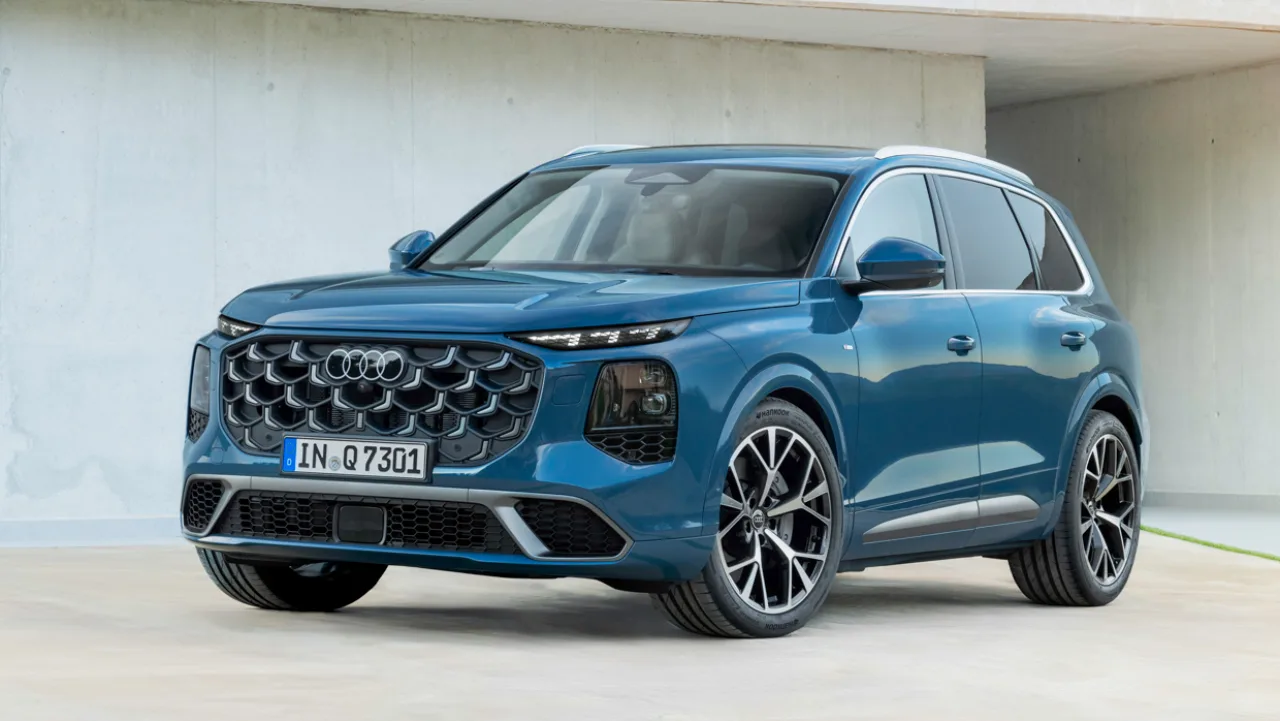
The exterior is an evolution rather than a reinvention. It picks up the boxier, more upright look Audi started with the Q6 e-tron and recent Q3, with a larger honeycomb grille (now with subtle LED downlighting at night), slim programmable daytime running lights, and muscled-up rear haunches. At 5,056mm long, 2,010mm wide and 1,800mm tall it stays close to today's Q7 in footprint.
Underneath, the bigger change: the Q7 moves off Audi's older MLB architecture onto a newer platform Audi calls Premium Platform Combustion. The practical upshot is a much-improved electrical system, which unlocks smarter driver-assistance tech, more efficient drivetrains and better packaging than the outgoing model.
Engines: diesel V6 first, plug-in coming
Australia launches on the 3.0-litre turbo-diesel V6 only, offered in two states of tune. The base produces 180kW and 500Nm; a stronger version (expected to anchor the mid-range S line) lifts that to 220kW and 630Nm. Audi provisionally quotes 7.1 to 7.8L/100km for the 180kW car, and both can tow a 3,500kg braked trailer.
Both diesels carry Audi's upgraded 48-volt MHEV Plus mild-hybrid system, which pairs a belt-alternator-starter, a powertrain generator and a compact lithium-iron-phosphate battery. It adds up to 18kW and 370Nm, runs an electric compressor to sharpen low-speed response, and lets the Q7 pull away from rest, park and coast briefly with the diesel switched off. It is not a hybrid you plug in, but it shaves fuel use and emissions in stop-start driving.
The more interesting news for local buyers is what follows. A 3.0-litre V6 petrol plug-in hybrid is confirmed globally and is a priority for Audi Australia, largely because its lower CO2 helps the brand under Australia's New Vehicle Efficiency Standard. Electric range hasn't been confirmed. A smaller four-cylinder is also slated for later in the model's life. And the V8 lives on, in a new SQ7 expected to keep the 4.0-litre twin-turbo, now with mild-hybrid help to cut CO2 by five to 10 per cent. In other words, the mild-hybrid and plug-in versions are doing the emissions heavy-lifting that lets Audi justify keeping a thirsty V8 at all.
The cabin is the real upgrade
If the outside is familiar, the inside is all-new and follows the same design language as the latest Q5 and A5. A 12.3-inch driver display and a 14.5-inch infotainment touchscreen sit under one curved panel, with an optional (and, frankly, slightly redundant) third screen ahead of the passenger. Wireless Apple CarPlay and Android Auto are along for the ride.
The bigger story is materials. Audi has dialled back the glossy black plastic it leaned on for years and brought in open-pore wood, soft fabric that wraps into the doors (hiding a 22-speaker Bang & Olufsen system), and stitched leather across the dash, door tops, steering-wheel boss and even the knee pads. New electrically adjustable front seats add heating, ventilation and massage, there are head-restraint speakers for private calls and navigation prompts, and an optional 4D sound system puts actuators in the seat bases so you can feel the music. A wide console carries two cupholders and two magnetic wireless charging pads that grip your phone even mid-drive.
Seats, space and ride
The Q7 comes as a five-, six- or seven-seater. The six-seat layout swaps the middle-row bench for two captain's chairs, which will appeal to chauffeur and airport-fleet operators as much as families. Boot space runs from 805 litres in the five-seater (2,075L folded) down to 722L in the seven-seater's five-seat mode (1,980L folded). Every rear seat gets ISOFIX anchors.
Three suspension setups are offered: passive steel springs (retuned for a comfier ride than before), adaptive air suspension with electronically controlled damping, and a sportier air-suspension option that drops ride height 30mm. The air setup self-levels regardless of load, can read geodata to soften itself before a known railway crossing, and lowers the car by up to 62mm to make getting in or loading the boot easier.
Lighting tech worth a mention
Audi is leaning hard on lighting. Optional digital Matrix LED headlights use 25,600 micro-LEDs and can mark out pedestrians on the road at night. Optional OLED tail-lights switch between patterns and flash static warning symbols when a car or pedestrian gets too close to the rear. There is even a turn signal that projects amber arrows onto the ground to make your intentions obvious to cyclists and pedestrians. Up to 23-inch wheels are available from the factory for the first time, over 400mm front brake discs with six-piston calipers.
What it means for Australian buyers
Two takeaways. First, Audi is making a deliberate bet that there is still strong demand for a torquey diesel seven-seater in the luxury space, even as the market races toward electric, and it is propping that bet up with mild-hybrid (and soon plug-in) tech to survive NVES. If you tow, do big country kilometres, or just prefer diesel range and effortless mid-range pull, the new Q7 is built for you.
Second, this is a wait-and-watch car for now. It is roughly nine to 12 months from local showrooms, pricing lands late this year, and the plug-in (the version that makes the most sense for novated-lease and FBT buyers chasing lower running costs) comes after the diesels. If you are cross-shopping today, the current Audi Q7, BMW X5 and Mercedes-Benz GLE are all on sale now, and our best luxury SUVs guide ranks the segment on real ownership cost. We will update this page the moment Audi confirms Australian pricing and specs.