Audi Q4 e-tron Review Australia (2026): SUV vs Sportback, Every Variant
Written by Uzzi · 2 May 2026
The Verdict
The 2026 Audi Q4 e-tron is the most polished mid-size luxury electric SUV under $110k. A genuine 470km WLTP range, 175kW DC fast charging, both rear-wheel drive and quattro all-wheel drive options, and a choice of upright SUV or sleeker Sportback bodies. Audi has refined the formula since the Q4 launched in 2021. The MY26 facelift sharpens the design, brings new digital cockpit graphics, and keeps the pricing where it has always been competitive against the Mercedes EQA and BMW iX1. The 45 e-tron Sportback is the smart-money pick on range. The 55 quattro Sportback is the smart-money pick if you want the AWD plus best value. Catches: the 1,000-1,200kg towing limit rules out caravan duty, the digital cockpit feels a generation behind the new Q6 e-tron, and the Volvo EX40 undercuts it on both price and warranty length. For most luxury EV buyers, though, the Q4 still hits the sweet spot.
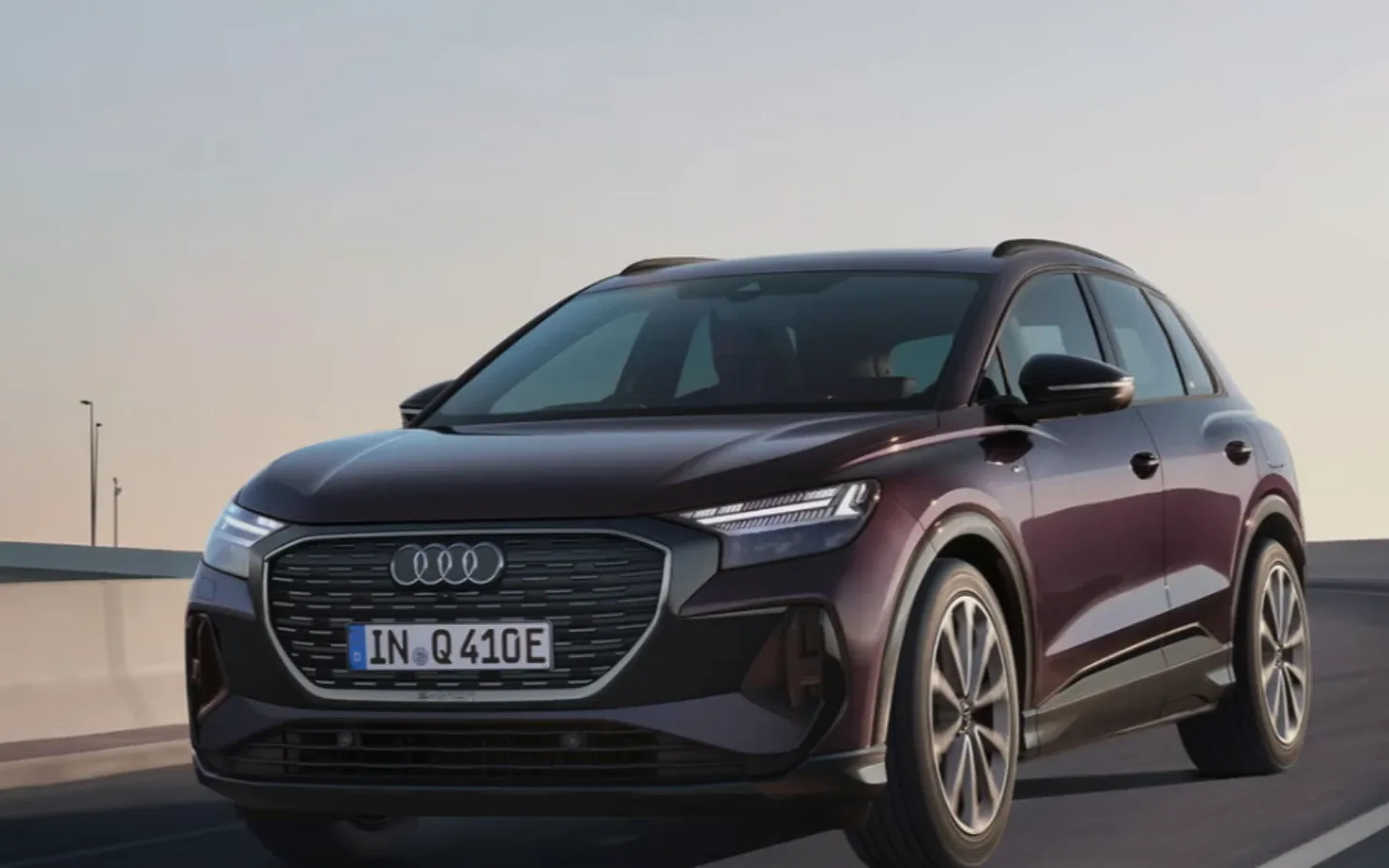
Image credit: Audi Australia
The Audi Q4 e-tron sits in the sweet spot of the luxury EV market. It is bigger and more practical than the Volvo EX30 and Mercedes EQA, smaller and significantly cheaper than the Audi Q6 e-tron and Mercedes EQE SUV. Built on the Volkswagen Group's MEB platform alongside the VW ID.4, Skoda Enyaq and Cupra Tavascan, the Q4 has spent four years quietly becoming one of the better-resolved compact luxury EVs you can buy in Australia.
The MY26 update sharpens the design, brings revised front and rear lighting, and gives Audi Australia an opportunity to keep the lineup priced sharply against an increasingly aggressive Chinese EV market. There are now four distinct variants: the entry rear-wheel-drive 45 e-tron, its Sportback-bodied sibling, the dual-motor 55 e-tron quattro, and the Sportback version of that. We have walked through each one to help you work out which is the right Q4 for you.
Pricing and the Lineup
Audi Australia keeps the Q4 e-tron lineup simple. Two power outputs, two body styles, four variants total. Pricing below is the recommended list price (RRP, before on-road costs).
| Variant | Drive | Power | Range | RRP |
|---|---|---|---|---|
| 45 e-tron SUV | RWD | 210kW | 470km | $84,900 |
| 45 e-tron Sportback | RWD | 210kW | 488km | $86,500 |
| 55 e-tron quattro Sportback | AWD | 250kW | 469km | $107,500 |
| 55 e-tron quattro SUV | AWD | 250kW | 459km | $105,900 |
A couple of useful observations from this table. First, the Sportback bodies cost more than their SUV counterparts, by a consistent $1,600. The 55 Sportback quattro at $107,500 sits above the 55 SUV quattro at $105,900. That is a consistent body-style premium rather than a quirk, and it makes the 55 Sportback the value pick of the range if you want all-wheel drive.
Second, going from the 45 RWD to the 55 quattro adds exactly $21,000 of RRP in either body and unlocks all-wheel drive plus 40kW more peak power. That premium also costs you a bit of range, since the dual-motor setup is less efficient than the single-motor RWD. Whether the AWD is worth it depends on where you live and what you tow (more on that below).
Standard kit on every Q4 includes Matrix LED headlights, dual-zone climate, the 11.6-inch MMI touchscreen, an 11.6-inch digital cockpit, wireless Apple CarPlay and Android Auto, panoramic glass roof on most trims, full ANCAP 5-star safety, and Audi's 5-year unlimited-kilometre warranty plus an 8-year/160,000km warranty on the high-voltage battery. Capped-price servicing intervals are 24 months or 30,000km, which is generous for an EV.
Powertrains: 45 RWD vs 55 quattro
Q4 Sportback e-tron shown. Image credit: Audi Australia
The Q4 e-tron uses an 82kWh useable battery (84.8kWh gross) on every variant in the Australian lineup. That capacity is fixed across the range, so the difference between the 45 and 55 trims comes down to motor count and tuning rather than battery size.
45 e-tron (210kW, rear-wheel drive)
The entry Q4 uses a single permanent-magnet synchronous motor on the rear axle producing 210kW and 545Nm. 0-100km/h takes 6.7 seconds, top speed is electronically limited to 180km/h. WLTP range is 470km on the SUV and 488km on the Sportback. Energy consumption is the lowest in the range at around 16.8-17.4 kWh/100km, which translates to roughly 380-420km of real-world range in mixed driving.
Driving a rear-wheel-drive electric SUV is a quietly delightful experience. Power goes to the rear, the front wheels are free to steer cleanly without torque steer, and the weight distribution feels balanced. For most Australian buyers in coastal cities, the 45 e-tron is plenty. It is only when you regularly drive in wet conditions, snow, gravel, or with a trailer that the lack of front-wheel drive starts to matter.
55 e-tron quattro (250kW, all-wheel drive)
The 55 adds a second motor to the front axle, bringing combined peak output to 250kW and 545Nm. The torque figure does not change much because the rear motor is doing most of the work most of the time. The front motor only joins in under acceleration or when traction at the rear runs short. 0-100km/h drops to 5.4 seconds, kerb weight rises to 2,298kg (versus 2,190kg for the 45 RWD), and WLTP range slips to 459km on the SUV or 469km on the Sportback.
That is a meaningful range trade-off, and it is the cost of the AWD safety blanket. If you are choosing on range alone, the 45 Sportback is the pick. If you want the extra punch and all-weather grip, the 55 quattro Sportback is the same package for $1,600 less than the 55 quattro SUV.
SUV vs Sportback: Body Choice
Q4 e-tron SUV body shown. Image credit: Audi Australia
Audi sells the Q4 e-tron in two body styles, and the choice is mostly about visual preference because the practical differences are small.
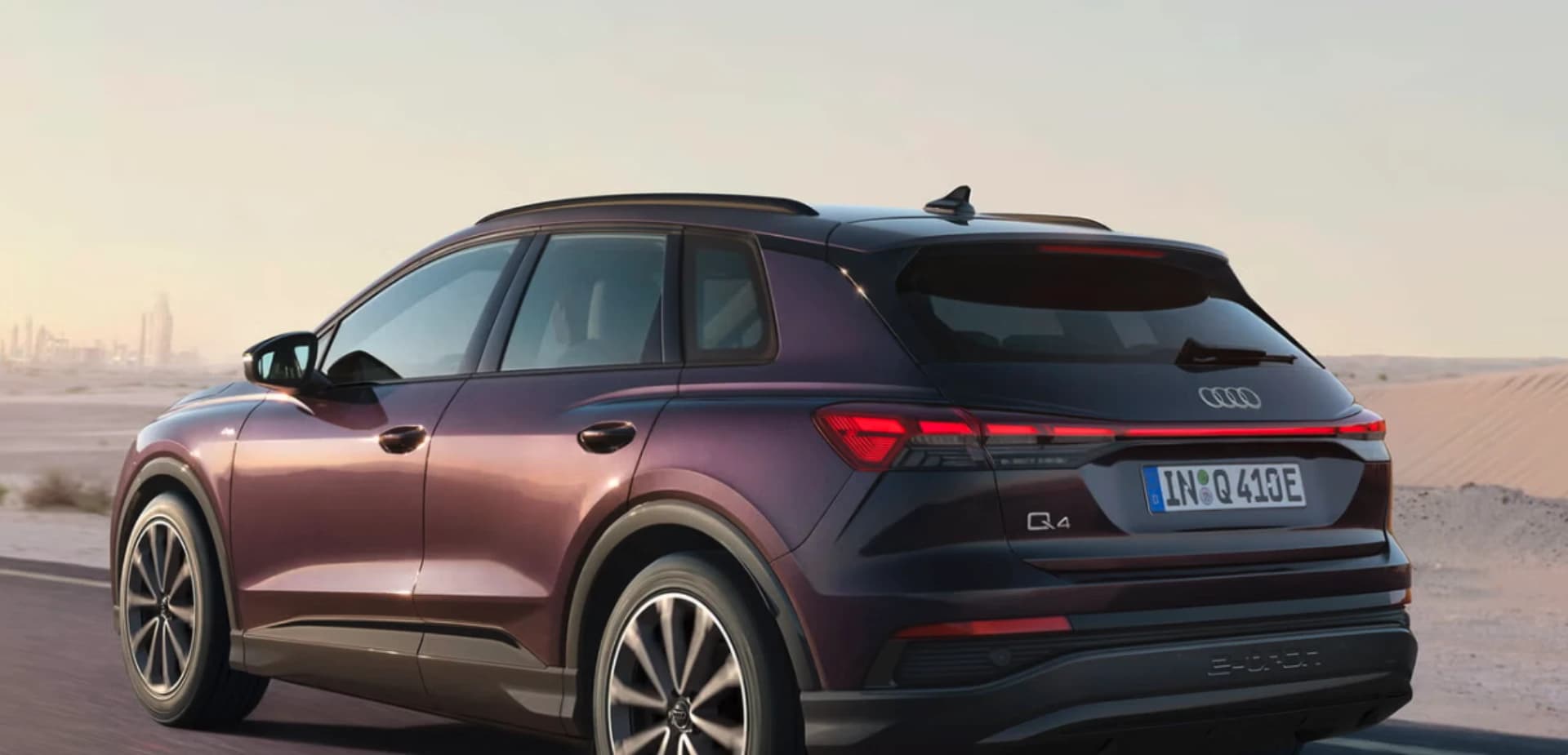
The standard Q4 e-tron SUV is the upright body. It stands 1,632mm tall, has a more traditional SUV silhouette, and gives passengers in row two a touch more headroom. It looks like an Audi crossover, not unlike a smaller Q5 or Q6, with a strong shoulder line and a cleanly resolved rear end. Boot space is 520 litres with the rear seats up.
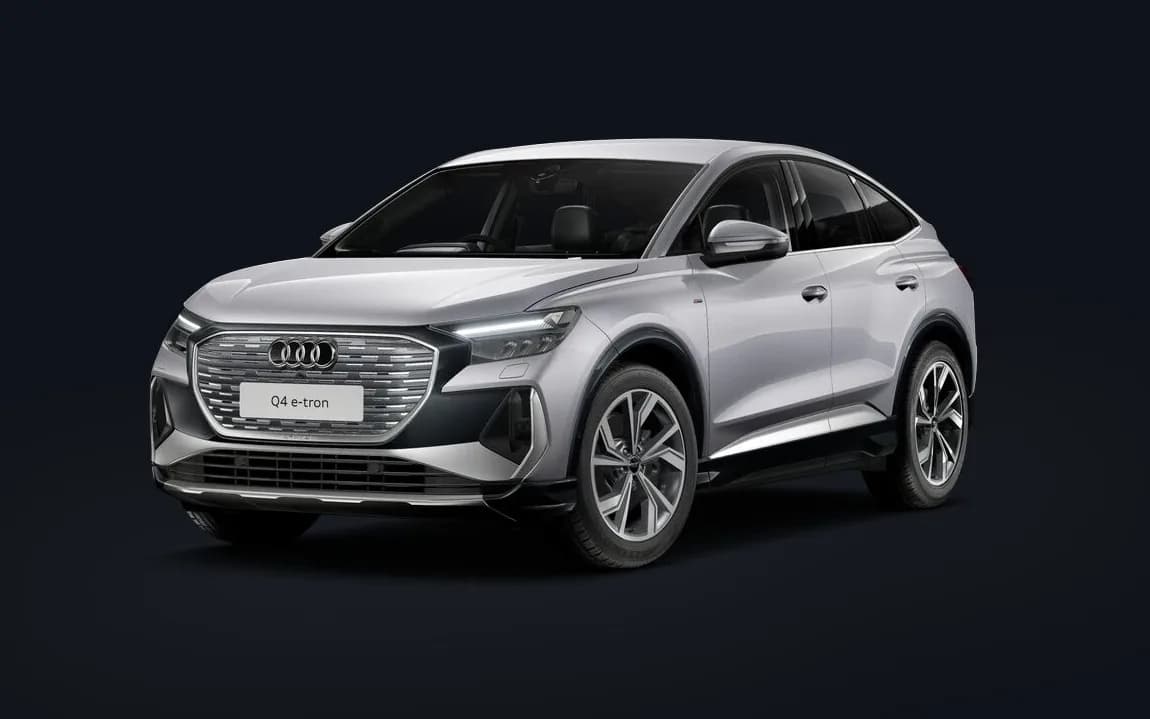
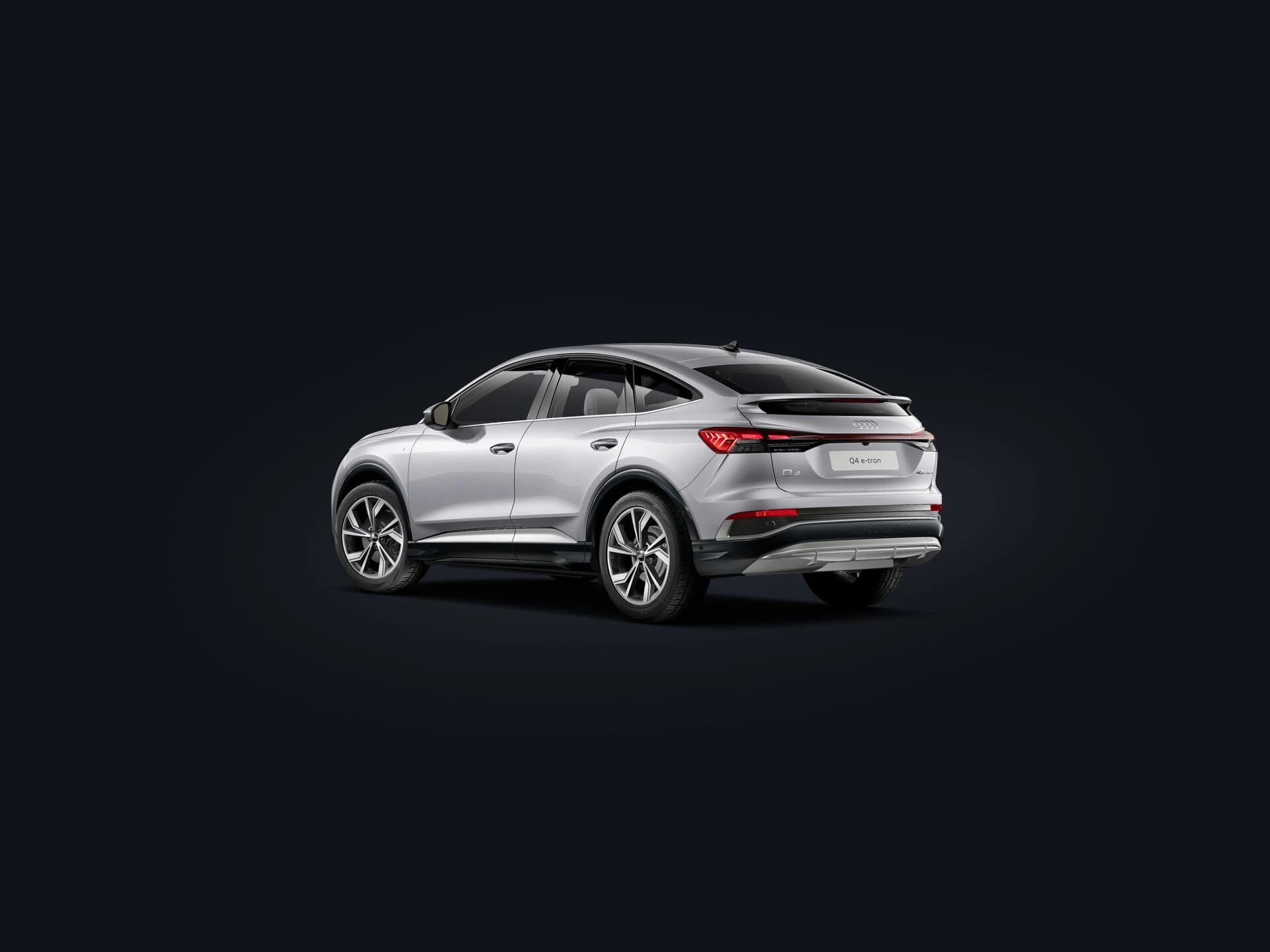
The Q4 Sportback e-tron drops the roofline by 18mm to 1,614mm and adds a coupe-style rake from the B-pillar back. It looks lower, more athletic, and a bit more expensive-looking on the road. The shaped tailgate gives the Sportback marginally better aerodynamics, which translates to 18-19km of additional WLTP range. Counterintuitively, the Sportback also has 15 litres more boot space (535L vs 520L) because the cargo area shape is more usable despite the sloping rear glass.
Headroom is where the Sportback gives a little back. Tall passengers (over 185cm) will feel the roof closer in row two, and access to the third row of seats... Wait, there is no third row. The Q4 e-tron is strictly five-seat in either body. If you need three rows, look at the Q6 e-tron or the Q7.
Pricing makes the choice interesting at the top of the range. On the entry 45, the Sportback costs $1,600 more than the SUV, which is the standard Audi pattern. On the 55 quattro, the Sportback is actually $4,950 cheaper. Audi's pricing logic is opaque here, but the upshot is that the 55 quattro Sportback is an unusually strong value pick.
Inside the Q4 e-tron
The Q4 cabin is recognisably Audi but plays it safer than the newer Q6 e-tron with its panoramic curved display. Here you get an 11.6-inch upper MMI touchscreen, an 11.6-inch digital instrument cluster, a small head-up display with augmented-reality navigation overlays on higher trims, and a clean dashboard layout that puts physical climate controls below the screen rather than burying them in a touch panel. It is older-school in approach, but easier to use in motion.
Materials feel appropriate for the price point. Soft-touch surfaces extend across the upper dash and door cards, the steering wheel is leather-trimmed with proper buttons rather than haptic touchpads, and the seats are covered in a synthetic leather mix that holds up well to family duty. Heated front seats and dual-zone climate are standard. Higher trims add ventilated front seats, memory functions, and the Sonos premium audio system. Wireless Apple CarPlay and Android Auto are standard, as is wireless phone charging.
Storage is well thought out. Big door pockets, a deep centre console bin, two cup holders that hold a reusable bottle without wobbling, and a sliding tray on the console for phones and keys. USB-C ports are provided front and rear. The driving position is good, with plenty of seat adjustment range and decent visibility forward. Rearward visibility on the Sportback is the one weak spot because the steeper rear glass cuts off the view, but the standard 360-degree camera covers that off when parking.
Practicality: Boot, Towing, Range
Boot space is competitive for the segment. 520 litres in the SUV and 535 litres in the Sportback with the rear seats up. Drop the 60/40 split second row and total cargo capacity grows to around 1,490 litres. There is no front trunk on the Q4 e-tron, which is a small disappointment given that EVs without a combustion engine usually offer one. If you are coming from a Tesla Model Y, you will miss the frunk for charging cable storage.
Rear seat room is decent for a vehicle this size. Two adults will sit comfortably for long trips, and three across is workable for school runs. ISOFIX mounts are standard on the outer rear seats, and there is enough leg room behind a 180cm front occupant for a teenager to sit comfortably in row two. Top tether anchors are accessible from the boot. Headroom is generous in the SUV, slightly tight under the Sportback's sloping roof.
Towing capacity is the Q4's weakest practical metric. The 45 RWD is rated at 1,000kg braked. The 55 quattro AWD lifts that to 1,200kg. For context, the diesel Audi Q5 TDI tows 2,000kg and the petrol Audi Q7 tows 3,500kg. If your weekend involves a boat trailer or a camper, the Q4 is not the EV for you. If your towing needs are limited to a small box trailer or a couple of jet skis, it manages. For serious EV towing, look at the Mercedes EQE SUV (1,800kg) or the upcoming Audi Q6 e-tron.
Charging and Real-World Range
Q4 Sportback e-tron shown. Image credit: Audi Australia
The Q4 e-tron supports DC fast charging at up to 175kW and AC charging at 11kW. Audi quotes a 10% to 80% fast charge in around 28 minutes on a sufficiently powerful DC charger, which is competitive in this segment. The Mercedes EQA tops out at 100kW DC, the BMW iX1 offers 130kW, and the Tesla Model Y manages 250kW peak. So the Q4 sits in the upper-middle of the EV charging speed pack, fast enough that road trips between major capitals are comfortable but not class-leading.
On AC, the 11kW three-phase wall box at home will replenish the 82kWh battery from empty in about eight hours, ideal for overnight charging. The standard AC charging cable that comes with the car will plug into a regular 240V household power point as well, but expect a 36-40 hour fill from empty at that rate. A dedicated wall box is genuinely worth the investment for daily-driver use.
Real-world range tracks WLTP roughly. Expect 380-420km on a full charge in mixed urban and highway driving for the 45 e-tron, and 360-400km for the 55 quattro. Highway-only driving at 110km/h knocks 10-15% off because EVs are most efficient at lower speeds. Cold weather and aggressive heater use will reduce range further. None of this is unique to Audi. Every EV in this segment behaves the same way.
Driving the Q4 e-tron
The Q4 e-tron drives like a competent compact SUV that happens to be electric. Steering is light and precise without much feedback. The ride is well-judged on the standard suspension, comfortable over rough urban roads and composed at highway speeds. The optional sport suspension drops the ride height by 15mm and tightens the chassis for buyers who prioritise sharp handling, although the trade-off is a firmer ride over bumps.
On the 45 RWD, the rear-driven layout gives the Q4 a clean, balanced feel through corners. Power delivery is instant but progressive, never jarring. Regenerative braking has multiple settings selectable through the steering wheel paddles, ranging from coasting to one-pedal driving, although the strongest regen does not bring the car to a complete stop the way some Tesla and Hyundai EVs do.
The 55 quattro adds genuine acceleration. 5.4 seconds to 100km/h does not sound headline-grabbing in 2026, but the way the dual motors deliver that pace is impressively refined. The traction is excellent in wet conditions and the slight nose-heaviness from the front motor is barely noticeable in everyday driving. It does not feel as quick as a Tesla Model Y Performance, but it feels more polished.
Rivals: BMW iX1, Mercedes EQA, Volvo EX40
BMW iX1 xDrive30 (from $93,900)
The iX1 is the Q4's most direct rival. Both are MEB-style platforms with a single-motor RWD or dual-motor AWD layout. The iX1 has a smaller 64.7kWh battery, shorter WLTP range (around 440km), but slightly faster 130kW DC charging and BMW's slick iDrive infotainment. The Q4 wins on outright range, faster DC charging, and a more spacious interior. The BMW counters with sharper handling and a more polished cabin in places. If you cross-shop, expect a close call.
Mercedes-Benz EQA 250 (from $79,900)
The EQA undercuts the Q4 on price and is genuinely good-looking inside thanks to the MBUX dual-screen layout. Range is a clear weakness at 419km WLTP from a 70kWh battery, and DC charging tops out at just 100kW. For urban-only buyers who rarely road-trip, the EQA is a decent buy on the badge alone. For range-and-charge-speed-focused buyers, the Q4 wins comfortably.
Volvo EX40 (from $76,990)
The EX40 (formerly XC40 Recharge) is the value leader of the segment. Single-motor RWD and dual-motor AWD options, similar 410-460km WLTP ranges, 200kW DC fast charging, and Volvo's clean Scandinavian interior. It also gets a 5-year unlimited-kilometre warranty plus the eight-year battery warranty. The Q4 fights back on interior space, the more premium Audi badge, and slightly better range in some configurations. If badge does not matter, the EX40 is a smart-money pick. If you want the Audi look and feel, the Q4 is worth the premium.
Should You Buy the Audi Q4 e-tron?
Buy the 45 e-tron Sportback at $86,500 if range and efficiency are your priorities. The 488km WLTP figure is the longest in the lineup, the rear-wheel drive layout is cleaner to drive, and the Sportback styling looks better than the SUV body in our view. For urban and suburban EV buyers without a tow ball, this is the smart pick of the range.
Buy the 45 e-tron SUV at $84,900 if you want the lowest entry price into the lineup, prefer the upright SUV body, and value a touch more rear headroom. You give up about 18km of WLTP range against the Sportback for $1,600 less.
Buy the 55 e-tron quattro Sportback at $107,500 if you want all-wheel drive in the Sportback body. It looks the sharpest and the 469km range is only marginally below the SUV equivalent. If we were spending our own money on a Q4 quattro, this is what we would pick.
Buy the 55 e-tron quattro SUV at $105,900 only if you specifically want the upright SUV body with quattro all-wheel drive. You pay a $4,950 premium for the body style and lose 10km of WLTP range against the Sportback. There are not many strong reasons to choose this variant over the Sportback equivalent unless you genuinely need the additional rear headroom.
Skip the Q4 entirely if you tow regularly. The 1,000-1,200kg limit is too restrictive for anything beyond very light towing. If you also need three rows of seats, the Q4 is not the answer either. Look at the Audi Q6 e-tron or the Audi Q7.
Compare all Q4 e-tron variants on CarSorted | Audi Q5 Review | Audi Q7 Review | Best Electric SUVs in Australia
Disclaimer: Pricing is sourced from the Audi Australia configurator at audi.com.au, current as of May 2026. RRPs exclude on-road costs (dealer delivery, registration, stamp duty, CTP). Drive-away pricing varies by state. Range figures are quoted to the WLTP standard. Real-world range varies with driving style, climate use, speed, and ambient temperature. Charging speeds are peak figures and depend on charger output, battery state of charge, and battery temperature. Always confirm current pricing and equipment with your local Audi dealer before making a purchase decision.
Compare these picks side by side
Stack 4 of them on 200+ specs, price, safety and running cost in one view.
Compare all 4 nowFrequently Asked Questions
How much does the Audi Q4 e-tron cost in Australia?
What is the difference between the Q4 e-tron and the Q4 Sportback e-tron?
What is the range of the Audi Q4 e-tron?
How long does the Audi Q4 e-tron take to charge?
Can the Audi Q4 e-tron tow a trailer?
Is the Audi Q4 e-tron all-wheel drive?
Audi Q4 e-tron vs Mercedes EQA: which is better?
Should I get the Q4 e-tron SUV or the Q4 Sportback?
New cars, real prices, straight to your inbox
Join the CarSorted mailing list for new-model launches, price drops and drive-away deals, honest reviews, and founding-member pricing on the upcoming CarSorted Pro Report.
- New-model launches
- Price drops & deals
- Honest reviews
No spam, unsubscribe anytime. By subscribing you agree to receive marketing emails.
Disclaimer: All information in this article was believed to be correct at the time of publishing (2 May 2026). Prices are manufacturer recommended retail prices (RRP) and may vary by state, dealer, and options. Specifications, government incentives, and rebates can change without notice. Always verify details with the manufacturer or relevant authority before making a purchase decision. Running cost estimates are based on average Australian driving conditions at 15,000 km/year. CarSorted does not accept payment for recommendations or rankings.
Written by Uzzi, CarSorted Editorial Team · 2 May 2026 · how we research
Comments (0)
Sign in to join the conversation
No comments yet. Be the first!