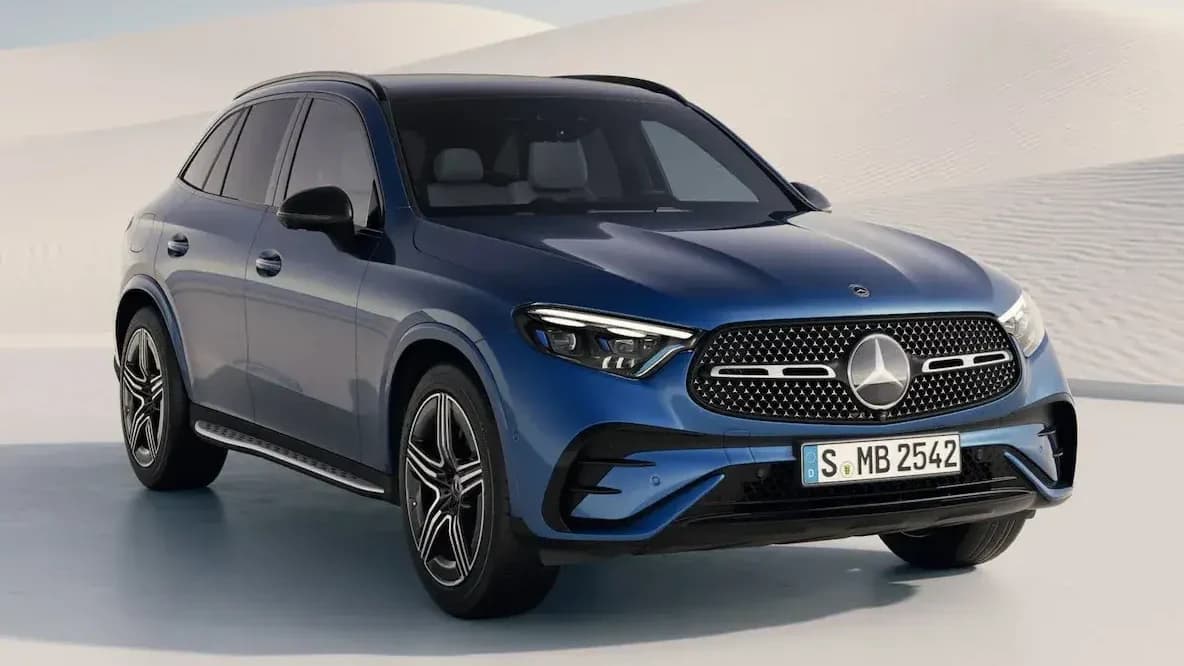
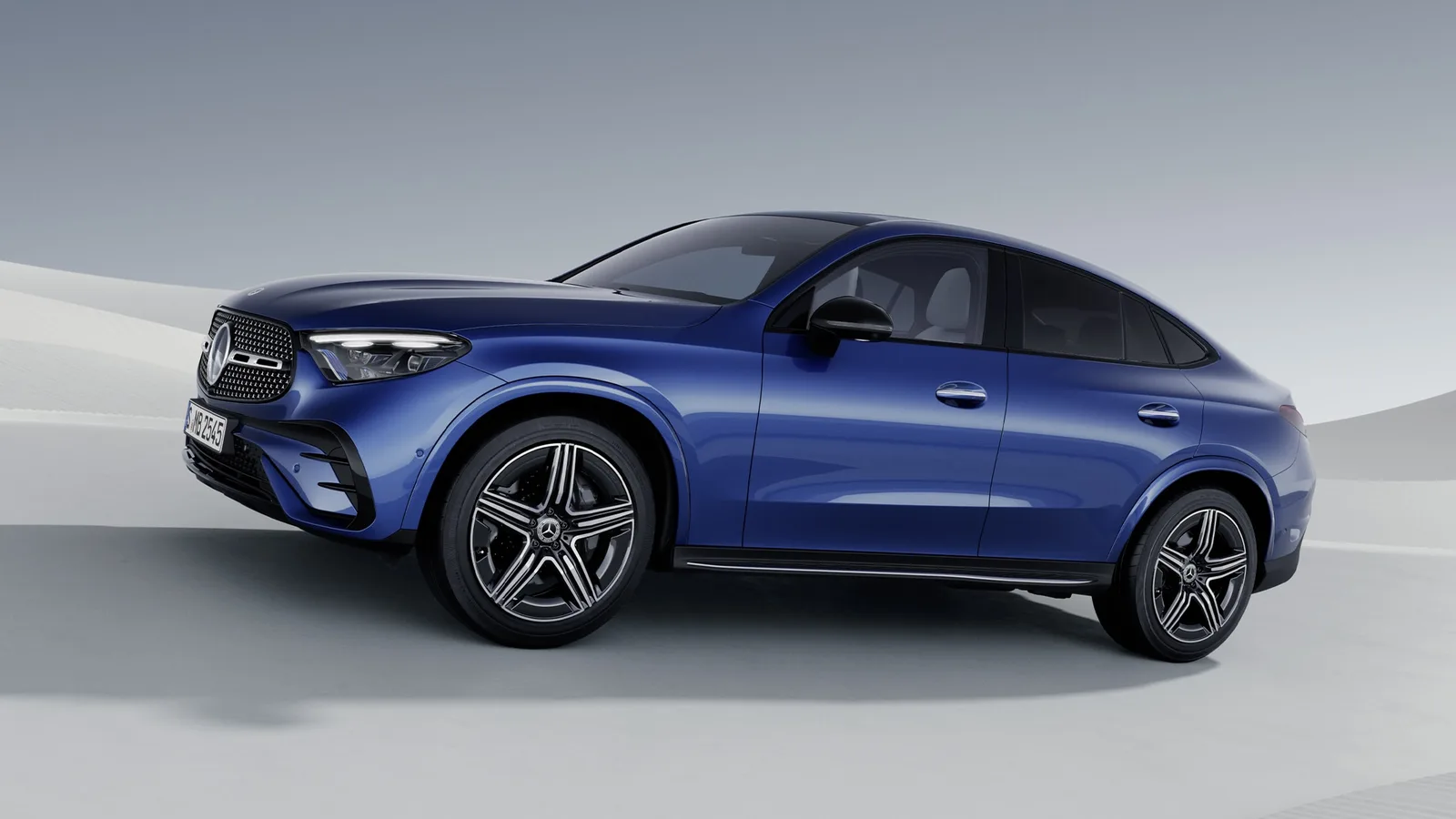
2018 Mercedes-Benz GLC: every variant sold in Australia
6 variants of the Mercedes-Benz GLC carry the 2018 model year in our catalogue — the X253 generation, sold new 2015–2022. Specs, safety, economy and standard equipment for every grade, side by side.
The 2018 Mercedes-Benz GLC is no longer sold new in Australia. A price is shown only where we hold Mercedes-Benz's own printed price for that variant: what it cost new, not a current offer or a used value. Specifications are kept for used-buyer research. See the current Mercedes-Benz GLC.
The 2018 Mercedes-Benz GLC in plain English
Read off the 6 rows we hold for this model year. Where a figure is not on record it is left out rather than estimated.
The 2018 Mercedes-Benz GLC is an SUV with all-wheel drive. The six grades we hold for 2018 are Mercedes-AMG GLC 43, GLC 250, Mercedes-AMG GLC 63 S, GLC 220 d, GLC 350 d and GLC 250 d. The ladder splits three diesel and three petrol grades.
No price is on record for the 2018 Mercedes-Benz GLC: a figure is printed only where we hold Mercedes-Benz’s own published price.
Mercedes-Benz’s combined consumption figures run 5.6 to 8.8 L/100km. At 15,000 km a year that is about $1,600 to $2,770 of fuel or energy, before servicing, rego, tyres and insurance.
We hold no ANCAP rating for any grade on this page, so none is shown. We never carry a rating across from another variant or model year.
Every 2018 Mercedes-Benz GLC variant
| Variant | Drivetrain | Power | Economy / range | Seats | Full specifications |
|---|---|---|---|---|---|
| Mercedes-AMG GLC 43SUV | Petrol · 9G-TRONIC 9-speed automatic · AWD | 270 kW | 8.8 L/100km | No data | Full specs → |
| GLC 250SUV | Petrol · 9G-TRONIC 9-speed automatic · AWD | 155 kW | 7.2 L/100km | No data | Full specs → |
| Mercedes-AMG GLC 63 SSUV | Petrol · AMG SPEEDSHIFT MCT 9-speed sports transmission · AWD | 375 kW | No data | No data | Full specs → |
| GLC 220 dSUV | Diesel · 9G-TRONIC 9-speed automatic · AWD | 125 kW | 5.6 L/100km | No data | Full specs → |
| GLC 350 dSUV | Diesel · 9G-TRONIC 9-speed automatic · AWD | 190 kW | 6.3 L/100km | No data | Full specs → |
| GLC 250 dSUV | Diesel · 9G-TRONIC 9-speed automatic · AWD | 150 kW | 5.7 L/100km | No data | Full specs → |
Equipment across the 2018 range
Four states, never three. Standard means the document prints it as standard on that grade. Optional means it is a factory extra, at the price the document prints. No means the document confirms it is not available. No data means we have not read it off a Mercedes-Benz document yet, which is not the same as saying the car does not have it.
| Variant | AEB | Adaptive cruise | Blind-spot monitor | Reversing camera |
|---|---|---|---|---|
| Mercedes-AMG GLC 43 | Standard | Standard | Standard | Standard |
| GLC 250 | Standard | Standard | Standard | Standard |
| Mercedes-AMG GLC 63 S | Standard | Standard | Standard | Standard |
| GLC 220 d | Standard | No data | Standard | Standard |
| GLC 350 d | Standard | Standard | Standard | Standard |
| GLC 250 d | Standard | Standard | Standard | Standard |
Not yet read off a Mercedes-Benz document for any 2018 variant: Apple CarPlay, Android Auto. Left out of the table rather than shown as a column of “No data”; it is not a “No”.
What changed from the 2017 GLC
Measured row by row against the 2017 variants we hold, matching each grade on its name, body, gearbox and drive (4 variants match across both years). A grade listed below as in one year’s rows only may be a grade we have not added yet rather than one Mercedes-Benz added or dropped; the variant table above is what we hold for 2018.
In our 2018 rows, not our 2017 rows: GLC 350 d, Mercedes-AMG GLC 63 S.
What changed after the 2018 GLC
No 2018 grade we hold carries into 2021 under the same name, body, gearbox and drive, so the change is shown as the line-up itself rather than as price or spec moves on a guessed pairing. See the 2021 Mercedes-Benz GLC.
In our 2021 rows, not our 2018 rows: GLC 200, GLC 300 4MATIC, GLC 300 e 4MATIC, Mercedes-AMG GLC 43 4MATIC, Mercedes-AMG GLC 63 S 4MATIC+.
In our 2018 rows, not our 2021 rows: GLC 220 d, GLC 250, GLC 250 d, GLC 350 d, Mercedes-AMG GLC 43, Mercedes-AMG GLC 63 S.
2018 Mercedes-Benz GLC: size, weights, towing and servicing
| Figure | Across the grades | Grades holding it |
|---|---|---|
| Size | ||
| Length | 4,656 mm | 3 of 6 |
| Width | 1,890 mm | 3 of 6 |
| Height | 1,639 mm | 3 of 6 |
| Wheelbase | 2,873 mm | 3 of 6 |
| Turning circle | 11.8 m | 3 of 6 |
| What it carries | ||
| Fuel tank | 66 L | 6 of 6 |
Nothing in this table is ranked. A figure the manufacturer prints on a different basis (a maximum kerb weight, a width including the mirrors, a length with a tow bar fitted) carries that basis beside it, because it is a different measurement and not a bigger number.
Not yet read off a Mercedes-Benz document for any grade on this page: ground clearance, boot space, seats up, boot space, rear seats down, kerb weight, tare mass, payload, gross vehicle mass (gvm), roof load, tray length, tray width, braked towing capacity, unbraked towing capacity, tow ball download, gross combination mass (gcm), wading depth, service interval (months), service interval (distance), warranty term. Those read “No data” rather than a guessed figure.
Recalls on the 2018 Mercedes-Benz GLC
Due to a manufacturing defect particles may have been trapped between the fuel rail and injectors damaging the seal causing a fuel leak into the engine compartment.
Published 2022-05-02. Year range on the notice: 2019 - 2020. Matched to 6 of the 6 variants on this page. REC-005426 on the government register
Leaked fuel may result in a fire if it makes contact with a hot surface in the engine. This could increase the risk of injury or death to vehicle occupants and other road users.
Due to a software issue, the automatic network search of the emergency call system (eCall) communication module may be deactivated.
Published 2022-04-06. Year range on the notice: 2018 - 2020. Matched to 2 of the 6 variants on this page. REC-005401 on the government register
If the eCall system is deactivated, in the event of an emergency it would not be possible for the vehicle occupants to connect with emergency services, either manually or automatically. As a consequence, emergency vehicles may not be directed to the affected vehicle or may be delayed. This could increase the risk of death if a serious injury has occurred.
Due to a software issue, the automatic network search of the emergency call system (eCall) communication module may be deactivated.
Published 2021-10-21. Year range on the notice: 2018 - 2020. Matched to 2 of the 6 variants on this page. REC-004979 on the government register
If the eCall system is deactivated, in the event of an emergency it would not be possible for the vehicle occupants to connect with emergency services, either manually or automatically. As a consequence, emergency vehicles may not be directed to the affected vehicle or may be delayed. This could increase the risk of death if a serious injury has occurred.
The software of the Electronic Stability Program (ESP) control unit may be incorrectly programmed for the type of brake in the vehicle.
Published 2020-10-07. Year range on the notice: 2018 - 2020. Matched to 1 of the 6 variants on this page. REC-000969 on the government register
Incorrect programming could lead to an inappropriate ESP intervention in some driving situations, increasing the risk of a crash or injuries and death of vehicle occupants and other road users.
The screws for the turbocharger oil feed and oil return lines may not have been correctly tensioned during the assembly process.
Published 2020-08-25. Year range on the notice: 2019 - 2020. Matched to 6 of the 6 variants on this page. REC-000968 on the government register
If the screws are loose, oil may leak out at the turbocharger oil feed and/or oil return line. Leaking oil may come into contact with hot component parts and a fire could occur. This could result in injuries or death of vehicle occupants or other road users.
The front seat belt buckle housings may not have been correctly manufactured.
Published 2020-07-28. Year range on the notice: 2018 - 2019. Matched to 6 of the 6 variants on this page. REC-000952 on the government register
If the front seat belts do not operate properly, occupants wearing the seat belts may not be properly restrained. This could result in serious injury or death to vehicle occupants in the event of an accident.
The four lock nuts for fastening the airbag may have been installed incorrectly.
Published 2019-10-22. Year range on the notice: 2019. Matched to 6 of the 6 variants on this page. REC-000943 on the government register
The airbag may detach from the base plate and enter into the vehicle interior at high speed, increasing the risk of injury to the vehicle occupants in the event of an accident.
The engine crankshaft may have surface damage due to a manufacturing error.
Published 2019-08-06. Matched to 1 of the 6 variants on this page. REC-003890 on the government register
The crankshaft may fail, resulting in sudden engine damage causing the engine to stop functioning. This may increase the risk of an accident and injury to vehicle occupants, and other road users.
A sensor for the electric power steering on the vehicle may have been manufactured outside of the specification.
Published 2019-05-26. Matched to 6 of the 6 variants on this page. REC-003876 on the government register
If the sensor fails, the power steering assistance may be disabled. This increases the risk of an accident.
On affected vehicles, the airbag gas generator housing may eject metal parts if the airbags are deployed.
Published 2018-09-23. Year range on the notice: 2018. Matched to 6 of the 6 variants on this page. REC-000915 on the government register
Deployment of the airbags may result in small metal parts becoming dislodged from the airbag gas generator housing, which could injure the occupants of the vehicle.
The connector pins to the airbag control unit may have been manufactured incorrectly.
Published 2018-05-27. Matched to 6 of the 6 variants on this page. REC-003838 on the government register
This may result in the deactivation of the passenger side frontal airbag. The restraint function for the front passenger seat occupant may also be reduced in an accident where the airbags are triggered, posing a greater risk of injury.
The propellant mix of certain front seat belt tensioner squibs may not meet the specifications.
Published 2018-02-20. Year range on the notice: 2016 - 2017. Matched to 6 of the 6 variants on this page. REC-000910 on the government register
The front seat belt tensioners may not deploy. If the vehicle is involved in an accident, the front occupants of the vehicle may be at increased risk of injury.
The propellant mixing ratio of certain front right (driver) seat belt tensioner squibs may not meet the specifications.
Published 2017-10-10. Matched to 6 of the 6 variants on this page. REC-003808 on the government register
The front right (driver's) seat belt tensioner may not deploy. This may increase the risk of injury to the driver if the vehicle is involved in an accident.
The propellant mixing ratio of certain passenger seat belt tensioner squibs may not meet the specifications.
Published 2017-10-05. Matched to 6 of the 6 variants on this page. REC-003805 on the government register
The front passenger seat belt tensioner may not deploy. This may increase the risk of injury to the passenger if the vehicle is involved in an accident.
Where a figure has not been read off a source document it reads “No data” rather than a zero or a dash, and an equipment column reads “No” only where a document confirms the feature is not available. Full specs, the source for each variant and a side-by-side configurator for every Mercedes-Benz GLC variant, including other model years, are on the model page.
2018 Mercedes-Benz GLC: common questions
How much does the 2018 Mercedes-Benz GLC cost to run each year?
At 15,000 km a year, fuel or energy for the 2018 Mercedes-Benz GLC works out at about $1,600 to $2,770 a year, on the manufacturer's own combined figure (15,000 km a year, $2.10/L premium petrol). That is fuel or energy only: servicing, registration, compulsory third party insurance, tyres and insurance are not in it, and a plug-in hybrid is costed with the battery not charged because that is the figure that holds when you do not plug in.
What is the fuel consumption of the 2018 Mercedes-Benz GLC?
Mercedes-Benz's combined-cycle figure for the 2018 Mercedes-Benz GLC is 5.6 to 8.8 L/100km across the grades, on five of the six grades we hold. A combined figure is a laboratory result; real consumption depends on how and where you drive.
How much power does the 2018 Mercedes-Benz GLC have?
The 2018 Mercedes-Benz GLC is listed at 125 to 375 kW and 350 to 700 Nm across the grades we hold, as published by Mercedes-Benz. A hybrid's combined system output and its engine output are different figures, and we store each grade's own as printed rather than adding them together.
What are the dimensions of the 2018 Mercedes-Benz GLC?
The 2018 Mercedes-Benz GLC measures 4,656 mm long and 1,890 mm wide, 1,639 mm tall. A width figure is the body unless this page labels it as including the mirrors, which is a different measurement and is marked where the manufacturer prints it that way.
Which 2018 Mercedes-Benz GLC grades are there?
We list six grades of the 2018 Mercedes-Benz GLC: Mercedes-AMG GLC 43, GLC 250, Mercedes-AMG GLC 63 S, GLC 220 d, GLC 350 d and GLC 250 d. Each one is a separate row with its own price, specification and equipment, read off Mercedes-Benz's Australian documents for that grade rather than averaged across the range.
Is the 2018 Mercedes-Benz GLC still sold new in Australia?
No. We hold no current new-car offer for the 2018 Mercedes-Benz GLC, so no current price is shown. The figures on this page are kept for used-buyer research, and a price appears only where we hold Mercedes-Benz's own printed price for that grade, labelled as the price when new.
Where to go next
- Every Mercedes-Benz GLC variant and price · the model page covers every generation and model year we hold, with the source for each variant and a side-by-side configurator.
- 2017 Mercedes-Benz GLC · the previous model year we hold, for the figures this page compares against.
- 2021 Mercedes-Benz GLC · the next model year we hold, and what changed after 2018.
- Compare any two cars side by side · price, specification, equipment and running cost in one table.