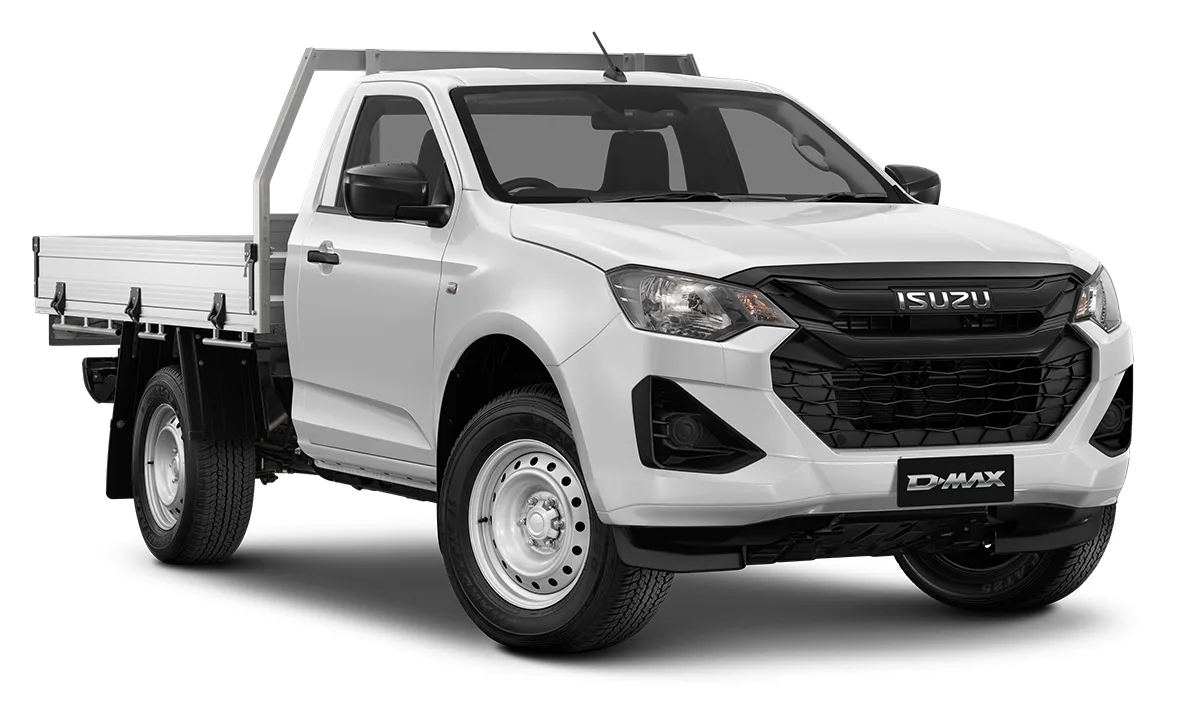
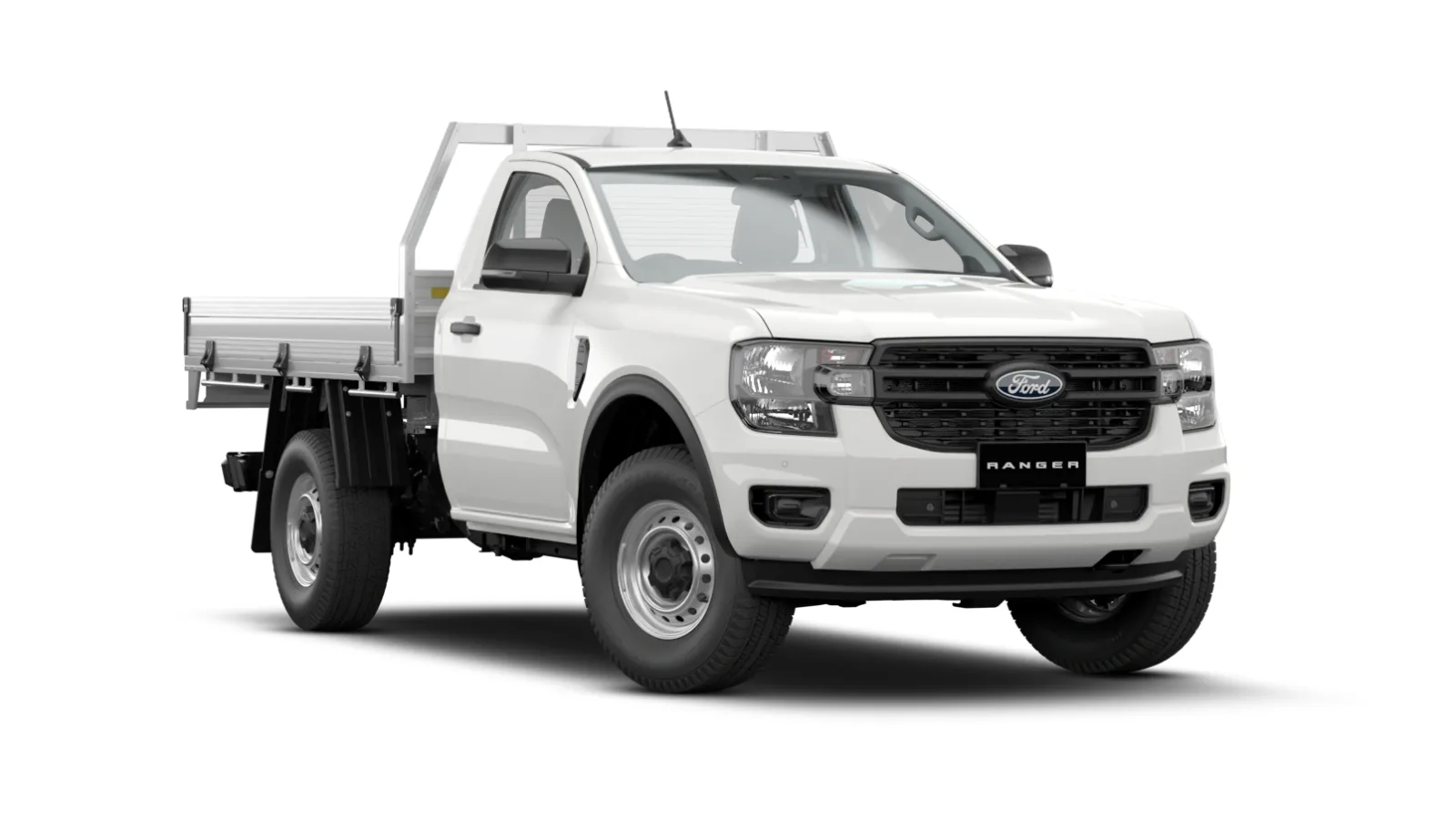
Isuzu D-Max vs Ford Ranger
Two of the biggest names in the Australian ute market. The D-Max brings serious value; the Ranger brings sheer popularity. Which one deserves your money?
Data checked: specs 27 Sep 2026, price 22 Jul 2026
Comparison snapshot
Prices, scores and edges below update from our car data.
1 more year of warranty
Cheaper by $4,113, 5kW more power
Written 7 April 2026. The snapshot, tables, scores and verdict on this page update from our car data; figures quoted in the text are as at that date.
Price
The Ranger XL starts at $37,130 vs $41,243 for the D-Max SX. That $4,113 gap is worth factoring in alongside dealer negotiation, driveaway costs, and any accessories you are going to bolt on.
Where the cost difference shows up is at the fuel bowser. The Ranger's 2.0-litre single turbo diesel uses 6.9L/100km combined, while the D-Max's bigger 3.0-litre unit drinks 7.7L/100km. At $2.10/L for diesel and 15,000km per year, that works out to roughly $2,174 for the Ranger and $2,426 for the D-Max. The Ranger saves you about $252 per year in fuel. Over a 5-year ownership period, that is $1,260 in the Ranger's favour.
Servicing costs are competitive for both. Isuzu's capped-price servicing program keeps things predictable, and Ford's Service Price Promise does the same. Expect to pay between $300 and $400 per scheduled service for either ute. Neither brand is taking the mickey on service pricing at this level.
Resale value is historically strong for both. The Ranger tends to edge ahead slightly in the secondhand market because of sheer demand; it is consistently among Australia's best-selling vehicles. The D-Max is not far behind, and the Isuzu badge carries enormous credibility with farmers, tradies, and fleet buyers who know the 3.0-litre diesel is bulletproof.
Safety
Both are 5-star ANCAP rated. Both come standard with autonomous emergency braking, lane departure warning, and driver attention monitoring. For work utes at this price, the safety equipment is genuinely impressive. Five years ago, you would have paid $60k+ for this level of active safety in a ute.
The D-Max SX includes Isuzu's Intelligent Driver Assistance System (IDAS), which bundles AEB, lane-keep assist, adaptive cruise control, and a multi-information display. It is comprehensive for a base-model ute.
The Ranger XL gets Ford's Pre-Collision Assist with AEB, lane-keeping system, auto high beam, and a rear-view camera. Both utes get trailer sway control, which is critical if you are towing on Australian highways. For a cab chassis work ute, neither skimps on the safety gear that actually saves lives.
One thing to note: the D-Max has a centre rear airbag as standard, which is unusual for utes in this price bracket. It protects rear-seat occupants from hitting each other in a side impact. It is a small detail but it speaks to Isuzu's commitment to safety.
Features
Let's be honest: these are base-model work utes. Neither is going to blow you away with luxury features. But both are surprisingly liveable for daily driving.
The D-Max SX gets a 7-inch touchscreen with Apple CarPlay and Android Auto (wired), air conditioning, power windows, cruise control, and steel wheels. The cabin is functional and well laid-out. Isuzu has never been about flash, but everything feels solid and built to last in dusty, dirty work environments.
The Ranger XL gets an 8-inch touchscreen with SYNC 4, wireless Apple CarPlay and Android Auto, air conditioning, and a similar set of work-oriented basics. The Ranger's infotainment system is more polished than the D-Max's, with better graphics and faster response times. If you spend a lot of time in the cab and value a decent screen, the Ranger has the edge.
Neither car gets leather seats, heated seats, or any of the creature comforts you will find further up the range. These are proper working vehicles, and the features reflect that. If you need more gear, both brands offer well-specced mid-range models (LS-M for the D-Max, XLT for the Ranger) for roughly $10-15k more.
Drivetrain
This is where the two utes diverge most significantly. The D-Max runs Isuzu's well-proven 3.0-litre four-cylinder turbo diesel making 140kW at 3,600rpm and 450Nm at 1,600-2,600rpm. This engine has been around in various forms for years, and Isuzu diesel reliability is the stuff of legend. Ask any farmer in regional Australia about their Isuzu, and you will hear a story about how it never stopped running.
The Ranger XL gets Ford's 2.0-litre single turbo diesel making 125kW at 3,750rpm and 405Nm at 1,750-2,000rpm. It is a smaller engine that relies on modern turbo technology rather than displacement. The advantage is better fuel economy; the trade-off is 15kW and 45Nm less than the D-Max. In daily driving, the difference is noticeable when you are loaded up or towing. The bigger Isuzu engine feels less stressed under load.
Both are paired with 6-speed automatic transmissions in the base models reviewed here. The Ranger's 10-speed auto is only available on the bi-turbo models further up the range. At this level, both gearboxes are competent and shift smoothly enough, though neither feels as polished as a modern passenger car transmission.
For towing, the D-Max's extra torque (450Nm vs 405Nm) makes a tangible difference when pulling a loaded trailer up a steep grade. Both are rated to 3,500kg braked towing, but the D-Max does it with more breathing room. If you tow regularly and especially on hilly terrain, the D-Max's engine is the better choice.
Cost to own
The warranty comparison is nuanced. The D-Max gets 6 years but capped at 150,000km. The Ranger gets 5 years with unlimited kilometres. For a tradie or fleet vehicle doing 30,000km+ per year, the Ranger's unlimited km warranty is actually more valuable because you will hit 150,000km in 5 years. For someone doing average kilometres (15,000km/year), the D-Max's extra year of coverage wins.
Parts availability is excellent for both. Ford and Isuzu dealer networks are extensive across Australia, and because both utes sell in such high volumes, aftermarket parts are plentiful and reasonably priced. Both are among the highest-volume vehicles in the country, so parts supply is about as good as it gets here.
Accessories are a huge market for both. Steel trays, canopies, bull bars, drawer systems: both the D-Max and Ranger have massive aftermarket support. There is a slightly wider range of accessories for the Ranger simply because it sells in higher numbers, but the D-Max is not far behind. Either ute can be fitted out exactly how you need it for work or touring.
Insurance costs are similar. Both sit in a moderate insurance bracket for commercial vehicles. Expect to pay between $1,000 and $1,600 per year depending on your circumstances and cover level.
The Engine Size Debate
There is a philosophical difference here that matters. Isuzu has stuck with a bigger, simpler engine (3.0L single turbo) that makes its power without working too hard. Ford has gone with a smaller, more technologically advanced engine (2.0L with modern turbo tech) that achieves better efficiency at the cost of outright grunt. Neither approach is wrong, but your preference might depend on how you use the ute.
If you are doing mostly highway cruising, suburban driving, and light-to-moderate towing, the Ranger's 2.0-litre is the smarter pick. It sips less diesel and the 405Nm is plenty for most tasks. If you are regularly loading up with heavy gear, towing on unsealed roads, or working the ute hard in agricultural or mining environments, the D-Max's 3.0-litre just feels like it has more in reserve. That extra displacement is a comfort blanket when you are 200km from the nearest mechanic.
Real-World Ownership
Both utes have massive owner communities in Australia. Forums, Facebook groups, and YouTube channels dedicated to modifying and touring in D-Maxes and Rangers are everywhere. This means you will never be short of advice on accessories, common issues, or setup ideas. It also means parts availability is excellent even in remote areas.
One thing that does not get talked about enough: cabin noise. The Ranger is noticeably quieter at highway speeds than the D-Max. Ford has done more work on sound insulation, and the smaller engine revs lower at cruising speeds. If you spend hours on the highway, the Ranger is the more comfortable long-distance cruiser. The D-Max is fine, but you hear the 3.0-litre diesel more clearly, especially at 100-110km/h.
Who Should Buy Which?
Buy the D-Max SX if: you want the more powerful engine (140kW/450Nm), a 6-year warranty, and Isuzu's legendary diesel reliability. Best for buyers doing under 25,000km/year who want a tough, no-nonsense work ute with grunt.
Buy the Ranger XL if: you want better fuel economy, a more refined cabin, wireless CarPlay, and an unlimited-km warranty. Best for high-mileage users, highway cruising, and buyers who value the Ranger's strong resale demand.
See also: Ranger vs HiLux vs D-Max three-way, D-Max vs HiLux, and our Best Utes in Australia 2026 guide.
Key details
A tick marks the better figure only where both cars have one and the gap is meaningful (3% or more; a whole star or year).
| Detail | Isuzu D-Max | Ford Ranger |
|---|---|---|
| Price | From $41,243 RRP | From $37,130 RRP |
| Drive-away estimate | Calculating... | Calculating... |
| Body | Ute | Ute |
| Powertrain | Diesel, 2.2L 4-cyl turbo | Diesel, 2L 4-cyl turbo |
| Power / torque | 120kW / 400Nm | 125kW / 405Nm |
| Fuel use | 6.9 L/100km | 6.9 L/100km |
| 0-100km/h | No data | 10.5s |
| Boot | No data | No data |
| Towing (braked) | 3,500kg | 3,500kg |
| ANCAP | 5 stars (2022) | 5 stars (2022) |
| Warranty | 6yr / 150,000 km | 5yr / unlimited km |
At a glance
- Seats
- 3
- Boot
- No data
- Length x width x height
- 5,340 x 1,870 x 1,790mm
- Wheelbase
- 3,125mm
- Engine
- 2.2L 4-cyl turbo
- Power
- 120kW
- Torque
- 400Nm
- Drive
- RWD
- Transmission
- Automatic
- Power-to-weight
- 73 kW/tonne
- Kerb weight
- 1,650kg
- Spare wheel
- Full size
- Payload
- 1,350kg
- Towing braked / unbraked
- 3,500kg / 750kg
- Turning circle
- 12.5m
- Seats
- 2
- Boot
- No data
- Length x width x height
- 5,225 x 1,910 x 1,872mm
- Wheelbase
- 3,270mm
- Engine
- 2L 4-cyl turbo
- Power
- 125kW
- Torque
- 405Nm
- Drive
- RWD
- Transmission
- Automatic
- Power-to-weight
- 70 kW/tonne
- Kerb weight
- 1,783kg
- Spare wheel
- 16" Steel
- Payload
- 1,447kg
- Towing braked / unbraked
- 3,500kg / 750kg
- Turning circle
- 12.9m
CarSorted Score breakdown
The CarSorted Score is algorithmic: it is calculated from each car's data, not from a road test. How it works.
Safety
Fuel Economy
Value
Practicality
Technology
Performance
Reliability
The verdict
Isuzu D-Max comes out ahead on the CarSorted Score (70 vs 66)
The deciding gaps
- Safety:Isuzu D-Max 84, Ford Ranger 73, Isuzu D-Max ahead by 11
- Reliability:Isuzu D-Max 70, Ford Ranger 59, Isuzu D-Max ahead by 11
- Technology:Isuzu D-Max 31, Ford Ranger 40, Ford Ranger ahead by 9
The Isuzu D-Max wins on the score; the Ford Ranger is the cheaper of the two, and price is already part of the Value axis.
Same scorer as the live comparison of these two exact cars.
Our take (written 7 April 2026)
At nearly identical pricing, these two are separated by their strengths rather than their weaknesses. The D-Max has a bigger, more powerful engine (140kW/450Nm vs 125kW/405Nm) and a 6-year warranty. The Ranger XL uses less fuel (6.9L vs 7.7L/100km) and has unlimited warranty kilometres. For tradies doing high mileage, the Ranger's unlimited km warranty is a genuine advantage. For those who want more grunt from a proven Isuzu diesel, the D-Max delivers. Both tow 3,500kg. Both are 5-star ANCAP. You genuinely cannot go wrong with either.
Prices on this page move. Want the next verdict?
One short email when prices shift or a new comparison lands. No spam, unsubscribe anytime.
Questions buyers ask
Which tows better, D-Max or Ranger?
Braked towing capacity: both are listed at 3,500kg.
Which ute is better on fuel?
On the official combined cycle, the Isuzu D-Max uses 6.9 L/100km and the Ford Ranger uses 6.9 L/100km.
Is the D-Max warranty better than the Ranger's?
The Isuzu D-Max comes with a 6yr / 150,000 km warranty; the Ford Ranger with a 5yr / unlimited km warranty.
Which holds value better?
The Ranger has a slight edge in resale because of higher demand, but the D-Max holds value strongly too. Both are safe bets.
Which is cheaper, the Isuzu D-Max or the Ford Ranger?
The Isuzu D-Max SX Single Cab Chassis 4x2 is from $41,243 RRP; the Ford Ranger XL 4x2 Hi-Rider Single Cab Cab-Chassis is from $37,130 RRP. That makes the Ford Ranger $4,113 cheaper.
What are the ANCAP ratings for the Isuzu D-Max and Ford Ranger?
The Isuzu D-Max holds 5 stars (rated 2022), and the Ford Ranger holds 5 stars (rated 2022).
Which comes out ahead overall?
On the CarSorted Score the Isuzu D-Max comes out ahead (Isuzu D-Max 70/100, Ford Ranger 66/100), mainly on safety, reliability. The score is algorithmic; the editorial above says who each car suits.
Related
In the news
- 2027 Mahindra Lifestyler Ute Confirmed for Australia: 3.5-Tonne Tow Target, Fresh Ladder-Frame Platform, Australian Suspension Tune
- 2026 Hyundai Palisade XRT Pro Priced for Australia: $79,900 Turbo Petrol Off-Roader, In Dealers From September
- New Mitsubishi Pajero vs Toyota Prado vs Ford Everest vs Isuzu MU-X: How It Stacks Up on Paper
- 13,907 Ford Rangers Recalled in Australia Over a Side Curtain Airbag That Can Snag the B-Pillar Trim
How to read this page. Prices, specs, ANCAP ratings, warranty, scores and the computed verdict come from our records for the two variants shown, sourced from manufacturer Australian documents, and update when those records change. RRP excludes on-road costs. Drive-away figures are estimates for the state you have selected unless marked as advertised. The editorial text was written on 7 April 2026. Always confirm price and specification with the manufacturer or dealer before you buy. CarSorted does not accept payment for recommendations.
Comments (0)
Sign in to join the conversation
No comments yet. Be the first!