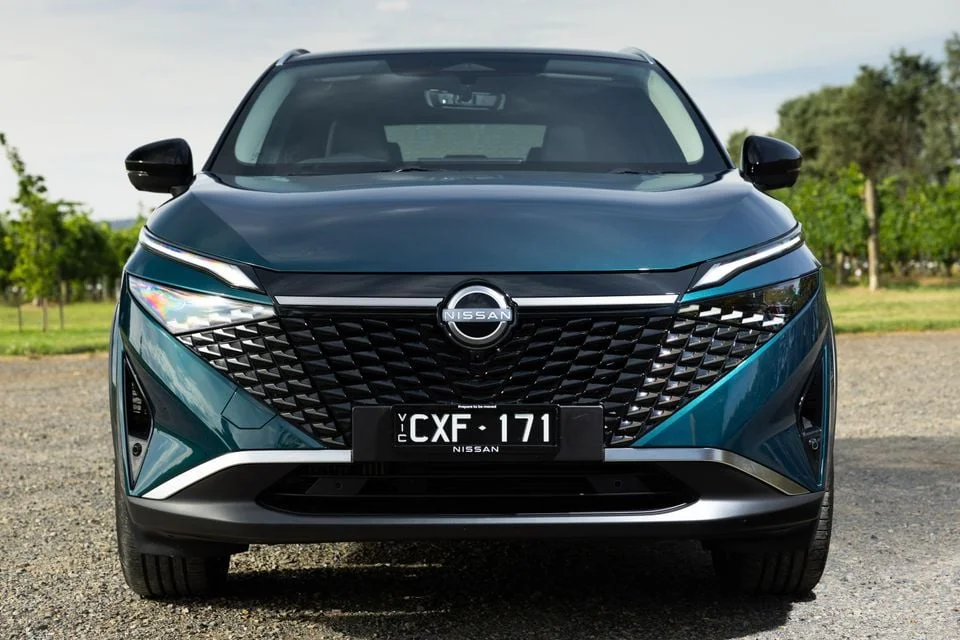
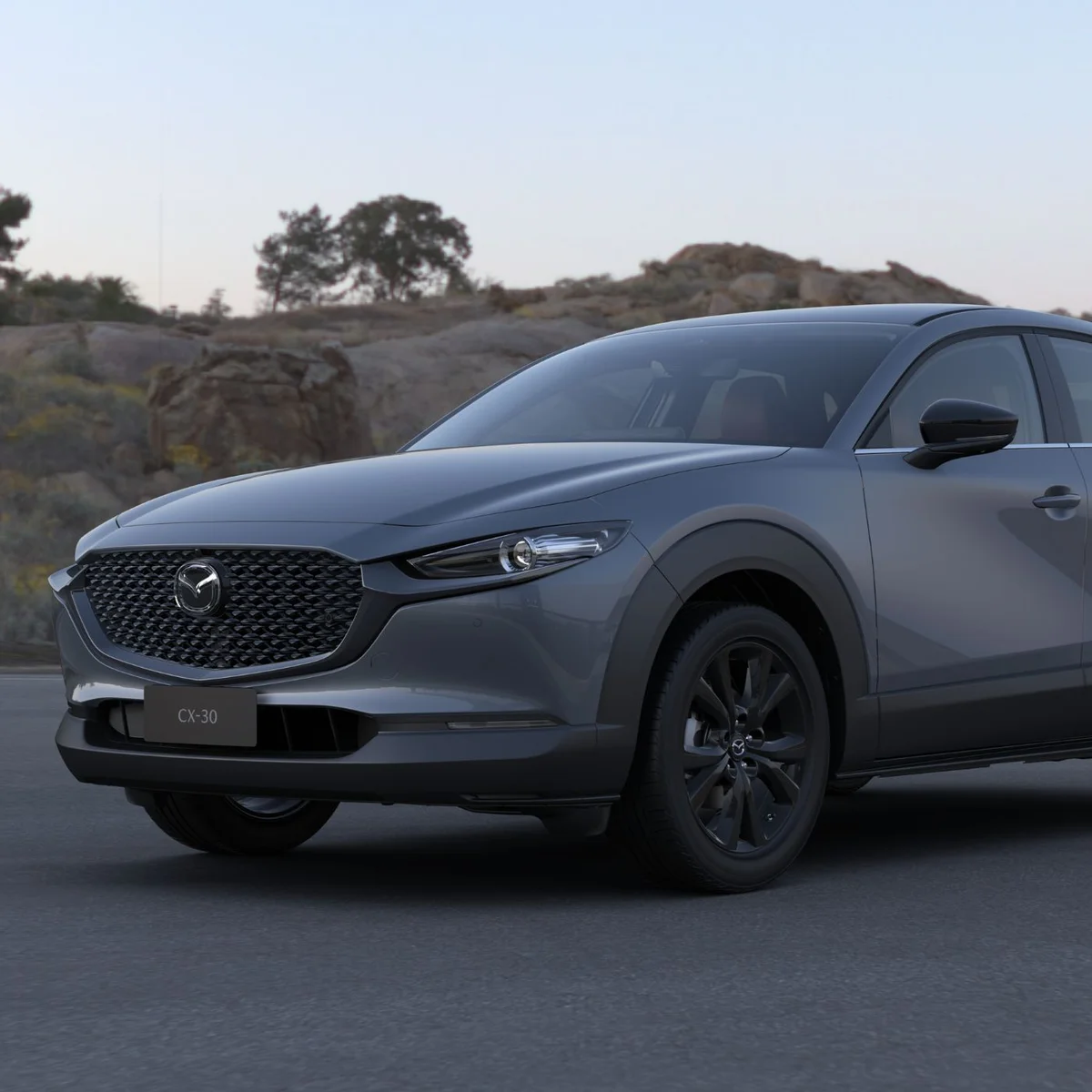
Nissan Qashqai vs Mazda CX-30
$47,165 vs $29,990. Nissan's warranty king vs Mazda's driving benchmark.
Data checked: specs 12 Sep 2026, price 5 Oct 2026
Comparison snapshot
Prices, scores and edges below update from our car data.
Lighter on fuel by 1.5 L/100km, 87L more boot
Cheaper by $19,650, tows 450kg more
Written 7 April 2026. The snapshot, tables, scores and verdict on this page update from our car data; figures quoted in the text are as at that date.
Price
The Qashqai ST starts at $47,165 while the CX-30 G20 Pure comes in at $29,990. That is a gap of $17,175, which puts the CX-30 firmly in the more affordable camp. For budget-conscious buyers, that difference covers a decent chunk of your on-road costs.
Running costs are slightly in the Qashqai's favour. At 6.1L/100km versus 6.3L for the CX-30, the Qashqai saves you about $60 per year in fuel based on 15,000km at $2.00/L. Over five years, that is $300. Over ten years (which the Qashqai's warranty encourages you to think about), that is $600. Not massive, but it helps.
The real value proposition of the Qashqai is that ten-year, unlimited-kilometre warranty. That is double the CX-30's five-year coverage. Think about what that means in practice: for an entire decade, major mechanical faults are covered. No surprise repair bills, no anxious moments when a warning light comes on. For buyers who plan to keep their car long-term, that is enormous peace of mind.
Servicing costs are comparable between the two brands. Both offer capped-price servicing, and per-service costs are in the same ballpark. Insurance premiums slightly favour the CX-30 due to its lower purchase price. Finance repayments are roughly $90 per month less on the CX-30 over a five-year loan.
Resale is where it gets interesting. Mazda traditionally holds its value better than Nissan in the Australian market. But the Qashqai's ten-year warranty is transferable, which means it adds genuine value when you come to sell. A five-year-old Qashqai still has five years of factory warranty remaining. That is a compelling selling point that could narrow the resale gap considerably. Our warranty comparison guide breaks down how different warranty programs work across brands.
Safety
Only one of these has an ANCAP result. The Qashqai was tested in 2025 and holds 4 stars, with 78% adult occupant protection, 91% child occupant protection, 68% vulnerable road user and 62% safety assist. The CX-30 has no ANCAP rating at all, so there is no published crash score for it. Both are well equipped with modern safety tech, but only the Nissan has been independently tested.
The Qashqai ST comes with autonomous emergency braking with pedestrian and cyclist detection, lane departure warning, lane keep assist, adaptive cruise control, blind spot monitoring, rear cross-traffic alert, and a reversing camera. That is a comprehensive suite for an entry-level variant and reflects Nissan's commitment to loading safety tech across the range.
The CX-30 G20 Pure gets Mazda's i-Activsense suite, including AEB, lane departure warning, lane keep assist, adaptive cruise control, and blind spot monitoring with rear cross-traffic alert. Mazda's safety systems are well calibrated and generally less intrusive than some competitors, which is appreciated by drivers who find overly aggressive lane-keep systems annoying.
Both cars have six airbags, ISOFIX child seat anchors, electronic stability control, and hill start assist. The Qashqai adds intelligent emergency braking with junction assist, which can help prevent T-bone collisions at intersections. It is a useful addition in urban driving.
Driver visibility is better in the CX-30 thanks to Mazda's slim A-pillar design, which reduces blind spots at intersections. The Qashqai is not bad in this regard, but the CX-30 has a noticeable advantage. If you want to understand more about what all these safety features actually do, our ANCAP guide covers it in detail.
Features
The Qashqai ST comes well featured for its price. You get an 8-inch touchscreen with wireless Apple CarPlay and Android Auto, a 7-inch digital instrument cluster, fabric seats, dual-zone climate control, LED headlights, push-button start, and rear parking sensors. Nissan has also included intelligent key with remote start, which is handy on hot Australian summer days when you want to cool the cabin before you get in.
The CX-30 G20 Pure gets an 8.8-inch display operated by Mazda's rotary controller (not a touchscreen), Apple CarPlay and Android Auto (wired), cloth seats, single-zone air conditioning, LED headlights, push-button start, and a reversing camera with rear parking sensors. On paper, the Qashqai has the edge in tech features with its wireless connectivity and dual-zone climate.
But step inside both cars and the difference in cabin quality is immediately obvious. The CX-30's interior is in a different league. Even at this Pure entry level, the materials, the panel gaps, the feel of every surface you touch. It is genuinely premium. Mazda has invested more in interior design and material quality than any other mainstream brand, and the CX-30 shows it.
The Qashqai's cabin is modern and functional but more obviously mainstream. The plastics are harder in places, the design is busier, and it does not quite have that same sense of craftsmanship. It is not bad by any means, but sitting in a CX-30 immediately after a Qashqai makes the difference clear.
Connectivity matters in 2026, and the Qashqai's wireless Apple CarPlay is a genuine convenience advantage over the CX-30's wired-only setup. If you do a lot of short trips and hate plugging in cables, the Qashqai makes daily life slightly easier. Mazda has been slow to adopt wireless connectivity, and it is one of the few areas where the CX-30 falls behind the competition.
Drivetrain
The Qashqai ST runs a 1.3-litre turbocharged four-cylinder producing 110kW and 250Nm, paired with a CVT. The CX-30 G20 Pure uses a 2.0-litre naturally aspirated four-cylinder making 114kW and 200Nm through a six-speed torque converter automatic. The engines are fundamentally different in character.
The Qashqai's turbo delivers its 250Nm of torque from low in the rev range, which makes it feel punchy and responsive in everyday driving. Merging, overtaking, and pulling away from lights all feel effortless. You rarely need to push the engine hard because the torque is there from idle. That 50Nm advantage over the CX-30 is noticeable in the real world.
The CX-30's naturally aspirated engine takes a different approach. Power delivery is linear and predictable, rewarding drivers who are happy to work the engine through the rev range. It needs more revs to access its power, but it does so smoothly and willingly. The engine sounds pleasant when pushed, which is more than you can say for most cars in this class.
The gearbox pairing is a critical differentiator. The Qashqai's CVT works well enough in gentle driving, and Nissan has tuned it to simulate stepped gear changes under acceleration. But it still has that characteristic rubber-band feel when you plant the throttle, and the engine drone under sustained acceleration is noticeable. CVTs divide buyers, and if you have driven one before and did not like it, the Qashqai will not change your mind.
The CX-30's six-speed auto is conventional, crisp, and well matched to the engine. It shifts predictably, responds promptly to throttle inputs, and does not draw attention to itself. For drivers who care about the feel of the drivetrain, the Mazda is the clear winner. The steering is sharper too, with better weight and feedback, and the chassis is beautifully balanced through corners.
Weight is worth noting. The Qashqai tips the scales at 1,454kg versus 1,370kg for the CX-30. That 84kg difference, combined with the Mazda's superior chassis tuning, makes the CX-30 feel noticeably more agile on winding roads. If your commute involves any kind of interesting driving, the CX-30 is significantly more enjoyable.
Space and comfort
The Qashqai has a substantial boot space advantage at 430 litres versus 350 litres for the CX-30. That 80-litre gap is meaningful in everyday life. It is the difference between easily fitting a pram and a week's worth of groceries, versus having to carefully arrange things to make them fit. The Qashqai's boot is also well shaped with a wide opening, making it easy to load bulky items.
The CX-30's 350-litre boot is adequate for most daily needs but will test your packing skills on longer trips. If you regularly carry gear for sport, hobbies, or weekend away trips, the Qashqai gives you noticeably more breathing room. For a broader look at boot space in this segment, our best SUV boot space guide ranks the field.
Rear seat space is a Qashqai win too. It is the larger car overall, and rear passengers benefit from more legroom, headroom, and shoulder room. The CX-30's rear seat is comfortable enough for average-sized adults but can feel snug for taller occupants, particularly in the headroom department. If you regularly carry adult passengers in the back, the Qashqai is the more accommodating car.
Towing capacity is a decisive win for the Qashqai. At 1,500kg braked, it can handle small boats, camper trailers, and loaded box trailers without breaking a sweat. The CX-30 tops out at 1,000kg, which limits you to lighter loads. That 500kg gap is the difference between towing a small camper and not being able to. If weekend adventures involving a trailer are part of your lifestyle, the Qashqai opens up options the CX-30 simply cannot match. Our towing capacity guide explains what these numbers mean in practical terms.
Both cars have split-folding rear seats for versatility and a flat load floor when the seats are down. The Qashqai offers more total cargo volume with seats folded, reinforcing its practicality advantage. Cabin storage is adequate in both, with standard cup holders, door pockets, and a centre console bin.
Cost to own
The warranty story is the headline here. Nissan offers a ten-year, unlimited-kilometre warranty on the Qashqai. That is double the industry standard and double the CX-30's five-year coverage. It is one of the longest warranties available from any mainstream manufacturer globally, and it speaks to Nissan's confidence in the product's reliability.
In practical terms, a ten-year warranty means you could buy a Qashqai today and still be covered in 2036. For buyers who keep their cars long-term, or who plan to pass the car on to a family member, that coverage is invaluable. The warranty is transferable too, which adds genuine resale value.
Mazda's five-year, unlimited-kilometre warranty is perfectly respectable and matches the industry standard. But against the Qashqai's ten-year offering, it looks modest. If long-term ownership peace of mind is high on your priority list, the Qashqai has a compelling edge.
Dealer networks favour Mazda in Australia. As a consistently top-three selling brand, Mazda dealers are well distributed in metro and regional areas, and independent mechanics have extensive experience with Mazda vehicles. Nissan's network is adequate in capital cities but thinner in regional areas. If you are outside a major centre, check your nearest Nissan dealer before buying.
Servicing costs are comparable under both brands' capped-price programs. Neither will surprise you with unexpectedly high bills at scheduled intervals. Reliability data for both models is positive, with no widespread issues reported for either the Qashqai or CX-30 in the Australian market.
Depreciation over five years slightly favours the CX-30. Mazda holds its value well, and the CX-30's lower purchase price means less money lost in absolute terms. But the Qashqai's transferable ten-year warranty acts as a depreciation buffer, particularly in the second half of the ownership period when most cars have lost their factory warranty. A seven-year-old Qashqai with three years of warranty remaining is a much more attractive used buy than a seven-year-old CX-30 with no warranty at all. Our depreciation guide has more detail on how different brands hold their value.
The Verdict
This is a genuinely tough call because both cars have clear, distinct strengths. The Qashqai wins on practicality, towing, and warranty coverage. The CX-30 wins on price, driving enjoyment, and interior quality. They are playing slightly different games.
Buy the Qashqai ST if: long-term ownership peace of mind matters to you. That ten-year warranty is unmatched. The 430L boot and 1,500kg towing make it the more practical car for families and weekend adventurers. If you need to carry more stuff and tow things, the Qashqai is the answer. The turbo torque is a bonus in daily driving.
Buy the CX-30 G20 Pure if: you want the best-driving, best-feeling small SUV at this price. At $29,990 it is over $17,000 cheaper than the Qashqai, with a cabin that feels genuinely premium and driving dynamics that set the benchmark in this class. If you do not need the extra boot space or towing capacity, the CX-30 is the more satisfying car to own day to day.
For most buyers, we would lean CX-30 for the price and driving experience. But if you keep cars for a long time and value the security of a decade-long warranty, the Qashqai deserves serious consideration.
Compare both on CarSorted. See also: Seltos vs CX-30, Tucson vs CX-30, and our best SUVs under $50k guide.
Key details
A tick marks the better figure only where both cars have one and the gap is meaningful (3% or more; a whole star or year).
| Detail | Nissan Qashqai | Mazda CX-30 |
|---|---|---|
| Price | From $49,640 RRP | From $29,990 RRP |
| Drive-away estimate | Calculating... | Calculating... |
| Body | SUV | SUV |
| Powertrain | Hybrid, 1.5L 3-cyl | Petrol, 2L 4-cyl |
| Power / torque | 140kW / 330Nm | 114kW / 200Nm |
| Fuel use | 4.8 L/100km | 6.3 L/100km |
| 0-100km/h | 7.9s | No data |
| Boot | 404L seats up · 1,328L seats folded | 317L seats up |
| Towing (braked) | 750kg | 1,200kg |
| ANCAP | 4 stars (2025) | No data |
| Warranty | 5yr / unlimited km | 5yr / unlimited km |
At a glance
- Seats
- 5
- Boot
- 404L seats up · 1,328L seats folded
- Length x width x height
- 4,425 x 1,835 x 1,625mm
- Wheelbase
- 2,665mm
- Engine
- 1.5L 3-cyl
- Power
- 140kW
- Torque
- 330Nm
- Drive
- FWD
- Transmission
- Automatic
- Power-to-weight
- 82 kW/tonne
- Kerb weight
- 1,707kg
- Spare wheel
- Space saver
- Payload
- 473kg
- Towing braked / unbraked
- 750kg / 750kg
- Turning circle
- 11.1m
- Seats
- 5
- Boot
- 317L seats up
- Length x width x height
- 4,395 x 1,795 x 1,540mm
- Wheelbase
- 2,655mm
- Engine
- 2L 4-cyl
- Power
- 114kW
- Torque
- 200Nm
- Drive
- FWD
- Transmission
- Automatic
- Power-to-weight
- 78 kW/tonne
- Kerb weight
- 1,468kg
- Spare wheel
- Temporary (steel)
- Payload
- No data
- Towing braked / unbraked
- 1,200kg / 600kg
- Turning circle
- 10.6m
CarSorted Score breakdown
The CarSorted Score is algorithmic: it is calculated from each car's data, not from a road test. How it works.
Safety
Fuel Economy
Value
Practicality
Technology
Performance
Reliability
The verdict
Nissan Qashqai comes out ahead on the CarSorted Score (72 vs 62)
The deciding gaps
- Technology:Nissan Qashqai 72, Mazda CX-30 33, Nissan Qashqai ahead by 39
- Safety:Nissan Qashqai 77, Mazda CX-30 52, Nissan Qashqai ahead by 25
- Fuel Economy:Nissan Qashqai 93, Mazda CX-30 79, Nissan Qashqai ahead by 14
The Nissan Qashqai wins on the score; the Mazda CX-30 is the cheaper of the two, and price is already part of the Value axis.
Same scorer as the live comparison of these two exact cars.
Our take (written 7 April 2026)
The CX-30 is $17,175 cheaper, lighter, and the better driver's car with its premium interior and conventional automatic. The Qashqai counters with a massive 10-year warranty, 80L more boot, 500kg more towing, more turbo torque, and slightly better fuel economy. If practicality and long-term peace of mind are your priorities, the Qashqai is hard to beat. If driving enjoyment and value matter more, the CX-30 wins.
Prices on this page move. Want the next verdict?
One short email when prices shift or a new comparison lands. No spam, unsubscribe anytime.
Questions buyers ask
How does the Qashqai warranty work?
The Nissan Qashqai comes with a 5yr / unlimited km warranty; the Mazda CX-30 with a 5yr / unlimited km warranty.
Which has better interior quality?
The CX-30 by a clear margin. Even at the G20 Pure entry level, Mazda's cabin materials and build quality feel a class above. The Qashqai is modern and functional but cannot match the Mazda's premium feel.
Which is the better driver's car?
The CX-30. Mazda's excellent chassis tuning, sharper steering, and conventional six-speed automatic make it the more engaging car to drive. The Qashqai is comfortable but its CVT and heavier weight dull the driving experience.
Which has better fuel economy?
On the official combined cycle, the Nissan Qashqai uses 4.8 L/100km and the Mazda CX-30 uses 6.3 L/100km.
Which is better for towing?
Braked towing capacity: the Mazda CX-30 at 1,200kg, against 750kg for the Nissan Qashqai.
Which is cheaper, the Nissan Qashqai or the Mazda CX-30?
The Nissan Qashqai Ti e-POWER is from $49,640 RRP; the Mazda CX-30 G20 Pure is from $29,990 RRP. That makes the Mazda CX-30 $19,650 cheaper.
What are the ANCAP ratings for the Nissan Qashqai and Mazda CX-30?
The Nissan Qashqai holds 4 stars (rated 2025), and we have no ANCAP rating on record for the Mazda CX-30.
Which has the bigger boot?
Boot space with the seats up: the Nissan Qashqai at 404L, against 317L for the Mazda CX-30.
Which comes out ahead overall?
On the CarSorted Score the Nissan Qashqai comes out ahead (Nissan Qashqai 72/100, Mazda CX-30 62/100), mainly on technology, safety, fuel economy. The score is algorithmic; the editorial above says who each car suits.
Related
In the news
- Avatr Previews the T09: a Patrol-Sized PHEV Flagship From a Brand Planning an Australian Launch
- VFACTS August 2026: EVs Outsell Petrol, Diesel and Hybrid for the First Time in Australian History
- 2026 Nissan Z Priced for Australia: First Manual NISMO Joins the Range, GT-R Brakes, Orders Open
- Hyundai Palisade LX3 Recall: Interim Over-the-Air Software Rolls Out for 2,304 Cars in Australia, New Deliveries Still Paused
How to read this page. Prices, specs, ANCAP ratings, warranty, scores and the computed verdict come from our records for the two variants shown, sourced from manufacturer Australian documents, and update when those records change. RRP excludes on-road costs. Drive-away figures are estimates for the state you have selected unless marked as advertised. The editorial text was written on 7 April 2026. Always confirm price and specification with the manufacturer or dealer before you buy. CarSorted does not accept payment for recommendations.
Comments (0)
Sign in to join the conversation
No comments yet. Be the first!