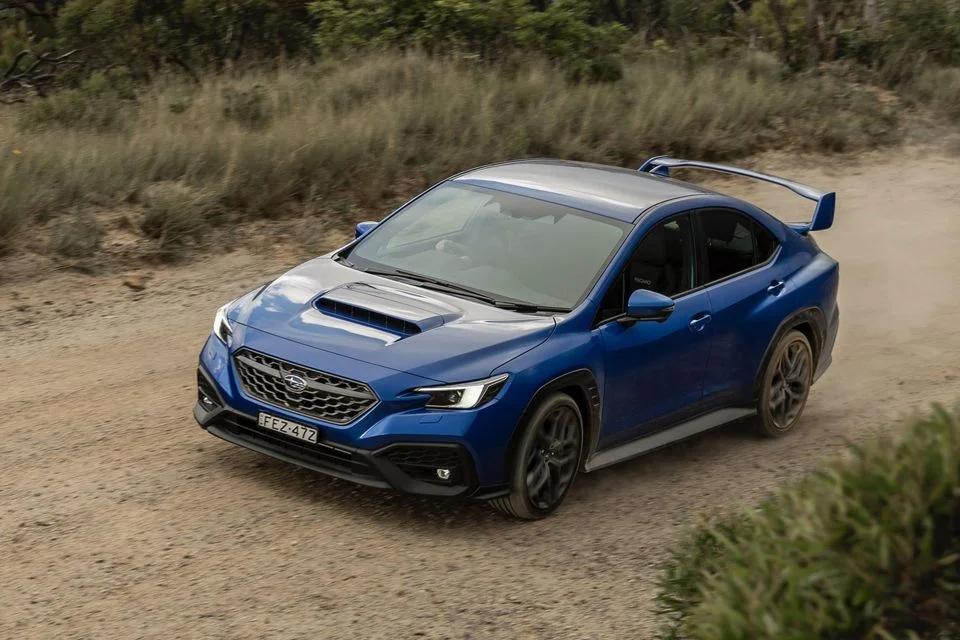
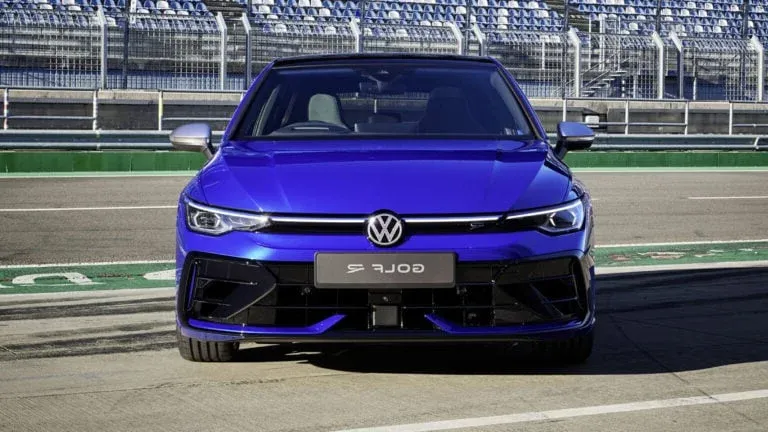
Subaru WRX vs Volkswagen Golf
$48,190 for Subaru's AWD sports sedan vs $38,690 for VW's refined European hatch. Two cars that could not be more different in philosophy.
Data checked: specs 27 Sep 2026, price 6 Sep 2026
Comparison snapshot
Prices, scores and edges below update from our car data.
40L more boot, 92kW more power
Cheaper by $10,200, lighter on fuel by 3.6 L/100km
Written 7 April 2026. The snapshot, tables, scores and verdict on this page update from our car data; figures quoted in the text are as at that date.
Price
The $9,500 price gap is real, but the running cost gap is even more significant. At $1.90/L for 91 unleaded and 15,000km per year, the WRX costs approximately $2,822 to fuel annually, while the Golf Life costs about $1,796. That is a $1,026 difference every single year. Over 5 years, the Golf saves you $5,130 in fuel alone. Add the $9,500 purchase price gap and you are looking at a total 5-year cost difference of roughly $14,630.
The WRX does require premium 98 RON fuel for optimal performance, which pushes the real-world fuel cost even higher. At $2.15/L for 98, the annual fuel bill climbs closer to $3,193. The Golf runs happily on 91 RON. This is a meaningful ongoing expense difference that a lot of buyers overlook when comparing sticker prices.
Servicing costs are comparable between the two. Subaru's capped-price servicing for the WRX runs roughly $350-$400 per visit, while VW's Care Plans for the Golf sit around $300-$350. Neither brand is cheap to service, but neither is outrageous for a performance-oriented car.
Insurance is where the WRX takes another hit. As a turbo AWD performance sedan popular with younger drivers, WRX insurance premiums are notoriously high. Expect to pay $2,000-$3,500+ per year depending on your age and history. The Golf Life, being a non-performance variant, typically insures for $1,200-$2,000. If you are under 30, this insurance difference can be brutal.
Safety
The Golf carries a 5-star ANCAP rating. The WRX has no ANCAP rating at all, so there is no published crash result to set against it. Both do come with comprehensive active safety suites. The WRX comes standard with Subaru's EyeSight driver assist system, which includes stereo camera-based AEB, adaptive cruise control, lane departure warning, and pre-collision throttle management. EyeSight is one of the more sophisticated systems on the market and uses dual cameras rather than the single camera-plus-radar approach used by most competitors.
The Golf Life gets VW's IQ.DRIVE suite with front assist (AEB), lane assist, adaptive cruise, and emergency assist (which can bring the car to a stop if it detects the driver is incapacitated). VW's system is polished and unobtrusive in daily driving, which is important because overly aggressive lane-keep systems can be annoying enough that people turn them off.
The WRX's symmetrical AWD gives it a meaningful safety advantage in wet conditions. All four wheels have traction at all times, which means better stability in rain, on gravel, and on wet roundabouts. The Golf's FWD is perfectly safe, but if you live somewhere with regular heavy rain (looking at you, Melbourne and Sydney), the WRX's AWD grip is genuinely reassuring. In terms of passive safety, both cars have thorough airbag coverage and strong structural rigidity.
Features
The Golf Life 110TSI is surprisingly well-equipped for the base model of the range. You get a 10-inch touchscreen with wireless Apple CarPlay and Android Auto, a digital cockpit display, LED headlights, ambient interior lighting, keyless entry, and VW's excellent build quality throughout. The Golf's interior has that Germanic solidity that makes everything feel like it will last 20 years. Buttons click with precision, panels fit perfectly, and the overall sensation is one of quiet quality.
The WRX base model counters with an 11.6-inch portrait-oriented touchscreen (similar to what you see in Teslas and newer Volvos), EyeSight safety, dual-zone climate control, and Apple CarPlay/Android Auto. The WRX's touchscreen is large but the software is not as polished as VW's system. Subaru's infotainment has improved significantly, but it still feels a step behind in terms of response speed and graphics quality.
Interior materials tell different stories. The Golf feels like a European car should: tight gaps, quality plastics, understated design. The WRX feels more purposeful and less refined: harder plastics in some areas, sportier seats, a thick-rimmed steering wheel, and the unmistakable manual gear lever in the centre console. It is not better or worse, just different priorities. The WRX's cabin says "driving matters here." The Golf's cabin says "everything matters here."
Drivetrain
The WRX's 2.4-litre turbocharged horizontally-opposed (boxer) four-cylinder is the star of this comparison. It produces 202kW at 5,600rpm and 350Nm from 2,000 to 5,200rpm. Paired with a 6-speed manual gearbox and permanent symmetrical AWD, it delivers the kind of mechanical involvement that is rapidly disappearing from the car market. The boxer engine sits low in the chassis, giving the WRX a lower centre of gravity than the Golf, which translates to more planted cornering and a more connected driving feel.
The Golf Life's 1.4-litre (110TSI) turbo petrol makes 110kW at 5,000rpm and 250Nm from 1,500 to 3,500rpm. It is paired with an 8-speed torque converter automatic and front-wheel drive. In isolation, it is a perfectly competent engine: smooth, quiet, efficient, and with enough torque at low revs to make city driving effortless. Compared to the WRX, it is in a completely different league of intent. This is not a performance engine; it is a commuter engine that happens to be well-engineered.
The 92kW power gap between these two is enormous. The WRX has nearly double the output of the Golf Life. In real terms, this means the WRX is significantly faster in a straight line, pulls harder out of corners, and has meaningful overtaking performance on country highways. The Golf Life is not slow in normal driving, but it does not have the reserves of power that the WRX does.
One thing worth noting: the WRX's manual gearbox is a dying breed. In 2026, you can count on one hand the number of new cars available in Australia with a manual transmission and over 200kW. If you value the manual driving experience, the WRX might be your last chance to buy one new. The Golf Life is auto-only, which suits its character as a relaxed daily driver.
Space and comfort
Boot space goes to the WRX with 441 litres vs 381 litres for the Golf. The WRX is a sedan, so the boot opening is smaller, but the actual cargo volume is larger. The Golf's hatchback opening is more versatile for loading bulky items, and the rear seats fold to create a much larger flat load floor. For practical everyday loading (groceries, prams, suitcases), the Golf's hatch shape is arguably more useful despite the smaller raw number.
Rear seat space is comparable in both. Neither is a spacious back-seat car, but both are adequate for two adults. Three adults in the back is a squeeze in either vehicle. The Golf's slightly shorter wheelbase means marginally less legroom, but the difference is tiny. Neither car is the one you buy for rear-seat luxury.
The WRX's front seats are more supportive with deeper bolsters for spirited driving. They hold you in place through corners in a way the Golf's seats do not attempt to. The Golf Life's front seats are comfortable for long-distance cruising but do not have the lateral support of the WRX's sport seats. If you plan to drive with any enthusiasm, the WRX's seats are noticeably better.
Noise levels are markedly different. The Golf is quiet: well-insulated, with minimal road noise and a refined engine note. The WRX is louder: the boxer engine has a distinctive rumble, road noise is more present, and wind noise at highway speeds is more noticeable. Some people love the WRX's mechanical soundtrack; others find it tiring on long trips. Test-drive both on the highway before deciding.
Cost to own
Both come with 5-year, unlimited-kilometre warranties. Subaru and VW are equal on paper here. Roadside assist is included for the warranty period on both.
Resale is interesting. The WRX holds value exceptionally well in Australia because there is always demand for used performance cars, and the WRX has a devoted following. A 3-year-old WRX typically retains 60-65% of its purchase price. The Golf Life holds value reasonably well but not quite at WRX levels; expect 55-60% at 3 years. The WRX's stronger resale partially offsets its higher purchase price and running costs.
Reliability is generally good for both, though they have different weak points. The WRX's turbocharged boxer engine is robust but demands regular oil changes and quality fuel. Neglect the servicing and problems can develop. The Golf's 1.4T engine is proven and reliable, but VW's electronics and infotainment systems occasionally throw gremlins. Neither car should give you major trouble if serviced on schedule.
Tyre costs deserve a mention. The WRX runs 245/40R18 performance tyres that cost $200-$300 each and wear faster due to the AWD system. The Golf Life runs 225/45R17 tyres that cost $150-$220 each and last longer. Over 5 years, tyre costs for the WRX could be $800-$1,200 more than the Golf. It is not a dealbreaker, but it adds up.
Different Cars, Different Lives
This comparison might seem odd on the surface. A 202kW AWD turbo sports sedan against a 110kW FWD hatch? But these two actually cross-shop more often than you would think. Both sit in the $39-48k range. Both are popular with enthusiast-minded buyers in their 20s and 30s. And both represent a specific philosophy about what makes a good car.
The WRX is for the person who considers driving a hobby. You buy it because you want to feel the road, row through gears, and have AWD grip on a wet Sunday morning. You accept the higher fuel costs, the louder cabin, and the less polished interior because the driving experience makes up for all of it. Every time you blip the throttle and slot the manual into third, you remember why you bought it.
The Manual Gearbox Question
In 2026, a manual gearbox is a statement. Dual-clutch autos, CVTs, and EVs have made the manual transmission commercially irrelevant. The WRX is one of the last holdouts. If you have never driven a manual performance car, test-drive the WRX before it disappears. The clutch is light, the shift throws are short, and the mechanical engagement is something no automatic or EV can replicate. If you have always driven autos and have no interest in changing, the Golf's 8-speed is smooth and well-calibrated.
The Fuel Reality
Let's not dance around it: 9.9L/100km is a lot. In city traffic, the WRX will sit closer to 11-12L/100km. The Golf Life will do 7-8L/100km in the same conditions. If you commute 30km each way in stop-start traffic, the WRX is going to hit your wallet every single week. The flip side? On a clear country road with the boost coming on at 2,500rpm, you will not care about fuel economy even slightly. It is a trade-off, and only you know which side of it you sit on.
Who Should Buy Which?
Buy the WRX if: you want a genuine performance car with AWD, a manual gearbox, and 202kW of turbo power. You accept higher fuel and insurance costs because driving matters to you. You want one of the last manual sports sedans ever made.
Buy the Golf Life if: you want a polished, efficient daily driver with European build quality, excellent tech, and lower running costs. You care more about comfort and refinement than outright speed. You want the sensible choice that still feels good to drive.
Compare both on CarSorted. See also: Golf vs Mazda3 and i30 vs Mazda3.
Key details
A tick marks the better figure only where both cars have one and the gap is meaningful (3% or more; a whole star or year).
| Detail | Subaru WRX | Volkswagen Golf |
|---|---|---|
| Price | From $48,890 RRP | From $38,690 RRP |
| Drive-away estimate | Calculating... | Calculating... |
| Body | Sedan | Hatch |
| Powertrain | Petrol, 2.4L 4-cyl turbo | Petrol, 1.4L 4-cyl turbo |
| Power / torque | 202kW / 350Nm | 110kW / 250Nm |
| Fuel use | 9.9 L/100km | 6.3 L/100km |
| 0-100km/h | 6.4s | 9s |
| Boot | 414L seats up | 374L seats up |
| Towing (braked) | No data | 1,500kg |
| ANCAP | No data | 5 stars (2022) |
| Warranty | 5yr / unlimited km | 5yr / unlimited km |
At a glance
- Seats
- 5
- Boot
- 414L seats up
- Length x width x height
- 4,670 x 1,825 x 1,465mm
- Wheelbase
- 2,675mm
- Engine
- 2.4L 4-cyl turbo
- Power
- 202kW
- Torque
- 350Nm
- Drive
- AWD
- Transmission
- Manual
- Power-to-weight
- 133 kW/tonne
- Kerb weight
- 1,524kg
- Spare wheel
- Space-saver
- Payload
- No data
- Towing braked / unbraked
- No data / 750kg
- Turning circle
- 11.2m
- Seats
- 5
- Boot
- 374L seats up
- Length x width x height
- 4,282 x 1,789 x 1,480mm
- Wheelbase
- 2,631mm
- Engine
- 1.4L 4-cyl turbo
- Power
- 110kW
- Torque
- 250Nm
- Drive
- FWD
- Transmission
- Auto
- Power-to-weight
- No data
- Kerb weight
- No data
- Spare wheel
- Space-saver
- Payload
- 425kg
- Towing braked / unbraked
- 1,500kg / 690kg
- Turning circle
- 11.1m
CarSorted Score breakdown
The CarSorted Score is algorithmic: it is calculated from each car's data, not from a road test. How it works.
Safety
Fuel Economy
Value
Practicality
Technology
Performance
Reliability
The verdict
Volkswagen Golf comes out ahead on the CarSorted Score (68 vs 56)
The deciding gaps
- Fuel Economy:Subaru WRX 46, Volkswagen Golf 79, Volkswagen Golf ahead by 33
- Safety:Subaru WRX 53, Volkswagen Golf 83, Volkswagen Golf ahead by 30
- Performance:Subaru WRX 67, Volkswagen Golf 44, Subaru WRX ahead by 23
The Volkswagen Golf is also the cheaper of the two.
Same scorer as the live comparison of these two exact cars.
Our take (written 7 April 2026)
These are not really competitors in the traditional sense. The WRX is a performance car disguised as a sedan: 202kW, AWD, manual gearbox, and the kind of driving engagement you simply cannot get from a Golf Life. The Golf is a sophisticated daily driver that does everything well, uses far less fuel, and costs $9,500 less. If you want thrills, buy the WRX. If you want a car that makes every day easier and cheaper, buy the Golf. Neither choice is wrong; they just scratch completely different itches.
Prices on this page move. Want the next verdict?
One short email when prices shift or a new comparison lands. No spam, unsubscribe anytime.
Questions buyers ask
Is the WRX much faster than the Golf Life?
Peak power: the Subaru WRX at 202kW, against 110kW for the Volkswagen Golf. The Subaru WRX is quicker to 100km/h (6.4s vs 9s).
Which is cheaper to run?
On the official combined cycle, the Subaru WRX uses 9.9 L/100km and the Volkswagen Golf uses 6.3 L/100km.
Which is better in the wet?
On the CarSorted Score the Volkswagen Golf comes out ahead (Subaru WRX 56/100, Volkswagen Golf 68/100), mainly on fuel economy, safety. The score is algorithmic; the editorial above says who each car suits.
Which is cheaper, the Subaru WRX or the Volkswagen Golf?
The Subaru WRX AWD Sedan Manual is from $48,890 RRP; the Volkswagen Golf Life 110TSI is from $38,690 RRP. That makes the Volkswagen Golf $10,200 cheaper.
What are the ANCAP ratings for the Subaru WRX and Volkswagen Golf?
We have no ANCAP rating on record for the Subaru WRX, and the Volkswagen Golf holds 5 stars (rated 2022).
Which has the bigger boot?
Boot space with the seats up: the Subaru WRX at 414L, against 374L for the Volkswagen Golf.
Which tows more?
Braked towing capacity: the Volkswagen Golf is listed at 1,500kg. We have no braked towing figure on record for the Subaru WRX.
Which has the better warranty?
The Subaru WRX comes with a 5yr / unlimited km warranty; the Volkswagen Golf with a 5yr / unlimited km warranty.
Related
In the news
- Honda Civic Type R Orders Reopen: 98 Cars for Australia at $85,000 Driveaway, Carbon Wing Left Off
- 2026 Subaru Outback Wilderness Priced for Australia: Turbo Boxer Returns From $59,690
- 2026 Subaru Uncharted: Brand's Cheapest EV Lands From $59,990
- 2026 Volkswagen Amarok W600 by Walkinshaw Priced for Australia: $91,990, $300 Above a Ford Ranger Raptor, in Dealers From August
How to read this page. Prices, specs, ANCAP ratings, warranty, scores and the computed verdict come from our records for the two variants shown, sourced from manufacturer Australian documents, and update when those records change. RRP excludes on-road costs. Drive-away figures are estimates for the state you have selected unless marked as advertised. The editorial text was written on 7 April 2026. Always confirm price and specification with the manufacturer or dealer before you buy. CarSorted does not accept payment for recommendations.
Comments (0)
Sign in to join the conversation
No comments yet. Be the first!