Key Takeaways
- New HR-V e:HEV RS hybrid flagship from $44,400 driveaway
- Sits $1,500 above the e:HEV L; full range now spans $32,900 to $44,400 driveaway
- Powertrain: 1.5L petrol plus dual motors, 96kW / 253Nm, FWD, e-CVT
- Honda claims 4.3 L/100km combined
- 18-inch alloys, Bernina Black grille, red interior stitching and trim
- 4-star ANCAP (2022), 5-year unlimited-km warranty, orders open now
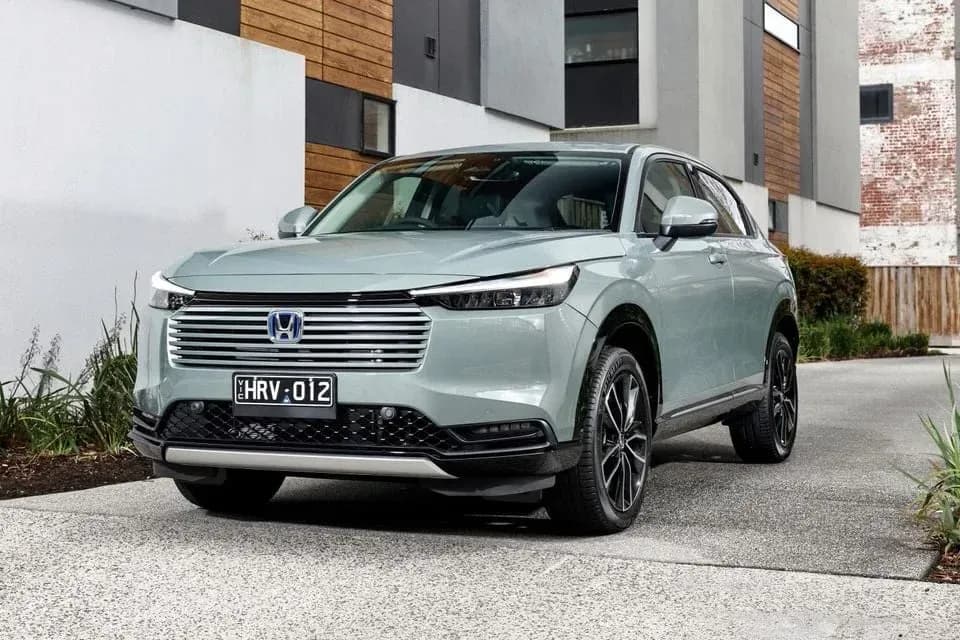
Image credit: Honda Australia
If you have been eyeing a small hybrid SUV but did not want to drop into Toyota Corolla Cross or Hyundai Kona Hybrid money, the Honda HR-V just got a more interesting answer. Honda Australia has added a sportier e:HEV RS grade to the top of the HR-V range, priced from $44,400 driveaway. It does not give you any more grunt than the e:HEV L sitting below it, but it brings the RS nameplate back to the small SUV and packages it with darker exterior trim, bigger wheels and a more aggressive cabin. For HR-V shoppers who have been frustrated by the grandma-spec look of the current car, this is the version to look at.
2026 Honda HR-V Pricing
The new RS slots in above the e:HEV L as the most expensive HR-V you can buy, while the entry petrol Vi X is still the way in for $32,900 driveaway. Honda Australia continues to price the HR-V on a driveaway basis, which keeps the on-roads sting out of the comparison with rivals quoted on RRP.
| Variant | Price (driveaway) |
|---|---|
| Petrol | |
| HR-V Vi X | $32,900 |
| Hybrid (e:HEV) | |
| HR-V e:HEV X | $39,900 |
| HR-V e:HEV L | $42,900 |
| HR-V e:HEV RS (new) | $44,400 |
A $1,500 walk from the e:HEV L to the new RS gets you the visual upgrades and the cabin trim package, but the mechanical setup carries straight over. Whether that walk is worth it comes down to how much you care about the wheels, the grille and the red highlights inside.
Powertrain and Performance
Honda is not changing the recipe under the bonnet. The e:HEV RS runs the same two-motor hybrid setup that has been in the HR-V since the e:HEV X joined the range in 2023. A 1.5-litre four-cylinder Atkinson-cycle petrol engine pairs with two electric motors, with drive going to the front wheels through an electric continuously variable transmission. Combined output is rated at 96kW and 253Nm, and Honda claims combined fuel use of 4.3 L/100km.
The headline number to remember is that 4.3 L/100km figure, because it is genuinely impressive for a small SUV and it is what makes the e:HEV grades worth their premium over the Vi X. The Vi X uses a 1.5-litre petrol with 89kW and 145Nm matched to a CVT, and its real-world fuel use sits closer to the mid-6s. Over 15,000km a year at $1.85 a litre, the hybrid saves roughly $570 in fuel against the petrol, so the payback on the $7,000 walk from Vi X to e:HEV X is a long one. The shorter argument is for refinement and quiet running around town, where the e:HEV genuinely feels like a class above the base car.
| Spec | Vi X (petrol) | e:HEV RS (hybrid) |
|---|---|---|
| Engine | 1.5L 4-cyl | 1.5L 4-cyl Atkinson + dual e-motors |
| Combined power | 89 kW | 96 kW |
| Torque | 145 Nm | 253 Nm |
| Transmission | CVT | e-CVT |
| Drive | FWD | FWD |
| Fuel (claimed) | ~6.2 L/100km | 4.3 L/100km |
| Length / Width / Height | 4,335 / 1,790 / 1,590 mm | |
| Wheelbase | 2,610 mm | |
| Boot (rear seats up / max) | 304 L / 1,274 L | |
What the RS Pack Actually Adds
The visual changes are mostly about darkening things and pushing the wheels up a size. Outside, you get an RS-specific grille finished in Bernina Black, gloss-black trim across the lower front bumper, the door garnishes and the mirror caps, plus 18-inch alloys in their own design. The e:HEV L below it runs smaller wheels and brighter trim, so even at a glance you can tell the two apart on a dealer forecourt.
Inside, Honda has wrapped the seats in a mix of black synthetic leather, suede and cloth, and added red stitching across the cabin along with red accents on the door cards and the lower dashboard. The rest of the equipment list is the same as the e:HEV L: LED lighting with adaptive high beam, a powered tailgate, dual-zone climate control, an 8.0-inch touchscreen with wireless Apple CarPlay and Android Auto, and Honda Connect connected services for things like remote lock and vehicle status.
Practicality
Bodywork is unchanged. The HR-V is 4,335mm long, 1,790mm wide and 1,590mm tall on a 2,610mm wheelbase, which keeps it sitting in the small-SUV bracket alongside the Kona, Yaris Cross and CX-30. Boot space is 304 litres with the rear seats up, growing to 1,274 litres measured to the roof with them folded. That is a smaller boot than a Kia Seltos or Hyundai Kona on paper, but the HR-V wins back ground with its Magic Seats, which fold flat and also flip up cinema-style to swallow tall items like a folded e-bike or a pot plant behind the front seats. It is genuinely the most flexible small-SUV cabin in the segment.
Safety
The HR-V holds a 4-star ANCAP rating based on testing conducted in 2022, and that result applies across the whole current range including the new e:HEV RS. Standard Honda Sensing kit includes autonomous emergency braking with pedestrian and cyclist detection, adaptive cruise control with low-speed follow, adaptive lane guidance, blind-spot monitoring, rear cross-traffic alert and a reversing camera. It is a solid kit list for the price, but the 4-star ANCAP result is something to be aware of if a 5-star score is on your tick list. Our guide to car safety features walks through what each system actually does in traffic.
How the e:HEV RS Stacks Up Against Its Rivals
At $44,400 driveaway, the e:HEV RS sits in a tight bracket against two obvious rivals. The Hyundai Kona Hybrid Premium opens at around $45,950 before on-roads, and a top-spec Toyota Corolla Cross Atmos Hybrid 2WD is closer to $47,990 before on-roads. Once you factor in registration, stamp duty and dealer charges, the Honda is roughly $1,500 cheaper than the Kona and around $3,500 cheaper than the Corolla Cross on like-for-like comparisons in most states.
On efficiency, all three sit within a litre of each other on the combined cycle, but the Honda has the simplest hybrid story, with no plug, no fancy charging strategy and a powertrain that has been on Australian roads for two years now without anything dramatic going wrong. The Toyota counters with the strongest resale of the three, and the Hyundai brings a longer warranty. If you want to drop the RS into a like-for-like cross-shop with a few of those rivals, our Honda HR-V vs Hyundai Kona comparison and the HR-V vs Corolla Cross page both lay out the numbers side by side.
The CarSorted Angle
On the CarSorted directory, the Honda HR-V already shows the e:HEV L as the top of the hybrid tree at $42,900 driveaway. The RS adds $1,500 to that number for the styling pack and 18-inch wheels without changing the powertrain, so it is a pure trim upgrade, not a performance one. Cross-shopped against in-database rivals, the e:HEV RS lines up at roughly $1,550 below the Hyundai Kona Hybrid Premium and $3,590 below the Corolla Cross Atmos Hybrid 2WD on driveaway-versus-list maths. It is also $1,500 below the cheapest Honda ZR-V hybrid (the e:HEV X at $45,900 driveaway), so the brand now lets you spend less to land in a smaller, lighter hybrid SUV instead of stepping straight up to the mid-size car.
Run the running-cost maths from our side and the picture firms up. At Honda's claimed 4.3 L/100km and 15,000km a year of city-leaning driving, the e:HEV RS uses about 645 litres of 91 RON a year. At $1.85 a litre that is roughly $1,193 in fuel. The same yearly mileage in the Vi X petrol works out closer to $1,720 on its 6.2 L/100km figure, so the hybrid pays back around $527 a year. Add it up over a 5-year hold and you have shaved most of the gap between the Vi X and the entry e:HEV X off your running costs, with the bonus that the hybrid is markedly quieter in stop-start traffic. Use the CarSorted compare tool to set those numbers against a Kona Hybrid, a Yaris Cross GXL Hybrid or a Mazda CX-30 to see which side of the fence the HR-V actually lands on for your driving.
Warranty and Servicing
Honda Australia covers the HR-V with a 5-year unlimited-kilometre warranty plus 5 years of roadside assistance and an 8-year battery warranty on the hybrid components. Servicing is on a 12-month or 10,000km schedule, whichever comes first, and Honda has been running capped-price service offers that include a few low-cost intervals at the start of ownership. That sits behind the seven and eight-year covers offered by Kia and MG, but it stays comfortably ahead of the older Toyota and Mazda standard programs.
What This Means for Buyers
If you are cross-shopping the e:HEV L at $42,900 against the new e:HEV RS at $44,400, the answer is mostly an aesthetic one. The drivetrain is identical, the safety kit carries over, the cabin tech is the same. The walk gets you 18-inch wheels, the darker exterior detailing and the red-trimmed interior. If you want the look, $1,500 over five years is small money. If you do not, the e:HEV L is the smarter buy.
The harder question is whether you should buy an HR-V e:HEV at all rather than stepping into something newer like a BYD Atto 2, a Hyundai Kona Hybrid Premium or a Mazda CX-30 G20e. The Honda counters with build quality, that two-motor hybrid that just works, and the Magic Seat trick, but it lands with a 4-star ANCAP score and a smaller boot than most of its rivals. For buyers who keep cars for seven or eight years and who like a quiet, polished commute, the e:HEV RS is the most appealing HR-V to date. For buyers chasing the best safety score or the longest warranty in the class, the Kona or a Chinese-brand alternative still has the edge. Use the CarSorted directory to filter the small-SUV class on price, ANCAP, fuel use and warranty, and shortlist on the things that matter to you rather than the colour of the grille.
Best Hybrid Cars 2026 | EV vs Hybrid: Which Saves More? | 2026 Honda ZR-V Price and Specs
Disclaimer: Pricing and specifications are sourced from Honda Australia and are current at time of writing. HR-V pricing is driveaway. Rival pricing is quoted before on-road costs as listed by the relevant manufacturer. Fuel economy is the manufacturer's combined cycle claim and will vary with driving conditions. ANCAP rating reflects 2022 testing. Always confirm final pricing and specification with a dealer before purchase.