Key Takeaways
- Chery's COO shared the first Stockman Super Hybrid prototype testing on Australian roads
- Australia is set to be the Stockman's first market in the world, launch expected late 2026
- Diesel plug-in hybrid, Chery-claimed 350kW / 800Nm, 4WD with low range
- 3,500kg braked towing, up to 100km electric-only range (NEDC), 1,000kg payload
- Aimed squarely at the BYD Shark 6; pricing not announced and we are not estimating one
- All figures are manufacturer claims and indicative until the local launch
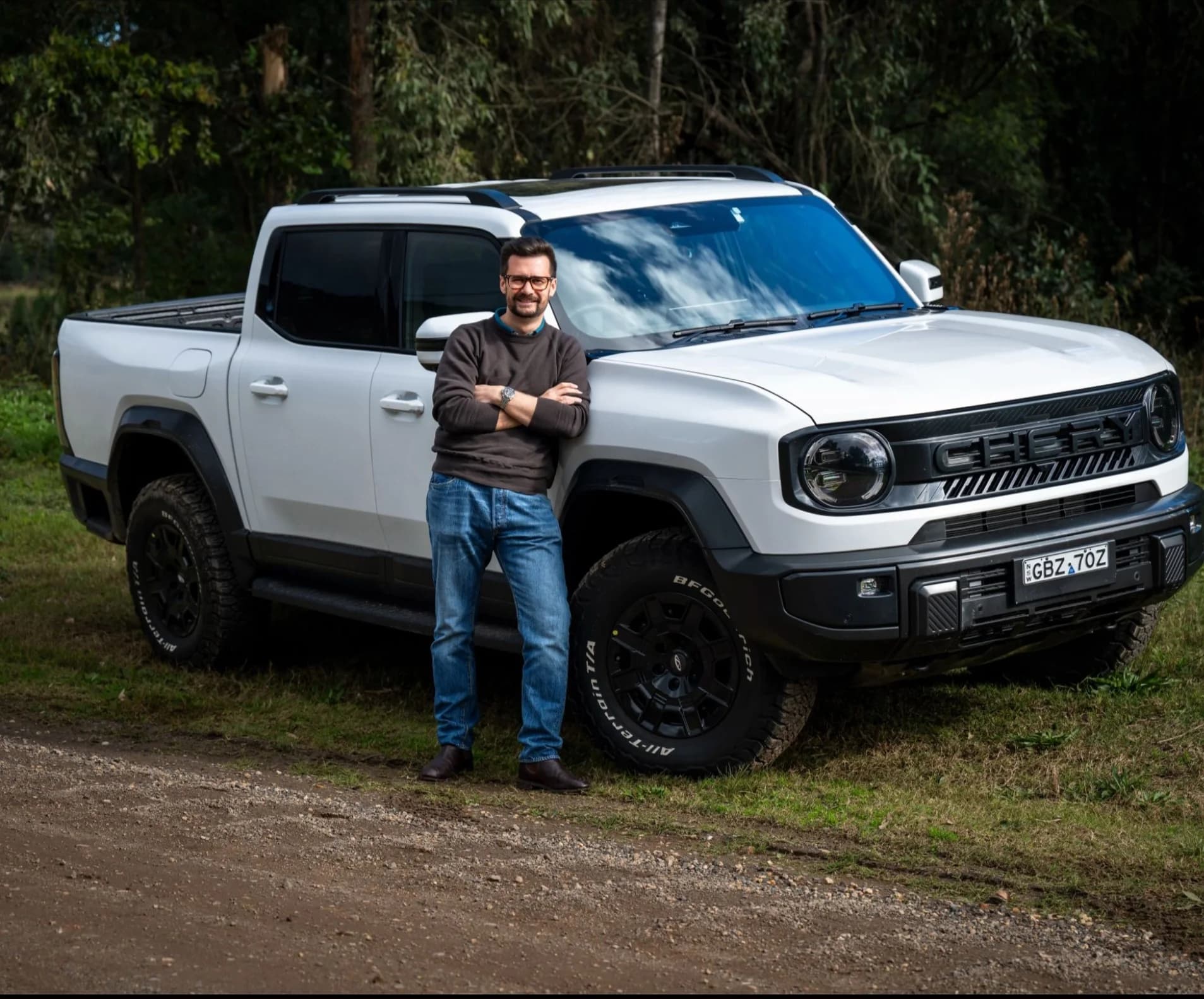
Image credit: Mr. Lucas H. (Chery COO) via LinkedIn
The Chery ute is getting real. Chery's chief operating officer, Lucas H., has posted a photo of the first Chery Stockman Super Hybrid prototype parked on a dirt roadside in Australia, and it is the clearest sign yet that the brand's first dual-cab is moving from show stand to showroom. Chery has already told us Australia will be the Stockman's launch market before anywhere else in the world, so seeing a running car on local soil is a genuine milestone rather than a render.
The prototype in the photo is a chunky, boxy dual-cab wearing an all-terrain tyre and a blacked-out grille with CHERY spelled out across it. It looks the part. What sits underneath is the more interesting story, because the Stockman is not chasing the diesel establishment with another diesel. It is going after the new wave of plug-in hybrid utes led by the BYD Shark 6.
What Chery is claiming
The launch powertrain is a diesel plug-in hybrid that Chery badges Super Hybrid. Rather than the petrol PHEV setup in the Shark 6, Chery pairs a 2.5-litre turbo-diesel with electric drive, which is an unusual and interesting combination for a work-focused ute. Here is what the brand is quoting so far. Treat these as manufacturer claims, because the car is still a prototype and Australian figures will be locked in closer to launch.
| Item | Chery claim (indicative) |
|---|---|
| Powertrain | 2.5L turbo-diesel plug-in hybrid (Super Hybrid) |
| Combined output | 350kW / 800Nm |
| Drive | 4WD with low range |
| Electric range | Up to 100km (NEDC); battery capacity not published |
| Combined fuel claim | near 2.0L/100km |
| Braked towing | 3,500kg |
| Payload | 1,000kg |
| Size | 5,450mm long, 3,250mm wheelbase |
| Launch | Late 2026, price not announced |
Why it matters
If Chery gets even close to those numbers, the Stockman lands among the most powerful utes in our database while still keeping the two things tradies actually check first: a full 3,500kg braked tow rating and a payload near a tonne. The plug-in side means it can do the school run and the daily commute on electricity, then behave like a diesel when the tray is loaded and the trailer is on. That is exactly the pitch the BYD Shark 6 has ridden to strong early sales, and the Stockman looks set to give buyers a genuine second option in a segment that had none a year ago.
The obvious unknown is price. Chery has not said a word on it beyond promising one closer to market introduction, and we are not going to invent a figure for a car that has none. It will also be cross-shopped against the diesel establishment, the Ford Ranger, Toyota HiLux and Isuzu D-Max, plus the other value hybrid challenger, the GWM Cannon Alpha.
For now, a prototype on an Australian back road is the update. We have the Stockman logged as coming soon in the CarSorted directory with the early specs above, and we will fill in pricing, confirmed Australian figures and an on-sale date the moment Chery makes them official.
The diesel plug-in question
Here is what makes the Stockman genuinely different. Almost every plug-in hybrid ute headed to Australia pairs a petrol engine with electric drive, the BYD Shark 6 and GWM Cannon Alpha included. Chery is going diesel plug-in. That is a deliberate call. Diesel makes torque low in the rev range and sips fuel on a long tow, which is exactly the job an Australian ute gets asked to do, and the electric side layers on instant response and a genuine EV commute in between. On paper it is the best-of-both pitch that towing buyers have been asking about for years.
The catch, and the reason we are keeping the caveats loud, is complexity and weight. A diesel engine plus a battery plus electric motors is a lot of hardware to carry, and heavy utes eat into payload fast. That is why the numbers below matter more than the power figure.
Can it really tow and carry at the same time?
A 3,500kg tow rating and a big power number look great on a spec sheet, but the figure that actually ends road trips is how much you can carry once the trailer is hooked up. Plug our claimed Stockman figures into the towing and payload calculator below, add your trailer, your passengers and your gear, and see what is left. When Chery confirms the kerb weight, GVM and GCM we will slot them straight in, and the maths will get sharper.
Payload 1,000 kg · Braked tow 3,500 ·
Passengers, accessories and the tow-ball all count against the vehicle's payload and GVM. The trailer adds to GCM.
Total weight of people and gear inside the vehicle
Fully-loaded trailer weight, not the dry tare
Assumed at 10% of trailer ATM
Enter both from a weighbridge / your compliance plate to add a rear-axle gauge. Nothing here is estimated.
How these are calculated
Payload = GVM − kerb weight. Passengers, accessories and the tow-ball download all count against it.
GVM used = kerb + passengers + accessories + tow-ball.
GCM used = kerb + passengers + accessories + trailer (ATM). The tow-ball isn't added twice: it's part of the vehicle load and comes out of the trailer's axle weight, so (kerb + load + tow-ball) + (ATM − tow-ball) = kerb + load + ATM.
Tow = trailer ATM vs the braked rating. Tow-ball is assumed at 10% of the trailer (a common rule of thumb) unless you enter your own.
When a vehicle's kerb weight isn't published but its payload is, we derive kerb = GVM − payload. Manufacturers usually quote payload off the lightest build, so a car with options already fitted will have a little less real-world payload.
Vehicle weights (kerb, GVM, GCM, braked-tow and tow-ball limits) are the manufacturer's published figures from our database. Figures are a guide, not independently verified. Confirm against the compliance plate and never exceed rated GVM, GCM, tow or tow-ball limits.
Prefer the full version? The same tool lives on our Towing & Payload Calculator, and you can line the Stockman up against every rival on the ute category page once its numbers are locked in.
Where it fits in Chery's Australian charge
The Stockman is not a one-off. Chery has gone from a standing start to one of Australia's fastest-growing brands in barely two years, stacking the small SUV space with the Tiggo range, the C5, the E5 and a wall of Super Hybrid options. A dual-cab ute is the last big-volume body style it did not have, and Australia buys utes like almost nowhere else on earth. Launching the Stockman here first, before its home market, tells you how seriously Chery is taking this segment. Where the price lands is the whole question, and Chery has not answered it yet.
Disclaimer: The Chery Stockman is a pre-production prototype. All performance, efficiency, battery, towing and dimension figures are manufacturer claims sourced from Chery Australia's preview material and its Stockman model page, and are indicative only, pending confirmation at the Australian launch. Pricing has not been announced and no CarSorted estimate is published. ANCAP has published no rating for this model. The lead image was shared publicly by Chery Australia's COO on LinkedIn and is used for editorial reporting.