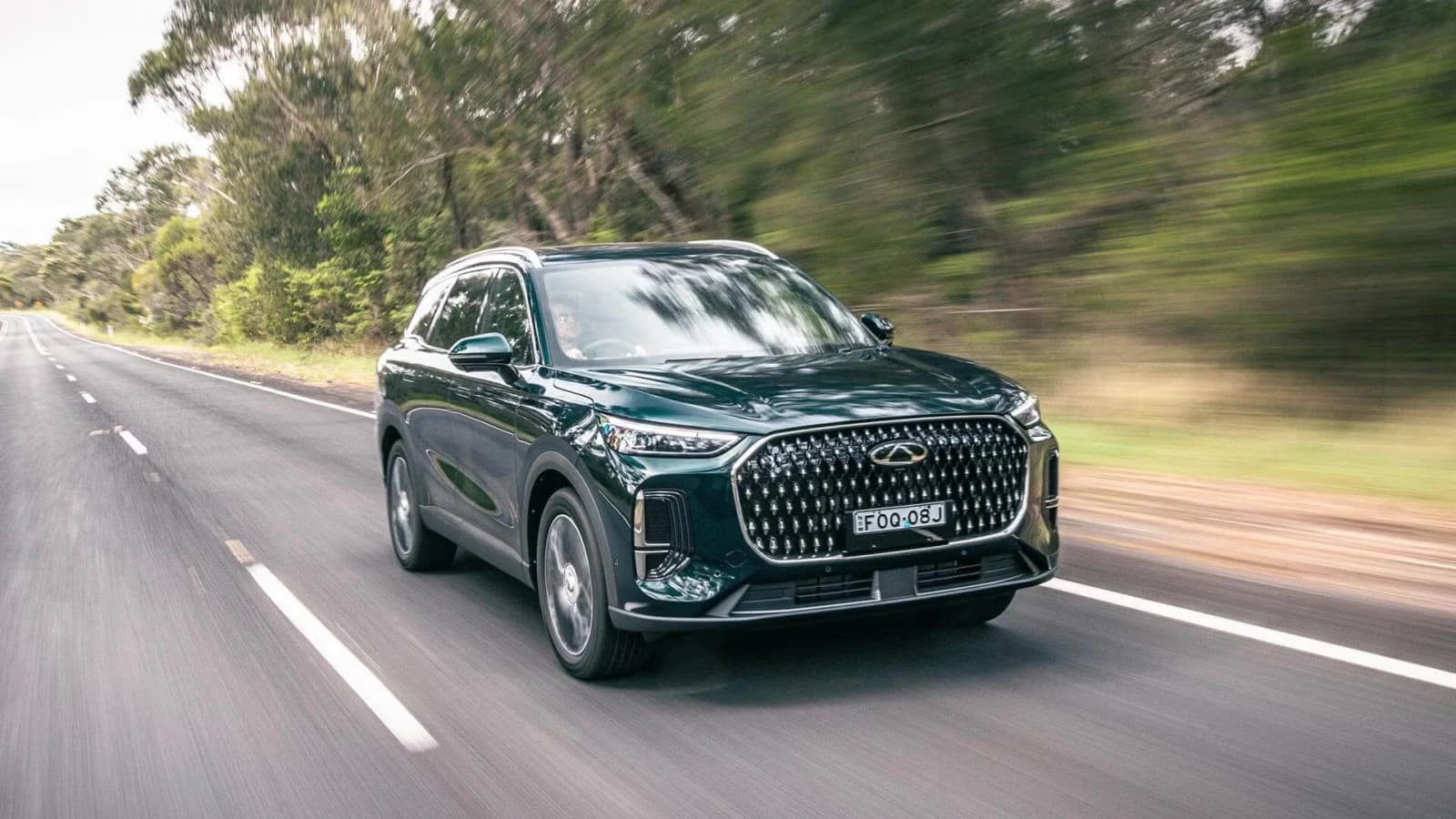
The Chery Tiggo 9 Super Hybrid is the newcomer challenging two established seven-seaters. Image credit: Chery Australia
Quick verdict
- Best value: Chery Tiggo 9 Super Hybrid Ultimate AWD at $59,990 plus on-road costs. Plug-in hybrid powertrain, 170km EV range, 315kW combined.
- Best all-rounder: Kia Sorento GT-Line Hybrid AWD. Best driving manners, best interior, but the most expensive to service.
- Best long-term hold: Toyota Kluger Grande. Highest resale (65.5 per cent at three years), cheapest servicing, biggest tow rating, but its cabin technology is a generation behind the others.
- For towers: Kluger only. 2,000kg braked vs 1,650kg Sorento vs 1,500kg Tiggo.
A generation ago the family driveway had a sedan or a station wagon. Today it has a seven-seat SUV. And right now there are three from three different eras vying for that spot: the evergreen Toyota Kluger, the award-winning Kia Sorento, and the brand new Chery Tiggo 9 Super Hybrid. Japan, South Korea, and now China, all pitching at the same growing family.
We compared the flagship of each, all hybrid or PHEV, all all-wheel drive. Here is how they stack up on price, powertrain, cabin, safety and the running costs that matter once the showroom honeymoon ends.
Price: the Chery lands a big punch
Pricing is where the comparison starts and where the Chery already swings hard. The Tiggo 9 Super Hybrid Ultimate AWD sits at $59,990 before on-road costs, which is roughly $14,500 under the Sorento Hybrid GT-Line AWD and $25,000 below the Kluger Grande.
| Model | RRP (excl. ORC) | Powertrain |
|---|---|---|
| 2026 Chery Tiggo 9 Super Hybrid Ultimate AWD | $59,990 | PHEV, 315kW combined |
| 2026 Kia Sorento GT-Line Hybrid AWD | $74,540 | HEV, 169kW combined |
| 2026 Toyota Kluger Grande Hybrid AWD | $85,135 | HEV, 184kW combined |
Kia offers a base petrol Sorento S from around $51,630 plus on-road costs, so the entry to the range is cheaper, but the apples-to-apples flagship hybrid is the GT-Line at $74,540. The Sorento PHEV adds about $10,000 again. Toyota only sells the Kluger as a petrol hybrid in Australia, with the range opening at $62,410 for the GX and topping out at $85,135 for the Grande. Chery offers a more affordable Tiggo 9 Super Hybrid Elite FWD at $52,990 plus on-road costs, which is the cheapest entry point of any in this set.
Powertrain: three very different ways to mix petrol and electric
All three are technically hybrids, but they do it in completely different ways. The Tiggo 9 is the only plug-in here. The Sorento uses a small lithium-ion buffer that recharges via regen only. The Kluger uses an older nickel-metal hydride pack with no plug.
| Spec | Tiggo 9 SH Ultimate | Sorento HEV GT-Line AWD | Kluger Grande Hybrid |
|---|---|---|---|
| Type | PHEV | HEV | HEV |
| Engine | 1.5L turbo, 105kW / 215Nm | 1.6L turbo, 132kW / 265Nm | 2.5L atmo, 142kW / 242Nm |
| Electric motors | 3 (75kW front + 90kW gearbox + 175kW rear) | 1 (44kW) | 2 (88kW front + rear motor) |
| System power | 315kW / 580Nm | 169kW / 350Nm | 184kW |
| Battery | 34kWh lithium-ion | 1.49kWh lithium-ion | 1.9kWh nickel-metal hydride |
| EV range | 170km NEDC | Regen only | Regen only |
| Transmission | Dedicated hybrid transmission | 6-speed auto | CVT |
| Drive | AWD | AWD | AWD |
| Fuel use (claimed) | 1.4L/100km NEDC | 5.7L/100km WLTP | 5.6L/100km WLTP |
| Fuel grade | 95 RON | 91 RON | 95 RON |
| Braked tow | 1,500kg | 1,650kg | 2,000kg |
The Tiggo 9's 315kW system power is genuinely large-SUV-eating territory, and its 580Nm arrives from three electric motors rather than having to be built up by a combustion engine. The 170km NEDC EV range is quoted on an old and generous test cycle, but even at a heavy discount it covers most family commutes without burning petrol, provided you can charge at home overnight. Chery quotes 6.6kW AC and 71kW DC charging.
The Sorento and Kluger feel more familiar. The Sorento's 1.6-litre turbo is the most engaging engine of the three, pairing a real torque converter six-speed auto with a small e-motor for clean, brisk progress. The Kluger's 2.5-litre Atkinson is the noisiest under load and the CVT flares more than the others when you push it. Drive any of them gently and they all feel quick enough; lean on the throttle and the Chery walks away.
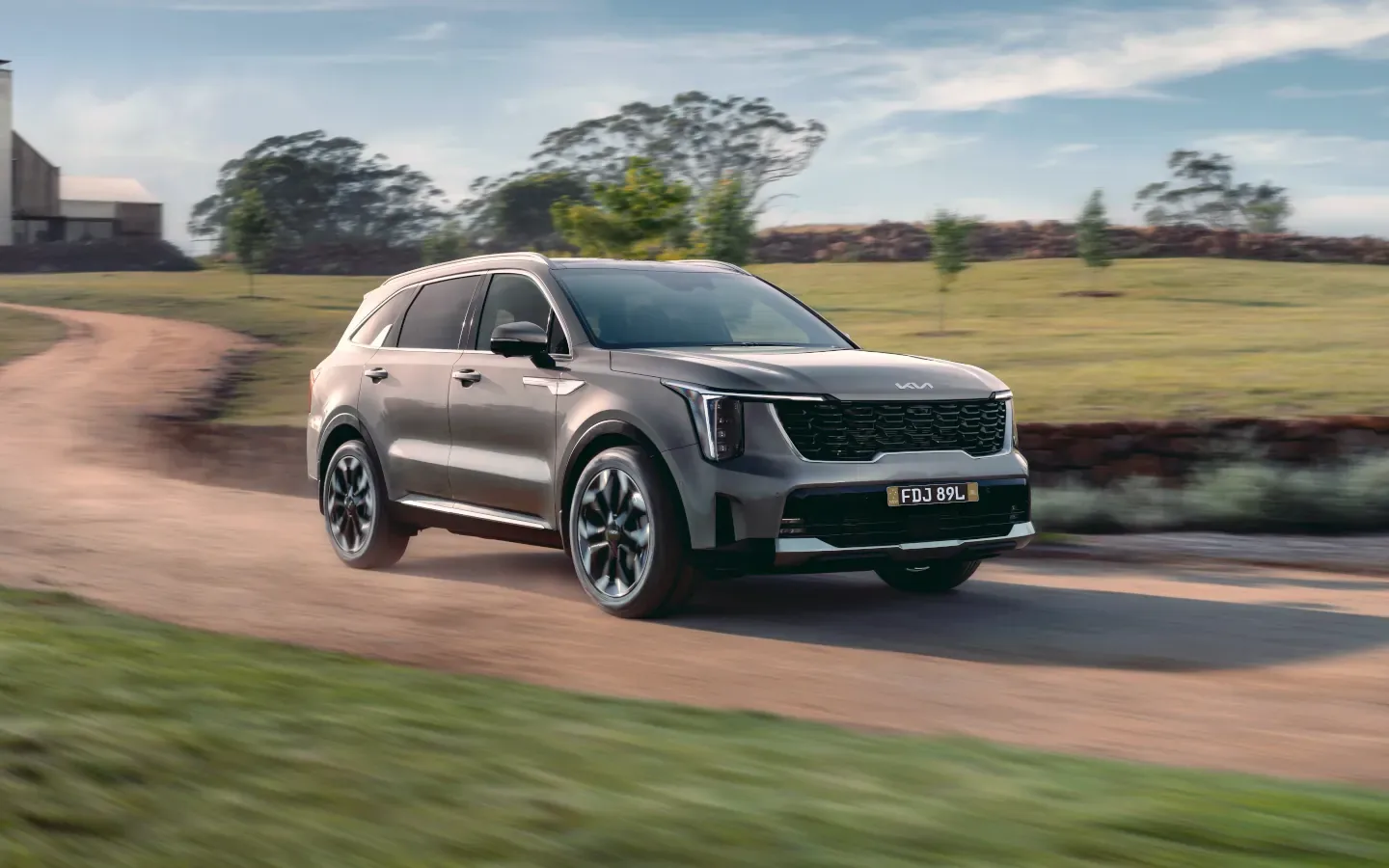
Kia Sorento GT-Line Hybrid AWD: the best driving feel of the three. Image credit: Kia Australia
Cabin: modern Chinese, practical Korean, dated Japanese
The Tiggo 9's cabin is built around a 15.6-inch central screen, which dominates the dash and runs basically every function. There is a 10.25-inch digital cluster, brushed metal trim across the centre console, organic stitch patterns on the door cards, and proper storage including a hidden compartment under the bin. It is the most modern cabin of the three by a wide margin.
Catch is, putting climate controls inside the touchscreen is a step backwards when you are also running Apple CarPlay. The Sorento and Kluger both have physical controls for the basics, and the Sorento's haptic ventilation panel is the slickest implementation of the three. Toyota's button-heavy approach looks dated next to the others but is the easiest to use eyes-up.
Build quality wise the Sorento and Kluger are roughly even and both ahead of the Chery, which is solid but has more brittle plastics in places. The Kia is the only one with wireless Android Auto. All three have wireless CarPlay, leather, heated and ventilated front seats, panoramic sunroof, head-up display, power tailgate, and twin digital screens.
| Dimension | Tiggo 9 | Sorento HEV | Kluger |
|---|---|---|---|
| Length | 4,800mm | 4,815mm | 4,966mm |
| Width | 1,930mm | 1,900mm | 1,930mm |
| Height | 1,730mm | 1,700mm | 1,755mm |
| Wheelbase | 2,750mm | 2,815mm | 2,850mm |
| Boot, 7 seats up | 143L | 175L | 241L |
| Boot, 3rd row down | 819L | 604L | 552L |
| Boot, both rows down | 2,065L | 1,988L | 1,150L |
The Kluger is the longest car here and has the biggest boot with all seven seats up. But fold the third row away and the picture flips: the Tiggo 9 has by far the most usable cargo space behind the front row, followed by the Sorento, with the Kluger a distant third.
Third row access is a sore point for the Tiggo. You have to flip the second-row backrest first and then slide the base separately. Both the Sorento and Kluger have one-touch tip-and-slide systems. Once you are in row three, the Sorento is the only car here that gives you USB power and face-level air vents back there.
Safety: two with stars, one without (yet)
Both the Sorento (tested 2020) and Kluger (tested 2021) carry a maximum five-star ANCAP rating. The Tiggo 9 Super Hybrid has not been ANCAP tested yet, so it has no published star rating. We will not assume one until the result is in.
| ANCAP category | Tiggo 9 | Sorento (2020) | Kluger (2021) |
|---|---|---|---|
| Adult occupant | Not tested | 82 per cent | 90 per cent |
| Child occupant | Not tested | 85 per cent | 88 per cent |
| Vulnerable road user | Not tested | 63 per cent | 76 per cent |
| Safety assist | Not tested | 89 per cent | 82 per cent |
On standard kit the Tiggo actually has more airbags (10 including driver knee and front centre) than either the Sorento or Kluger (seven each). All three have AEB, adaptive cruise, blind-spot, lane-keep, rear cross-traffic alert, 360-degree camera and tyre pressure monitoring. The Sorento adds a digital rear-view mirror that none of the others fit.
ADAS calibration is the open question on the Tiggo: early Chery products in Australia drew consistent published criticism for over-eager lane keep and adaptive cruise tuning, and Chery has been shipping software updates in response. Worth testing on your own drive before you decide.
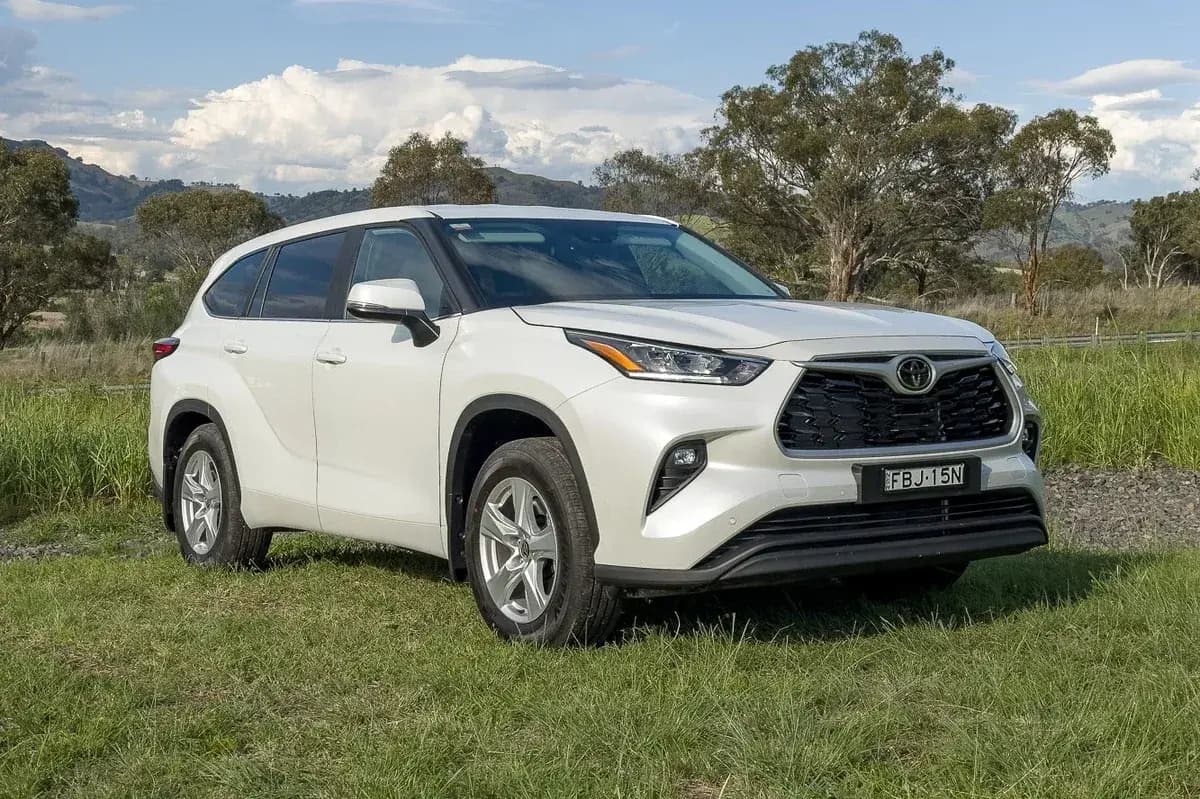
Toyota Kluger Grande Hybrid AWD: highest resale, cheapest to service. Image credit: Toyota Australia
On the road
We have not driven these three back to back, so rather than hand you impressions, here is what the published hardware and figures actually tell you about how each one will behave.
Start with mass, because it sets up everything else. The Tiggo 9 Ultimate AWD is the heavy one at 2,220kg, which is what carrying a 34kWh battery costs you. The Kluger Grande Hybrid AWD is 2,095kg. The Sorento runs from 1,898kg to 2,040kg depending on grade. All three top grades roll on 20-inch wheels, so the heaviest car here is managing the most weight on the least tyre sidewall. That combination usually shows up as a firmer edge over sharp bumps rather than as better body control.
The suspension hardware is published and it differs. Chery gives the Tiggo 9 MacPherson struts at the front and a multi-link rear. Toyota pairs MacPherson struts with a double-wishbone rear on the Kluger. We hold no suspension specification for the Sorento, so we are not going to characterise how it rides. None of the three is listed with adaptive damping, so there is no drive mode that meaningfully changes the ride. What each car leaves the factory with is what you live with.
Packaging is what you notice at low speed. The Kluger is the longest at 4,966mm on a 2,850mm wheelbase, and still turns inside 11.4m. The Sorento is 4,815mm on a 2,815mm wheelbase and needs 11.6m. The Tiggo 9 has the shortest wheelbase of the three at 2,750mm but the widest turning circle at 11.8m. In a multi-storey car park, that is the number you will meet first.
Outputs are not close. The Tiggo 9 combines a 1.5-litre turbo petrol with three motors for 315kW and 580Nm, against 184kW for the Kluger hybrid system and 169kW for the Sorento HEV. Chery quotes 6.6kW AC and 71kW DC charging, and 170km of electric range on the NEDC cycle. NEDC is an old and generous test, so treat that as a laboratory ceiling rather than a number you will see on your commute.
Towing is where the Chery concedes the most. The Kluger and the petrol Sorento are both rated to 2,000kg braked. The Tiggo 9 is rated to 1,500kg. If you tow a caravan or a decent boat, that single line settles this comparison before ride quality gets a vote.
Ownership: warranty, service, resale
| Item | Tiggo 9 SH | Sorento HEV | Kluger |
|---|---|---|---|
| Warranty | 7 years, unlimited km | 7 years, unlimited km | 5 years, unlimited km |
| Battery warranty | 8 years, unlimited km | 8 years, 160,000km | 10 years, conditional |
| Roadside | Free up to 7 yrs | Free up to 8 yrs | $99 to $139 / yr |
| Service interval | 12 mo / 15,000km | 12 mo / 10,000km | 12 mo / 15,000km |
| Avg annual service | $453 | $650 | $280 |
| 7-yr total servicing | $3,174 | $4,552 | $1,400 (5 yrs) |
| 3-yr retained value (RedBook) | 56.8 per cent | 57.5 per cent | 65.5 per cent |
The Kluger is the cheapest car to service by a wide margin and holds its value better than anything else here. The catch is the five-year warranty, which is two years shorter than what Kia and Chery offer, and the lack of free roadside cover. If you keep cars for ten years, the Toyota will likely cost the least overall once you factor in resale.
The Sorento is the most expensive to service, but it also gets the longest free roadside cover (8 years) and the most generous warranty terms in the segment.
The Tiggo 9 sits comfortably between the two on running costs and lines up with Kia on warranty. Its real cost advantage is fuel: if you have a home wallbox and drive 30 to 50km per day, you can plausibly run the car on electricity alone for the first 170km of every charge cycle.
Verdict
Each of these cars wins on a different metric. The trick is matching the right one to how you actually use a family seven-seater.
- Buy the Chery Tiggo 9 Super Hybrid Ultimate if value and running cost matter more than long-term resale. $25,000 less than the Kluger plus the option to drive on electricity most of the time is a serious case, particularly if you have rooftop solar.
- Buy the Kia Sorento GT-Line Hybrid AWD if you want the most complete all-rounder. It is the lightest of the three, it is the only one offered with petrol, diesel, hybrid and PHEV drivetrains, and it holds a 5-star ANCAP rating from 2020. Kia Australia runs a local ride and handling tuning program for it, which is worth a back-to-back test drive of your own before you decide.
- Buy the Toyota Kluger Grande if you tow regularly, plan to keep the car for a long time, and want cheap servicing plus Toyota dealer coverage everywhere. Its tech and interior are a generation behind the other two, but it is the lowest-friction option to own.
On the day-to-day, head-to-head comparison: the Sorento wins. It has the best chassis, the best interior on balance, and the most resolved hybrid. The Tiggo 9 is the breakout disruptor of the segment but still needs a software pass to feel finished. The Kluger is the safe long-term play.
Compare any two of these head-to-head on the directory: Tiggo 9 vs Sorento, Tiggo 9 vs Kluger, or Sorento vs Kluger.
Disclaimer: Pricing reflects manufacturer RRPs excluding on-road costs at time of writing. Servicing and resale figures sourced from manufacturer capped-price schedules and RedBook three-year retained value estimates. ANCAP percentages from ancap.com.au tested 2020 (Sorento) and 2021 (Kluger); Tiggo 9 Super Hybrid is untested at time of writing. Read our methodology for how we source and verify data.