Key Takeaways
- In mycar's 2026 survey of 2,025 vehicle owners, 47% said they use AI tools to support servicing decisions
- mycar reported one in three petrol and diesel drivers trust AI advice as much as, or more than, a professional technician
- Around one in ten said AI made them more comfortable with jobs like air filters (17%), fuel filters (14%) and brake pads (12%)
- Our take: AI is a good research assistant and a poor mechanic. Use it to prepare questions and compare facts; leave safety-critical work to a professional
- Whatever the tool, check the number against a source you can see: the manufacturer's Australian page, the owner's manual or the technician's report
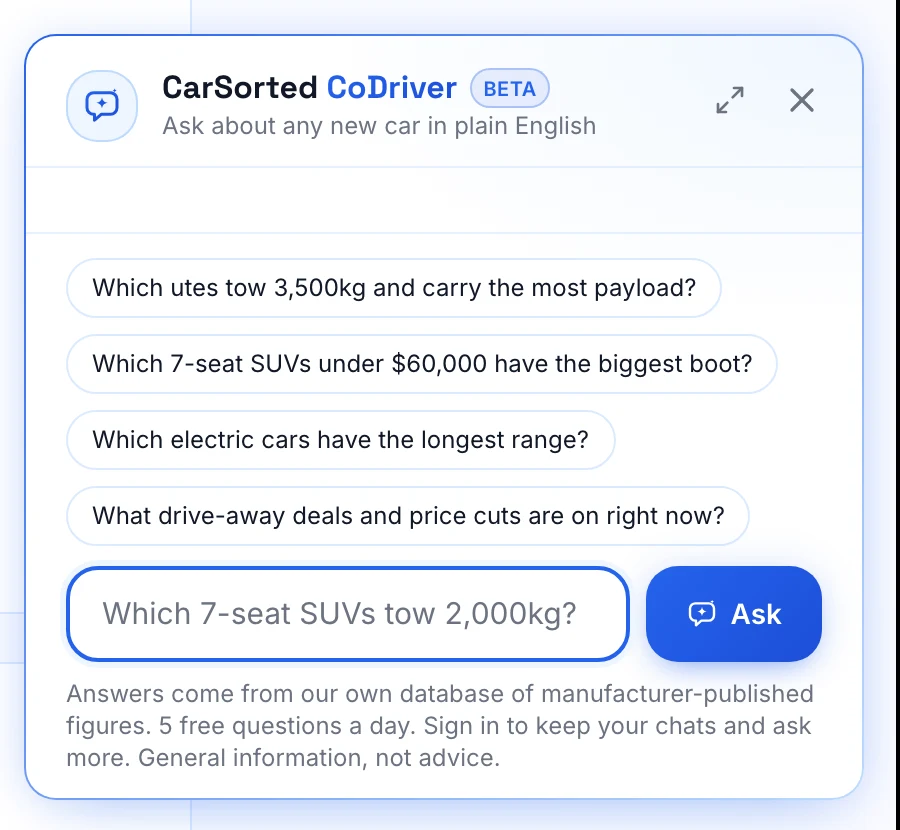
CarSorted's CoDriver, which answers from manufacturer-published figures. Image: CarSorted
Ask a chatbot why your car is making a noise and you'll get an answer in seconds, written with total confidence. That speed is exactly why so many drivers are using it, and exactly why it needs a bit of care.
mycar Tyre & Auto's third annual Mobility Index, a national survey of 2,025 vehicle owners released in June, put numbers on it. Nearly half (47%) of respondents said they turn to AI tools to support servicing decisions. mycar also reported that one in three petrol and diesel drivers trust AI advice as much as, or more than, a professional technician. The survey has been doing the rounds again this week, and it raises a fair question for anyone buying or running a car: should you use AI for car advice at all?
We think yes, for some things, and firmly no for others. Here's where we'd draw the line.
What the Survey Actually Found
| Finding (mycar Mobility Index 2026) | Share |
|---|---|
| Use AI tools to support vehicle servicing decisions | 47% |
| Petrol and diesel drivers who say AI helps them feel better informed with technicians | 49% |
| Petrol and diesel drivers who trust AI as much as, or more than, a technician | 33% |
| More comfortable replacing wiper blades or changing tyres because of AI | 21% |
| More comfortable replacing air filters themselves | 17% |
| More comfortable replacing fuel filters themselves | 14% |
| More comfortable replacing brake pads themselves | 12% |
mycar runs a national network of service centres, so it has a view on this, and it was upfront about it. Its managing director, Sylvain Borré, said AI is "not a replacement for expert care", that AI tools "consider vehicle servicing questions in isolation" and can't take a holistic view of the vehicle, and that "it's important to not place all your trust on AI tools". Its chief customer officer, Adele Coswello, made the case for the upside: AI can help drivers feel more informed and confident when they talk to a technician.
Both points are right, and they aren't in conflict. The useful question is which job you're giving the AI.
Researching your next car?
Search the directory, compare cars side by side or ask CoDriver. Figures are sourced from manufacturers' own published documents, with the source shown on each car page.
Where AI Genuinely Helps
Preparing for a service or a dealer visit. Asking an AI to explain what a timing belt does, what "capped-price servicing" covers, or what questions to ask before agreeing to a repair is a good use of it. You walk in better informed, and the technician still does the diagnosis. That matches what the survey found: about half of petrol and diesel drivers said AI helps them feel better informed.
Narrowing a shortlist. "Which seven-seat SUVs can tow 2,000kg?" or "Which small EVs have a heat pump?" are research questions, and research is where AI saves real time. The catch is the source. A general chatbot can blend model years, grades and overseas versions, so a towing figure for last year's car, or a range figure on a different test, can come back presented as current fact.
Explaining the jargon. Drive-away versus RRP, WLTP versus real-world range, GVM and GCM, what the luxury car tax threshold means. Plain-English explanations are something AI does well, and they make you a harder customer to confuse.
Where We'd Stop and Call a Professional
Anything that stops, steers or holds the car up. Brakes, steering, suspension, tyres and wheels are safety-critical. A chatbot can describe how brake pads are changed; it can't see your caliper, check the disc thickness or torque the wheel nuts. The 12% of respondents who feel more comfortable doing their own brake pads because of AI is the number in this survey that worries us.
Fuel systems and high-voltage parts. Fuel filters on modern cars can sit on pressurised lines, and hybrids and EVs carry high-voltage systems that are dangerous to touch without training. These are jobs for a qualified technician, whatever an app says.
Warranty-sensitive work. Many new-car warranties set conditions on servicing, such as the intervals, the parts and the records. Before doing anything yourself on a car under warranty, read the manufacturer's own warranty terms; an AI summary of "warranty rules in general" isn't your contract.
Diagnosis from a description. "It makes a grinding noise when I brake" has a handful of possible causes. An AI will list them; a technician will find the right one. Use the list to understand the conversation, not to skip it.
A Simple Test for Any AI Car Answer
Before you act on an AI answer about a car, ask three things:
- Can I see where this number came from? A price, towing figure, warranty or safety rating should trace back to the manufacturer's Australian page, the owner's manual or ANCAP. If it can't, treat it as a lead, not a fact.
- Is it the right car? Model year, grade, engine and market can each change the answer. An overseas figure or last year's spec is a common way to get a confident wrong answer.
- What happens if it's wrong? A wrong boot size is an annoyance. A wrong torque figure on a wheel nut is a safety problem. The higher the stakes, the more the answer needs a professional to check it.
Why We Built CoDriver the Way We Did
We have a stake in this question too, so here's ours in the open. CarSorted's CoDriver answers questions about new cars sold in Australia from our own database of manufacturer-published figures, and each car page shows the source behind its numbers. It's built for research and comparison, which is the part of the job we think AI is good at. It doesn't diagnose faults or walk you through repairs, and it's general information, not advice.
That's the same line we'd suggest for any tool you use: let AI do the reading and the comparing, keep the facts traceable, and keep a professional in the loop for anything that affects safety.
Get new-car facts you can trace, once a week
One short weekly email: launches, prices and the cars that changed. Unsubscribe anytime.
Our Take
AI is a good research assistant and a poor mechanic. The survey's upside is real: drivers who understand what they're being told make better decisions and get talked into fewer unnecessary jobs. The risk is the one in three who trust a chatbot as much as a trained technician, and the smaller group taking that confidence into brake and fuel work. Use AI to get informed, check the numbers against a source you can see, and let a professional put the spanners on anything that matters. The facts, side by side; your decision.
MORE: CarSorted CoDriver: ask about any new car in plain English
MORE: This month's manufacturer deals, each with its source and end date
Researching a new car?
The facts, side by side. Your decision.
Survey figures are from mycar Tyre & Auto's 2026 Mobility Index (national survey of 2,025 vehicle owners, released 18 June 2026), as published by mycar. This is an opinion piece and general information only, not mechanical, financial or legal advice. For repairs and servicing, use a qualified technician and follow your manufacturer's warranty terms.