Key Takeaways
- Audi quotes the RS 5 Sedan from $179,900 and the Avant from $182,900. Its own price calculator estimates $195,993 drive-away for the Sedan in NSW
- A twin-turbo V6 plus a 130kW motor makes 470kW and 825Nm, 139kW and 225Nm more than the old car, with a claimed 3.6 seconds to 100km/h
- Up to 78km (Sedan) or 76km (Avant) of claimed electric range, from a 25.9kWh battery with 11kW AC charging
- It is a heavy car: Audi quotes 2,497kg for the Sedan including a 75kg driver
- At 4.2 L/100km it misses the fuel-efficient tax line, so luxury car tax is about $24,350 on Audi's figures, and there is no FBT exemption
- Orders are open and cars are due before the end of 2026. No towing figure, no ANCAP rating
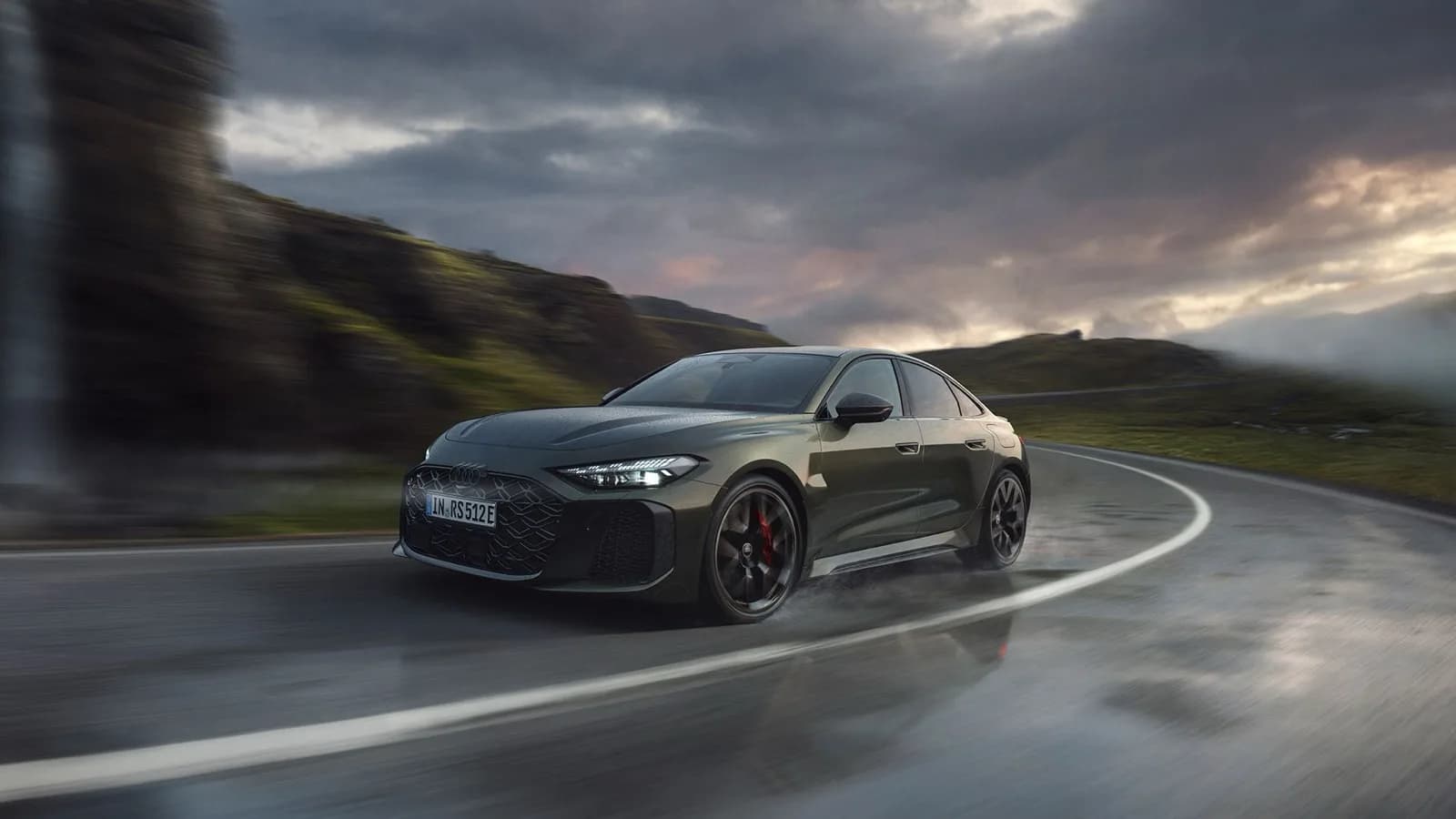
Image credit: Audi Australia. Overseas model shown.
The RS 5 is back, and it plugs in. Audi Australia has priced the new generation in two bodies, a liftback Sedan from $179,900 and an Avant wagon from $182,900, and says the cars are due before the end of the year. The RS 5 pages on Audi's Australian site now say dealers are taking orders. Audi calls it its first high-performance plug-in hybrid, and the numbers back up the ambition: 470kW and 825Nm from a twin-turbo V6 and an electric motor working together.
The part the headline price does not tell you is what this car costs on the road, how much of that is tax, and how much the battery weighs. Audi has already published a full Australian specification guide and a price calculator on its own site, so we can do better than repeat the launch figures. Here is what it actually adds up to.
Pricing
There is one powertrain and one grade, so the table is grouped by body. Audi's magazine article of 27 August quotes the two "from" prices with an asterisk it does not explain. Launch coverage in April reported them as excluding on-road costs. The other columns come from the starting price calculator on Audi Australia's RS 5 pages, which we checked on 1 October 2026.
| Figure | RS 5 Sedan | RS 5 Avant |
|---|---|---|
| Plug-in hybrid, 470kW / 825Nm, quattro | ||
| Audi's quoted "from" price | $179,900 | $182,900 |
| Manufacturer's list price (calculator, inc. GST) | $156,976.69 | $159,284.38 |
| Luxury car tax (calculator) | $24,350.31 | $25,042.61 |
| Recommended dealer delivery fee | $5,000 | $5,000 |
| Estimated drive-away, NSW | $195,993 | $199,142.99 |
Add the list price and LCT lines together and you get $181,327 for the Sedan and $184,327 for the Avant, about $1,427 more than the quoted "from" figures. The calculator's LCT line works out to exactly 33% of the GST-exclusive amount by which the list price plus the $5,000 delivery fee exceeds $80,809, so it is taxing the delivery fee as well as the car. Audi has not said how its headline figure was built. For budgeting, the calculator is the more complete of the two, and the drive-away estimate is the number to start from.
Stamp duty and registration are what move the drive-away figure between states. These are Audi's estimates for a car with no options, and Audi says the actual price is agreed with the selling dealer:
| State or territory | Sedan, drive-away (est.) | Avant, drive-away (est.) |
|---|---|---|
| NSW | $195,993.00 | $199,142.99 |
| Victoria | $195,216.10 | $198,342.09 |
| Queensland | $197,355.10 | $200,520.09 |
| Western Australia | $199,451.16 | $202,646.15 |
| South Australia | $194,618.01 | $197,738.00 |
| Tasmania | $194,506.73 | $197,626.72 |
| ACT | $198,933.00 | $202,172.99 |
| Northern Territory | $192,878.25 | $195,968.24 |
The wagon costs about $3,150 more than the Sedan once it is on the road in NSW. For that you get black roof rails, an item the Sedan does not offer, and, on Audi's figures, 361 litres of luggage space rising to 1,302 litres with the rear seats folded. Audi has not published a boot figure for the Sedan in the documents we checked.
The Powertrain: a V6, a Motor and a Small Battery
The engine is a 2,894cc twin-turbo V6 (Audi's magazine calls it a 3.0-litre, its model pages say 2.9), paired with a 130kW electric motor and an eight-speed automatic. Combined, the system makes 470kW at 6,300 to 6,800rpm and 825Nm from 2,000 to 5,000rpm. Audi says that is 139kW and 225Nm more than the previous model, which matches the 331kW and 600Nm we list for the outgoing RS 5 Sportback. The claimed 0 to 100km/h time is 3.6 seconds for both bodies, and top speed is limited to 250km/h, or 285km/h if you pay $4,400 for the Audi Sport package.
The battery is 25.9kWh gross, 22kWh usable, sitting under the boot floor. Audi quotes up to 78km of electric-only range for the Sedan and 76km for the Avant, figures its RS 5 pages footnote to the ADR 81/02 laboratory test, and charging at up to 11kW on three-phase AC. Its model page says a full charge can take as little as 2 hours 45 minutes; the magazine says about two and a half hours. There is no DC fast charging listed. Audi also says the car holds the battery at around 90 percent in its RS sport and RS torque rear modes, so the electric motor is always ready to help. That suits hard driving, but it suggests the engine will be working to keep the battery topped up when you drive it that way.
The official combined figures are 4.2 L/100km and 97g/km of CO2 for the Sedan, and 4.4 L/100km and 101g/km for the Avant. Those are laboratory numbers that assume a charged battery, and Audi has not published a figure for driving with a flat one. If you will not plug it in most nights, plan on a lot more than that. The old RS 5 Sportback we list is rated at 9.4 L/100km, which gives you an idea of where a V6 RS sits without help from the battery.
What the battery buys you, apart from the electric range, is the clever bit at the back: a rear axle with electromechanical torque vectoring, driven by its own small electric motor, which Audi says can shuffle torque between the rear wheels in 15 milliseconds. It is paired with a new centre differential that is always partly locked, adaptive two-valve dampers and standard 21-inch wheels.
The Weight
Audi Australia's specification guide lists the unladen weight at 2,497kg for the Sedan and 2,517kg for the Avant. That figure includes a 75kg driver and a 90 percent full tank, so it is not quite a kerb weight, but even with the driver taken out the Sedan is more than 600kg heavier than the 1,795kg we list for the outgoing RS 5 Sportback. For context, we list the BMW M5 Sedan, another plug-in hybrid, at 2,435kg, and the Mercedes-AMG C63 S E Performance at 2,111kg.
None of that stops it being very fast in a straight line; 3.6 seconds is quick by any measure. It does mean tyres and brakes have more to do. Audi fits RS steel brakes with red calipers as standard. The Audi magazine piece mentions a ceramic brake option, but Audi's Australian specification guide does not list one, so do not assume you can order it here until a dealer confirms it.
What You Get as Standard
There is one specification, and it is a full one. The Australian guide lists as standard:
- 21-inch Audi Sport wheels, RS sport suspension with two-valve dampers, RS sport exhaust and quattro with Dynamic Torque Control
- Darkened matrix LED headlights and digital OLED tail-lights
- Panoramic glass roof with switchable transparency, privacy glass and an electric tailgate
- RS sport seats with massage, ventilation and heating in front, heated outer rear seats and a heated steering wheel
- Bang & Olufsen 3D sound with 16 speakers, a head-up display, an 11.9-inch driver display, 14.5-inch touchscreen and a 10.9-inch passenger screen
- 360-degree cameras, Park assist pro, adaptive cruise, and a front dash cam (Audi notes the SD card is not supplied)
- A tyre repair kit (the guide lists no spare wheel)
Options are mostly cosmetic. The Audi Sport package at $4,400 adds different bumpers and the 285km/h limit. The Carbon Styling package is $6,350 and the Carbon Camouflage Matt package is $9,300, and that one needs the Audi Sport package too. Ascari blue paint is $1,200, Audi exclusive paint is $9,700, and the other listed colours and both interior packages are no-cost options. Audi lists these option prices as manufacturer's list prices including GST and LCT where it applies. A Sedan with the Audi Sport and Carbon Camouflage packages adds $13,700 in printed option prices before anything else.
Where the Tax Line Falls
This is the part of the price that surprises people. For the 2026-27 financial year there are two luxury car tax thresholds: $91,661 for fuel-efficient vehicles and $80,809 for everything else. Since 1 July 2025, a car only counts as fuel-efficient at 3.5 L/100km or less. The RS 5 is rated at 4.2 L/100km as a Sedan and 4.4 as an Avant, so despite the plug, it is taxed on the lower threshold.
That is why Audi's calculator shows around $24,350 of LCT on the Sedan and about $25,040 on the Avant. The gap between the two thresholds is $10,852, and at 33% of the GST-exclusive amount that works out to roughly $3,256 of extra tax compared with a car that qualified as fuel-efficient. It is not a huge share of a $196,000 car, but it is a reminder that a plug-in badge on its own does not get you the better treatment. Our 2026-27 LCT explainer has the detail.
On a novated lease there is no help either. Plug-in hybrids lost the fringe benefits tax exemption for electric cars for cars first held on or after 1 April 2025, and the exemption is capped at the fuel-efficient LCT threshold ($91,661 for 2026-27) anyway. The RS 5 is well over it. All of this is general information, not tax advice, and thresholds change each 1 July.
What It Replaces, and What It Is Up Against
The new RS 5 replaces the RS 5 Sportback and, in effect, the RS 5 Coupé, which we list as discontinued. Audi Australia lists no coupe in the new range; the Sedan is a five-door liftback, like the old Sportback. The outgoing cars no longer appear in Audi's starting price calculator and we do not hold a checked price for them, so we cannot give you a like-for-like price step. What the new one brings is 139kW more, an electric range, a newer cabin and, on Audi's figures, a lot more weight.
We have not re-checked the rivals' current prices against BMW and Mercedes-Benz, so we compare them here on specifications only. On the figures we list, the M3 Competition xDrive Sedan makes 390kW and 650Nm and the M3 Competition xDrive Touring is its wagon equivalent. Neither plugs in. The C63 S E Performance is also a plug-in hybrid, with 500kW and 1,020Nm from a four-cylinder, but we list its electric range at just 13km. The M5 Sedan and M5 Touring are a class up, with 535kW, 1,000Nm and more than 60km of electric range on our figures.
So the RS 5's position is clear enough: more power than an M3, less than a C63, and far more electric range than the Mercedes. For a buyer who does most weekday driving in town and wants a fast wagon for the weekend, that 76 to 78km is the part none of the BMW or Mercedes-AMG rivals above matches on the figures we list.
Pick two
Fast sedans and wagons, side by side
The rivals an RS 5 buyer is already looking at, plus the two Audis under it. Tap any two.
| Spec | BMW M3 Competition xDrive | BMW M3 Competition Touring |
|---|---|---|
| Price from | $181,500RRP, before on-roads | $183,500RRP, before on-roads |
| Fuel use | 10.2 L/100km | 10.4 L/100km |
| Electric-only range | N/Ano plug, cannot run on battery alone | N/Ano plug, cannot run on battery alone |
| Seats | 5 | 5 |
| Braked towing | 1,800 kg | 1,800 kg |
| ANCAP | No data | No data |
| Warranty | 5 yrunlimited km | 5 yrunlimited km |
| Service interval | 80,000 km | 80,000 km |
Prices shown are each car's listed price, are not all on the same basis and have not all been re-checked recently. Electric range is the figure we list for each car, and the test standard is not the same for every one. The new RS 5 is not in this widget yet because its listing does not carry a price or electric range. Figures come from our car database, which is built from Australian manufacturer documents. A blank field reads “No data” rather than a zero or a dash.
Inside Audi's own range, the step down is to the S5 Avant, a 270kW mild hybrid, or the A5 e-hybrid quattro 270kW Avant, which uses a 25.9kWh battery of the same gross size and which we list with 95km of electric range on the ADR 81/02 test, the same test Audi's RS 5 pages cite. If what you want is a plug-in Audi wagon that is quick rather than savage, the A5 e-hybrid is the one to price against it.
What Audi Has Not Told Us Yet
- Towing capacity. The Australian specification guide does not list one. We list the A5 e-hybrid Avant at 1,900kg braked, but that is a different car and the figure does not transfer.
- An ANCAP rating. We hold none for the new RS 5, and Audi's Australian specification guide does not list one.
- Fuel use with a flat battery, which is what the car will use on a long trip.
- Boot space for the Sedan, in the documents we checked.
- Ceramic brakes, which Audi's magazine mentions and its Australian guide does not list.
Warranty is the one thing that is clear. Audi Australia's warranty page gives every new Audi five years with unlimited kilometres, and says plug-in hybrid batteries (it names e-hybrid and TFSI e models) get eight years or 160,000km. It does not name the RS 5, so confirm the battery cover when you order.
Who It Suits
It suits someone who can charge at home, drives short distances most days and wants a genuinely quick all-wheel drive wagon or liftback on weekends. Used that way, a lot of the weekly running could be on electricity, and the Avant gives you proper load space.
It suits you less if you cannot plug in, because then you are carrying about 2.5 tonnes and a battery for no benefit. There is no FBT exemption to lean on if you were planning a novated lease. And if you want to tow, wait until Audi publishes a figure. If you are cross-shopping, look at the BMW M3 Competition for lighter weight and no battery, or the M5 if the budget stretches.
The RS 5 Sedan and RS 5 Avant are now in the CarSorted directory with specifications from Audi Australia's guide. They will join the comparison above once their listings carry a price and electric range.
Disclaimer: The "from" prices are as quoted by Audi Australia in its magazine on 27 August 2026; Audi does not explain the asterisk next to them, and launch coverage reported them as excluding on-road costs. List prices, LCT, dealer delivery and drive-away estimates are from the starting price calculator on Audi Australia's RS 5 pages, checked on 1 October 2026, and are Audi's estimates for a car with no options; the final price is agreed with the selling dealer. Specifications, option prices and weights are from Audi Australia's RS 5 Sedan and Avant Australian Specifications guide, published August 2026, which Audi says is planned as of 8 June 2026 production and subject to change. Electric range is Audi's claimed figure, which its RS 5 pages footnote to the ADR 81/02 laboratory test. The luxury car tax thresholds quoted are the 2026-27 figures and change each 1 July; this is general information, not tax advice. Rival figures are the ones listed on CarSorted at the time of writing. Confirm price, specification and availability with an Audi dealer before ordering.