Kia EV3 vs Kia EV5
Two numbers apart on the badge, $9,170 apart on the price list, and a whole size class apart in the metal. The cheaper one also goes further on a charge, which is the part nobody expects.
Specifications and pricing correct at time of publishing. Prices are RRP before on-road costs unless stated otherwise. Always confirm with the manufacturer or dealer before purchasing.
Kia EV3 Air Standard Range
From $47,600 plus on-roads
Small Electric SUV
Single Motor (FWD)
150kW
436km WLTP
5★ ANCAP (2025)
460L
Kia EV5 Air Standard Range
From $56,770 plus on-roads
Mid-size Electric SUV
Single Motor (FWD)
160kW
400km WLTP
5★ ANCAP (2024)
513L
Price Breakdown
Kia's electric range keeps growing, and two of its SUVs sit right next to each other on the showroom floor with almost the same name. The EV3 is the small one. The EV5 is the mid-size one. ANCAP classifies them exactly that way, as a Small SUV and a Medium SUV, so this is not a marketing distinction, it is a real size gap.
Both ranges open with a grade called Air Standard Range, and there the resemblance stops. The EV3 Air Standard Range is $47,600. The EV5 Air Standard Range is $56,770. That is $9,170 for the same badge, the same warranty, the same dealer and the same colour palette, which is a lot of money to explain with 315 millimetres of length.
One thing to get straight before the tables: every price on this page is Kia's recommended retail, before on-road costs. Kia's own Build & Price tool quotes a separate "Drive Away Estimate" that adds registration, CTP, stamp duty and an estimated dealer delivery charge on top, so the number you sign for will be several thousand higher than the ones below. Ask for the drive-away figure on the specific car in stock rather than working it out from the list price, because Kia moves campaign drive-away pricing around monthly.
Kia EV3 (front-wheel drive, single-speed)
| Variant | Battery | Price (RRP) | WLTP range |
|---|---|---|---|
| Air Standard Range | 58.3kWh | $47,600 | 436km |
| Air Long Range | 81.4kWh | $53,315 | 604km |
| Earth Long Range | 81.4kWh | $58,600 | 563km |
| GT-Line Long Range | 81.4kWh | $63,950 | 563km |
Kia EV5 (single-speed)
| Variant | Drive | Battery | Price (RRP) | WLTP range |
|---|---|---|---|---|
| Air Standard Range | FWD | 64.2kWh | $56,770 | 400km |
| Air Long Range | FWD | 88.1kWh | $61,170 | 555km |
| Earth Long Range | AWD | 88.1kWh | $64,770 | 500km |
| GT-Line Long Range | AWD | 88.1kWh | $71,770 | 470km |
Read those two tables side by side and the interesting line is not the one where they meet on price, it is the one where they cross. The EV3 Air Long Range costs $53,315 and travels 604km. The cheapest EV5 costs $56,770 and travels 400km. The small Kia is $3,455 cheaper and goes 204km further, which is slightly more than half as far again. If range is the thing that brought you to this page, the decision is already made and the rest of this article is about whether you can live with the smaller boot.
Both cars are in a Kia campaign through September 2026. Kia is offering $2,000 cashback on any EV5 and $1,000 cashback on any EV3, redeemable as a price reduction, on in-stock new or demo cars, or a 1.88 per cent comparison rate through Kia Finance instead (36-month maximum term, 20 per cent deposit). Both offers end 30 September 2026. Note what that actually does to the comparison: because the EV3 gets money too, the campaign narrows the gap by $1,000, not $2,000. Check it is still running before you rely on it.
Safety Rundown
Both hold a current five-star ANCAP rating that runs to December 2031, and both ratings cover all variants. They were tested a year apart, and the underlying numbers are closer than the size difference would suggest.
| ANCAP | EV3 (2025) | EV5 (2024) |
|---|---|---|
| Adult occupant | 83% | 88% |
| Child occupant | 86% | 86% |
| Vulnerable road user | 78% | 74% |
| Safety assist | 81% | 82% |
The EV5 is five points ahead on adult occupant protection, which is what you would expect from a heavier car with more crush structure in front of it, and it scored a perfect four out of four on rescue and extrication where the EV3 managed 2.67. The EV3 is four points ahead on vulnerable road user protection. Child occupant and safety assist are effectively a draw. There is no version of this table where one car is meaningfully safer than the other.
Both arrive with seven airbags including a front centre airbag, autonomous emergency braking covering cars, pedestrians, cyclists and junction turning, blind-spot collision avoidance, rear cross-traffic collision avoidance, lane keeping with lane following assist, safe exit warning, driver attention monitoring with an in-cabin camera, and intelligent speed limit assist. All standard from the base Air on both. Neither car has a spare wheel; both get a tyre mobility kit.
Worth noting for dates: the EV5 has been on sale in Australia since October 2024 and was rated in December 2024, while the EV3 arrived in March 2025 and was rated in May 2025. The EV3 was therefore tested under a slightly later protocol, which makes its 83 per cent adult score a little harder-won than the raw comparison implies.
Feature Showdown
Both cars run the same headline cabin hardware, and it is good: a 12.3-inch driver cluster, a 5-inch climate strip and a 12.3-inch touchscreen in one panoramic housing, a column-mounted shifter, Kia Connect with over-the-air updates, satellite navigation, DAB, and wired plus wireless Apple CarPlay and Android Auto. Standard on every grade of both. That is a genuinely well-equipped base car by 2026 standards.
The interesting differences are the small ones, and they do not all run the way the price does.
The EV5 Air gives you seat kit the EV3 Air does not. Heated front seats are standard on every EV5 grade; on the EV3 you have to reach the $58,600 Earth to get them. The EV5 Air also has an 8-way power driver's seat with 4-way power lumbar and a 3-cell massage function, where the EV3 Air is on manual seats. Add an auto-dimming rear-view mirror and a rear sliding storage tray. For anyone who spends real hours in the driver's seat, that is the strongest argument on this page for the bigger car.
The EV3 Air gives you things the EV5 Air does not, which is the part that surprises people. Wireless Qi phone charging is standard on every EV3 and is a GT-Line-only item on the EV5, so a $47,600 EV3 has it and a $64,770 EV5 Earth does not. Vehicle-to-load is the same story: every EV3 gets both the interior socket and the exterior adaptor, so you can run a fridge or a projector off the car anywhere. The EV5 Air gets the interior socket only, and you need the Earth before the exterior adaptor appears.
On driver assistance the EV5 has the clearer advantage. Highway Drive Assist 2 with Lane Change Assist is standard across the EV5 range and is not offered on the EV3 at any grade, which matters if your week includes a lot of motorway. The EV3 answers with a slightly more comprehensive AEB specification, adding steering assist and auto evasive steering assist to the car, pedestrian, cyclist, junction and lane-change detection both cars share. Neither car offers a surround-view camera below its top grade, and the EV3 does not offer one at all, so if you park in tight spaces every day that is a point to the EV5 GT-Line and nothing else in either range.
Drivetrain
The EV3 Air Standard Range runs a single front motor making 150kW and 283Nm, does 0-100km/h in 7.5 seconds and tops out at 170km/h. The EV5 Air Standard Range has more of both, 160kW and 310Nm, and is slower, 8.5 seconds, because it is carrying 65 more kilograms of car before you put anyone in it. Neither is quick and neither needs to be. If you want a fast Kia SUV, the EV5 Earth and GT-Line get a second motor on the rear axle for 230kW, 480Nm and a 6.1-second run to 100km/h, and that is genuinely rapid.
Range is where the small car embarrasses the big one. The EV3 Air Standard Range claims 436km WLTP from 58.3kWh. The EV5 Air Standard Range claims 400km from a larger 64.2kWh pack. Kia publishes the reason right underneath: the EV3 is rated at 149Wh per kilometre and the EV5 at 182Wh per kilometre. That is 22 per cent more energy to move the bigger car the same distance, and no battery chemistry can argue with a frontal area.
Charging splits the same way, and it is worse than the range gap suggests because the entry EV5 is short-changed on the home side. On DC, Kia quotes 10 to 80 per cent in approximately 29 minutes for the EV3 Standard Range on a 350kW charger (55 minutes on a 50kW unit), against approximately 36 minutes for the EV5 Standard Range (57 minutes on 50kW). Fine. The problem is the onboard charger. Every EV3 gets a 6.9kW single-phase or 10.5kW three-phase unit, and a 10 to 100 per cent top-up takes about 5 hours 20 minutes. The EV5 Air Standard Range gets 6.6kW single-phase only, and Kia's own figure for a 10 to 100 per cent charge on a 7kW wallbox is 9 hours 43 minutes. Step up to the EV5 Air Long Range and you get the 11kW three-phase charger back.
One thing the EV5 does have that the EV3 does not: Kia says its charging system works on both 400V and 800V infrastructure without an adapter, which is useful as Australia's high-power network fills out. Both cars use a CCS Type 2 port on the driver's side front.
WLTP is a laboratory figure and neither car will see it at 110km/h with the air conditioning on. Our range estimator works from the battery and your actual conditions rather than the brochure, which is the honest way to decide whether 436km or 400km is enough.
Space & Comfort
Here is what $9,170 actually buys, and it is not nothing.
| Dimension | EV3 Air | EV5 Air | Difference |
|---|---|---|---|
| Length | 4,300mm | 4,615mm | 315mm |
| Width | 1,850mm | 1,875mm | 25mm |
| Height | 1,560mm | 1,715mm | 155mm |
| Wheelbase | 2,680mm | 2,750mm | 70mm |
| Boot, seats up | 460L | 513L | 53L |
| Boot, seats folded | No data | 1,714L | Not comparable |
| Front boot | 25L | 67L | 42L |
| Turning circle | 10.4m | 11.7m | 1.3m |
| Ground clearance | 140mm | 175mm | 35mm |
The honest reading of that table is that the boot gap is smaller than the badge gap implies. Fifty-three litres behind the rear seats is one extra carry-on bag, not a transformation, and the EV3's 460 litres is already a good number for a small SUV. Where the EV5 pulls clear is everything else about the shape. It is 155mm taller and 70mm longer in the wheelbase, which is headroom and knee room you can feel rather than read, and it is squarer, so the cargo space is usable as a box rather than as a wedge. The 1,714-litre seats-down figure has no EV3 equivalent because Kia does not publish one, and the 67-litre frunk is the difference between storing your charging cables and storing your charging cables plus a weekend bag.
What the small car gives back is the bit people underrate until they own the big one. A 10.4-metre turning circle against 11.7 metres is a genuinely different car in a shopping centre ramp, and 4,300mm slots into a standard Australian garage without the shuffle. Both are 5-seaters and neither will seat three adults across the back in comfort, so do not buy the EV5 expecting a people mover.
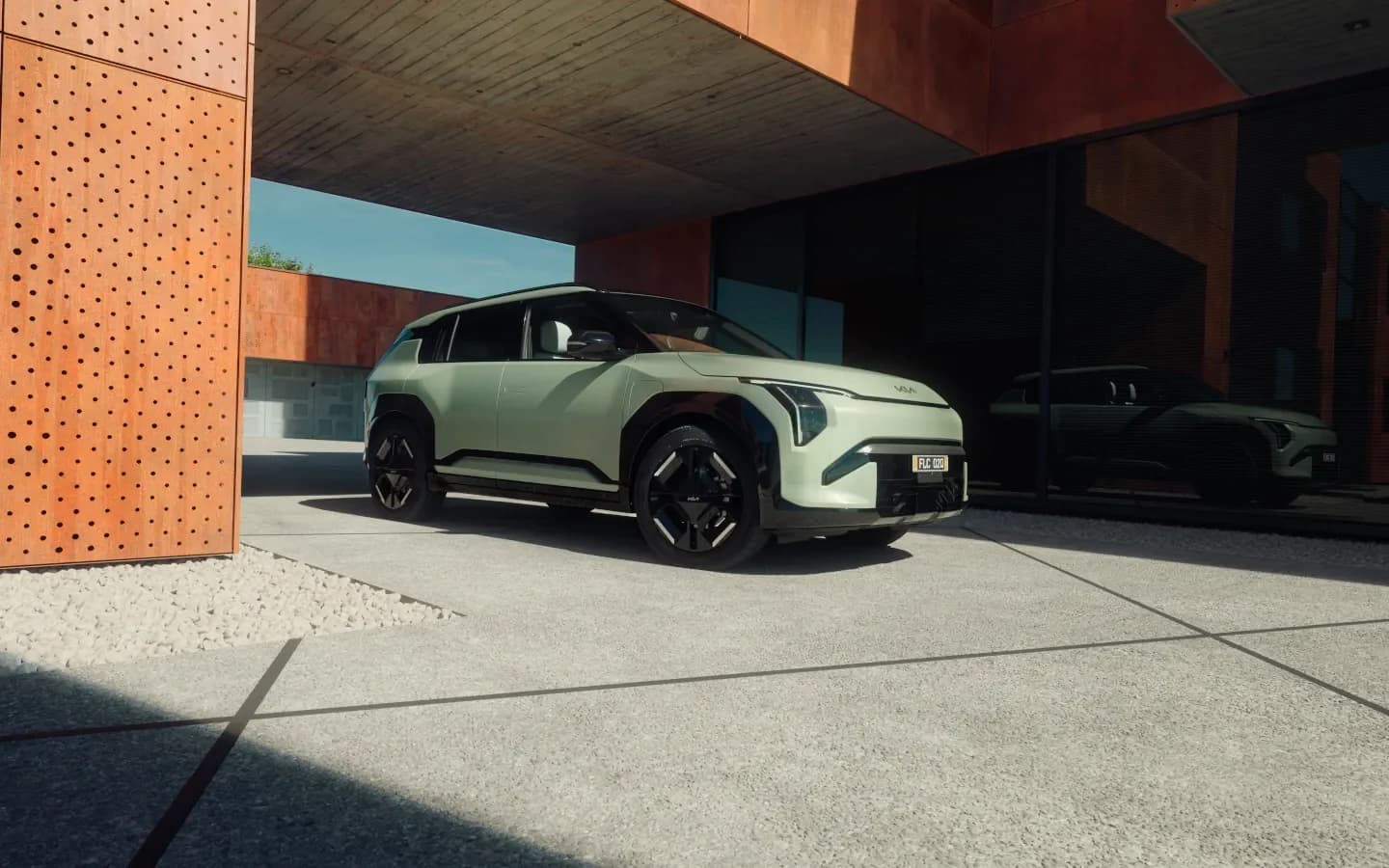
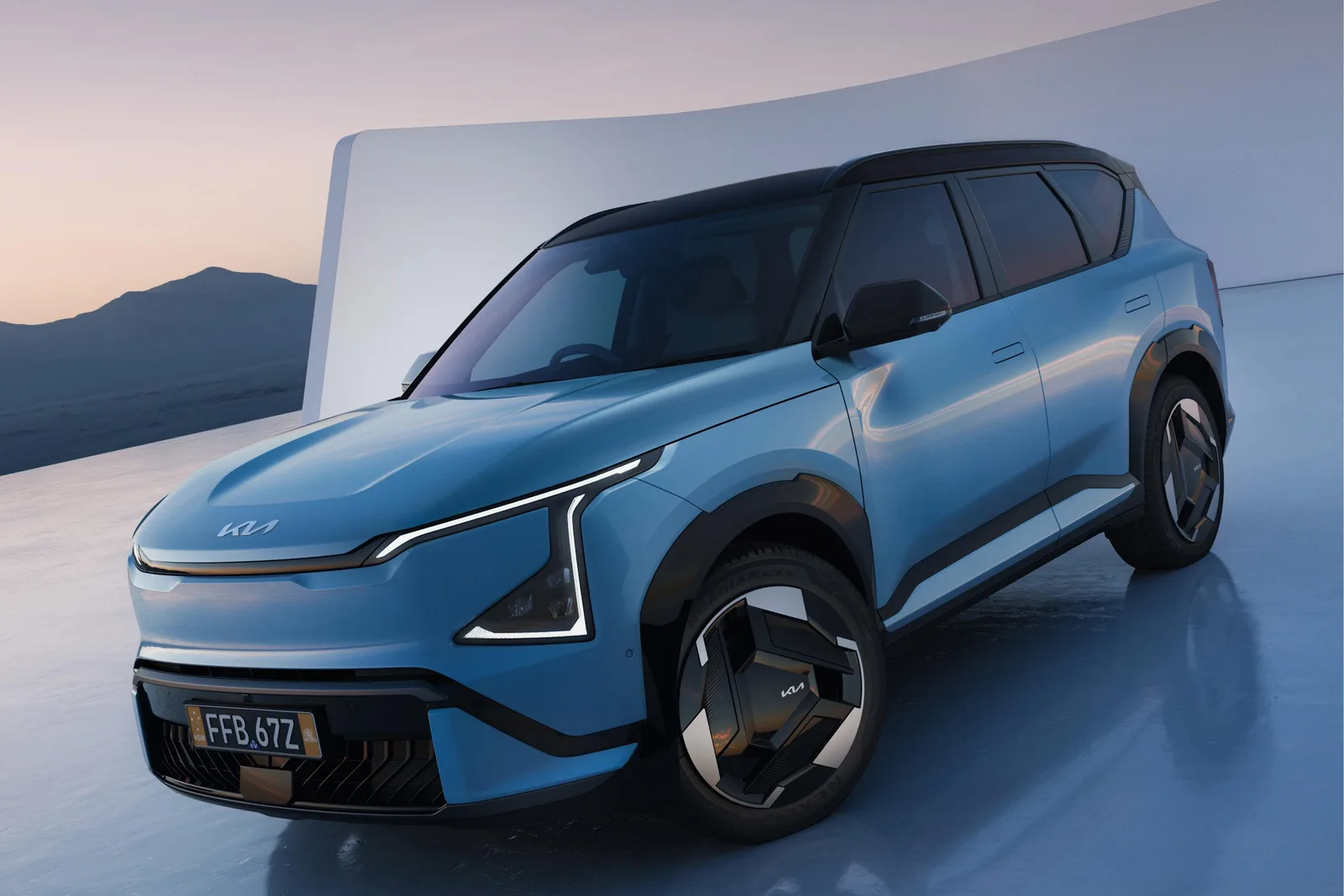
There is one dimension people forget to check on an electric SUV, and the EV5 loses it badly. Braked towing on the EV5 Air Standard Range is 300kg. The smaller, cheaper EV3 Air Standard Range is rated at 500kg, and every long-range EV3 grade is rated at 1,000kg. You have to spend $61,170 on the EV5 Air Long Range before the EV5 becomes the better tow car, at which point it jumps to 1,250kg and wins comfortably. If you own a box trailer, read that paragraph twice.
True Cost to Own
Warranty is identical and it is the best in the mainstream market: seven years, unlimited kilometres on the vehicle for private use, seven years of roadside assist, and seven years or 150,000km on the high-voltage drive components. Nothing separates them.
The battery cover does separate them, and it is a detail almost nobody checks. Kia's current warranty terms cover the high-voltage battery against capacity dropping below 70 per cent for seven years or 150,000km on pre-model-year-2027 vehicles, and eight years or 160,000km on model year 2027 and later. Kia Australia's current EV3 specification sheet is the MY27 document; the current EV5 sheet is still MY26. So depending on the build year of the actual car on the lot, the EV3 in front of you may carry a year and 10,000km more battery cover than the EV5 next to it. Ask for the build year and check it against Kia's warranty terms rather than assuming, because this cuts off at the model year and not at the model.
Servicing is where the running-cost gap gets real. Kia's seven-year capped-price servicing program does not apply to its EVs; instead you can prepay 3, 5 or 7 scheduled services. Kia publishes the prices, and they are not close.
| Prepaid plan | EV3 | EV5 Air | EV5 Earth / GT-Line |
|---|---|---|---|
| 3 services | $695 | $1,185 | $1,517 |
| 5 services | $1,320 | $1,839 | $2,389 |
| 7 services | $1,946 | $2,892 | $3,667 |
Seven services cost $946 more on an EV5 Air than on an EV3, and $1,721 more on an EV5 Earth or GT-Line. On a car you keep, that is a meaningful slice of the purchase-price gap going the wrong way.
Energy is the other monthly number, and it runs the same direction. At 15,000km a year and around 32 cents a kilowatt-hour at home, the EV3 Air Standard Range's 149Wh/km works out to roughly $715 a year, and the EV5 Air Standard Range's 182Wh/km to roughly $875. About $160 a year, or a bit over $1,100 across seven years of ownership. Neither is expensive next to petrol, but the small car is consistently the cheaper one to feed as well as the cheaper one to buy and the cheaper one to service.
Resale is the one column where we would not lean on either car yet. Both are recent nameplates in a segment with a lot of new supply arriving, and Kia's brand strength in Australia should hold both up better than most newcomers. If you are trying to work out what either is worth in four years, our depreciation calculator is a more useful starting point than anyone's confident prediction.
CarSorted Data Insight
Pull both ranges out of our database and line them up by price, and something odd falls out: the two Kias overlap for $7,180 in the middle of the price list, and in every part of that overlap the EV3 is the longer-legged car. The $58,600 EV3 Earth travels 563km. The $56,770 EV5 Air Standard Range travels 400km and the $61,170 EV5 Air Long Range travels 555km. There is no price point between $56,770 and $63,950 at which spending your money on the EV5 buys you more range than spending it on the EV3.
The second thing the data says is that the EV5 Air Standard Range is the weak link in either range. It is the only grade across both cars without a three-phase onboard charger, the only one that needs nearly ten hours on a wallbox, the shortest-range grade Kia sells in these two models, and the worst tow rating of the eight rows we hold. It exists to put an EV5 on a price list under $57,000 and it does that job, but $4,400 more for the Air Long Range fixes every one of those four problems at once. That is the single most cost-effective step in either range.
The Verdict
Buy the Kia EV3 if: range matters to you, you park in the city, you want wireless charging and both vehicle-to-load sockets without climbing the grade ladder, or you simply do not want to pay $9,170 and then another $946 in servicing for a boot that is 53 litres bigger. Start at the Air Long Range at $53,315, which is still cheaper than the cheapest EV5 and travels 204km further.
Buy the Kia EV5 if: you genuinely fill a car, you want the taller, squarer cabin and the 1,714-litre load bay, you do enough motorway kilometres for Highway Drive Assist 2 to earn its keep, you want heated and powered front seats on the base grade, or you want to tow more than a kilogram of firewood. If that is you, buy the Air Long Range at $61,170 rather than the Standard Range.
These two are not really rivals. They are a small SUV and a mid-size SUV wearing consecutive numbers, and the price list makes them look like grades of the same car when they are not. Work out how much car you actually need first. Then argue about range.
Compare both on CarSorted. See also: Model Y vs EV3 | Model Y vs EV5 | EV5 vs Sealion 7 | EV3 vs EX30. More from Kia.
The Verdict
Most people walking into a Kia dealership to look at these two should walk out with an EV3, and specifically the Air Long Range at $53,315. It is still $3,455 cheaper than the cheapest EV5 and it travels 604km to that car's 400km, which is not a small margin, it is a different kind of car ownership. The EV5 earns its money in exactly one way and it is a good way: it is a genuinely bigger vehicle, 315mm longer with 53 more litres in the boot, a 67-litre frunk, a taller and squarer cabin, Highway Drive Assist 2 as standard and a power driver's seat with massage on the base grade. If you carry three across the back or load the thing properly every weekend, that is worth $9,170. If you do not, you are paying nine grand for space you will spend three years parking. And if you do want an EV5, skip the Standard Range and buy the Air Long Range instead.
Prices on this page move. Want the next verdict?
One short email when prices shift or a new comparison lands. No spam, unsubscribe anytime.
Disclaimer: All information in this comparison was believed to be correct at the time of publishing (20 September 2026). Prices are manufacturer recommended retail prices (RRP) and may vary by state, dealer, and options. Driveaway costs include estimated on-road costs for Victoria. Fuel economy figures are WLTP/ADR combined cycle. Specifications can change without notice. Always verify with the manufacturer before making a purchase decision. CarSorted does not accept payment for recommendations.
Published by CarSorted Editorial Team · 20 September 2026
Comments (0)
Sign in to join the conversation
No comments yet. Be the first!