Key Takeaways
- The seven-seat Wey G9 people mover has been reported as approved for Australian sale, in plug-in hybrid and hybrid form, both all-wheel drive
- Reported outputs from the approval documents: 325kW for the 1.5-litre PHEV and 263kW for the 2.0-litre hybrid
- The PHEV is reportedly listed with zero towing capacity; the hybrid is reportedly approved to tow 1,500kg braked
- No price, no launch date and no specification from GWM Australia yet; outlets report a launch before the end of 2026 and a brand-wide positioning below $100,000
- On the reported PHEV masses, there is about 596kg between tare and GVM, which is not a lot for a seven-seater. We explain why below
- We hold no ANCAP rating for the G9, and neither version would get the FBT exemption on a novated lease
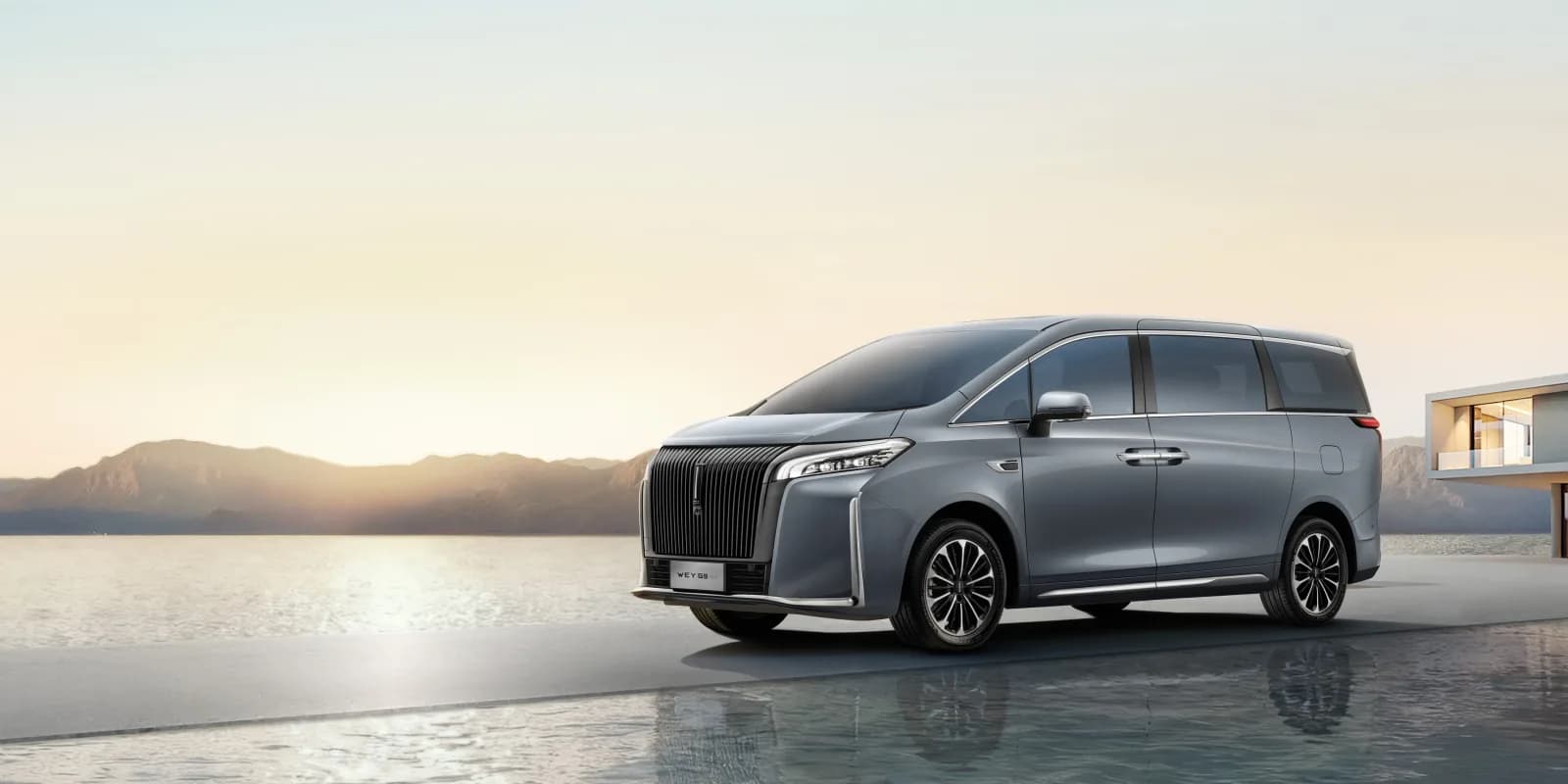
Image credit: GWM. Export-market Wey G9 shown; the Australian specification has not been confirmed.
GWM's premium Wey brand has been promised to Australia for months, and the first car it will sell here now looks settled. Australian outlets reported on 17 and 18 September 2026 that the Wey G9, a seven-seat luxury people mover known as the Gaoshan in China, has appeared in federal vehicle approval documents with two all-wheel-drive powertrains: a plug-in hybrid and, less expected, a conventional hybrid.
Here is the catch, and it is the reason this article reads the way it does. As of 1 October 2026, GWM Australia has published nothing about the G9. Its Australian news page carries no Wey release, its upcoming-models menu lists only the new Haval H7, its Wey and G9 model addresses return a not-found page, and wey.com.au is a parked domain rather than a GWM site. So every figure below comes from those reports of the approval documents, not from GWM, and we have labelled it that way. What we have added is the part the reports leave to you: what those figures would mean for a family choosing between this and a people mover already in showrooms.
What Is Confirmed, and by Whom
| Item | Status | Source |
|---|---|---|
| Wey brand coming to Australia | Reported | GWM briefing to Australian media, July 2026, as reported |
| G9 approved for Australian sale | Reported | Federal approval documents, as reported by outlets on 17 and 18 September 2026 |
| PHEV and hybrid versions | Reported | As above |
| Launch timing | Reported: before the end of 2026 | Outlets; not stated by GWM Australia online |
| Price | Not announced | Brand-wide positioning below $100,000 reported only |
| Equipment, fuel use, warranty, ANCAP | Not published | Nothing from GWM Australia yet |
The Two Reported Versions, and What They Would Cost
The table groups the two powertrains the way the approval documents reportedly do. There is no price in it because GWM has not set one. Every figure is as reported from the Australian approval, and none has been confirmed by GWM Australia.
| Version (reported) | Engine and drive | Output | Braked towing | Price |
|---|---|---|---|---|
| Plug-in hybrid | ||||
| Wey G9 PHEV | 1.5L turbo-petrol, front and rear motors, six-speed DHT, AWD | 325kW | 0kg (as listed) | Not announced |
| Hybrid (not plug-in) | ||||
| Wey G9 HEV | 2.0L turbo-petrol with electric assistance, six-speed DHT, AWD | 263kW | 1,500kg | Not announced |
The reports also give the body as 5,055mm long, 1,985mm wide and 1,925mm high on a 3,085mm wheelbase, with seven seats, and list the PHEV at a 2,759kg tare mass and 3,355kg gross vehicle mass. The hybrid is reported at 2,504kg tare, 255kg lighter. The approval reportedly calls the car the M81 internally and gives its Australian name as the GWM Wey G9. Battery size, electric range, fuel consumption and charging have not been reported for the Australian car, and we have not filled those gaps with figures from GWM's Chinese or other export pages, because an Australian specification can differ.
On price, the only thing in circulation is a reported GWM indication that Wey models would be positioned below $100,000. That is a statement about the brand, not a quote for this car, and it does not say whether it means before on-road costs or drive-away. GWM Australia quotes drive-away prices on models such as the Cannon, so it would not be a surprise if Wey did too, but that is our expectation, not something GWM has said.
The Towing Split Is the Real News
Plenty of Australian families buy a big people mover partly because it can pull a camper trailer, a box trailer or a small boat. On the reported approval figures, only one G9 can. The PHEV is reportedly listed with zero braked and zero unbraked towing, while the hybrid is reportedly approved for 1,500kg braked and 750kg unbraked.
A zero in an approval document is not necessarily the final word. It can mean the maker has not certified a towing rating yet rather than that the car physically cannot tow, and a rating can be added later. But until GWM publishes a figure, the only responsible reading is the literal one: if you need a towbar, the plug-in G9 is not your car at launch. Towing without a rating is not something to guess about, both for safety and for insurance.
It is also a pattern worth knowing about in this class. We list the GAC M8 PHEV Luxury with a braked towing figure of zero too, and the BYD M9 Premium at 1,500kg. So among the plug-in people movers, towing is not a given, and it is worth checking the specific variant rather than assuming.
If the hybrid's reported 1,500kg holds, it covers a small camper trailer or a box trailer, but not a typical family caravan. Once GWM publishes the gross combination mass and towball download, run your rig through our TowingSorted planner, which does the mass arithmetic properly. A braked towing number on its own tells you less than it seems.
Carrying Seven: Check the Mass Figures Before the Seats
The approval reports give the masses but not the sum. The gap between a car's tare mass and its gross vehicle mass is roughly what you can put in it: people, luggage, accessories and the rest of the fuel. Tare in Australia is measured with only a small amount of fuel on board, so a full tank eats into the gap as well.
Using the reported PHEV figures, 3,355kg less 2,759kg leaves about 596kg. Seven adults at a typical 75kg each is 525kg before a single bag goes in the back, and before the fuel tank is topped up. That is our arithmetic on reported numbers, not a GWM payload figure, and final Australian masses may differ. But it does suggest a fully loaded seven-adult airport run could sit close to the limit. For a family with young kids in the back rows, it is much less of a concern.
The hybrid is reportedly 255kg lighter at tare, but its gross vehicle mass has not been reported, so we cannot say whether it carries more. That is one of the first numbers worth asking a dealer for once the car is priced. One small upside of the reported PHEV mass: at 3,355kg GVM it sits well under the 4,500kg line, so an ordinary car licence covers it.
Where It Would Sit Against People Movers on Sale Now
Outlets report that Wey is being positioned as a rival for BYD's premium Denza brand, and the Denza D9 is the obvious reference point. The D9 we list is fully electric, though, while the G9 would be a plug-in or a conventional hybrid, so the more direct comparison is with the electrified, non-battery-only people movers already here.
The BYD M9 is the plug-in people mover the G9 PHEV is likely to be shopped against most, and we covered its launch in our BYD M9 article. On the specifications we list, the M9 Premium makes 218kW and weighs 2,650kg at kerb with a 3,274kg GVM. The reported G9 PHEV output of 325kW is well above that, but it is also the heavier car: its reported 2,759kg tare, which counts only a little fuel, is already above the M9's kerb figure. The GAC M8 PHEV is the other Chinese plug-in people mover we list, at 274kW on our figures. We have not quoted prices for the M9, M8 or D9 here because we have not yet checked those rows against the manufacturers; the comparison below shows the figures we currently list.
For the G9 hybrid, the natural rivals are the hybrid people movers that have been on sale for a while. Kia Australia lists the hybrid Carnival S HEV at $56,310 and the Carnival GT-Line HEV at $76,840, both before on-road costs. Hyundai lists the Staria Lounge Hybrid at $73,740 before on-road costs. At the other end, Lexus lists the LM 350h Sports Luxury E-Four at $165,888 before on-road costs. If Wey does land under $100,000, the G9 hybrid would be priced well below the LM, and somewhere from Carnival and Staria money upward, with a reported 263kW and all-wheel drive. Whether it earns that price depends on equipment and finish, which GWM has not shown for Australia.
Pick two
Electrified people movers on sale, side by side
The BYD M9, GAC M8 PHEV, Kia Carnival hybrid, Hyundai Staria hybrid, Denza D9 and Lexus LM. Tap any two.
| Spec | BYD M9 Premium | GAC M8 PHEV Luxury |
|---|---|---|
| Price from | $72,990RRP, before on-roads | $83,590RRP, before on-roads |
| Fuel use | No data | No data |
| Electric-only range | 145 km | 106 km |
| Seats | 7 | 7 |
| Braked towing | 1,500 kg | 0 kg |
| ANCAP | 5 starstested 2026 | No data |
| Warranty | 6 yr150k km | 8 yr150k km |
| Service interval | No data | 10,000 km |
Prices shown are each car's listed price on CarSorted and not all have been checked against the manufacturer. Electric range figures can be on different test cycles. The Wey G9 is not included because it is not on sale and GWM Australia has not published its specification. Figures come from our car database, which is built from Australian manufacturer documents. A blank field reads “No data” rather than a zero or a dash.
Why a Hybrid Makes Sense Here
According to the reports, GWM originally planned to launch Wey in Australia with plug-in hybrids only, so the hybrid is a change of plan. For a big, heavy people mover, it is a sensible one. A plug-in earns its keep when most of your driving fits inside the battery and you can charge at home. Plenty of people-mover owners do school runs that suit that well, but plenty also live in apartments, share a single driveway, or do long weekend drives where the battery is gone early and a heavy car is carrying its batteries on petrol.
A hybrid needs no charging habits at all, and on the reported figures it is also the one that tows. The trade is that it cannot run on electricity alone for meaningful distances, and GWM has not yet published fuel consumption for either version in Australia, so we cannot say how the two will compare at the bowser. Until those figures are out, choose by how you live: a garage and a short daily run point to the plug-in, a caravan park booking and no charger point to the hybrid.
Safety, Tax and the Fine Print
ANCAP. We hold no ANCAP rating for the Wey G9, so treat its rating as no data. If a rating matters to you, for a fleet or family policy, that is something to wait for.
FBT. As general information for the 2026-27 financial year: plug-in hybrids lost the electric car fringe benefits tax exemption from 1 April 2025, apart from some arrangements already in place before that date, and conventional hybrids were never eligible. So neither G9 would be FBT-exempt on a novated lease.
Luxury car tax. Also as general information for 2026-27, the thresholds are $80,809, or $91,661 for a fuel-efficient vehicle, which now means combined fuel consumption of no more than 3.5L/100km. Whether either G9 qualifies depends on an official fuel figure GWM has not published. That matters for the G9 because a price anywhere between $80,809 and the reported sub-$100,000 positioning would sit right across those lines. We cannot say which side either version lands on until GWM publishes prices and official fuel figures.
Warranty. GWM Australia quotes a seven-year warranty on models such as the Cannon, but it has not stated terms for Wey, so do not assume they carry across.
What GWM Has Not Told Us Yet
- Anything, officially. The approval, the powertrains and the timing all come from reports of government documents, not from GWM Australia.
- Price and price basis, including whether Wey will quote drive-away like GWM's other brands.
- Which versions launch first, and in which grades.
- Battery size, electric range and charging for the PHEV.
- Official fuel consumption for both, which decides the luxury car tax threshold and the running costs.
- A towing rating for the PHEV, and gross combination mass and towball download for both.
- The hybrid's gross vehicle mass, and so how much either version can carry.
- Equipment, warranty, servicing and where to buy one, since Wey's dealer arrangements have not been announced.
Who It Might Suit, and Who Should Wait
It might suit the family that wants something taller and more upmarket than a Carnival but will not stretch to Lexus money, and likes the idea of a people mover built more for comfort than for commuting. If you can charge at home and your week is mostly short runs, the reported PHEV has the most power. If you tow a small trailer or cannot charge, the reported hybrid is the one to watch.
It suits less well anyone who regularly fills all seven seats with adults and luggage until the final masses are known, anyone who needs to tow a caravan, and anyone who needs to buy in the next few weeks. There is also the brand question: Wey is new here, with no local track record, no published warranty and, so far, no confirmed dealer network. None of that is a reason to rule it out, but it is a reason to let the price and the fine print land before you plan around it.
We will update this story when GWM Australia publishes prices and specifications, and add each G9 version to the CarSorted directory with its full details then. In the meantime, the people movers you can buy today are all in the comparison above.
Disclaimer: GWM Australia had published no information on the Wey G9 when we checked its Australian website on 1 October 2026. The approval, powertrains, outputs, dimensions, masses, towing figures, timing and the brand's sub-$100,000 positioning are as reported by Australian motoring outlets from federal approval documents and GWM briefings, and have not been confirmed by GWM Australia. The payload arithmetic is our own calculation from those reported figures, not a manufacturer figure. Rival prices are as listed by Kia, Hyundai and Lexus Australia and recorded on CarSorted, before on-road costs; other rival figures are the ones listed on CarSorted at the time of writing. Tax information is general information for the 2026-27 financial year, not tax advice. Confirm price, specification and availability with GWM before ordering.