Key Takeaways
- Two grades: Lux $50,990 and Ultra $54,990 driveaway for private buyers, or $49,990 and $53,990 for eligible ABN holders
- Launch offer: a $2,000 driveaway cash bonus or a $2,000 fuel card on PHEVs purchased before 31 October 2026
- 310kW and 750Nm from a 2.0-litre turbo-petrol and a 130kW electric motor, with a 33.1kWh battery and up to 115km NEDC electric range
- 3,500kg braked towing, an 835kg payload, low range and a rear diff lock
- The Lux PHEV is $6,500 under the Cannon Alpha Lux PHEV and roughly $8,500 to $9,500 over the diesel Cannon Lux, depending on whether the diesel's $1,000 offer saving still applies
- GWM says the Cannon's ANCAP rating excludes the PHEV, we hold no ANCAP rating for it, and GWM has not yet published fuel use, weights, GCM or charging speeds
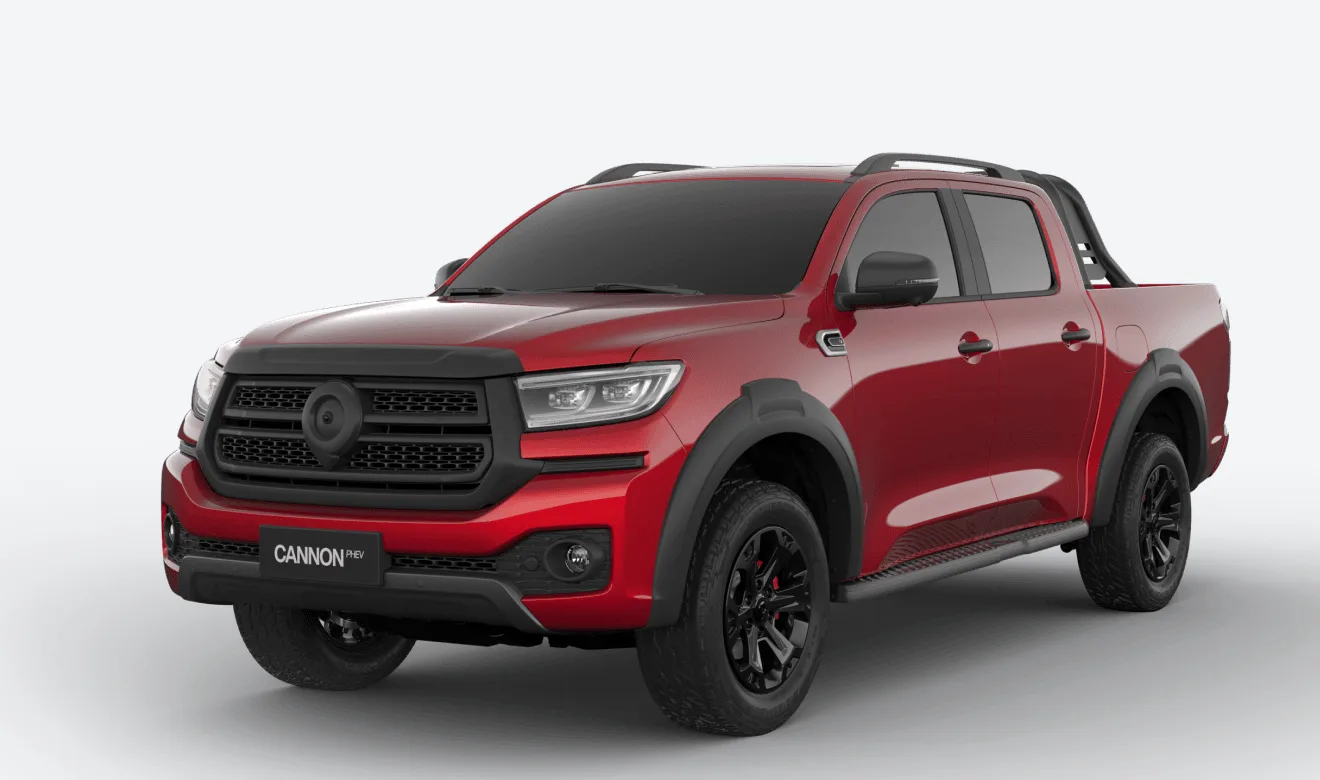
Image credit: GWM Australia. Studio image of the Ultra PHEV; GWM notes an overseas model is shown.
GWM Australia has put prices on the plug-in hybrid version of its smaller ute. The Cannon Hi4-T PHEV comes in two dual-cab 4x4 grades, Lux at $50,990 driveaway and Ultra at $54,990 driveaway, both quoted for private buyers. It made its Australian public debut at the Everything Electric show at Sydney Olympic Park from 18 to 20 September, and GWM's Cannon page now carries it under an introductory offer marked "Now Available".
The short version is that GWM has taken the big-number drivetrain idea from the larger Cannon Alpha PHEV and put it into the smaller, cheaper Cannon body. It keeps the numbers ute buyers screen for first, 3,500kg braked towing and a real low-range transfer case, and it lands at a price that makes it a genuine alternative to a well-specified diesel rather than a luxury stretch. Whether it is the right ute depends almost entirely on how far you drive each day and what you hang off the towbar, so that is where most of this piece goes.
Pricing
GWM quotes driveaway prices, not RRPs, and it lists a separate figure for ABN holders. The diesel Cannon grades are included below because they are the obvious thing the PHEV will be cross-shopped against in the same showroom.
| Variant | Drive | Driveaway (private) | Driveaway (ABN) |
|---|---|---|---|
| Plug-in hybrid (2.0L turbo-petrol + electric) | |||
| Cannon Hi4-T PHEV Lux | 4x4, low range | $50,990 | $49,990 |
| Cannon Hi4-T PHEV Ultra | 4x4, low range | $54,990 | $53,990 |
| 2.4L turbo-diesel, for comparison | |||
| Cannon Lux | 4x4 | $41,490 | $40,490 |
| Cannon Ultra | 4x4 | $44,490 | $43,490 |
The conditions matter here, so read them before you put a number into a budget. GWM says its driveaway prices are indicative and subject to change. The ABN figure is for holders of a valid ABN that has been registered for at least 60 days. Metallic paint is $595 extra, and GWM notes that adding accessories to a new-car purchase can attract additional stamp duty. The PHEV headline on GWM's page does not name a state; the price cards elsewhere on the same page are labelled for private buyers in Victoria, so confirm the figure for your own state with a dealer. The diesel prices in the table are the ones GWM's configurator shows for 2026-build stock, including a $1,000 saving under an offer GWM says ended on 30 September 2026; more on that below.
On top of that, GWM is running a launch offer: a $2,000 driveaway cash bonus or a $2,000 fuel card with every new Cannon Hi4-T PHEV purchased before 31 October 2026. GWM's terms say the cash bonus is deducted from the advertised driveaway price, cannot be combined with any other offer, and is subject to stock. The cash bonus footnote also refers to vehicles ordered and delivered by 31 October 2026, so with first dealer arrivals reported for mid-October, get the delivery date in writing. Taken at face value, that puts a private-buyer Lux at $48,990 driveaway for the month. It is an either-or, so if you take the fuel card instead you pay the full driveaway price.
What You Get Under the Tray
| Spec (both grades) | As GWM Australia quotes it |
|---|---|
| Engine | 2.0L turbo-petrol + 130kW electric motor |
| Combined output | 310kW / 750Nm |
| Battery | 33.1kWh |
| Electric-only range | Up to 115km (NEDC) |
| Combined range | Up to 1,037km |
| Transmission | Automatic (listed by GWM as 9HAT) |
| 4x4 hardware | Low-range transfer case, rear diff lock |
| Braked / unbraked towing | 3,500kg / 750kg |
| Payload | 835kg |
GWM lists the terrain modes as 2H, 4H, 4L, Sport, Snow, Mud and Sand. Both grades ride on 18-inch alloy wheels and get Comfort-Tek seats. The Ultra adds heated and ventilated front seats and a 360-degree camera, which GWM specifically lists for the Cannon Hi4-T PHEV Ultra. For the $4,000 step, that is a fairly thin list, so the Lux is likely to be the grade most people should look at first.
A word on those range figures, because they are the part most likely to be misread. The 115km electric range is an NEDC figure, and GWM says both it and the 1,037km combined figure come from its own internal testing under optimal conditions and are a guide only. NEDC is an older and gentler test than WLTP, so an NEDC number will typically look better than a WLTP number for the same car. If a rival quotes a WLTP electric range, the two cannot be lined up as if they were the same measure. We have not compared them in this piece for that reason.
Against the Diesel Cannon: Roughly $8,500 to $9,500 for the Plug
At the prices GWM's configurator still shows, the Lux PHEV is $9,500 more than the diesel Cannon Lux and the Ultra PHEV is $10,500 more than the diesel Cannon Ultra. One big caution on that gap: GWM labels those diesel prices as 2026-build stock that includes a $1,000 saving, under an offer it says ended on 30 September 2026. Without that saving the diesels would be $42,490 and $45,490, and the gaps narrow to $8,500 and $9,500. Ask for both prices on the same day.
What does the extra money buy? A lot more performance on paper. The diesel makes 135kW and 480Nm according to GWM, against the PHEV's 310kW and 750Nm. Braked towing is the same 3,500kg on both Lux and Ultra. And if your daily running fits inside the battery, most of those kilometres can be done on electricity from home rather than diesel from a bowser.
What it gives up is payload. GWM quotes 835kg for the PHEV. We list the diesel Lux and Ultra at 995kg, and GWM's own Cannon page gives 995kg as the diesel's payload in New Zealand trim. That is a difference of about 160kg, which is two adults or a decent toolbox and a generator, and it is carrying capacity that the battery and motor have taken. For a tradie who routinely loads the tray to the limit, that matters more than the kilowatts.
Whether you earn the extra money back depends on your electricity price, your fuel price and your kilometres, and GWM has not yet published official fuel consumption for the PHEV, so we are not going to put a payback period on it. What we can say is that the case is strongest for short daily runs you can charge at home, and weakest for long highway and towing days, where the petrol engine does the work.
Against the Cannon Alpha PHEV: $6,500 Less, and More Payload
This is the more interesting comparison. GWM lists the larger Cannon Alpha Lux PHEV at $57,490 driveaway for private buyers and the Alpha Ultra PHEV at $64,490, so the new Cannon Lux PHEV undercuts the Alpha Lux PHEV by $6,500, and the Ultras are $9,500 apart. Those are the headline figures on both sides; GWM's configurator also lists an optional additional $3,000 off 2026-build Alpha PHEVs as one of two offers, which would narrow the gap, so check whether it is still running when you shop.
On the published figures the smaller ute gives little away. GWM quotes the Alpha PHEV at 300kW and 750Nm, so the Cannon PHEV has the same torque and 10kW more power. Both are rated to tow 3,500kg braked. We list the Alpha PHEV's payload at 685kg, against 835kg for the new Cannon, so the cheaper ute also carries more on paper. Where the Alpha still pulls ahead is battery: GWM quotes 37.1kWh of usable capacity for the Alpha against 33.1kWh for the Cannon (GWM does not say whether the Cannon figure is usable or gross), and the Alpha has front and rear diff locks and 6kW vehicle-to-load, neither of which GWM has listed for the Cannon PHEV. The Alpha is also the bigger ute overall.
If you were already looking at an Alpha PHEV mainly for the towing figure and the plug, the smaller Cannon is worth pricing beside it before you sign.
Towing and Payload: What GWM Has and Has Not Printed
GWM Australia's page says both Cannon Hi4-T PHEV grades are rated to tow 3,500kg braked, and gives 750kg unbraked for the Cannon range. It quotes an 835kg payload for both Lux and Ultra. So far, so good.
What it has not printed yet is the set of numbers that decides whether you can actually use those two figures at once: the gross vehicle mass, the gross combination mass, the kerb weight and the maximum towball download. A dual-cab ute towing 3,500kg almost never has its full payload left over, because the towball weight counts against payload and the combined weight of ute plus trailer is capped by the GCM. Until GWM publishes those figures, treat 3,500kg and 835kg as two separate maximums rather than something you can load to at the same time.
Once the numbers are out, run your own rig through our TowingSorted planner or the towing and payload calculator, which do the GVM, GCM and ball-weight arithmetic properly. It is also worth remembering that towing a heavy van will use the battery quickly, so the electric range figures above say very little about a towing trip.
The Plug-In Utes We List, Side by Side
We do not hold a row for the Cannon Hi4-T PHEV yet, so it is not in the comparison below. What is in it are the plug-in hybrid utes on sale that we list, plus the diesel Cannon Lux for reference. Pick any two.
Pick two
Plug-in utes on sale, side by side
The Cannon Alpha PHEV, BYD Shark 6, Ford Ranger PHEV and JAC Hunter PHEV, plus the diesel Cannon Lux. Tap any two.
| Spec | GWM Cannon Alpha Lux PHEV | BYD Shark 6 Premium |
|---|---|---|
| Price from | $57,490drive-away, not an RRP | $57,900RRP, before on-roads |
| Electric-only range | 115 km | 100 km |
| Braked towing | 3,500 kg | 2,500 kg |
| Payload | 685 kg | No data |
| Fuel use | 1.7 L/100kmfrom a full battery, 7.9 once flat | 2.0 L/100kmfrom a full battery, 7.9 once flat |
| ANCAP | 5 starstested 2024 | 5 starstested 2025 |
| Warranty | 7 yrunlimited km | 6 yr150k km |
Prices shown are each car's listed price on CarSorted and are not all on the same basis: GWM quotes driveaway, some others quote before on-road costs. Electric range figures can be on different test cycles. The Cannon Hi4-T PHEV will be added once we list it. Figures come from our car database, which is built from Australian manufacturer documents. A blank field reads “No data” rather than a zero or a dash.
On the specifications we list, the BYD Shark 6 Premium is an obvious rival, but it is rated to tow 2,500kg braked, against 3,500kg for the Cannon PHEV. The Ford Ranger PHEV XLT matches the 3,500kg rating and we list a 973kg payload, but it carries an 11.8kWh battery on our figures, much smaller than the Cannon's. The JAC Hunter Pro PHEV is another 3,500kg plug-in ute we list. We have not quoted prices for those three because we have not yet checked them against the manufacturers; the comparison tool shows the figures we currently list.
Safety, Tax and the Fine Print
ANCAP. GWM's Cannon page advertises an ANCAP rating for the Cannon range, but says in its own footnote that the rating excludes the PHEV variants. We hold no rating for the Cannon Hi4-T PHEV, and a rating for the diesel does not carry across. If a rating matters to you, for a fleet policy for example, that is a real gap for now.
FBT and luxury car tax. As general information for the 2026-27 financial year: plug-in hybrids lost the electric car fringe benefits tax exemption for cars first held on or after 1 April 2025, so the Cannon PHEV does not get it on a novated lease. Luxury car tax is not a factor at this price; the 2026-27 thresholds are $80,809, and $91,661 for fuel-efficient vehicles. Business buyers should talk to their accountant about how a dual-cab ute is treated for their use.
Warranty. GWM Australia quotes a 7-year, unlimited-kilometre warranty for the Cannon for private, ABN and fleet buyers, dropping to 7 years or 150,000km for commercial uses such as rental or hire. GWM's Cannon page does not state a separate battery warranty for the PHEV, so ask for it in writing.
What GWM Has Not Told Us Yet
- Official fuel consumption and CO2, which decide the running-cost case.
- Kerb weight, GVM, GCM and towball download, which decide whether 3,500kg and 835kg work together.
- Charging: AC and DC charging rates, and whether it has vehicle-to-load.
- Battery warranty terms for the PHEV.
- A full equipment list for each grade. GWM's configurator so far highlights only a handful of features.
- Delivery timing. The launch offer is live, but GWM's page does not give a delivery date. Motoring outlets have reported dealer arrivals from mid-October 2026, which we have not been able to confirm with GWM.
Who It Suits, and Who It Does Not
It suits the buyer who does short to medium daily runs, can charge at home, and wants a ute that still tows a 3,500kg van or boat on the weekend. It also suits the buyer who was looking at a Cannon Alpha PHEV mostly for the plug and the towing figure, because the smaller ute delivers the same headline numbers for $6,500 less at GWM's current headline prices.
It suits less well the tradie who loads the tray to the limit every day, because the diesel carries around 160kg more. It also suits less well the buyer who mostly does long highway runs or tows often, where the battery is used up early and the petrol engine carries the load; until GWM publishes fuel figures, the diesel is the known quantity there. And fleets that need an ANCAP rating should wait.
If you are ready to order this month, the $2,000 launch offer is real money, but make sure the price you are quoted is the right one for your state and buyer type. We will add both grades to the CarSorted directory with full specifications as GWM Australia publishes them, and current offers are on our deals page.
Disclaimer: Prices, specifications, towing, payload, range figures and offer terms are as published by GWM Australia on its Cannon model page and configurator, checked on 1 October 2026. GWM describes its driveaway prices as indicative and subject to change, with ABN prices for holders of an ABN registered for at least 60 days; metallic paint is extra. Range figures are GWM's own, from internal testing under optimal conditions, and the electric range is on the NEDC cycle. Delivery timing from mid-October 2026 is as reported by Australian motoring outlets and not confirmed by GWM. Rival payload, battery and towing figures are the ones listed on CarSorted at the time of writing. The tax information is general information for the 2026-27 financial year, not tax advice. Confirm price, specification and availability with a GWM dealer before ordering.