Key Takeaways
- New 67kWh LFP battery (up from 60kWh NMC), 500km WLTP range (up from 454km)
- DC fast charging lifted from 130kW to 165kW, 15 to 80 per cent in around 24 minutes
- V2L standard, bi-directional AC charging up to 22kW available, heat pump and battery preconditioning standard
- Single front 220hp (about 162kW) motor carries over, but the car gains around 100kg
- New chequered LED daytime running lights, dual 12-inch screens with Gemini AI
- European sales late 2026. Renault Australia confirms first half of 2027 for local showrooms. ANCAP not yet rated for the new car.
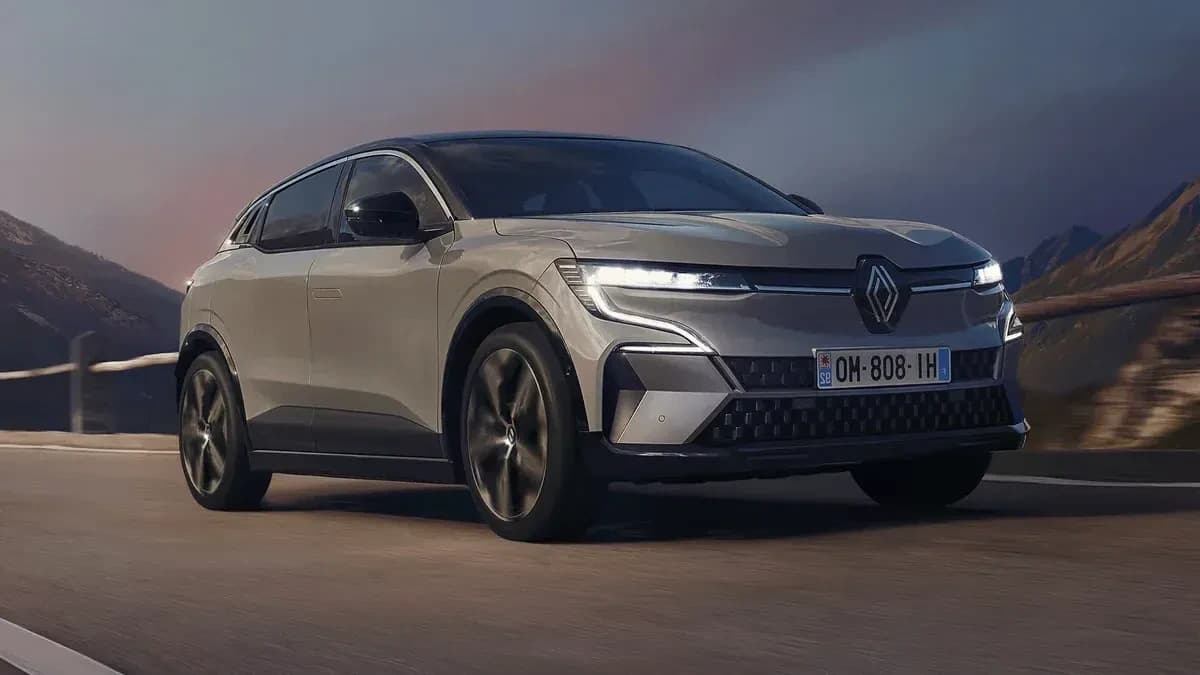
Image credit: Renault Australia (current-generation model shown ahead of the facelifted car's 2027 Australian arrival).
Renault has given the Megane E-Tech its biggest update since launch, and the version that lands in Australia in the first half of 2027 will be a measurably different car for anyone shopping small electric hatchbacks. A bigger 67kWh LFP battery pushes the WLTP range to 500km, the DC charging peak climbs to 165kW, V2L is now standard, and the interior swaps in dual 12-inch screens running a Gemini AI assistant. For the current Megane E-Tech Techno at $49,990 driveaway this month, the facelift quietly closes most of the gaps that buyers compared with a Hyundai Kona Electric or a BYD Atto 3.
The reveal landed in Renault's European press kit on 22 June 2026. Renault Australia confirmed shortly after that the updated car is on the local plan for the first half of 2027, with pricing and final Australian equipment lists to be announced closer to launch. The current Megane E-Tech stays on sale through that window, so this is a future-buy question rather than a wait-and-see one if a 60kWh EV at $50k driveaway suits your patterns now.
What actually changes
Renault calls this a facelift, but mechanically it is closer to a mid-life overhaul. The headline is the battery: a new 67kWh usable pack using lithium iron phosphate cells in a cell-to-pack layout, replacing the previous 60kWh NMC pack. Renault claims 500km of WLTP range on the back of that, up from 461km in Europe and 454km on the Australian Techno EV60. The pack is bigger and the cells are heavier, so ride height rises 20mm to accommodate the larger floor structure, and kerb weight grows by around 100kg to roughly 1,772kg.
The 220hp front-mounted synchronous motor carries over, so this is not a performance update. What does change is how quickly you can put energy back into the car. Peak DC charging is up from 130kW to 165kW, and Renault quotes a 15 to 80 per cent recharge of about 24 minutes under ideal conditions, roughly a quarter faster than the current car. AC charging stays at 11kW, but the facelift also gains optional 22kW bi-directional AC charging in markets that support it, plus V2L as standard across the range. The heat pump and battery preconditioning that were patchy across European trims are now standard everywhere.
Powertrain and battery, old vs new
| Spec | Current Megane E-Tech (AU) | 2027 Facelift |
|---|---|---|
| Usable battery | 60kWh NMC | 67kWh LFP, cell to pack |
| WLTP range | 454 km | 500 km |
| Motor | Front 160kW synchronous | Front 220hp synchronous (about 162kW) |
| Drive | FWD | FWD |
| 0 to 100 km/h | 7.4 sec (current) | Not yet confirmed |
| Max DC charge | 130 kW | 165 kW |
| AC charge | 7.4 kW (Australia) | 11 kW, optional 22kW bi-directional |
| V2L | Not offered | Standard |
| Heat pump | Optional | Standard |
| Battery preconditioning | Optional | Standard |
| Kerb weight | 1,642 kg | About 1,772 kg |
Current-model figures: Renault Australia Megane E-Tech Techno EV60. Facelift figures: Renault global media kit, 22 June 2026. Australian variant lineup and final tech for 2027 still to be confirmed.
New face, new cabin tech
Outside, the front clip is essentially a new module above the bumper line, swapping the old vertical air intakes for a body-coloured panel and a checkerboard LED daytime running light made up of eight diamond-shaped segments. The Renault diamond now sits lower on a slimmer panel, and the lower bumper gains a shallow splitter. From the A-pillars back, the body and glasshouse carry over, so the silhouette buyers know from the current car is unchanged. New 20-inch alloy designs and a darker rear graphic round out the styling tweaks.
Inside is where the daily-driving difference will be obvious. Renault has kept the dual 12-inch display layout but moved the software onto a newer OS, with Gemini AI now embedded for natural-language voice search, climate and navigation. There are sharper graphics, refreshed cabin trim materials and recycled-fabric upholstery options carried across from the European Megane line. The big upgrade for Australian buyers is that the heat pump and battery preconditioning that used to be pricey extras now come standard, which matters every July in Melbourne or Canberra when DC charging in the cold normally costs you range.
Trim lineup
Renault has rationalised the Megane E-Tech down to two grades globally. The entry car becomes Techno, the flagship moves to Esprit Alpine, and Iconic Esprit Alpine sits up top in some markets. The Australian line at launch in early 2024 was a single Techno EV60 trim, so it is reasonable to assume Renault Australia will keep things simple here too, with the Esprit Alpine likely added at launch if the price gap is manageable. We will update this story when Renault Australia confirms the local grade walk.
Safety
The current Megane E-Tech holds a 5-star ANCAP result from November 2023, based on 2022 Euro NCAP testing, with 85% Adult, 88% Child, 65% VRU and 80% Safety Assist. That rating expires in December 2028. The 2027 facelift has not been independently retested yet, so its safety outcome is best treated as not yet rated. Standard kit on the European car still includes AEB with car, pedestrian and junction detection, lane keeping, emergency lane keeping, and an intelligent speed assistance system. Renault Australia's habit is to carry the European safety pack across without trimming gear, so a similar standard list is the working assumption.
How it compares
The car the new Megane E-Tech is squaring up to has shifted under Renault's feet. The Hyundai Kona Electric Premium Extended Range lists at $59,990 driveaway during EOFY 2026 with a 64kWh battery and around 505km WLTP, while the BYD Atto 3 Premium opens at about $44,990 with 60.5kWh and 420km. The MG 4 Essence 64 from $39,990 driveaway has just become the price floor of the segment with 64kWh and 452km, and the new Cupra Born and Volvo EX30 Extended Range sit either side of $55,000 for similar range numbers. None of those rivals currently quote 500km of WLTP at this size, and only the Hyundai and Cupra match the Renault on European-style chassis polish.
Use our DB-driven shortlists if you want to see the like-for-like maths against the current Megane: Megane E-Tech vs Toyota bZ4X, Megane E-Tech vs Volvo XC40, Megane E-Tech vs Renault Scenic E-Tech, and Megane E-Tech vs Xpeng G6. The facelift specs will refresh into those tables once the 2027 car is in our database.
Warranty and ownership
Renault Australia covers the current Megane E-Tech with a 5-year unlimited-kilometre vehicle warranty and an 8-year/160,000km cover on the high-voltage battery. Capped-price servicing runs across the first five visits. Renault Australia has not flagged any change to those terms with the facelift, although the move to LFP cells should improve battery longevity, since LFP packs typically tolerate frequent 100 per cent charging better than the NMC pack in the current car.
The CarSorted angle
On CarSorted, the current Megane E-Tech Techno EV60 is listed with a 60kWh NMC battery, 454km WLTP, 160kW front motor, 130kW peak DC charging and a 7.4-second 0 to 100. Stack the facelift numbers next to that and the headline change for an Australian buyer is not the styling, it is the charging speed plus V2L. The current car can sit on a 50kW public DC stall and add about 30 minutes worth of usable range in a typical session. The 2027 car's 165kW peak means a road trip stop drops from coffee-plus-pastry to genuinely coffee-only, and you can also run a fridge or a powerboard off the V2L socket at a campsite, which the current car simply cannot. The other knock-on is the LFP cell chemistry. The current Megane's NMC pack is best treated like a phone battery (charge to 80 per cent for daily use), where LFP cells handle 100 per cent more comfortably and degrade more slowly, so the practical usable range over a five-year ownership tail will be closer to the 500km claim than the current car's 454km is to today's figure. Cross-shop using our Megane vs Volvo XC40 EV page for a sense of how the European-tuned mid-size electric hatch stacks up against a similarly upmarket SUV at today's prices.
What this means for buyers
If you are looking at a 60kWh European-built EV at around $50,000 driveaway right now, the EOFY 2026 Megane E-Tech Techno deal is still one of the strongest in the segment, and waiting nine to twelve months for the facelift only makes sense if you specifically need either V2L, faster DC charging or the LFP longevity story. Buyers who plan to keep the car past 2030 should probably wait. Buyers who do most of their charging at home on AC and only road-trip occasionally are no worse off taking the discount now.
If you are cross-shopping a Hyundai Kona Electric Extended Range, a Cupra Born or the MG 4 Essence 64 instead, the facelifted Megane E-Tech goes from being a thin-on-features outlier to genuinely competitive once you account for the 500km range, the 165kW DC charging and the LFP pack. The piece nobody can lock in yet is the price. Renault Australia has been chasing volume hard in 2026, so a sticker close to the current $54,990 RRP would make the facelift a strong shortlist car. Anything north of $60,000 puts it in Polestar 2 and Volvo EX30 Extended Range territory, where the value calculus changes.
Best Electric Cars Under $50k 2026 | Best Electric SUVs Australia 2026 | Renault Megane E-Tech on CarSorted
Disclaimer: Specifications for the facelifted Renault Megane E-Tech are based on the Renault global media release dated 22 June 2026 and may differ from the final Australian-market specification. Current Megane E-Tech figures sourced from Renault Australia. The $49,990 driveaway EOFY offer applies to solid white Techno EV60 stock and is current to 30 June 2026. Australian pricing, equipment and ANCAP rating for the 2027 facelifted car are still to be confirmed.
Cars in This Article
Frequently Asked Questions
When does the new Renault Megane E-Tech facelift arrive in Australia?
What is the new battery capacity and range?
How fast does the new Megane E-Tech charge?
Is the facelifted Megane E-Tech more powerful?
Does it still have a 5-star safety rating?
What about pricing for the new car?
New cars, real prices, straight to your inbox
Join the CarSorted mailing list for new-model launches, price drops and drive-away deals, honest reviews, and founding-member pricing on the upcoming CarSorted Pro Report.
- New-model launches
- Price drops & deals
- Honest reviews
No spam, unsubscribe anytime. By subscribing you agree to receive marketing emails.
Disclaimer: All information in this article was believed to be correct at the time of publishing (25 June 2026). Prices are manufacturer recommended retail prices (RRP) and may vary by state, dealer, and options. Specifications, government incentives, and rebates can change without notice. Always verify details with the manufacturer or relevant authority before making a purchase decision. Running cost estimates are based on average Australian driving conditions at 15,000 km/year. CarSorted does not accept payment for recommendations or rankings.
Written by Uzzi, CarSorted Editorial Team · 25 June 2026 · how we research
Comments (0)
Sign in to join the conversation
No comments yet. Be the first!