Key Takeaways
- Volvo has given the XC60 and XC90 a new 41.2kWh plug-in hybrid battery (37.9kWh usable), up from 18.8kWh, and the XC60 a facelift
- European figures: about 200km WLTP electric range for the XC60 T6, about 189km for the XC60 T8 and 164km for the XC90 T8, all described by Volvo as preliminary
- Australian arrival is reported for the second quarter of 2027, from a Volvo Car Australia spokesperson quoted by Australian media
- No Australian price, range figure or grade list has been published. Volvo's Australian site still shows the current XC60 plug-in at 89km and the XC90 at 77km
- A long-range plug-in is still a plug-in: as general information for 2026-27 it gets no electric car FBT exemption, which keeps the EX60 the tax-friendlier Volvo on a novated lease
- We hold no ANCAP rating for the updated cars
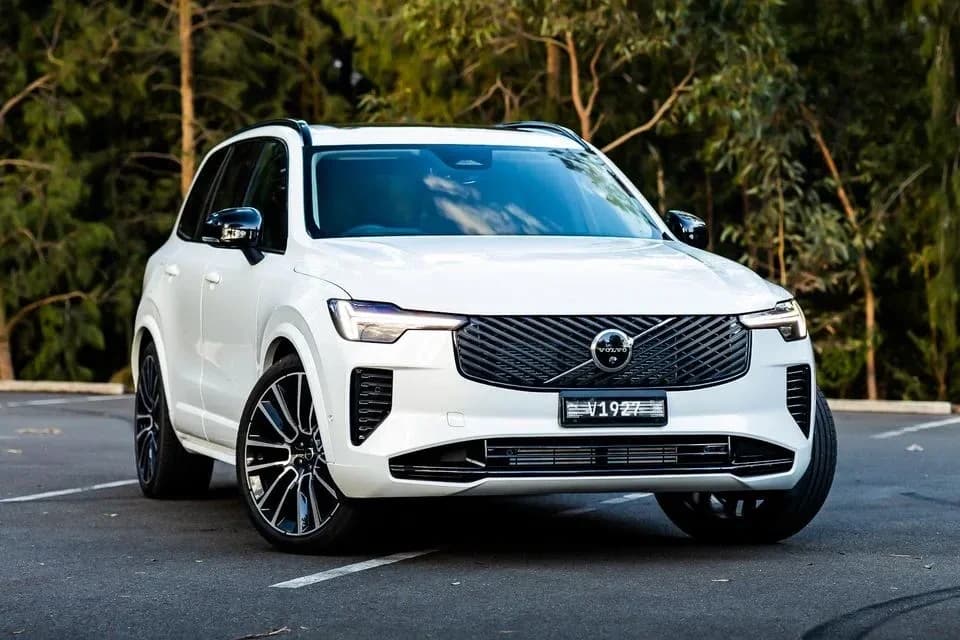
Image credit: Volvo Australia. The current XC90 is shown. Volvo's announcement lists exterior design changes for the XC60, and none for the XC90.
Volvo has put a much bigger battery into the plug-in hybrid versions of what it calls its best-selling SUVs. The XC60 and XC90 plug-ins now carry a 41.2kWh pack, more than double the 18.8kWh Volvo quotes for the outgoing plug-ins, and Volvo quotes up to 200km of electric range on the WLTP test for the XC60. The XC60 also gets a facelift. Volvo announced the cars overseas on 15 September 2026 and says order books are open in selected markets, with production starting later this autumn in the northern hemisphere.
For Australia, the picture is thinner than the headline suggests. Volvo Car Australia has not published anything about the updated cars on its own website. A Volvo Car Australia spokesperson has been reported as saying that current planning has both arriving in the second quarter of 2027, that both will again be offered as mild hybrids and plug-in hybrids, and that final pricing and specification will come closer to launch. That is all there is, so this piece is about what the new drivetrain changes for an Australian buyer, what we already know from Volvo's own documents, and what is still missing.
What Volvo Has Actually Changed
The headline is the battery, but the drivetrain around it has changed too. Volvo's European technical specifications, dated August 2026 and marked preliminary, list two long-range plug-in versions of the XC60 and one of the XC90. All three use a 2.0-litre turbo-petrol four driving the front wheels and a 130kW electric motor on the rear axle, up from 115kW before. The battery sits in the floor.
| Variant (European spec) | System power | 0-100km/h | Electric range (WLTP) |
|---|---|---|---|
| Long-range plug-in hybrid, 41.2kWh (37.9kWh usable) | |||
| XC60 T6 AWD | 262kW | 5.7 sec | About 200km |
| XC60 T8 AWD | 339kW | 4.8 sec | About 189km |
| XC90 T8 AWD | 339kW | 5.2 sec | 164km |
| Mild hybrid, for comparison | |||
| XC60 B5 AWD | 184kW (engine) | 6.9 sec | No plug |
| XC90 B5 AWD | 184kW (engine) | 7.7 sec | No plug |
The interesting new car is the T6. It pairs the electric motor with a detuned 132kW, 280Nm version of the petrol engine, where the T8 gets the full 184kW, 360Nm version, and the T6 is the one Volvo quotes at 200km. The T8 keeps roughly the pace of today's car: Volvo Australia quotes the current XC60 plug-in at 4.8 seconds to 100km/h, the same as the new T8's European figure. Volvo has not published a combined torque figure in its specification sheets, so we have left one out.
What we do not know is which of these Australia gets. The spokesperson's reported line was that both models will be available with mild hybrid and plug-in hybrid power "as current", which describes the range's shape, not its grades. Today Australia has only a T8 plug-in. Whether the cheaper, longer-range T6 comes here is the single most useful thing Volvo could tell buyers, and it has not said.
The XC60 facelift is the familiar kind. Volvo lists a new grille, front bumper, bonnet and front wings, restyled Thor's Hammer matrix LED headlights, and a reworked tailgate, tail-lights and rear bumper. Inside there is a new dashboard and door-panel design and an 11.2-inch centre screen running Volvo's latest infotainment software. Volvo also lists newer active safety hardware, including automatic emergency steering and a warning for cyclists approaching before a door is opened. None of that has an Australian equipment list attached yet, and Volvo notes that features may vary by market, so treat it as the direction of travel rather than what an Australian car will have.
What 200km Means Here, and Why the Number Will Move
Two cautions before anyone plans a life around 200km. First, it is a European WLTP figure, and Volvo calls it preliminary. Volvo's New Zealand site already lists the long-range XC60 T8 at up to 180km, against about 189km for the same car in Europe, with the same preliminary caveat, so the figure a given market prints can differ from the European one. Australia's number has not been published. Second, it is a test figure. Real-world electric range drops with speed, cold, air-conditioning and load, and a big SUV on a freeway will fall well short of it.
Even so, the jump is large enough to change how the car gets used. Volvo Australia quotes the current XC60 plug-in at 89km and the current XC90 plug-in at 77km. More than doubling that moves a plug-in Volvo from "most school runs on electricity" to "most weeks on electricity" for a lot of suburban households, with the petrol engine there for the drive to the coast. That is the pitch, and for a driver who charges at home every night it is a strong one.
The catch is charging. Volvo's European sheets give AC charging times of 4, 6 and 10 hours on 16, 10 and 6 amp supplies, and the XC90 sheet labels those as three-phase times. Many Australian homes are on single-phase power, and Volvo has published no Australian charging figure, nor any mention of DC fast charging, in the documents we have. What is safe to say is that a battery twice the size takes about twice as long to fill on the same charger. If you plan to charge from a standard power point, ask the dealer for the Australian figure before you order.
And some context on the number itself. Volvo calls the XC60's range class-leading. That is Volvo's claim, and it is worth setting against what Australians can already buy, because plug-in hybrids with big batteries are not new here. Of the 131 plug-in hybrid rows we list as on sale as at 4 October 2026, only one, the GWM Haval H6GT Ultra PHEV, quotes 180km or more, and several Chinese-brand plug-ins we list, such as the Omoda 9 SHS Virtue AWD and the BYD Sealion 8 Premium AWD, quote around 150 to 170km. Those figures are not all measured on the same test, so treat them as a rough guide rather than a ranking. The Volvo's case against those cars will rest on the badge, the cabin and the dealer network, not on range alone.
Price: What We Can and Cannot Say
There is no Australian price, and we are not going to guess one. Volvo Car Australia's site still lists the current XC60 and XC90 as of 1 October 2026. For reference, we list the current XC60 Plus B5 Bright mild hybrid at $74,990 before on-road costs, a figure that matches the from-price on Volvo Australia's site. We are not quoting a current plug-in XC60 price here, because the figure Volvo's site shows for it and the figure we hold do not agree, and we are rechecking it.
The price will matter more than usual because of where it lands against the luxury car tax. As general information for the 2026-27 financial year, the LCT threshold is $91,661 for fuel-efficient vehicles and $80,809 for everything else, and a car counts as fuel-efficient at 3.5 litres per 100km or less on its Australian combined figure. Volvo Australia quotes the current XC60 plug-in at 1.6L/100km and the XC90 plug-in at 1.8L/100km, so plug-ins have been assessed against the higher line. The long-range cars' Australian fuel figures have not been published. Volvo's European weighted figures are 1.0 to 1.1L/100km for the XC60 and 1.6L/100km for the XC90, but Australian figures are certified separately and can differ.
A bigger battery, a stronger electric motor and a facelift rarely make a car cheaper. If the XC60 plug-in comes in above $91,661, the LCT applies to the amount over the line. That is a question for Volvo's price list next year, not a prediction.
The Novated Lease Problem
This is where a lot of plug-in buyers will be disappointed. As general information for 2026-27, plug-in hybrids lost the electric car FBT exemption for cars first held on or after 1 April 2025. Electric range does not come into it: a plug-in with 200km of range is treated the same as one with 50km. So a long-range XC60 on a novated lease will carry FBT in the way a petrol car does.
Volvo's own showroom makes the contrast sharp. The EX60 P6, the electric mid-size SUV Volvo's chief executive named alongside these cars, is listed on CarSorted at $86,990 before on-road costs, with 610km of WLTP range. At that price it sits under the fuel-efficient LCT threshold, which is the condition a battery electric car needs to meet for the exemption. If you are buying through salary packaging and you are open to a fully electric car, run the numbers on the EX60 before you wait for the XC60. Your lease provider can tell you how the exemption applies to you.
If you are paying cash or buying through a business, the maths is different, and a long-range plug-in may well suit you better than an electric car: no range planning on a long trip, and electric running for the daily miles.
Towing and Practicality
Plenty of XC60 and XC90 owners tow a camper, a boat or a horse float, so this matters. Volvo's European sheets rate the long-range XC60 plug-in at 2,250kg braked, against 2,400kg for the mild-hybrid XC60, and the XC90 at 2,400kg. We list the current Australian XC60 plug-in at 2,250kg and the current XC90 plug-in at 2,400kg, so on Volvo's European numbers nothing gets worse. Australian ratings, towball download and gross combination mass have not been published for the new cars, so confirm them before you commit a trailer to one. Our TowingSorted planner will show what a given rig leaves you once the Australian figures are out.
Two smaller things from the same sheets. The plug-in XC60 has a 68-litre fuel tank against 71 litres for the mild hybrid, and a slightly smaller boot on Volvo's European measurements: 468 litres against 483 litres with the rear seats up, by the same measuring method. The XC90 stays a seven-seater. Neither change is big, but both are there.
The Current Plug-Ins and Their Rivals, Side by Side
The long-range cars are not on sale here, so they are not in the comparison below. What is in it are the cars you can order today: the current XC60 and XC90 plug-ins they will replace, and plug-in SUVs a buyer at this money is likely to cross-shop.
Pick two
Plug-in SUVs on sale today
The current Volvo plug-ins and four rivals. Tap any two.
| Spec | Volvo XC60 Plus T8 (current) | Volvo XC90 Ultra T8 Dark (current) |
|---|---|---|
| Price from | $84,200RRP, before on-roads | $130,990RRP, before on-roads |
| Fuel use | 1.6 L/100kmcombined cycle from a full battery | 1.8 L/100kmcombined cycle from a full battery |
| Electric-only range | 89 km | 77 km |
| Seats | 5 | 7 |
| Braked towing | 2,250 kg | 2,400 kg |
| ANCAP | No data | No data |
| Warranty | 5 yrunlimited km | 5 yrunlimited km |
| Service interval | 15,000 km | 15,000 km |
Prices shown are each car's listed price and are not all on the same basis. Electric range figures are the ones we list and are not all measured on the same test. The long-range XC60 and XC90 will be added once Volvo Car Australia publishes pricing and specification. Figures come from our car database, which is built from Australian manufacturer documents. A blank field reads “No data” rather than a zero or a dash.
The premium rivals, the Mercedes-Benz GLC 350e, the BMW X3 30e xDrive and the Lexus NX 450h+ Luxury, all quote between 87km and 120km of electric range on the figures we list. If Volvo's Australian number lands anywhere near the European one, the XC60 will clear all three comfortably on paper. For seven seats, the Jaecoo J8 SHS Summit AWD is listed at $59,990 before on-road costs with 134km quoted, which shows how much range the cheaper brands already sell for the money. The XC90 T8's 164km would put it ahead of that on paper, at what is likely to be a very different price.
What Volvo Has Not Told Australia Yet
- Price for any grade, and whether it lands above or below the $91,661 LCT line.
- Which plug-ins come here. The longer-range T6, the T8, or both.
- Australian electric range and fuel figures, which decide the LCT threshold and your running costs.
- Charging on single-phase Australian supply, and whether DC charging is offered.
- Towing ratings, towball download and GCM for the Australian cars.
- Equipment and grades, including which of the new safety features are standard.
- An ANCAP rating. We hold none for the updated XC60 or XC90.
What This Means for Buyers
If you were about to order a current XC60 or XC90 plug-in, the arrival reported for next year is a real reason to pause. More than double the electric range is not a small update, and for a home charger it is the difference between a plug-in you use electrically and one you mostly drive on petrol. The counter-argument is timing and price: the new car is reported for the second quarter of 2027 at an unknown price, and run-out deals on the current car may appear before then. We track them on our deals page.
If you are on a novated lease, a long-range plug-in solves the range problem but not the tax problem, and the EX60 is the Volvo to look at first. If you tow near the limit, wait for the Australian towing figures. And if range per dollar is what you care about, the Chinese-brand plug-ins already sell 130km-plus for a lot less. The Volvo's argument will be everything around the battery.
We will add the long-range XC60 and XC90 to the CarSorted directory as Volvo Car Australia publishes pricing and specifications.
Disclaimer: Specifications for the long-range XC60 and XC90 are from Volvo Cars' international announcement of 15 September 2026 and its European technical specifications dated August 2026, which Volvo describes as preliminary and which may not match Australian cars. Australian timing is as reported by Australian media from a Volvo Car Australia spokesperson; Volvo Car Australia had not published it on its own website when we checked on 1 October 2026. Current-model figures are from Volvo Car Australia's website on 1 October 2026. Rival prices and ranges are the ones listed on CarSorted at the time of writing. The luxury car tax thresholds quoted are the 2026-27 figures and change each 1 July, and the FBT comments are general information, not tax advice. Confirm price, specification and availability with a Volvo retailer before ordering.