Key Takeaways
- New Starray EM-i Inspire AWD at $44,990 before on-road costs, as listed in Geely's configurator. Geely's estimated drive-away on 1 October: $48,523 (Sydney 2000) and $48,883 (Melbourne 3000), private buyer
- $3,500 over the front-drive Inspire Extended Range and $7,500 over the Complete
- Adds an 80kW/150Nm rear motor: 0 to 100km/h drops from 8.2 to 6.3 seconds
- 130km WLTP electric range (down 6km), 1.7L/100km WLTP (up 0.1), and a bigger 60-litre tank for 1,065km combined
- The costs: 89kg more tare mass and less cargo space once you use more than the 428 litres behind the rear seats
- Not yet published: a braked towing capacity, a flat-battery fuel figure, and an ANCAP record that names the AWD
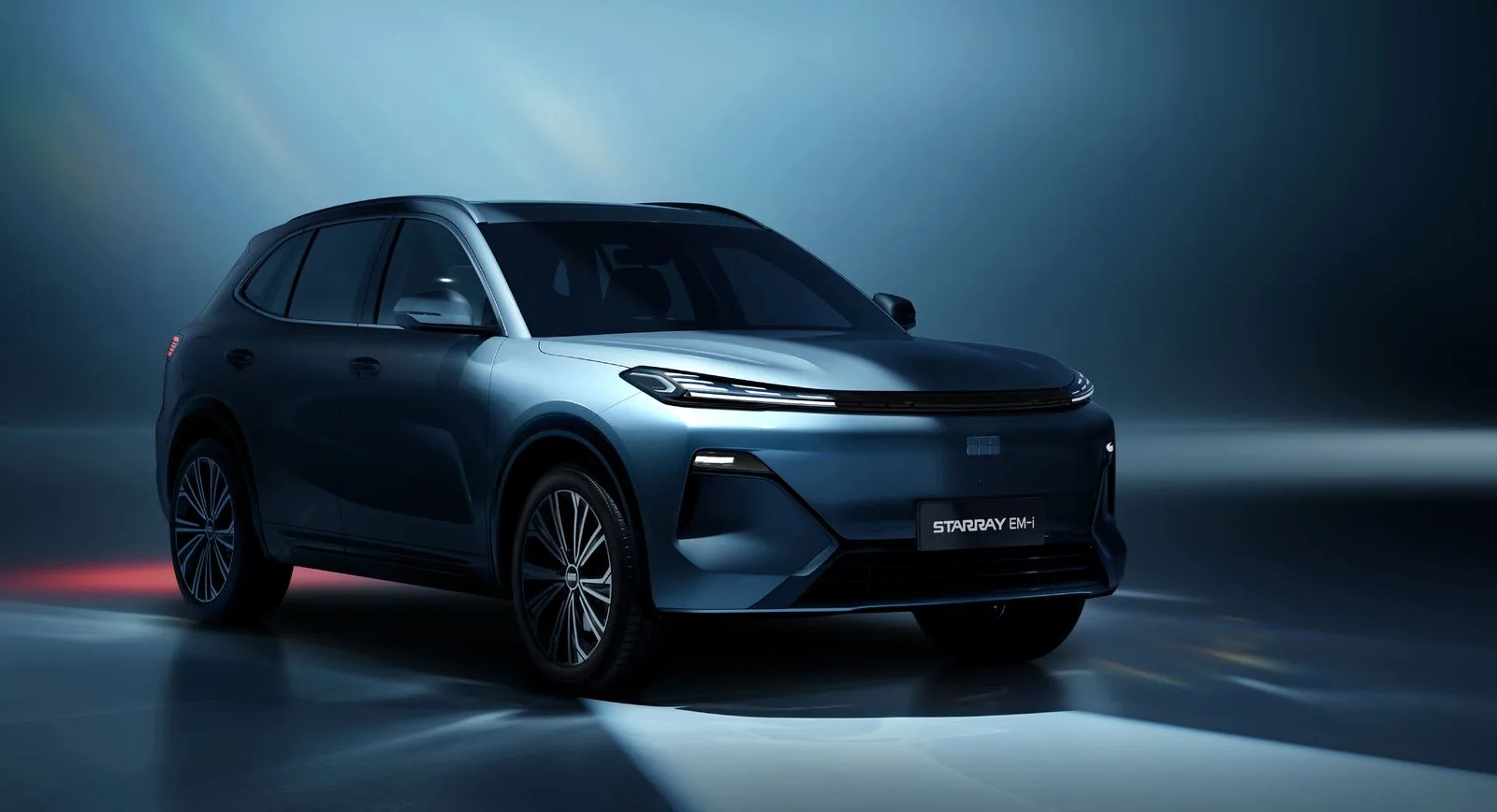
Image credit: Geely Australia. Starray EM-i shown; Geely's imagery does not single out the AWD.
Geely Australia has added an all-wheel drive grade to the Starray EM-i plug-in hybrid, and it is now live in the company's online configurator. The Inspire AWD is listed at $44,990, with on-road costs added on top, which makes it the dearest of the three Starray grades Geely lists and puts it $3,500 above the front-drive Inspire Extended Range it is based on. Motoring outlets reported the grade in September, with dealer arrivals from mid-September.
On paper this is a real step up, not a badge job. A second electric motor on the rear axle takes almost two seconds out of the 0 to 100km/h time, a bigger fuel tank lifts combined range past 1,000km, and all-wheel drive opens the car up to buyers on gravel, wet country roads and snow runs who would never have looked at a front-drive plug-in. It is also the version where the small print matters most, because the things an all-wheel drive buyer tends to care about, towing above all, are exactly the things Geely has not yet put on paper. Here is what the extra $3,500 buys, what it costs you, and where it sits against the plug-in SUVs already on sale.
Pricing
Geely's configurator currently lists three grades, grouped here by drivetrain. Each price is the vehicle price the configurator shows before it adds on-road costs.
| Variant | Battery | Electric power | Price (before on-roads) |
|---|---|---|---|
| Plug-in hybrid, front-wheel drive | |||
| Complete | 18.4kWh | 160kW | $37,490 |
| Inspire Extended Range | 29.8kWh | 160kW | $41,490 |
| Plug-in hybrid, all-wheel drive | |||
| Inspire AWD | 29.8kWh | 160kW front + 80kW rear | $44,990 |
Geely also shows what it calls a Manufacturer's Recommended Drive Away Price once you give it a postcode and a registration type. It describes that figure as an estimate that includes the dealer delivery fee, stamp duty, 12 months' registration and 12 months' compulsory third-party insurance, and it says dealers may charge more or less. For the Inspire AWD in the standard Alpine White with a private registration, on 1 October 2026 it showed:
| Postcode (private buyer) | Vehicle | On-road costs | Estimated drive-away |
|---|---|---|---|
| Sydney, NSW 2000 | $44,990 | $3,533 | $48,523 |
| Melbourne, VIC 3000 | $44,990 | $3,893 | $48,883 |
The five optional paint colours are $600 each on the configurator, and only Alpine White is included. Budget for that if you are pricing a blue or green car.
One change to the range worth knowing about: the original Inspire with the smaller 18.4kWh battery, which sat at $39,990, no longer appears in Geely's configurator or in its current specification guide. The guide now simply calls the 29.8kWh car the Inspire, while the configurator still labels it Inspire Extended Range. They are the same car, and it is the one the AWD is built on.
What the Second Motor Buys
The front of the car is unchanged. The 1.5-litre naturally aspirated petrol engine (73kW and 125Nm) still mostly works with the 160kW and 262Nm front motor, and the battery is the same 29.8kWh lithium iron phosphate pack as the front-drive Inspire. What Geely adds is a rear motor making 80kW and 150Nm, which its specification guide lists as an asynchronous type, where the front motor is a permanent magnet unit.
The result on Geely's figures is 0 to 100km/h in 6.3 seconds, against 8.2 seconds for the front-drive Inspire and 8 seconds for the lighter Complete. That is a big jump for a family SUV at this price, and it is the difference you will notice every time you merge or overtake. Top speed stays electronically limited to 170km/h across the range.
Geely has not published a combined system output for the AWD. Motoring outlets have reported 220kW and 412Nm combined, but that figure is not in Geely Australia's specification guide, so treat it as reported rather than confirmed. You cannot get to it by adding up the individual motors and the engine, because a hybrid system rarely delivers all of its peaks at once.
Beyond the motor, the AWD gets two extra drive modes, listed in the specification guide as Snow and Off Road (Geely's model page calls the second one Dirt), alongside the existing Pure, Hybrid and Power. The configurator also lists a five-link independent rear suspension among the AWD's features, although the specification guide shows a multi-link rear suspension on all three grades, so it is not clear that the layout differs from the front-drive car. Wheels are the same 19-inch alloys with 235/50 tyres as the front-drive Inspire, and the equipment list otherwise mirrors that car: the head-up display, 16-speaker Flyme Sound system, heated, ventilated and massaging front seats, panoramic sunroof and power tailgate all carry over.
A word on what "off road" means here. Geely's specification guide gives no separate ground clearance for the AWD (it lists 172mm for the Complete and the Inspire), no approach or departure angles for any grade, and no low range or locking differential. Read it as all-wheel drive for traction on loose and slippery surfaces, not as a four-wheel drive.
What It Costs You: Range, Weight and Space
The trade-offs are small, but they are real, and they are all in Geely's own specification guide.
| Spec | Inspire (FWD) | Inspire AWD |
|---|---|---|
| Price (before on-roads) | $41,490 | $44,990 |
| 0 to 100km/h (claimed) | 8.2 seconds | 6.3 seconds |
| Electric-only range (WLTP) | 136km | 130km |
| Fuel consumption (WLTP combined) | 1.6L/100km | 1.7L/100km |
| Energy consumption (WLTP) | 17.5kWh/100km | 17.9kWh/100km |
| Fuel tank | 51 litres | 60 litres |
| Combined range (WLTP) | 996km | 1,065km |
| Tare mass | 1,784kg | 1,873kg |
| Gross vehicle mass | 2,288kg | 2,425kg |
| Cargo, rear seats up | 428 litres | 428 litres |
| Cargo, "expanded" | 528 litres | 456 litres |
| Cargo, rear seats folded | 2,065 litres | 1,993 litres |
Read the range figures carefully. The AWD's longer combined range is not an efficiency gain. On Geely's own numbers the AWD uses slightly more electricity and slightly more fuel per 100km than the front-drive car. The extra 69km comes from a fuel tank that is nine litres bigger. That is still useful on a long trip, and it is the reason Geely can put a four-digit range on the brochure, but the car itself is a little thirstier.
The weight goes up by 89kg of tare mass, and Geely has lifted the gross vehicle mass by more than that, so the margin between the two (which has to cover fuel, people and luggage) is 552kg on the AWD against 504kg on the front-drive Inspire. With five adults aboard and a full tank that margin goes quickly, so it is worth doing the sum for your own family.
Space is the one to check in person. Geely lists the same 428 litres behind the rear seats, but its "expanded" figure drops by 72 litres and the seats-folded figure by the same amount. Geely does not explain what "expanded" measures, so take a pram or a golf bag to the dealer and see whether the difference matters to you.
The Fuel Figure Depends on the Plug
The 1.7L/100km figure is a WLTP combined result for a plug-in hybrid, and it assumes the car starts the test with a charged battery. That is how every plug-in hybrid is tested, and it is why the numbers look so low. If you charge at home most nights and your daily driving fits inside the electric range, you may go weeks without burning much petrol. If you rarely plug in, the car runs as a regular hybrid carrying a heavy battery and a second motor, and you should expect to use a lot more than 1.7L/100km.
The figure that tells you what the car uses with the battery run down is a charge-sustaining number, and Geely has not published one for the Starray EM-i AWD. That is the number that matters for anyone who does long country runs, because on a 500km trip the battery is empty for most of it. Until Geely publishes it, compare plug-in hybrids on electric range and how often you will realistically charge, not on the headline L/100km.
Charging is the same as the front-drive Inspire: up to 6.6kW on AC and up to 78kW on DC, according to the current specification guide, with 6kW vehicle-to-load for running appliances from the car. A 6.6kW wallbox is the practical way to refill a 29.8kWh battery overnight.
Towing: The Question Geely Has Not Answered
This is the biggest gap in the launch information, and it matters more for the AWD than for any other Starray. A lot of people shopping an all-wheel drive SUV want to pull a camper trailer, a boat or a box trailer. Geely's specification guide lists towing preparation (a harness and control unit) and trailer stability assist as standard, but it does not list a braked or unbraked towing capacity for any Starray EM-i grade, including the AWD.
So we will not guess one. If towing is part of the reason you want all-wheel drive, get the braked towing capacity and the maximum towball download from the dealer in writing, for this exact variant, before you sign. For context, the other all-wheel drive plug-in hybrids in the comparison below carry braked towing figures in our listings, and once you have a number for the Starray you can check a real combination with our TowingSorted planner.
Safety and Warranty
ANCAP rated the Starray EM-i in 2025, and its published record says the rating applies to all variants. That rating was issued before the AWD went on sale here and the record does not name it, and the AWD adds a second motor and 89kg. We hold no ANCAP rating for the AWD specifically. If a rating is important to your decision, which it should be, ask Geely to confirm in writing that the existing rating covers the Inspire AWD.
The active safety list in the specification guide is the same across all three grades, including autonomous emergency braking, adaptive cruise, lane keeping and lane change assist, blind spot detection, rear cross traffic alert and brake, and a driver fatigue alert. The warranty is seven years with unlimited kilometres on the car and eight years with unlimited kilometres on the traction battery, with up to seven years of roadside assist. Geely's footnote says the unlimited kilometres apply to private owners only, so fleet and rideshare buyers should check the terms.
Tax and Novated Leasing
Luxury car tax is not a factor. At $44,990 the Starray AWD sits well under both 2026-27 thresholds: $80,809 for most cars and $91,661 for fuel-efficient ones.
The fringe benefits tax position is the one that catches people out. Plug-in hybrids stopped qualifying for the electric car FBT exemption for cars first held on or after 1 April 2025, so a new novated lease on this car pays FBT in the usual way. A novated lease can still make sense, but it will not carry the saving that a battery-electric car under the threshold gets. This is general information, not tax advice; check the numbers with your lease provider.
How It Stacks Up
The rival Geely is really aiming at is the Jaecoo J7 SHS-P Summit AWD, which we do not list yet. Jaecoo's site advertises it at $47,990 drive-away for MY27 cars ordered by 31 October 2026 and delivered by 30 November 2026, with no metallic paint, at participating dealers, and not for fleet, government or rental buyers. It uses a 150kW and 310Nm front motor and a 113kW and 210Nm rear motor.
This is where the headline prices mislead. The Geely's $44,990 is before on-road costs and the Jaecoo's $47,990 already includes them. On Geely's own drive-away estimates of $48,523 in Sydney and $48,883 in Melbourne, the Starray AWD comes out about $530 to $890 dearer than the Jaecoo's offer price, not $3,000 cheaper. The Jaecoo price is a time-limited offer and may vary by location, so get a written drive-away quote for both. And do not compare their fuel figures directly: Jaecoo quotes 1.9L/100km on the older NEDC test and Geely quotes 1.7L/100km on WLTP.
Among the plug-in hybrids we list on sale, the front-drive BYD Sealion 6 Essential is at $42,990 before on-road costs, $2,000 under the Starray AWD, with 92km of electric range on our figures. Its all-wheel drive versions, including the Sealion 6 Premium Extended Range, are listed with more power (253kW) and 128km of electric range. The Haval H6 Ultra PHEV AWD is the other obvious all-wheel drive plug-in near this money, and we list it with 268kW and a 1,500kg braked towing capacity. Further up, the Mitsubishi Outlander PHEV ES is listed with 86km of electric range and 1,600kg braked towing, and the Toyota RAV4 XSE PHEV AWD is $63,340 before on-road costs with 144km of electric range. Rival specifications quoted here are the ones we list; compare them side by side below.
Pick two
Plug-in hybrid SUVs, side by side
The front-drive Starray and the plug-in SUVs a Starray AWD buyer is likely to cross-shop. Tap any two.
| Spec | Geely Starray EM-i Inspire Extended Range (FWD) | BYD Sealion 6 Essential |
|---|---|---|
| Price from | $41,490RRP, before on-roads | $42,990RRP, before on-roads |
| Fuel use | 1.4 L/100kmcombined cycle from a full battery | 1.1 L/100kmfrom a full battery, 4.7 once flat |
| Electric-only range | 136 km | 92 km |
| Seats | 5 | 5 |
| Braked towing | No data | 1,500 kg |
| ANCAP | 5 starstested 2025 | 5 starstested 2023 |
| Warranty | 7 yrunlimited km | 6 yr150k km |
| Service interval | 20,000 km | 20,000 km |
Prices shown are each car's listed price and are not all on the same basis. Electric range is the figure we list for each car. The Starray EM-i Inspire AWD is not in this comparison yet; we will add it once its full specification is published, including a towing capacity. Figures come from our car database, which is built from Australian manufacturer documents. A blank field reads “No data” rather than a zero or a dash.
What Geely Has Not Told Us Yet
- Towing capacity. No braked or unbraked figure, and no towball download, in the current specification guide.
- Fuel use with a flat battery. No charge-sustaining figure, which is what you use on long trips.
- Combined system output. The 220kW and 412Nm figure in circulation is reported, not in Geely Australia's documents.
- Ground clearance and tracks for the AWD. The guide lists them for the Complete and the Inspire, with no separate AWD figure.
- An ANCAP record that names the AWD. The existing rating predates it.
Who It Suits, and Who It Does Not
The Starray EM-i AWD makes most sense for a buyer who can charge at home, lives somewhere with gravel, wet or icy roads, and wants a quicker, more sure-footed family SUV than the front-drive car without paying Outlander or RAV4 money. The 1,065km combined range is a genuine help on long country drives, even though the gain over the front-drive car comes from the bigger tank rather than better efficiency.
It makes less sense if you mostly drive in town on sealed roads. The front-drive Inspire Extended Range goes slightly further on electricity, uses slightly less fuel, has more cargo space with the seats folded and costs $3,500 less. And if you need to tow, wait until Geely publishes a figure, or buy a rival that already has one. If a novated lease tax saving is the goal, a plug-in hybrid no longer gets it.
We will add the Inspire AWD to the CarSorted directory with its full specification as Geely publishes the missing figures. Until then, the front-drive Extended Range is the car to compare it against.
Disclaimer: Prices and drive-away estimates are from Geely Australia's online configurator on 1 October 2026 (private registration, standard Alpine White, postcodes 2000 and 3000). Geely describes its drive-away figures as estimates and says individual dealers may set their own prices. Specifications, masses, cargo volumes, charging figures and warranty terms are from Geely Australia's current Starray EM-i specification guide (September 2026). Range and consumption figures are WLTP laboratory results for comparison only; real-world results will differ. The combined system output and dealer arrival timing are as reported by Australian motoring outlets and have not been confirmed in Geely's documents. The Jaecoo price is from Jaecoo's Australian website on 1 October 2026 and is a time-limited offer with conditions. Other rival figures are the ones listed on CarSorted at the time of writing. Luxury car tax thresholds are for the 2026-27 financial year and change each 1 July; tax information is general information, not advice. Confirm price, specification and availability with a Geely dealer before ordering.