Key Takeaways
- Standard from $36,900 driveaway, Two-Tone from $37,400 driveaway
- Honda Australia's first ever EV, sub-3.6m city hatch with a 29.6kWh battery
- 206km WLTP combined, up to 320km on the WLTP city cycle
- 47kW / 162Nm normal, 70kW Boost mode with a simulated seven-speed and Active Sound Control
- Fewer than 130 cars for 2026, larger allocation from early 2027
- 5yr unlimited-km warranty, $199 capped-price servicing, October deliveries
- Pre-orders open now at Honda Australia dealers
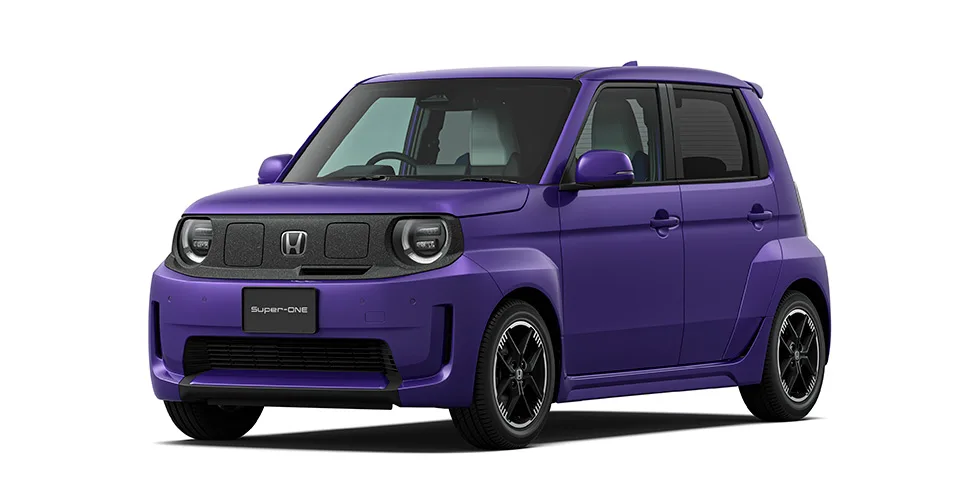
Image credit: Honda Australia
If you have been waiting for Honda Australia to actually sell you an electric car, this is the week. Honda has locked in Australian pricing for the Super-ONE, its first fully electric passenger vehicle for our market, opening pre-orders on 4 August 2026 at $36,900 driveaway for the standard car and $37,400 driveaway for the Two-Tone. The catch is not the price. It is the volume: fewer than 130 cars are coming to Australia for 2026, and Honda quietly says it has already collected more than 6,500 expressions of interest, which is more sign-ups than it took for the returning Civic Type R hot hatch.
For someone shopping a small EV this week, that supply gap changes the buying decision entirely. The Super-ONE is not going to be a car you cross-shop on the showroom floor next month, it is a car you either register interest in now or wait a year for. What you get for the money is a very short (3,580mm), very light (1,093kg) city hatch with a small 29.6kWh battery, a modest 206km WLTP range, and a driver-focused mission that has almost nothing in common with the value-per-kilometre calculations that dominate the rest of the sub-$40k EV segment.
Pricing
| Variant | Price (driveaway) |
|---|---|
| Super-ONE (standard) | $36,900 |
| Super-ONE Two-Tone (Violet Boost + blackout roof) | $37,400 |
Both prices are national driveaway, which is a rarity at this end of the market. On a $37k car the driveaway framing is worth roughly $2,500 versus a similarly priced RRP-only competitor once you layer stamp duty, registration and CTP on top. There is no hidden Metallic paint charge and Honda has not carved out separate fleet or private-buyer pricing.
Powertrain and Battery
The Super-ONE is a single-motor front-drive EV. In its default drive mode the front motor produces 47kW and 162Nm. Press the dedicated Boost button on the steering wheel and Honda lifts output to 70kW, holds the extra power for a limited window, and pipes a synthesised motor note through the speakers. There is no all-wheel-drive option and no larger battery on the way for Australia.
| Spec | Honda Super-ONE |
|---|---|
| Motor | Single front, permanent magnet |
| Power (normal) | 47 kW |
| Power (Boost mode) | 70 kW |
| Torque | 162 Nm |
| Battery | 29.6 kWh lithium-ion |
| WLTP range (combined) | 206 km |
| WLTP range (city cycle) | 320 km |
| Max AC charging | 10 kW (about 4.5 hr full charge) |
| Max DC charging | 50 kW (about 30 min 10 to 80 per cent) |
| Drive | Front-wheel drive |
| Length | 3,580 mm |
| Width | 1,575 mm |
| Height | 1,615 mm |
| Wheelbase | 2,520 mm |
| Kerb weight | 1,093 kg |
| Boot volume | 162 L (967 L rear seats folded) |
| Wheels and tyres | 16-inch alloys, Yokohama Advan Fleva |
Numbers on a page do the Super-ONE no favours. 206km WLTP combined is thin for a $37k EV in 2026, and the 29.6kWh pack is roughly the same size as the battery a first-gen Nissan Leaf launched with more than a decade ago. Where the pitch changes is on the WLTP city cycle, where Honda quotes 320km off a single charge, and in real weekly use if you plug in at home nightly the actual number stops mattering. If you drive fewer than 30km a day, a 29.6kWh battery just means you spend less on electricity per full charge.
The Cabin, and Why It Matters More Than the Battery
Standard equipment is where the Super-ONE argues its case. Every car gets a 9.0-inch central touchscreen with wireless Apple CarPlay and Android Auto, a 7.0-inch digital driver display, and an eight-speaker Bose premium audio system with a subwoofer. That is unusual kit at the price point, and it explains a good chunk of the sticker versus a stripped-out entry Chinese EV.
The seating trick is the same Magic Seats setup Honda uses in the Jazz. The rear seat bases flip vertically up against the backrests, which turns the back of the cabin into a tall, floor-to-ceiling square, useful for a folded bike, a large houseplant or an IKEA flatpack that no other 3.6m car will swallow. Fold the backrest flat and cargo grows from 162 litres to 967 litres, which is a genuinely big number for the outside footprint.
The party trick nobody expected is the simulated transmission. Honda has coded a virtual seven-speed with steering-wheel paddles into the drivetrain, backed by an Active Sound Control system that pipes a synthetic engine note through the speakers, changes tone in Boost mode, and colour-shifts the interior ambient lighting to purple when Boost is active. If you have written off simulated sound as a gimmick on other EVs, fair enough, but it is genuinely aimed at Type R buyers who want an urban EV that still feels like a Honda enthusiast car.
Safety
The Super-ONE has not yet been rated by ANCAP, and Honda has not confirmed whether it will submit the car for local testing given the tiny 130-unit allocation. Honda's active safety suite covers AEB with pedestrian and cyclist detection, adaptive cruise control, lane-keep assist, lane departure warning, traffic sign recognition, driver attention monitoring and a reversing camera. Airbag count and specific ADAS calibration for the Australian car are yet to be published by Honda.
How It Compares
This is the section where the Super-ONE gets awkward on a spec sheet. Against the small EV set on CarSorted at similar money, it is short on battery and range. On our own directory, the GWM ORA 5 Lux is $33,990 driveaway with a 58.3kWh LFP pack and 430km of range. The MG MG4 51 sits inside a similar driveaway window with roughly 350km of range and a 51kWh battery, so nearly double the pack of the Honda for less money.
| Small EV | Price | Battery | Range |
|---|---|---|---|
| Honda Super-ONE | $36,900 driveaway | 29.6 kWh | 206 km WLTP |
| GWM ORA 5 Lux | $33,990 driveaway | 58.3 kWh | 430 km |
| MG MG4 51 Excite | $34,990 driveaway | 51 kWh | 350 km WLTP |
| BYD Atto 3 Essential | $39,990 before on-roads | 50.1 kWh | 345 km WLTP |
Read the table cold and the Super-ONE looks over-priced. Read the same table with a different question in mind (which of these do I actually want to drive to the shops, park at Bondi, park at a Sydney terrace, and sit inside on a Bose stereo?) and it starts to make sense. This is a heart-buy at a small-EV price, not a value pick. Honda knows it, which is why the allocation is 130 cars and Honda already has 6,500 people waiting.
Warranty and Servicing
Honda covers the Super-ONE with a 5-year unlimited-kilometre vehicle warranty, 5 years of roadside assistance, and capped-price servicing at $199 per annual service for the first five services or 50,000km, whichever comes first. Owners who service exclusively through the Honda dealer network can extend both warranty and roadside cover to 8 years under Honda's Extend program. Honda has not published a separate high-voltage battery warranty term for the Super-ONE yet, though the eight-year clock is standard practice for the segment. For how that compares to competitor cover, see our warranty comparison.
The CarSorted Angle
On CarSorted, if we filter the directory to electric hatchbacks priced under $40,000 driveaway, the Super-ONE sits alongside the GWM ORA 5, the MG MG4 and the incoming BYD Dolphin. The Honda is the shortest, lightest and least powerful of the group, and by a distance the shortest on battery per dollar. Where it sits ahead is on kit list and brand confidence: standard wireless CarPlay, an 8-speaker Bose stereo and a 5-year unlimited-km warranty from a mainstream Japanese OEM with a dealer on every second corner. Nothing else at this price point matches all three.
The running-cost picture flips the value discussion again. On the current CarSorted energy assumption of 33c/kWh for home charging, filling the Super-ONE's 29.6kWh battery costs about $9.77 per full charge. Over 15,000km a year at the WLTP combined figure, that works out to roughly $710 in home electricity compared with about $2,940 in petrol for an equivalent 6.5 L/100km Honda Jazz on 91 RON at $2.10/L. That is a $2,230 annual saving on fuel that stacks up regardless of range, plus zero excise exposure to next week's 17c/L bowser jump when the fuel excise cut ends on 3 August 2026. Play the same maths against the MG4 or ORA 5 and the Honda is line-ball on running cost per kilometre, so the choice really does come back to whether you value the badge and the interior over the extra 150km of range.
For a broader look at how the small-EV pack lines up, our CarSorted comparison tool lets you drop the Super-ONE, ORA 5 and MG4 side by side, and the Best Electric Cars Australia 2026 guide has the full context on where each one fits.
What This Means for Buyers
If your commute is fewer than 40km a day and you have a driveway with a 10-amp GPO, this is a serious EV for you. Honda has built the Super-ONE for exactly that person: a metro buyer who wants a small, characterful, well-equipped car that costs almost nothing to run and can be recharged overnight on a normal home socket. The $36,900 driveaway sticker is a fair-to-generous number for a Honda-branded EV with a Bose stereo, a 5-year unlimited-km warranty and $199 servicing, especially against a Honda Jazz Vibe hybrid which sits at similar money without the plug-in ability.
If you drive more than 100km on a bad day, tow anything, road trip more than a couple of times a year, or want the cheapest kWh you can buy in an EV, look at the GWM ORA 5 or the MG MG4 first. You will save around $3,000 driveaway, gain nearly double the range, and lose the Bose, the Magic Seats and the Honda badge. That is the trade honestly stated.
Whichever way you land, you should register interest today if you want the Super-ONE in 2026. Honda already has more than 6,500 sign-ups for 130 cars, which is a 50-to-1 oversubscription. Anyone joining the queue this week is realistically playing for a 2027 build slot.
Best Electric Cars 2026 | GWM ORA 5 Priced for Australia | CarSorted Comparison Tool
Disclaimer: Pricing and specifications are sourced from Honda Australia. All prices are driveaway as quoted by Honda for the initial pre-order allocation. WLTP range figures are manufacturer claims and will vary in real-world driving. ANCAP has not yet published a safety rating for the Honda Super-ONE. Running-cost figures use a home electricity price of 33c/kWh and a petrol price of $2.10/L on 91 RON; your actual costs will vary with your tariff and driving pattern.
Compare these picks side by side
Stack 4 of them on 200+ specs, price, safety and running cost in one view.
Compare all 4 nowFrequently Asked Questions
How much is the Honda Super-ONE in Australia?
What is the range of the Honda Super-ONE?
How fast does the Honda Super-ONE charge?
How many Honda Super-ONE are coming to Australia in 2026?
What warranty does the Honda Super-ONE get?
Does the Honda Super-ONE have Apple CarPlay?
New cars, real prices, straight to your inbox
Join the CarSorted mailing list for new-model launches, price drops and drive-away deals, honest reviews, and founding-member pricing on the upcoming CarSorted Pro Report.
- New-model launches
- Price drops & deals
- Honest reviews
No spam, unsubscribe anytime. By subscribing you agree to receive marketing emails.
Disclaimer: All information in this article was believed to be correct at the time of publishing (5 August 2026). Prices are manufacturer recommended retail prices (RRP) and may vary by state, dealer, and options. Specifications, government incentives, and rebates can change without notice. Always verify details with the manufacturer or relevant authority before making a purchase decision. Running cost estimates are based on average Australian driving conditions at 15,000 km/year. CarSorted does not accept payment for recommendations or rankings.
Written by Uzzi, CarSorted Editorial Team · 5 August 2026 · how we research
Comments (0)
Sign in to join the conversation
No comments yet. Be the first!