GWM Cannon Alpha Review (2026): The 300kW Plug-In Ute That Still Tows 3.5 Tonnes
Written by Uzzi · 20 June 2026
CarSorted Verdict
The GWM Cannon Alpha is a big, comfortable dual-cab that gives you a real choice: a value 135kW diesel from $52,990, or a 300kW/750Nm plug-in hybrid with 115km of electric range from $59,990. Crucially, the PHEV keeps the full 3,500kg braked tow rating, which not every plug-in ute manages. If you want a large family hauler that can commute on electricity and still tow a caravan, it is one of the most interesting utes on sale.
What we like
- + PHEV keeps the full 3,500kg braked tow rating
- + 300kW/750Nm PHEV out-muscles most diesel dual-cab rivals
- + 115km of claimed EV range for cheap commuting
- + Big, plush, well-equipped cabin
- + 7-year, unlimited-kilometre warranty
What could be better
- - Heavy: the PHEV is 2,810kg before you load it
- - Large 5,445mm length and 13m turning circle
- - 50kW DC charging is modest for the battery
- - Younger brand, resale still establishing
- - Five seats only, like most dual-cabs
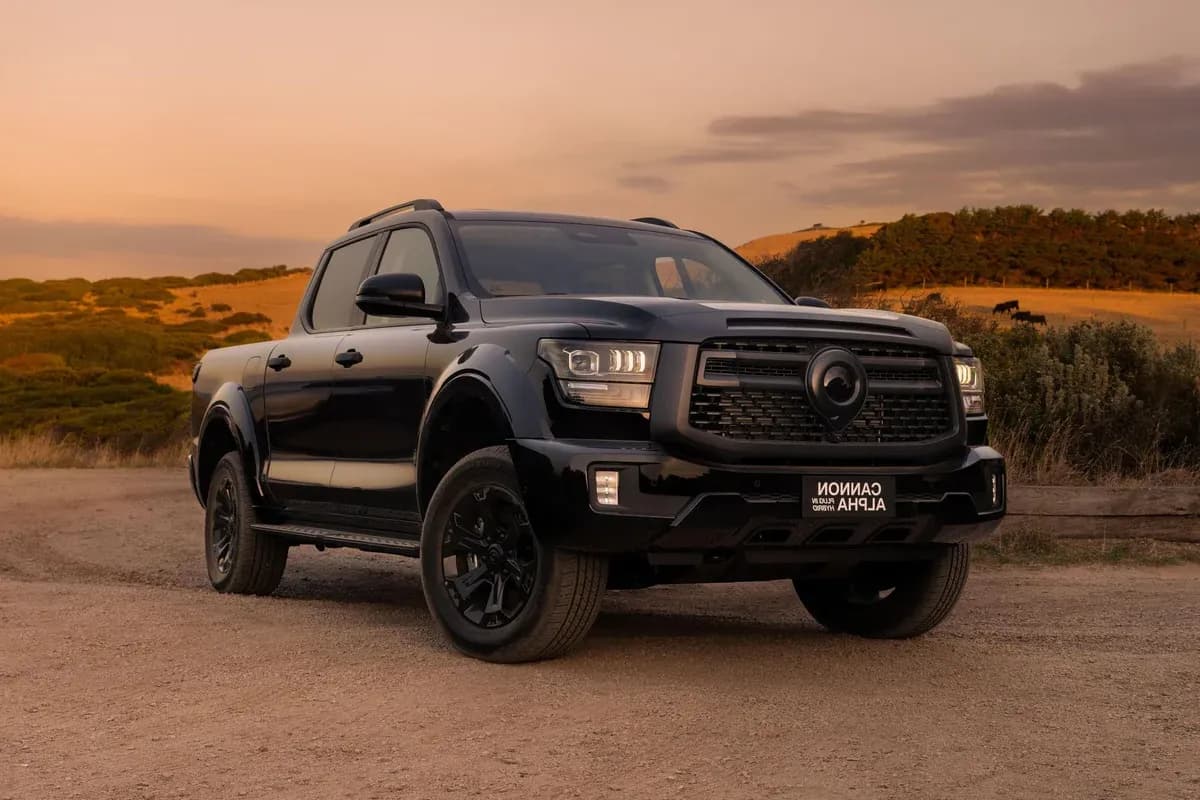
The GWM Cannon Alpha is GWM's flagship dual-cab, sitting above the regular Cannon and going straight after the big-truck end of the ute market. It is longer, plusher and more powerful than the utes most Australians know, and the headline is the plug-in hybrid version: a 300kW twin-motor truck that can commute on electricity yet still tow 3.5 tonnes. Here is the data-led take.
How much is the GWM Cannon Alpha?
Four grades across two powertrains. All prices are before on-road costs.
| Variant | Powertrain | Power | Tow (braked) | RRP |
|---|---|---|---|---|
| Cannon Alpha Lux Diesel | Diesel | 135kW / 480Nm | 3,500kg | $52,990 |
| Cannon Alpha Ultra Diesel | Diesel | 135kW / 480Nm | 3,500kg | $56,990 |
| Cannon Alpha Lux PHEV | Plug-in Hybrid | 300kW / 750Nm | 3,500kg | $59,990 |
| Cannon Alpha Ultra PHEV | Plug-in Hybrid | 300kW / 750Nm | 3,500kg | $66,990 |
The pricing is sharp for the size. A loaded mainstream dual-cab like a Ford Ranger or Toyota HiLux in flagship trim sits well into the $70,000s, and the Cannon Alpha undercuts them while giving you a bigger body and, in PHEV form, far more power. The roughly $7,000 step from diesel to plug-in hybrid is the key decision, and it comes down to whether you can charge.
Diesel or plug-in hybrid?
The diesel is the straightforward workhorse. Its 2.4-litre turbo-diesel makes 135kW/480Nm through a 9-speed automatic and a proper 4WD system, uses a claimed 8.9L/100km, and tows 3,500kg. It is the value pick at $52,990 and the easy choice if you do big distances or tow regularly without anywhere to plug in.
The plug-in hybrid is the showstopper. It pairs a turbo-petrol engine with electric motors for a combined 300kW and 750Nm, which is more grunt than almost any diesel dual-cab on sale. It carries a battery good for a claimed 115km of electric range, so a typical commute can be done on electricity alone, and it still tows the full 3,500kg braked. That last point matters: some plug-in hybrid utes trade away tow capacity for their batteries, so keeping 3,500kg is a genuine selling point for anyone with a caravan or big trailer.
Performance, charging and towing
With 300kW and instant electric torque, the PHEV is properly quick for a 2.8-tonne truck, and the electric assistance makes it feel effortless when loaded or towing. Charging is the one soft spot: DC fast charging peaks at 50kW, which tops the battery up but is slow next to a passenger EV, and home AC charging runs at 6.6kW. In practice you will charge it overnight at home rather than relying on public chargers, which suits the use case fine.
On towing, both powertrains carry the full 3,500kg braked rating, and the diesel's 78-litre tank (75 litres on the PHEV) gives it long touring legs. As with any heavy ute, keep an eye on the gross combined mass when you load people, gear and a loaded trailer all at once, because kerb weights here are high: 2,489-2,550kg for the diesel and 2,810kg for the PHEV.
Dimensions and practicality
This is a big truck. At 5,445mm long, 1,991mm wide and riding on a 3,350mm wheelbase, the Cannon Alpha is longer than a Ranger and needs a 13m turning circle, so tight carparks and bush tracks take more thought. The payoff is a roomy five-seat cabin with limousine-like rear legroom and a large tray. Ground clearance is a useful 224mm on the diesel (210mm on the PHEV), and the 4WD hardware is genuine rather than soft-roader.
Inside, the Cannon Alpha leans premium for a ute, with a big touchscreen, soft materials, heated and ventilated seats on the higher grades, and a level of cabin plushness that shames a lot of work-focused rivals. It is pitched as much at families and tourers as it is at tradies.
Running costs
The diesel's claimed 8.9L/100km works out to roughly $2,670 a year in fuel over 15,000km at $2.00/L, typical for a big diesel dual-cab. The plug-in hybrid is where the sums get interesting. If you charge at home and keep most trips inside the 115km EV range, a lot of your driving runs on electricity at a fraction of the cost of diesel, and you only burn petrol on longer hauls and while towing. The official 1.7L/100km combined figure assumes a charged battery, so treat it as a best case, not an everyday number. The real saving depends entirely on how often you plug in; for a home-charging commuter who tows on weekends, the PHEV can be dramatically cheaper to run than the diesel.
Safety and ownership
The Cannon Alpha holds a 5-star ANCAP rating dated 2024, with autonomous emergency braking, lane-keep assist, blind-spot monitoring and adaptive cruise standard. Ownership is covered by GWM's 7-year, unlimited-kilometre warranty, with separate longer cover on the PHEV's high-voltage battery. As with any newer Chinese ute, resale values are still being established, so factor that into the total cost rather than just the drive-away price.
How it compares
The obvious rival is the BYD Shark 6, the plug-in hybrid ute that kicked off the category. The Shark 6 is more affordable and very efficient, but the Cannon Alpha is the bigger, more powerful truck and keeps the full 3,500kg braked tow rating, so heavy towers should look hard at the GWM. Against the establishment, the Ford Ranger and Toyota HiLux drive with more polish and hold their value better, but cost more in flagship trim and cannot offer a plug-in option. If you like the GWM cabin but want a wagon, the Tank 500 shares much of the mechanical story in seven-seat SUV form.
Cross-shopping the plug-in utes? Line them up in our best plug-in hybrid utes guide and the wider best utes roundup.
The verdict
The GWM Cannon Alpha is one of the most compelling big utes on sale because it lets you choose your trade-off. The diesel is a value, no-nonsense 3.5-tonne tow truck from $52,990. The PHEV is a 300kW powerhouse that can commute on electricity, save you a fortune in fuel if you charge at home, and still tow a caravan. It is large, heavy and the charging is slow, and GWM is still building its resale reputation, but on capability for the money it is hard to ignore. For a home-charging family that tows, the PHEV is our pick.
Compare these picks side by side
Stack 4 of them on 200+ specs, price, safety and running cost in one view.
Compare all 4 nowFrequently Asked Questions
How much is the GWM Cannon Alpha in Australia?
What is the GWM Cannon Alpha PHEV's electric range?
How much can the GWM Cannon Alpha tow?
How powerful is the Cannon Alpha PHEV?
What warranty does the GWM Cannon Alpha come with?
Is the GWM Cannon Alpha safe?
Is the Cannon Alpha PHEV better than the BYD Shark 6?
Is the GWM Cannon Alpha worth buying in 2026?
New cars, real prices, straight to your inbox
Join the CarSorted mailing list for new-model launches, price drops and drive-away deals, honest reviews, and founding-member pricing on the upcoming CarSorted Pro Report.
- New-model launches
- Price drops & deals
- Honest reviews
No spam, unsubscribe anytime. By subscribing you agree to receive marketing emails.
Disclaimer: All information in this article was believed to be correct at the time of publishing (20 June 2026). Prices are manufacturer recommended retail prices (RRP) and may vary by state, dealer, and options. Specifications, government incentives, and rebates can change without notice. Always verify details with the manufacturer or relevant authority before making a purchase decision. Running cost estimates are based on average Australian driving conditions at 15,000 km/year. CarSorted does not accept payment for recommendations or rankings.
Written by Uzzi, CarSorted Editorial Team · 20 June 2026 · how we research
Comments (0)
Sign in to join the conversation
No comments yet. Be the first!