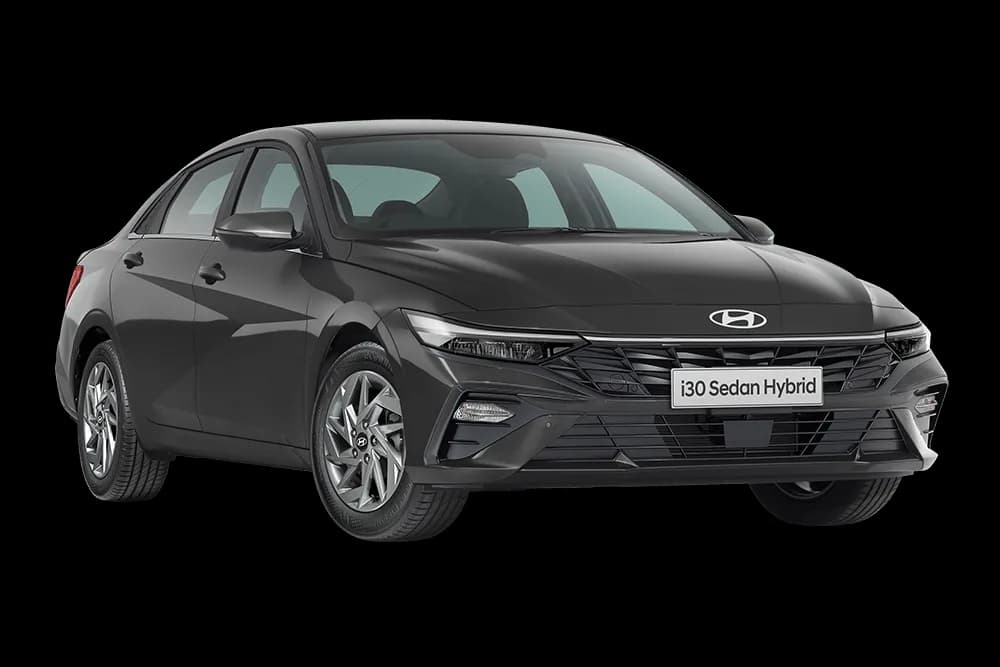
Compare every Hyundai i30 Sedan variant sold new in Australia. 23 variants, from $29,000 RRP. Side-by-side specs, ANCAP safety, fuel economy, towing capacity, warranty and running costs, pricing sourced from the Hyundai Australian website and updated weekly. This page also covers 3 previous-generation variants (sold new until 2023), kept for used-buyer research — their prices are what those cars cost when new, not current offers.
23 variants of the Hyundai i30 Sedan are on sale in Australia. Tap to compare them side-by-side, then tap any variant for its full specs.
The MY24 Hyundai i30 Sedan i30 2.0 MPi is a small four-door sold new in Australia in 2024. Its 2.0-litre Atkinson-cycle SmartStream four makes 110 kW and 180 Nm through an IVT continuously variable transmission to the front wheels, and Hyundai quotes 6.1 L/100km combined on ADR 81/02 with 139 g/km of CO2. It is 4,710 mm long on a 2,720 mm wheelbase, carries 474 litres in the boot, tows 1,100 kg braked and rides on 16-inch alloys with a full-size alloy spare. Smart Cruise Control with stop and go, forward collision-avoidance assist with cyclist detection, lane following assist and an electronic park brake with auto hold are standard across the range.
Configure the i30 2.0 MPiThe 2026 Hyundai i30 Sedan Active is a practical family sedan that suits Australian buyers wanting affordable everyday transport with a 474-litre boot and genuine three-star ANCAP safety credentials. Its standout strength is the combination of a frugal 2.0-litre petrol engine achieving 7L/100km consumption with a responsive 117kW and 191Nm torque delivery, keeping annual running costs around $2825. One consideration is the manual transmission-while it helps keep costs down, buyers should verify it suits their driving style, particularly in heavy urban traffic.
Configure the ActiveThe MY24 Hyundai i30 Sedan Elite 2.0 MPi is a small four-door sold new in Australia in 2024. Its 2.0-litre Atkinson-cycle SmartStream four makes 110 kW and 180 Nm through an IVT continuously variable transmission to the front wheels, and Hyundai quotes 6.1 L/100km combined on ADR 81/02 with 139 g/km of CO2. It is 4,710 mm long on a 2,720 mm wheelbase, carries 474 litres in the boot, tows 1,100 kg braked and rides on 17-inch alloys with a full-size alloy spare. Smart Cruise Control with stop and go, forward collision-avoidance assist with cyclist detection, lane following assist and an electronic park brake with auto hold are standard across the range.
Configure the Elite 2.0 MPiThe 2026 Hyundai i30 Sedan Elite is a practical front-wheel-drive family sedan powered by a 2.0-litre petrol engine that suits buyers seeking affordable daily transport with genuine safety credentials-its 3-star ANCAP rating and 1200kg towing capacity make it a sensible choice for young families or commuters. Its standout strength is running cost efficiency, combining a 7L/100km fuel consumption figure with Hyundai's 5-year warranty and relatively modest annual servicing costs, making it genuinely affordable to own long-term. One consideration is the 117kW power output, which is modest by contemporary standards, so test-drive it if you frequently drive on motorways or need spirited acceleration.
Configure the EliteThe 2026 Hyundai i30 Sedan N Line is a sharp-looking compact sedan that appeals to buyers wanting sportier styling and responsive performance without stepping into genuine performance car territory. Its standout strength is the combination of a punchy 1.6-litre turbopetrol engine delivering 150kW and 265Nm through a slick DCT gearbox, paired with genuine everyday practicality-a 474-litre boot, 1,100kg braked towing capacity, and a reasonable 6.6L/100km fuel economy. One thing to consider is that running costs of around $2762 annually, combined with the five-year warranty, mean you'll want to factor in maintenance beyond the initial purchase, particularly if you're doing significant kilometres.
Configure the N LineThe 2026 Hyundai i30 Sedan N M/T is a 5-seat sedan powered by a petrol engine making 206kW and 392Nm, driving the FWD and using 8.5L/100km on the combined cycle. It carries a 5-year/unlimited-km warranty. It offers 464 litres of boot space and is priced from $52,000.
Configure the N M/TThe 2026 Hyundai i30 Sedan N DCT is a 5-seat sedan powered by a petrol engine making 206kW and 392Nm, driving the FWD and using 8.3L/100km on the combined cycle. It carries a 5-year/unlimited-km warranty. It offers 464 litres of boot space and is priced from $54,000.
Configure the N DCTThe CN7 Hyundai i30 Sedan N Line Manual pairs the 1,598 cc Smartstream G1.6 T-GDi turbo four - 150 kW at 6,000 rpm and 265 Nm from 1,500-4,500 rpm - with a six-speed manual. Hyundai's ADR 81/02 figures are 7.5 L/100km combined and 174 g/km CO2 from a 47-litre tank. N Line specification brings multi-link rear suspension, 18-inch alloys on Goodyear Eagle F1 Asymmetric 2 tyres, 305 mm ventilated front discs, sports front seats with extended bolsters, LED headlights, a gloss-black N Line body kit with dual chrome exhaust tips, dual-zone climate and leather-appointed trim. It runs an 8-inch touchscreen with six speakers and a 4.2-inch supervision cluster.
Configure the N Line ManualThe CN7 Hyundai i30 Sedan N Line DCT pairs the 1,598 cc Smartstream G1.6 T-GDi turbo four - 150 kW at 6,000 rpm and 265 Nm from 1,500-4,500 rpm - with a seven-speed dry-clutch DCT. Hyundai's ADR 81/02 figures are 6.8 L/100km combined and 157 g/km CO2 from a 47-litre tank. N Line specification brings multi-link rear suspension, 18-inch alloys on Goodyear Eagle F1 Asymmetric 2 tyres, 305 mm ventilated front discs, sports front seats with extended bolsters, LED headlights, a gloss-black N Line body kit with dual chrome exhaust tips, dual-zone climate and leather-appointed trim. It runs an 8-inch touchscreen with six speakers and a 4.2-inch supervision cluster.
Configure the N Line DCTThe MY25 Hyundai i30 Sedan i30 uses the 110 kW 2.0-litre Smartstream G2.0 MPi Atkinson-cycle four with the Smartstream IVT. ADR 81/02 consumption is 6.1 L/100km combined with 139 g/km CO2 on 91 RON unleaded. The CN7 body measures 4,710 mm long on a 2,720 mm wheelbase with a 474-litre VDA boot, and this grade rides on 16-inch alloys. Every grade gets Forward Collision-Avoidance Assist 1.5 with car, powered-two-wheeler, pedestrian and cyclist detection plus direct-oncoming and junction-turning functions, Lane Following Assist, Intelligent Speed Limit Assist, Smart Cruise Control with Stop & Go, an electric park brake with auto hold and front and rear parking sensors. Base i30: no Bluelink, no satellite navigation, no DAB+, no blind-spot or rear cross-traffic assist, no safe-exit warning, no smart key, no auto-dimming or power-folding mirrors, no rain-sensing wipers on the petrol, and manual air conditioning.
Configure the i30 2.0 MPiThe MY25 Hyundai i30 Sedan i30 uses the 1.6-litre GDi Atkinson-cycle hybrid with a 32 kW electric motor and a six-speed dual-clutch. Hyundai quotes engine output of 77 kW at 5,700 rpm and 147 Nm at 4,000 rpm with a 32 kW / 170 Nm motor and a 1.32 kWh lithium-ion polymer battery, for a combined system 104 kW and 265 Nm, and ADR 81/02 consumption of 3.9 L/100km with 92 g/km CO2. The CN7 body measures 4,710 mm long on a 2,720 mm wheelbase with a 474-litre VDA boot, and this grade rides on 16-inch alloys. Every grade gets Forward Collision-Avoidance Assist 1.5 with car, powered-two-wheeler, pedestrian and cyclist detection plus direct-oncoming and junction-turning functions, Lane Following Assist, Intelligent Speed Limit Assist, Smart Cruise Control with Stop & Go, an electric park brake with auto hold and front and rear parking sensors. Base i30 hybrid: gains dual-zone climate with a PTC electric heater, rain-sensing wipers and the Virtual Engine Sound System over the petrol i30, and uses the three-setting Eco/Sport/Smart drive mode in place of the petrol's four-setting Normal/Eco/Sport/Smart. Still no Bluelink, navigation, DAB+, blind-spot assist or smart key.
Configure the i30 1.6 HybridThe MY25 Hyundai i30 Sedan Elite uses the 110 kW 2.0-litre Smartstream G2.0 MPi Atkinson-cycle four with the Smartstream IVT. ADR 81/02 consumption is 6.1 L/100km combined with 139 g/km CO2 on 91 RON unleaded. The CN7 body measures 4,710 mm long on a 2,720 mm wheelbase with a 474-litre VDA boot, and this grade rides on 17-inch alloys. Every grade gets Forward Collision-Avoidance Assist 1.5 with car, powered-two-wheeler, pedestrian and cyclist detection plus direct-oncoming and junction-turning functions, Lane Following Assist, Intelligent Speed Limit Assist, Smart Cruise Control with Stop & Go, an electric park brake with auto hold and front and rear parking sensors. Elite adds Bluelink, satellite navigation, DAB+, a 10.25-inch touchscreen and 10.25-inch digital cluster, leather-appointed seats, dual-zone climate, smart key, blind-spot and rear cross-traffic collision-avoidance assist, safe exit warning and dashboard ambient lighting. It does not get the surround-view camera, sunroof, power seats, heated/ventilated seats or the Bose system.
Configure the Elite 2.0 MPiThe MY25 Hyundai i30 Sedan Elite uses the 1.6-litre GDi Atkinson-cycle hybrid with a 32 kW electric motor and a six-speed dual-clutch. Hyundai quotes engine output of 77 kW at 5,700 rpm and 147 Nm at 4,000 rpm with a 32 kW / 170 Nm motor and a 1.32 kWh lithium-ion polymer battery, for a combined system 104 kW and 265 Nm, and ADR 81/02 consumption of 3.9 L/100km with 92 g/km CO2. The CN7 body measures 4,710 mm long on a 2,720 mm wheelbase with a 474-litre VDA boot, and this grade rides on 16-inch alloys. Every grade gets Forward Collision-Avoidance Assist 1.5 with car, powered-two-wheeler, pedestrian and cyclist detection plus direct-oncoming and junction-turning functions, Lane Following Assist, Intelligent Speed Limit Assist, Smart Cruise Control with Stop & Go, an electric park brake with auto hold and front and rear parking sensors. Elite hybrid: as Elite petrol but on 16-inch wheels with a space-saver spare, with a PTC electric cabin heater, the three-setting drive mode and the Virtual Engine Sound System. The sheet marks Smart Boot hands-free opening and the one-touch driver's window as petrol-only on this grade.
Configure the Elite 1.6 HybridThe MY25 Hyundai i30 Sedan N Line uses the 150 kW 1.6-litre Smartstream G1.6 T-GDi turbo with the seven-speed dual-clutch. ADR 81/02 consumption is 6.6 L/100km combined with 155 g/km CO2 on 91 RON unleaded. The CN7 body measures 4,710 mm long on a 2,720 mm wheelbase with a 474-litre VDA boot, and this grade rides on 18-inch alloys. Every grade gets Forward Collision-Avoidance Assist 1.5 with car, powered-two-wheeler, pedestrian and cyclist detection plus direct-oncoming and junction-turning functions, Lane Following Assist, Intelligent Speed Limit Assist, Smart Cruise Control with Stop & Go, an electric park brake with auto hold and front and rear parking sensors. N Line brings the 1.6 T-GDi turbo, multi-link rear suspension, 18-inch alloys, 305 mm ventilated front discs, paddle shifters, the N Line body kit with gloss-black inserts and dual chrome exhaust tips, sports seats with extended bolsters, alloy pedals and a black headlining. It keeps the 8-inch touchscreen and six speakers and, unlike Elite, has no Bluelink, satellite navigation, DAB+ or ambient lighting.
Configure the N Line 1.6 T-GDiRelated reading
News, buying guides and owner reviews relevant to this model.


Stack two models side-by-side. Price, range, towing, ANCAP and ownership cost in one view.