Key Takeaways
- SR cab-chassis from $74,990, SR pick-up $76,490, SR5 pick-up $82,990 (before on-roads)
- Single powertrain: 59.2kWh battery, 144kW/468Nm dual-motor AWD
- Claimed range of 240km WLTP
- Braked towing drops to 1,600kg, down from 3,500kg on the diesel
- ANCAP not yet rated on the BEV bodyshell
- Q2 2026 arrival, around 500 units forecast for year one, fleet-led launch
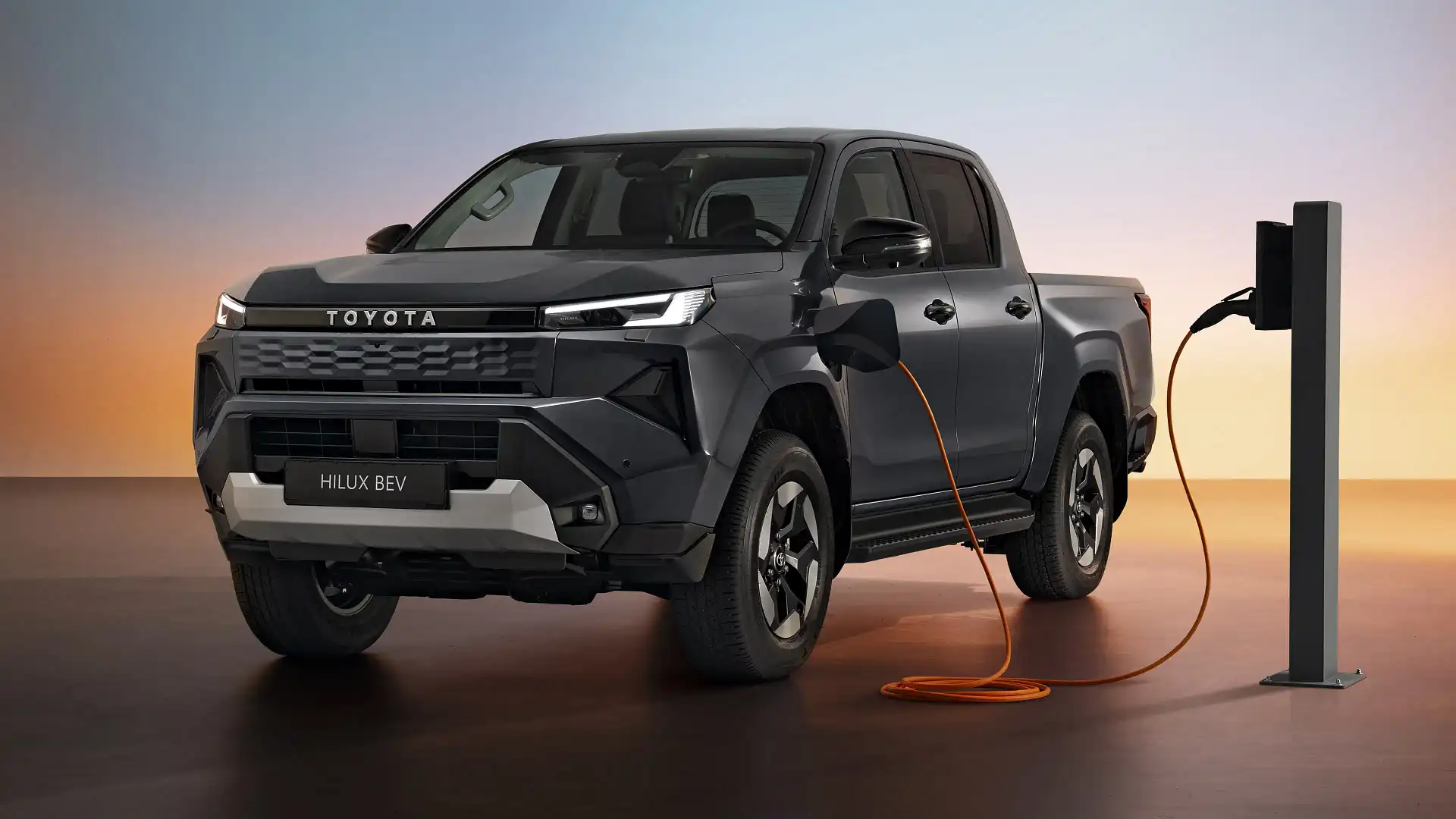
Image credit: Toyota
Australia's favourite ute now plugs in, and the headline is not the price, it is the trade-off. The Toyota HiLux BEV opens at $74,990 plus on-roads, runs a 59.2kWh battery and a dual-motor AWD system, then asks fleet buyers to live with 1,600kg of braked towing instead of 3,500kg. If you are a tradie, a farmer or a tourer who hooks a caravan up every weekend, this is not the HiLux for you. If you run a council fleet, a mine site shuttle, a port-side delivery loop or a council asset team, the maths suddenly looks very different. We have run the cross-shop on CarSorted to show where it lands.
Full Australian Pricing
Toyota has confirmed three variants, all double-cab, all dual-motor AWD. The cab-chassis is the only body style that sits below $75k, and the SR5 pick-up now wears the title of most expensive HiLux Toyota Australia has ever listed. For context, the diesel SR5 sits in the high $60k range, so the BEV step-up is roughly $14k to $17k depending on body.
| Variant | Body | Price (before on-roads) |
|---|---|---|
| HiLux BEV SR | Double cab-chassis, AWD | $74,990 |
| HiLux BEV SR | Double cab pick-up, AWD | $76,490 |
| HiLux BEV SR5 | Double cab pick-up, AWD | $82,990 |
Current price on CarSorted: Toyota HiLux WorkMate 4x2 Single Cab Manual $33,990 RRP, as at 6 Sep 2026; BYD Shark 6 Premium $57,900 RRP, as at 14 Oct 2026.
Single cab and extra cab body styles are not on the local menu, which is a deliberate fleet-first call. Toyota Australia has signalled around 500 sales in year one, which is roughly one per cent of the typical 50,000 annual HiLux volume. Treat this as a test fleet, not a mass-market pivot.
Powertrain and Battery
Every HiLux BEV runs the same setup. A 59.2kWh lithium-ion battery feeds two electric motors, one on each axle, for full-time AWD with no transfer case, no low range and no diff lockers in the conventional sense. Outputs sit at 82kW/206Nm up front and 129kW/269Nm out back, with a combined headline of 144kW and 468Nm. Diesel HiLux SR5 buyers leaving a 2.8-litre turbo diesel behind get roughly the same torque on paper, plus the EV upside of all of it the instant you touch the pedal.
| Spec | HiLux BEV (all variants) |
|---|---|
| Battery | 59.2 kWh lithium-ion |
| Front motor | 82 kW / 206 Nm |
| Rear motor | 129 kW / 269 Nm |
| Combined output | 144 kW / 468 Nm |
| Drive | Dual-motor AWD (full time) |
| Range | 240 km WLTP |
| Max DC charge | 150 kW (10 to 80% in ~30 min) |
| Max AC charge | 10 kW (10 to 100% in ~6.5 hrs) |
| Braked towing | 1,600 kg |
| Payload (approx.) | ~715 kg |
| Kerb weight | 2,455 kg (GVM 3,170 kg) |
| Ground clearance | 212 mm |
A quick reality check on range. The 240km figure is WLTP, measured unladen, and a ute spends most of its life carrying something. Loaded, or with a trailer behind it, plan on meaningfully less, and less again in the cold or at sustained highway speed. For a fleet doing 80 to 120km a day out of a depot, that is fine. For a remote site running 300km between charge points, it is not.
Towing, Payload and the Trade-Off
The single most important number on this car is 1,600kg. Every diesel HiLux dual-cab on sale today is rated to 3,500kg braked, and that 3.5T figure is what most ute buyers default to without even thinking about it. The HiLux BEV does not manage half of it. Payload is also down from around 1,000kg on a diesel SR cab-chassis to roughly 715kg here. Together those two numbers tell you who this car is built for. It is built for short metro loops where the truck is carrying tools and people, not for towing a 22-foot van up the Hume.
Ground clearance is 212mm, a whisker under the diesel, and the AWD system retains brake-based off-road logic, so light dirt road and unsealed site work is still on the menu. Toyota is openly steering this BEV at councils, mining and construction fleets where range is bounded by a depot and where tailpipe emissions matter on tenders. If your business model is a builder running a trailer, you are not the buyer.
Charging and Daily Running
On a 150kW DC fast charger the HiLux BEV takes about half an hour from 10 to 80 per cent, which is in the ballpark of a modern medium-sized EV SUV. On a fleet-friendly 10kW three-phase AC charger the full 10 to 100 per cent cycle lands at around 6.5 hours, which neatly fits an overnight depot recharge. There is no 22kW AC option mentioned at launch, which is unusual for a fleet-aimed vehicle and worth a conversation with your dealer if your yard already runs 22kW infrastructure.
For metro running cost maths, work on roughly 25 to 30kWh per 100km loaded. A depot tariff at 25c/kWh puts you near $6 to $7.50 per 100km of energy. The diesel HiLux SR5 sits at 7.9L/100km claimed, so at $2.00/L you are at about $15.80 per 100km. On a 50,000km per year fleet vehicle the energy gap alone is in the order of $4,000 a year before you touch servicing.
Equipment
Toyota has kept the BEV walk-up familiar to anyone who has stepped through a 2024 HiLux. The SR sits in the workmanlike middle of the diesel ladder, with cloth trim, the standard 8.0-inch infotainment screen, wireless Apple CarPlay and Android Auto, a 7.0-inch driver display, dual-zone climate control, LED headlights and steel wheels on the cab-chassis. The pick-up SR moves to alloys.
The SR5 layers in a larger screen, leather-accented trim, eight-way power driver's seat, heated front seats, 18-inch alloys, front parking sensors, a surround view monitor and an upgraded sound system. Both grades carry Toyota Safety Sense as standard, which means autonomous emergency braking, lane departure warning, lane trace assist, adaptive cruise, road sign assist and a driver monitor camera.
Safety
The electric HiLux is not yet rated by ANCAP. The current diesel HiLux holds a 5-star ANCAP score, but a different body structure, the addition of a battery floor and revised crash software all mean the BEV needs its own assessment. Toyota has fitted nine airbags, the full Toyota Safety Sense suite, blind spot monitoring and rear cross-traffic alert as standard across the range, so the bones are there for a strong result when the test happens.
How It Compares
The electric ute market in Australia is no longer a single-car field. The BYD Shark 6 PHEV has set the floor on price, and the LDV eT60 was the first battery-only dual-cab to land in volume. Toyota slots in above all of them on price.
| Ute | Price (before on-roads) | Powertrain | EV range | Braked tow |
|---|---|---|---|---|
| Toyota HiLux BEV SR pick-up | $76,490 | Dual-motor EV | 240 km WLTP | 1,600 kg |
| BYD Shark 6 Premium PHEV | $57,900 | PHEV (1.5T + 2 motors) | ~100 km claimed | 2,500 kg |
| Ford Ranger XLT V6 diesel | ~$67,890 | 3.0L V6 turbo diesel | n/a | 3,500 kg |
| Toyota HiLux SR5 diesel | $58,190 | 2.8L turbo diesel | n/a | 3,500 kg |
| LDV eT60 (outgoing) | ~$92,990 | Single-motor EV RWD | 330 km NEDC | 1,000 kg |
Current price on CarSorted: BYD Shark 6 Premium $57,900 RRP, as at 14 Oct 2026; Toyota HiLux WorkMate 4x2 Single Cab Manual $33,990 RRP, as at 6 Sep 2026.
The Shark 6 is the obvious cross-shop on price. It is roughly $19,000 cheaper, tows more, and gives you petrol back-up for the bush trip you do twice a year. On the other hand, the HiLux name in Australia carries a residual value premium that fleet managers know how to bank, and Toyota's parts and service network reaches places BYD's does not. For an in-depth segment view, see our best electric utes 2026 guide and the Ranger vs HiLux vs D-Max three-way.
Warranty and Service
Toyota Australia's standard new-vehicle cover applies, which is five years and unlimited kilometres, and the engine and driveline can be extended to seven years if you service inside the Toyota dealer network. The high-voltage battery sits under a separate warranty consistent with Toyota's wider EV lineup, with detailed terms confirmed at handover. Capped-price service intervals are expected to be lighter than diesel as there is no oil change, no diesel particulate filter and no AdBlue system to maintain.
The CarSorted Angle
On CarSorted, the existing Toyota HiLux SR5 diesel is listed at $58,190 with 150kW/500Nm, 7.9L/100km claimed and a running cost we calculate at around $12,800 a year for a private buyer. The HiLux BEV SR5 pick-up at $82,990 lands $24,800 above that diesel before on-roads, with 1,600kg of braked towing instead of 3,500kg. The argument only stacks up if you can lock in cheap depot charging and avoid the heavy-tow use case entirely. For a fleet doing 25,000 to 50,000km a year on flat metro routes, energy savings alone close the price gap in three to four years before you touch the saved servicing and FBT treatment. For a private builder doing 8,000km a year with a tandem trailer, it never does. Cross-shop the alternatives yourself on our BYD Shark 6 vs Toyota HiLux comparison, or browse the full ute category in the CarSorted directory.
What This Means for Buyers
If you are a council, a utility or a mine that already runs a depot with three-phase power and a routes-and-rosters discipline, the HiLux BEV is a low-risk way to put zero-tailpipe utes onto your tender response. The badge does most of the political work for you. If you are a builder, a plumber, a tradie shopping under your ABN, you are better served by the BYD Shark 6 PHEV at $57,900 driveaway-ish, or by a diesel Ford Ranger XLT V6 for the same money as the HiLux BEV cab-chassis. The Shark 6 gives you 80 to 100km of daily EV running before the petrol engine wakes up, and still tows 2,500kg. If you tow at 3,500kg or you run remote, stay diesel for now. The HiLux BEV is a precise tool for a narrow job, and Toyota knows it, which is why the volume forecast is 500 cars and not 50,000.
Best Electric Utes 2026 | Best Utes Australia 2026 | Ranger vs HiLux vs D-Max
Disclaimer: Pricing is before on-road costs and was confirmed by Toyota Australia at launch. Range is Toyota's claimed WLTP figure, measured unladen; expect less loaded, towing or in the cold. ANCAP rating refers to the diesel HiLux only; the HiLux BEV is not yet independently rated. Specifications and warranty terms may vary by variant and are subject to change.