Key Takeaways
- All-new fifth-generation Hyundai Tucson (NX5) revealed in South Korea on 19 August 2026, the first full redesign in six years
- New Art of Steel design language: boxy body, vertical H-Edge daytime running lights, three-dimensional prism-style taillights
- Reported at 4,700mm long, 1,905mm wide, 1,685mm tall on a 2,785mm wheelbase (+60mm length, +40mm width, +30mm wheelbase vs the outgoing Australian NX4)
- New rugged XRT variant revealed alongside the standard car, with skid plates, black wheel arch extensions and its own grille and wheels
- Hyundai Australia has told local media the new Tucson is due in mid-2027, as a hybrid only at launch, with the XRT confirmed for Australia
- Current MY26 Tucson still on sale from $39,350 before on-road costs (Hyundai list price); ANCAP for the NX5 not yet rated
Update, 3 October 2026: Hyundai Australia has told Australian media the new Tucson is due here in mid-2027 and will launch as a hybrid only, with no pure petrol version at first, and with the rugged XRT grade included. Hyundai's Australian website now has a register-your-interest page for the all-new Tucson that says "coming soon in 2027", but local pricing, grades and outputs remain unconfirmed. Current-model prices on this page are Hyundai's Manufacturer List Prices before on-road costs as at 1 October 2026, which put the entry 2.0 petrol at $39,350 and the Elite 2.0 petrol at $44,350.
Image credit: CarSorted branded card. No NX5 photograph is shown.
Hyundai has done what a lot of Tucson buyers half-expected and half-feared. The Korean brand has torn up the current parametric look for its medium SUV and replaced it with something noticeably squarer, tougher and, in XRT trim, borderline off-roader. The all-new fifth-generation Tucson (codename NX5) was revealed in South Korea on 19 August 2026, and Hyundai Australia has told local media it expects the new car here in mid-2027. That gives current MY26 Tucson shoppers a matter of months, not years, before the outgoing car is rotated out.
Two things stand out for anyone cross-shopping this size of SUV right now. First, the design shift is real, not a facelift with new lights. Hyundai is calling the new theme Art of Steel and it uses vertical H-Edge daytime running lights, a slim horizontal centre lamp and heavy vertical rear lamps built into a stacked prism-style housing. Second, the Tucson has grown, and the interior is a full redo rather than a tidy-up. On our own compare tool the current Tucson slots between the RAV4 and the Sportage on length and entry list price, so a bigger, boxier Tucson going upmarket has knock-on effects across the segment.
What Hyundai Actually Revealed
This was a Korean design reveal, not a full launch. Hyundai Motor showed the new car in Seoul, confirmed the Art of Steel identity and released the first official studio images of the standard body and the XRT. Hyundai has since shown the car in New York, and Hyundai Australia has told local media to expect it here in mid-2027.
Local pricing, the Australian variant walk, powertrain outputs, warranty and ANCAP have not been confirmed. Anyone quoting Australian numbers for the NX5 today is guessing. What Hyundai has shown are the headline dimensions, the design and the fact that there is an XRT-badged variant from launch.
Dimensions From Hyundai's Reveal
These are Hyundai's Korean reveal figures as reported by Australian and international media. Hyundai Australia has not published NX5 specifications yet.
| Dimension | 2027 Tucson (NX5) | Change vs outgoing NX4 |
|---|---|---|
| Length | 4,700 mm | +60 mm |
| Width | 1,905 mm | +40 mm |
| Height | 1,685 mm | +20 mm |
| Wheelbase | 2,785 mm | +30 mm |
| Second-row headroom | 1,031 mm (reported) | Not stated |
Against the outgoing Australian-spec NX4 (4,640 mm long, 1,865 mm wide, 1,665 mm tall on a 2,755 mm wheelbase), the NX5 is 60 mm longer, 40 mm wider and rides on a 30 mm longer wheelbase, with the extra length aimed at interior space. Against rivals like the Toyota RAV4, the more upright body sides and squarer glasshouse should show up most in second-row headroom and boot shape.
The Design: Art of Steel Explained
Hyundai's design brief for the new Tucson borrows from architectural lighting. The vertical daytime running lights sit high on the nose, joined by a slim horizontal centre bar to form an elongated H shape. Main headlamps drop down low into dark bumper housings. At the back, the taillamps go the other direction, running horizontally across the tail with a three-dimensional prism appearance and a full-width TUCSON script under the glass.
The bodywork itself is where the biggest change lives. The rear doors and side fenders are visibly more volumetric, wheel arches are square, and a strong horizontal character line runs the length of the car. Roofline is more upright, glass area is boxier, and lower cladding is thicker across the sills and around the wheels. The overall effect is a Tucson pitched more as an urban 4x4 than a curvy family SUV.
Meet the XRT: Tucson's Off-Road Alter Ego
The bigger surprise is that Hyundai revealed a dedicated XRT variant alongside the standard car. XRT badging in the Hyundai world signals a rugged trim, and this one leans into it. The XRT gets a wider rectangular grille, a more prominent front skid plate, black wheel arch extensions, its own rear bumper and skid plate, XRT badging and dedicated wheels. Australian media report the XRT is confirmed for Australia. Whether it arrives as a full variant or as a pack on another grade has not been detailed, and the tougher XRT Pro stays exclusive to North America.
The XRT plants a very clear rival for the Toyota RAV4 GXL AWD and the Subaru Forester Hybrid Sport in the family-SUV-with-attitude cross-shop. It would also give the Tucson a tougher-looking answer to the reworked Kia Sportage.
Inside: Digital Cluster, Floating Screen, Three-Dimensional Theme
The interior has moved on more than the outside. The dashboard goes more horizontal, with the upper and lower sections separated to give a floating look, a large central display, a slim digital display for the driver and a new steering wheel. Reports also mention dual wireless phone charging and rear doors that now open to 83 degrees, up from 73.
Specification detail such as screen sizes, ambient lighting, upholstery choices and the standard head-up display has not been released for Australia yet. Given how consistent Hyundai has been about running the same core hardware across the Kona, Tucson, Santa Fe and Palisade, expect the new Tucson to carry over the Apple CarPlay and Android Auto, Digital Key 2 and over-the-air update capability the current Tucson already has on every grade.
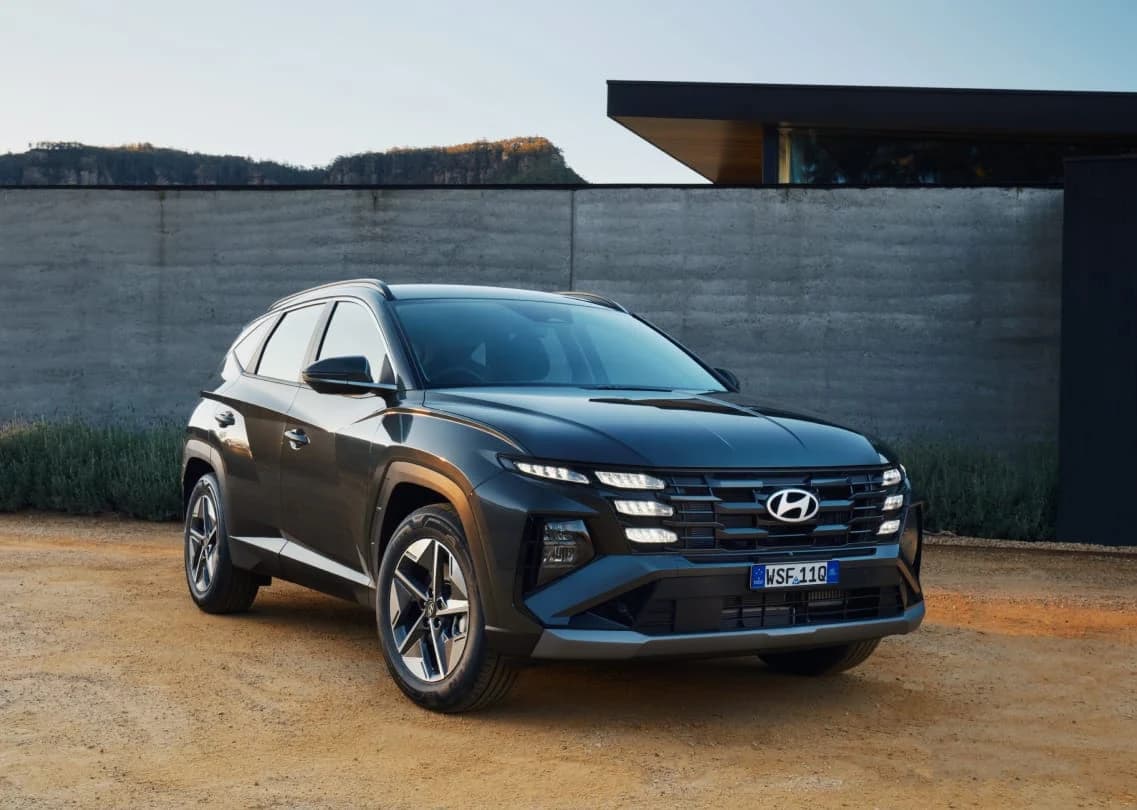
Image credit: Hyundai Australia. Current fourth-generation Tucson shown for reference; the new fifth-generation NX5 revealed 19 August 2026 is due to replace it in mid-2027.
Powertrains: Hybrid Only at Launch
Hyundai Australia has told local media the NX5 will launch here with a hybrid powertrain only, and Australian cars will continue to come from Korea. That follows the direction of the current range. The current MY26 Tucson range has already been culled to a hybrid-heavy line-up, with the 1.6-litre turbo-petrol dual-clutch dropped, a hybrid offered at every grade, and the Premium sold as a hybrid only. That hybrid uses a 1.6-litre turbocharged four-cylinder petrol with a 47.7kW gearbox-mounted electric motor for a combined 172kW and 367Nm, driving through a six-speed automatic in either FWD or AWD form.
Overseas, the new Tucson is also sold with 2.0-litre and 1.6-litre turbo petrol engines and as a plug-in hybrid, but those are not part of the Australian launch. Hyundai Australia launched the current Santa Fe and Palisade as hybrids before adding petrol versions months later, so a petrol Tucson later on is possible, though nothing has been confirmed. Australian reports put the new hybrid at 174kW to 180kW and 380Nm in overseas form; Hyundai Australia has not published local outputs. That means the current 2.0-litre petrol entry grade has no announced NX5 equivalent.
Safety and ANCAP
The fifth-generation Tucson is not yet rated by ANCAP. No target star result has been published for the NX5, and ratings do not carry across generations. The outgoing fourth-generation NX4 Tucson carries a five-star ANCAP rating from 2021, which ANCAP lists as expiring in December 2027, but that stops at the current bodyshell.
Neither Hyundai Australia nor ANCAP has announced an NX5 assessment. Expect Hyundai SmartSense to be standard, including adaptive cruise with stop and go, lane following assist, blind-spot collision avoidance, rear cross-traffic collision avoidance, driver attention warning, safe exit warning and intelligent speed limit assist, in line with what the current MY26 Tucson already offers as standard on every grade.
Current MY26 Tucson: What You Can Actually Buy Today
With the NX5 due in mid-2027, the MY26 fourth-generation Tucson is what dealers have on the floor for the next several months. Here is where Hyundai lists it as at 1 October 2026.
| Variant | Powertrain | List price (before on-road costs) |
|---|---|---|
| Petrol | ||
| Tucson 2.0 MPi FWD | 2.0L petrol, 115kW/192Nm | $39,350 |
| Tucson Elite 2.0 MPi FWD | 2.0L petrol, 115kW/192Nm | $44,350 |
| Hybrid | ||
| Tucson Hybrid FWD | 1.6L T-GDi hybrid, 172kW/367Nm | $42,850 |
| Tucson Elite Hybrid FWD | 1.6L T-GDi hybrid, 172kW/367Nm | $48,350 |
| Tucson Elite Hybrid AWD | 1.6L T-GDi hybrid, 172kW/367Nm | $50,850 |
| Tucson Premium Hybrid AWD | 1.6L T-GDi hybrid, 172kW/367Nm | $58,350 |
Prices are Hyundai Australia's Manufacturer List Prices from its online price calculator, before on-road costs. The N Line Package adds $2,500 to either Elite Hybrid and $1,500 to the Premium Hybrid. Your drive-away figure depends on your state and the dealer, so check Hyundai's calculator for your postcode. Once NX5 pricing lands next year, expect a clearance push on remaining MY26 stock.
How It Compares in the Segment
The current Tucson Hybrid already sits inside a very tight cluster. On CarSorted's own RAV4 vs Tucson comparison, the Toyota holds the estimated resale edge, while the Tucson answers with more power (172kW combined against 143kW for the entry RAV4 GX Hybrid) and a slightly longer body. Against the Sportage, the NX5's 30 mm longer wheelbase is the number to watch for rear-seat room once both are on sale.
The Mazda CX-5 comparison changes shape with the third-generation CX-5 now on sale. Have a look at our CX-5 vs Tucson head-to-head for how those two currently stack up on price, standard equipment and running cost. The three-way RAV4 vs CX-5 vs Tucson comparison puts all three side by side.
Warranty and Ownership
Hyundai Australia currently gives the Tucson a five-year, unlimited-kilometre warranty, extended to seven years when every scheduled service is done at an authorised Hyundai dealer (for cars first registered from 1 June 2025), plus an eight-year, 160,000km warranty on the high-voltage hybrid battery. Pre-paid service plans are also sold. Hyundai Australia has not said what cover the NX5 will get, but the same package is the reasonable base assumption.
What This Means for Buyers on CarSorted
If you are actively shopping a medium SUV under $55,000, the reveal changes the timeline more than the shortlist. The MY26 Tucson Hybrid FWD lists at $42,850 before on-road costs with 172kW combined, and dealers have stock to clear before the NX5 lands in mid-2027. A signed order today at MY26 money, especially on the Elite Hybrid FWD at $48,350 before on-road costs, is not obviously worse value than waiting for an NX5 that could well launch at a higher price.
If you are willing to wait, the NX5 is where the bigger interior, boxier design and the XRT live. Also worth flagging: outgoing models often lose value faster once a replacement arrives, so factor that into a private-sale exit in three years. Use CarSorted's Tucson Hybrid page for the current numbers, our three-way comparison for the alternatives, and the compare tool if you want to line the Tucson up against the Sportage, RAV4, CX-5 or Outlander on your own inputs.
The short version: buy the MY26 today if you need a car in the next six months and love the current design, or wait for the NX5 in 2027 if you want the bigger, boxier take and the XRT. Do not pay 2027 prices for a 2026 car just because a new one has been announced.
Disclaimer: Fifth-generation Hyundai Tucson (NX5) specifications are Hyundai Motor Company's reveal figures of 19 August 2026 as reported by media. Mid-2027 Australian timing and the hybrid-only launch line-up are as stated by Hyundai Australia to Australian media on 2 October 2026. Australian pricing, variant walk, powertrain outputs, warranty and ANCAP results for the NX5 have not been confirmed by Hyundai Motor Company Australia as at 3 October 2026. Current MY26 Tucson prices are Hyundai Australia Manufacturer's List Prices before on-road costs, taken from Hyundai's online price calculator on 1 October 2026. Prices, specifications and timing are subject to change.