Key Takeaways
- The new Pajero is Prado-sized: 70mm shorter, 55mm narrower, 20mm longer in wheelbase
- 480Nm splits the field: under Prado (500Nm) and Everest V6 (600Nm), over MU-X (450Nm)
- Its Super Select 4WD-II is the only system here with a full-time 4WD mode AND a locked low range
- Claimed 230mm clearance edges Prado and Everest; MU-X still leads at 235mm
- Reported from $68,490 before on-roads, with 3,500kg braked towing on Mitsubishi's Australian page; power is still the missing number
Update, 1 October 2026: Mitsubishi Australia has opened pre-orders for the Pajero ahead of December 2026 arrivals, in four grades, and its Australian page lists 3.5-tonne braked towing. Australian outlets report pricing of $68,490 (GLS five-seat), $69,990 (GLS seven-seat), $79,990 (Exceed) and $84,990 (GSR), all before on-road costs. Those prices have not appeared on Mitsubishi's Australian Pajero page, so the table marks the Pajero price as reported.
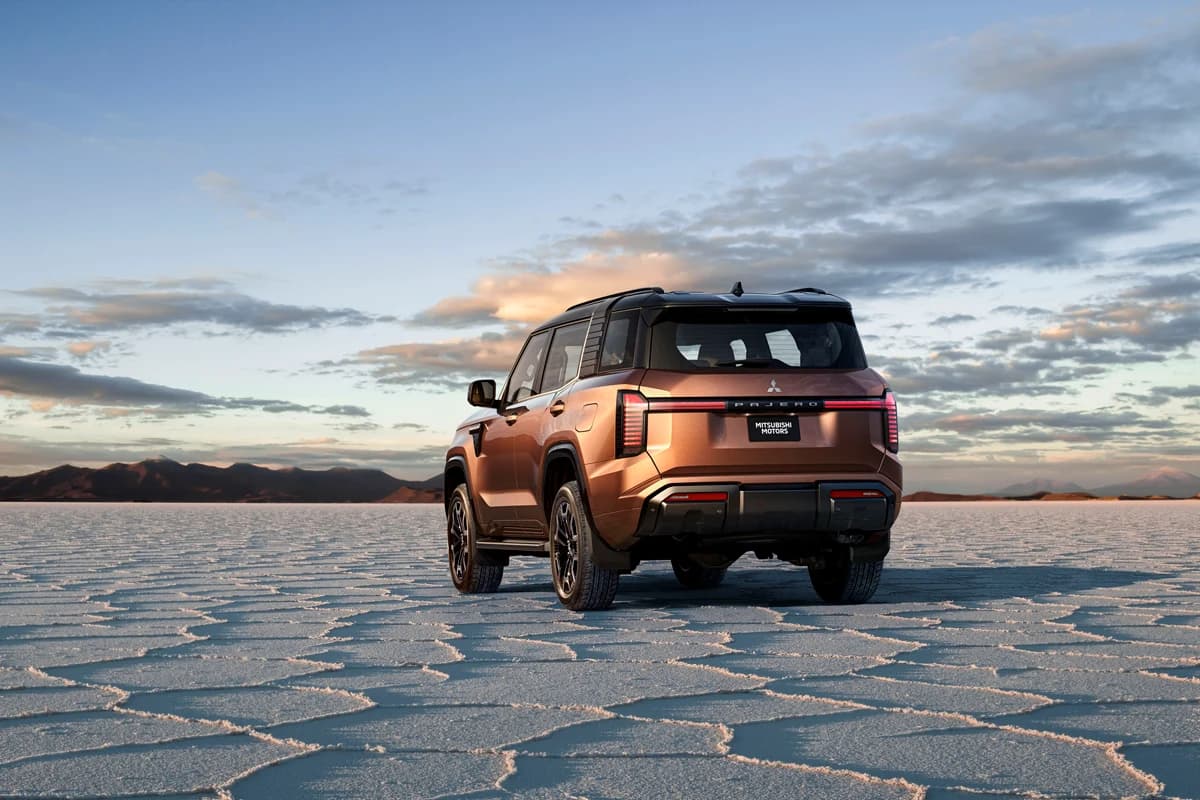
Image credit: Mitsubishi Motors
The reborn Mitsubishi Pajero lands in the middle of Australia's most contested class: the ladder-frame, seven-seat family 4WD. This is the segment that tows the nation's caravans, carries its camping gear and fills its school pickup zones, and for the last few years it has been a two-horse race at the premium end with a value pick underneath. Before the Pajero arrives here, this is how Mitsubishi's published figures line up against the segment's establishment: the Toyota Prado, Ford Everest and Isuzu MU-X.
A word on method before the numbers, because it matters. Every rival figure below is the current Australian specification from our database, sourced from the manufacturers' own documents. The Pajero column is what Mitsubishi published at the world premiere, plus the towing rating on its Australian page and the Australian price as reported by local outlets, labelled as such. Where Mitsubishi has not announced a figure, the cell says so honestly rather than guessing, because a made-up number in a comparison table is worse than a gap. Power and kerb weight are still missing, so treat this as the opening exchange rather than the verdict.
Meet the contenders
The Pajero arrives with the biggest reputation and the longest absence. Twelve outright Dakar wins, 3.29 million sold across four generations, and five years out of the market. The new car is Thai-built, sits above Pajero Sport in Mitsubishi's range, and brings a newly developed 2.4-litre single-turbo diesel with 480Nm, an 8-speed automatic, and the segment's most flexible four-wheel-drive hardware. Mitsubishi's Australian page lists 3.5-tonne braked towing, and local outlets report a starting price of $68,490 before on-road costs. What it does not yet bring is a power figure or an ANCAP assessment.
The Prado is the incumbent king. Toyota's 2.8-litre turbo-diesel with 48-volt assistance makes 150kW and 500Nm through an 8-speed auto, and the range opens at $72,500 before on-roads for the GX, stretching through the volume-selling GXL at $79,990 in seven-seat form. It carries a five-star ANCAP rating, nine airbags, full-time four-wheel drive and the largest footprint here at 4,990mm long and 1,980mm wide. Its 32-degree approach angle is the best in this table.
The Everest is the driver's pick of the establishment. The Sport V6 brings 184kW and a class-crushing 600Nm from its 3.0-litre V6 diesel through a 10-speed automatic, from $68,990 before on-roads. It rides the longest wheelbase here at 2,900mm, tows 3,500kg braked, and for buyers chasing maximum capability the Tremor variant lifts clearance to 255mm and the approach angle to 32 degrees for $79,990. Five ANCAP stars and nine airbags, same as the Toyota.
The MU-X is the value anchor, and it is no cheap seat. The LS-M with the 3.0-litre diesel and four-wheel drive starts at $57,900 before on-roads, a full fourteen thousand under the cheapest Prado, with 140kW, 450Nm, 3,500kg braked towing and the best departure angle in this comparison at 26.9 degrees. It is also the lightest car here by a wide margin, which pays off every day at the fuel pump. Five ANCAP stars and eight airbags round out a spec sheet that punches well above its price.
The numbers, side by side
| Pajero (new) | Prado | Everest | MU-X | |
|---|---|---|---|---|
| Body | Ladder frame, 7 seats | Ladder frame, 5 or 7 seats | Ladder frame, 7 seats | Ladder frame, 7 seats |
| Engine | 2.4L single-VGT turbo-diesel | 2.8L turbo-diesel 48V | 3.0L V6 turbo-diesel (Sport) | 3.0L turbo-diesel |
| Power | Not yet announced | 150kW | 184kW | 140kW |
| Torque | 480Nm | 500Nm | 600Nm | 450Nm |
| Transmission | 8-speed auto | 8-speed auto | 10-speed auto | 6-speed auto |
| 4WD system | Super Select 4WD-II + low range | Full-time 4WD + low range | Selectable 4WD + low range | Selectable 4WD + low range |
| Length | 4,920mm | 4,990mm | 4,978mm | 4,860mm |
| Width | 1,925mm | 1,980mm | 1,923mm | 1,870mm |
| Height | 1,910mm* | 1,925mm | 1,876mm | 1,815mm |
| Wheelbase | 2,870mm | 2,850mm | 2,900mm | 2,855mm |
| Kerb weight | Not yet announced | 2,495kg | 2,455kg | 2,085kg |
| Ground clearance | 230mm* | 225mm | 226mm | 235mm |
| Approach angle | 30.4°* | 32° | 30.2° | 29.2° |
| Departure angle | 25.8°* | 22° | 25° | 26.9° |
| Airbags | 8 (incl. front-centre) | 9 | 9 | 8 |
| ANCAP | Not yet rated | 5 stars | 5 stars | 5 stars |
| Braked towing | 3,500kg | 3,500kg | 3,500kg | 3,500kg |
| Price (before on-roads) | From $68,490 (GLS 5-seat, reported) | From $72,500 | From $68,990 (Sport) | From $57,900 (LS-M 3.0 4x4) |
Current price on CarSorted: Toyota Prado GX Diesel $72,500 RRP, as at 6 Sep 2026; Toyota Prado GXL Diesel 7-seat $79,990 RRP, as at 6 Sep 2026.
*Mitsubishi notes height, clearance and angle figures vary by specification. Rival figures are current Australian specs for the variants named; Prado and Everest figures shown are for the entry diesel grades listed, and kerb weights are for those same variants.
Size and packaging: Prado-sized, deliberately
Park these four nose to tail and the story is tighter than the badges suggest. The Pajero is 70mm shorter and 55mm narrower than the Prado, 58mm shorter than the Everest, and 60mm longer than the MU-X. The interesting number is the wheelbase: at 2,870mm the Pajero stretches 20mm past the Prado and 15mm past the MU-X, with only the Everest's 2,900mm ahead of it. A long wheelbase inside a shorter body is the classic recipe for cabin space without car-park pain, and it squares with Mitsubishi's specific claims about the third row: adult headroom, and a footwell scalloped so back-row passengers can slide their toes under the second-row seats. The second row slides through 150mm and tumbles, which is more travel than a bench needs for cargo flexibility and exactly what one needs for third-row access.
Height is where the Pajero stands tallest, literally: 1,910mm against the Everest's 1,876mm and the MU-X's 1,815mm, with only the Prado above it. Tall bodies mean headroom and presence, and also shopping-centre car park clearance checks, so it cuts both ways. Width matters more than buyers expect in this class, and here the Pajero's 1,925mm splits the difference between the rangy Prado and the narrower MU-X. One packaging note worth carrying into the road tests when they come: Mitsubishi quotes a 52:48 front-rear weight balance, unusually even for a diesel ladder-frame wagon, and credits the layout for the car's claimed composure.
Powertrains and towing: the missing kilowatts
On torque, the field reads Everest 600, Prado 500, Pajero 480, MU-X 450, and the temptation is to rank them exactly that way. Resist it, for two reasons. First, Mitsubishi has not published a power figure, and kilowatts shape how a heavy wagon actually accelerates once the torque peak is behind you. Second, weight is missing from the Pajero's column too, and torque-to-weight is what you feel. The Prado carries 2,495kg in GX form and the Everest Sport 2,455kg, while the MU-X undercuts them dramatically at 2,085kg, which is precisely why its 450Nm never feels as modest as the table implies. Until the Pajero's kerb weight lands, its 480Nm is a number without context.
The transmission choices tell their own story. Ford runs ten ratios, Toyota and Mitsubishi eight, Isuzu six. More gears keep a diesel in its narrow sweet spot, though calibration beats count, and the MU-X's six-speed has made that argument for years. Mitsubishi's choice of a single wide-range variable-geometry turbo over a twin-turbo layout reads as a durability-and-response play rather than a spec-sheet one, in keeping with a car developed, in the company's words, with off-road comfort as a benchmark.
Towing is the one everybody will scroll to. All three rivals rate 3,500kg braked. That figure is the table stakes of this class: caravan buyers filter on it before they read another line. The old fourth-generation Pajero topped out at 3,000kg and wore that asterisk for a decade, and the current Pajero Sport rates 3,100kg. Mitsubishi's Australian page now lists 3.5-tonne braked towing for the new car, which matches the class and removes one of the last practical objections to the nameplate.
Four-wheel-drive systems: the Pajero's strongest card
Here the new car genuinely stands apart. Super Select 4WD-II offers four modes: rear-drive 2H, full-time 4H that is safe on sealed roads, 4HLc with the centre differential locked, and 4LLc adding low-range gearing. The Prado runs full-time four-wheel drive with low range, always driving all four wheels. The Everest and MU-X use part-time selectable systems: excellent off-road, but their four-wheel-drive modes are not for dry bitumen. The practical difference shows up on a wet highway or a long gravel-and-tar mix, where a Super Select driver just leaves it in 4H, the Prado does its thing automatically, and the part-time cars stay in rear drive.
Layered on top, the Pajero brings S-AWC integrated control with Active Yaw Control managing torque side to side via the front brakes, plus seven terrain modes spanning Normal, Eco, Gravel, Snow, Mud, Sand and Rock. The camera trick is the one owners will actually use: a front under-floor view that switches on automatically in the locked 4WD modes, showing the surface beneath the front axle exactly when you are picking a line over rock. On geometry, the published figures give the Prado the best nose at 32 degrees, the MU-X the cleanest exit at 26.9 degrees, and the Pajero the most balanced set, 30.4 approach, 22.6 rampover and 25.8 departure, with 230mm of clearance that edges the Prado and standard Everest while trailing the MU-X's 235mm and the Everest Tremor's 255mm. All of the Pajero's figures carry Mitsubishi's own varies-by-specification caveat, so expect grade-to-grade movement when the Australian range lands.
Cabin, tech and safety: modern where it counts
All four are seven-seaters (the Prado also sells five-seat variants), and all four are family cars first. The Pajero's pitch is that its cabin is a generation newer than the class: two 14.3-inch screens in a single housing, a digital reincarnation of the classic triple-gauge cluster reading altitude, compass, temperature and the car's live pitch and roll, wireless smartphone connectivity, three-zone climate reaching the third row, ventilated seats, and acoustic glass in the windscreen and all four door windows in pursuit of conversation-grade quietness at highway speed. Those are Mitsubishi's claims from the premiere rather than measured results, but they are specific, checkable claims, and we will check them when the car arrives.
Safety is the column where the establishment holds a hard, documented edge. The Prado, Everest and MU-X all carry current five-star ANCAP ratings; the Prado and Everest count nine airbags each, the MU-X eight. The Pajero is not yet rated, and no responsible comparison treats an unrated car as either safe or unsafe: it is simply undocumented until ANCAP assesses it. What Mitsubishi has announced is a strong equipment hand, eight airbags including the brand's first front-centre bag, AEB with pedestrian, cyclist and motorcyclist detection plus junction assist, a first-for-Mitsubishi emergency lane assist, front cross-traffic alert and the MI-PILOT highway assistant. On paper that is a competitive suite. Stars require crash sleds, and those take time.
The money question
Nothing decides a comparison like the price column. Australian outlets report the Pajero at $68,490 for the GLS five-seat, $69,990 for the GLS seven-seat, $79,990 for the Exceed and $84,990 for the GSR, all before on-road costs. Those prices have not appeared on Mitsubishi's Australian Pajero page, which lists the grades without figures, so read them as reported. The context they land into: the MU-X's 3.0-litre 4x4 range opens at $57,900, the Everest Sport V6 at $68,990, and the Prado at $72,500, all before on-road costs, with the volume grades of the two premium players clustering in the seventies and eighties. The Pajero Sport, Mitsubishi's current biggest wagon, spans $58,440 to $64,140, so the new car sits well above it, as Mitsubishi's flagship positioning suggested.
On those numbers the entry Pajero opens under both the Prado's $72,500 start and the Everest Sport V6's $68,990, with a 3,500kg rating to match them, which is the scenario that puts it on every shortlist in the class. The seven-seat GLS at $69,990 is the fairer like-for-like against those two seven-seaters, and it still starts below the Prado. Further up, the Exceed and GSR land in the same seventies-and-eighties bracket as the Prado GXL and Everest Tremor, where the fight becomes brand trust against fresh metal. That is the half-step-under pricing Mitsubishi has used in Australia for the past decade, and the brand has more riding on this launch than any since.
Who should wait, and who should not
If you are buying in this class in the next few months and you tow heavy, the established trio are known quantities with documented 3,500kg ratings, five-star assessments and dealer networks that have been servicing these exact drivelines for years. Nothing about the Pajero's announcement changes that maths today. If your budget lives closer to the MU-X, it remains the segment's quiet bargain and the new Pajero is unlikely to be aimed at your wallet at all. And if you are a Pajero Sport intender, note that Mitsubishi explicitly positions the new car above it, not in place of it.
The buyers with a real decision are the ones eyeing a Prado GXL or an Everest Sport for delivery in mid-to-late 2027. For them, the Pajero's arrival inside Mitsubishi's fiscal 2026 puts a genuine third option on the table within their shopping window: the only car in the class with Super Select's both-worlds four-wheel drive, the freshest cabin technology in the segment, and a nameplate whose off-road credentials predate every rival here. Whether it converts that paper promise now rests on the numbers still to come. On the evidence so far, the new Pajero is a legitimate Prado rival with the segment's most flexible drivetrain, a class-matching tow rating and a reported entry price under the Prado's. The verdict waits on the kilowatts and the kilograms, and we will update the Pajero's page and this comparison the day those numbers exist.