Key Takeaways
- The Pajero nameplate returns after five years, unveiled in Tokyo as Mitsubishi's new flagship
- Australia is confirmed for launch during Mitsubishi's fiscal 2026, which ends March 2027
- New 2.4L single-turbo diesel with 480Nm and a new 8-speed automatic. No power figure published yet
- Proper off-road hardware: ladder frame, Super Select 4WD-II with low range, S-AWC, 230mm clearance, seven terrain modes
- Seven seats, two 14.3-inch screens, eight airbags including Mitsubishi's first centre airbag
- Reported from $68,490 before on-road costs, up to $84,990 for the GSR. Pre-orders open, arriving December 2026
Update, 1 October 2026: Mitsubishi Australia has opened pre-orders for the new Pajero and says it arrives in December 2026. The range runs to four grades, GLS five-seat, GLS seven-seat, Exceed and GSR, and Mitsubishi's Australian page lists 3.5-tonne braked towing. Pricing reported by Australian outlets is $68,490 (GLS five-seat), $69,990 (GLS seven-seat), $79,990 (Exceed) and $84,990 (GSR), all before on-road costs. Those prices have not appeared on Mitsubishi's Australian Pajero page, which shows the grades without figures.
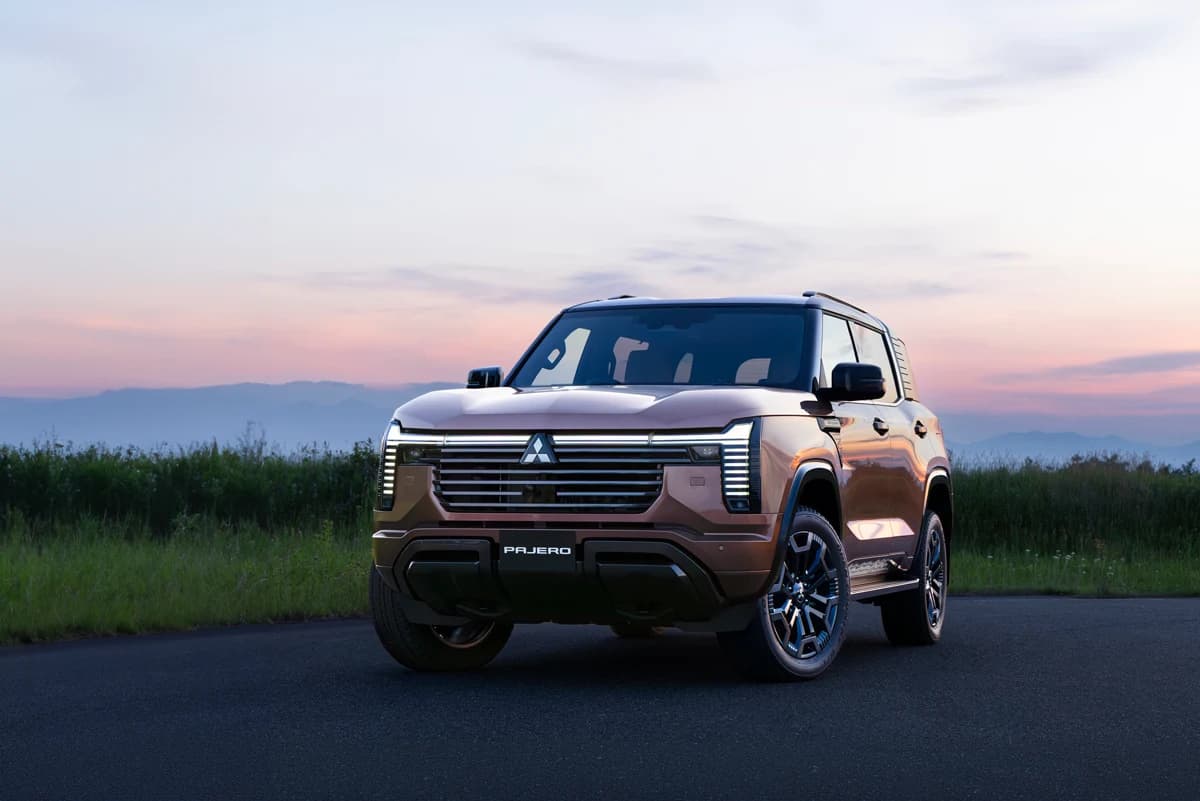
Image credit: Mitsubishi Motors
Twenty years after the last all-new one, the Mitsubishi Pajero is officially back. Mitsubishi pulled the covers off the fifth-generation model at a world premiere in Tokyo and, importantly for us, named Australia in the first group of launch markets. Thailand gets the car first, then Japan and Australia inside Mitsubishi's fiscal 2026, which runs to the end of March 2027. From fiscal 2027 the rollout widens to roughly 100 countries across ASEAN, Latin America and the Middle East, but we are in the front row, and that is not an accident. Australia has always been one of the Pajero's best markets, and Mitsubishi Australia has been without a proper flagship since the fourth-generation car quietly ended its 21-year run in 2021.
This is not a badge revival on a soft-roader, and that matters, because plenty of famous 4WD nameplates have come back as crossovers wearing their father's medals. The new Pajero is a body-on-frame, seven-seat cross-country 4WD, built in Thailand alongside the Triton, positioned above Pajero Sport as the brand's flagship. Mitsubishi built 3.29 million Pajeros across four generations from 1982 and sold them in more than 170 countries. The company itself credits the original with helping kick off Japan's RV boom in the 1990s, and the nameplate's competition record needs no embellishment: the Pajero is the most successful car in the history of the Dakar Rally, with twelve outright victories including seven in a row through the 2000s. When Mitsubishi says the new car's ladder frame was "forged through decades of rally experience", that is the history it is pointing at.
Why this launch matters more than most
Mitsubishi's president and COO Keisuke Kishiura called the new Pajero the first model of the company's mid-to-long-term plan for the 2030s, and said it will lead "not only the Pajero series to follow, but the entire Mitsubishi Motors lineup". Read that carefully: a Pajero series. Mitsubishi is signalling that this is the start of a family, not a one-off halo car. For a brand whose Australian range currently tops out with the ute-based Pajero Sport and the Outlander, a genuine flagship changes what the badge means in a showroom.
The company frames the new car around three words. "Confidence" covers the off-road capability and reliability the nameplate was built on. "Comfort" covers the passenger-car ease of use that separated the original Pajero from the agricultural 4WDs of 1982. The new addition is "Prestige", and that word is doing a lot of work: it tells you Mitsubishi intends to charge flagship money, and it tells you the car is aimed squarely at the premium end of the ladder-frame family wagon class, which in Australia means the Toyota Prado and Ford Everest.
The hardware: ladder frame, Super Select, and a new diesel
Under the skin is a high-tensile-steel ladder frame with a larger cross-section than before. Mitsubishi says torsional and bending rigidity are both significantly up, while the expanded use of high-tensile steel pulls weight out of the structure. Suspension is double-wishbone at the front and a newly developed five-link rigid axle at the rear, a layout chosen to keep the tyres planted on broken surfaces, and the body mounts have been strengthened specifically to stop rough-road vibration reaching the cabin. Mitsubishi set an internal development benchmark it calls "off-road comfort", the idea being that a car this capable should not punish its passengers for using that capability.
The engine is a purpose-developed 2.4-litre turbo-diesel with a single wide-range variable-geometry turbocharger making 480Nm, driving through a new 8-speed automatic with a sport mode. Mitsubishi has not published a kW figure yet, which is worth remembering when you see numbers floating around online. The interesting engineering choice is the single VGT: rather than chasing a headline twin-turbo number, Mitsubishi talks about response from standstill, seamless shifts and quietness. This is a touring engine tuned for the way these cars are actually used, which in Australia means long unsealed distances with a load on.
The 4WD system is the one Pajero people will want: Super Select 4WD-II. If you have not lived with it, the party trick is that it gives you both worlds. There are four modes: 2H sends drive to the rear wheels, 4H is a genuine full-time four-wheel-drive mode you can use on sealed roads in the rain, 4HLc locks the centre differential for slippery going, and 4LLc adds low-range gearing with the centre diff locked for the properly hard stuff. Most rivals make you choose: the Prado runs full-time 4WD without a two-wheel-drive economy mode, while the Everest and MU-X run part-time systems you should not lock on dry bitumen. Super Select does both, and it has been proven, in Mitsubishi's words, in some of the world's harshest environments.
Layered over the drivetrain is S-AWC, Mitsubishi's integrated vehicle dynamics control. It ties together Active Yaw Control, which shuffles torque between the left and right wheels using the front brakes, Active Stability and Traction Control for slippery surfaces, and the anti-lock braking system, and it manages drive and braking force at each corner based on what the driver is asking for and what the road is doing. Seven drive modes sit on top: Normal, Eco, Gravel, Snow, Mud, Sand and Rock. Braking hardware is sized for the job too, with 18-inch rotors and an electric brake booster.
The claimed numbers: 230mm of ground clearance, a 30.4-degree approach angle, 22.6-degree rampover and 25.8-degree departure, with a 52:48 front-rear weight balance. Mitsubishi notes some of those figures vary by specification, so treat them as the headline set until Australian specs land. At 4,920mm long, 1,925mm wide and 1,910mm tall on a 2,870mm wheelbase with 1,630mm tracks front and rear, it is a big car that is deliberately not the biggest in the class, and Mitsubishi makes a point of the dimensions being chosen for manoeuvrability as much as presence.
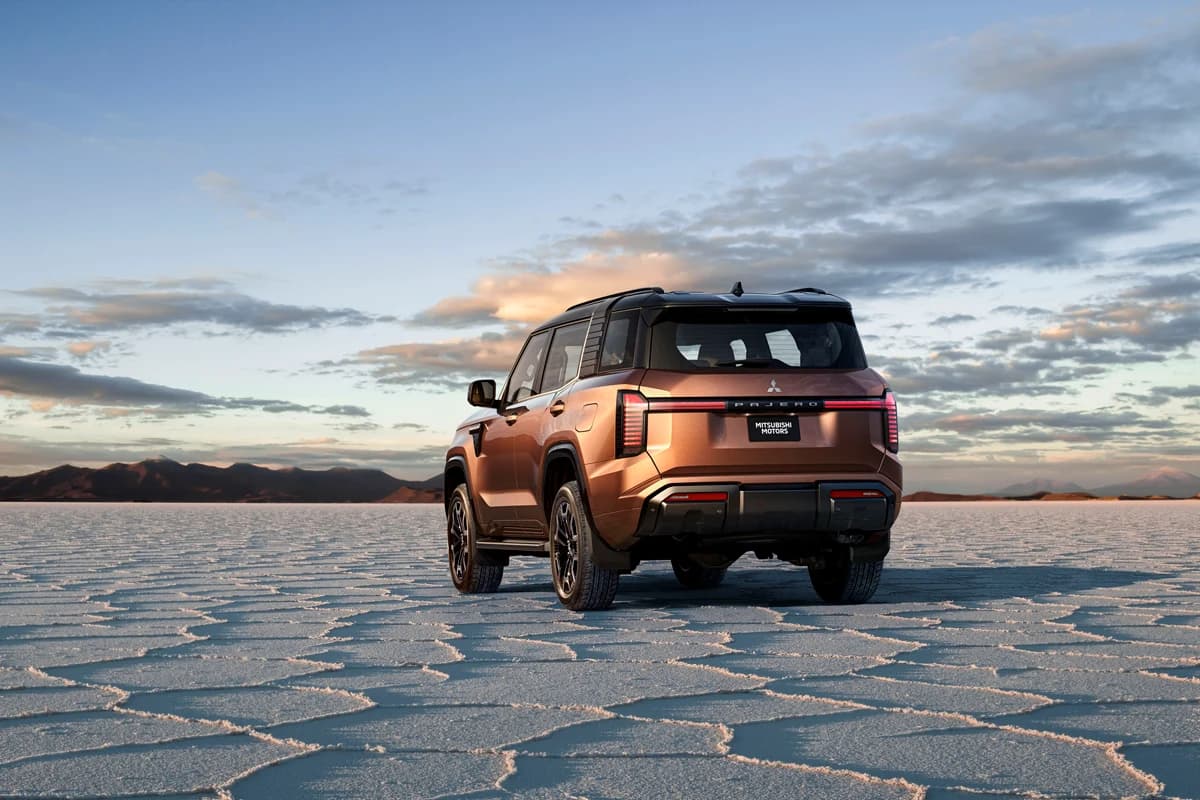
Image credit: Mitsubishi Motors
The design: heritage worn openly
Mitsubishi calls the design concept "Grand Charisma", and the car leans hard on first-generation cues without turning into a retro pastiche. The upright proportions and strong horizontal lines come straight from the 1982 original. The C-pillar treatment is a nod to the first car's exposed roll bar, and the hexagonal motif pressed into the tailgate reinterprets the rear-mounted spare tyre earlier generations carried. The headlights are a distinctive T-shape, and buyers get a choice of two grille designs: a horizontal-bar face Mitsubishi links to the precision of Japanese craftsmanship, and a honeycomb face pitched at functional strength. The front-end character, the company says, was inspired by kendo, the Japanese martial art, all discipline and composure rather than aggression.
The two launch colours tell you who this car is for. Armor Copper Metallic is a deep metal-flake bronze designed to emphasise the sculpted panels, and it is the colour Mitsubishi has splashed across most of the premiere imagery. Phantom Blue Metallic is a grey-blue with gold highlights that surface as the light moves. Inside, the hero scheme is a Camel tan chosen, in a very Mitsubishi piece of pragmatism, partly because it makes everyday wear less visible. The dashboard and door trims wear a soft-touch material with stitching inspired by Kimekomi, a traditional Japanese fabric craft, and the instrument panel runs horizontally, another first-generation reference that also happens to help the driver read the car's attitude off-road.
The cabin: seven seats and two 14.3-inch screens
The three-row, seven-seat cabin is where the "Comfort" pillar gets cashed in. The driver sits high, deliberately, so the corners of the car are easy to judge. The second row slides through 150mm and tumbles forward for third-row access. The third row is claimed to fit adults with real headroom, and the floor is scalloped so back-row passengers can tuck their toes under the second-row seats, the small packaging trick that separates a usable third row from a kids-only one. Climate control is three-zone with independent settings reaching the back row, and the seats offer ventilation that Mitsubishi says cools across the whole seat surface rather than in patches.
Refinement gets specific engineering attention rather than a marketing sentence. Acoustic glass is used not just for the windscreen but for the front and rear door windows, and noise insulation runs throughout the body. The stated goal is that all three rows can hold a conversation at highway speed. Anyone who has owned an older ladder-frame 4WD knows exactly why Mitsubishi is making that promise out loud.
The technology centrepiece is a monolithic display housing two 14.3-inch screens. The old triple-gauge cluster that Pajero owners will remember comes back in digital form as the Multi-Meter, reading altitude, compass heading, outside temperature, the vehicle's pitch and roll angles, and the live status of the Active Yaw Control system. The meter display carries 16 background themes that shift with the time of day, each drive mode gets its own visual treatment, and smartphone connection for maps and music is wireless. It is the most modern cabin Mitsubishi has ever built, sitting inside its most traditional silhouette.
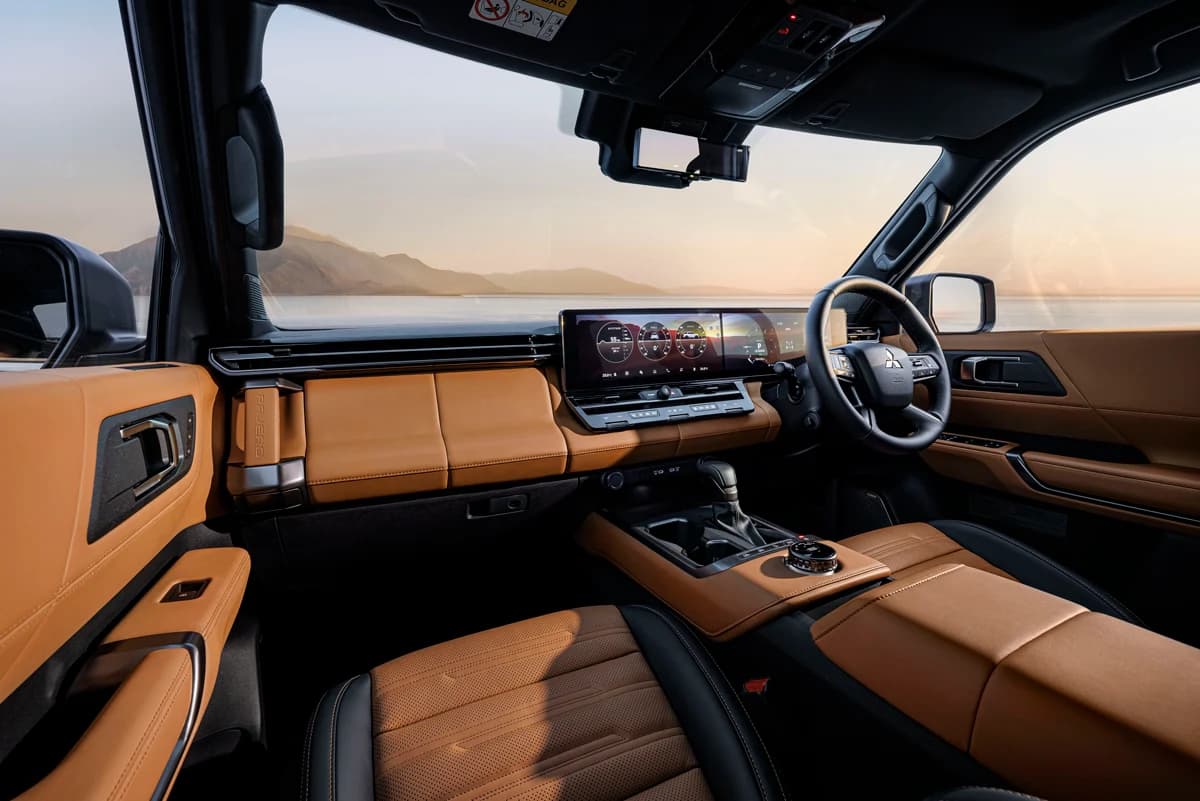
Image credit: Mitsubishi Motors
Safety kit, no rating yet
The safety list is long and, in places, new for the brand. Eight airbags include Mitsubishi's first front-centre airbag, the one that stops front occupants colliding with each other in a side impact. Forward collision mitigation detects pedestrians, cyclists and motorcyclists and works at junctions, backed by a predictive forward collision warning and a system that catches pedal misapplication. Emergency Lane Assist appears for the first time on a Mitsubishi, using the camera and radar to steer as well as warn when the car senses a lane departure risk, and front cross-traffic alert watches both directions at intersections. MI-PILOT bundles adaptive cruise and lane centring into a single-lane highway assistant for long hauls.
The camera system deserves its own mention. The 3D Multi Around Monitor stitches four cameras into a live 3D view at roughly 30 frames per second, and adds a front under-floor view that shows the road surface beneath and ahead of the car. That view switches on automatically in the 4HLc and 4LLc drive modes, which is genuinely clever: exactly when you are picking a line over rock is exactly when you want to see what is under the front axle. There is no ANCAP data yet; the car has only just been revealed, and we will not guess at a rating before the assessment exists.
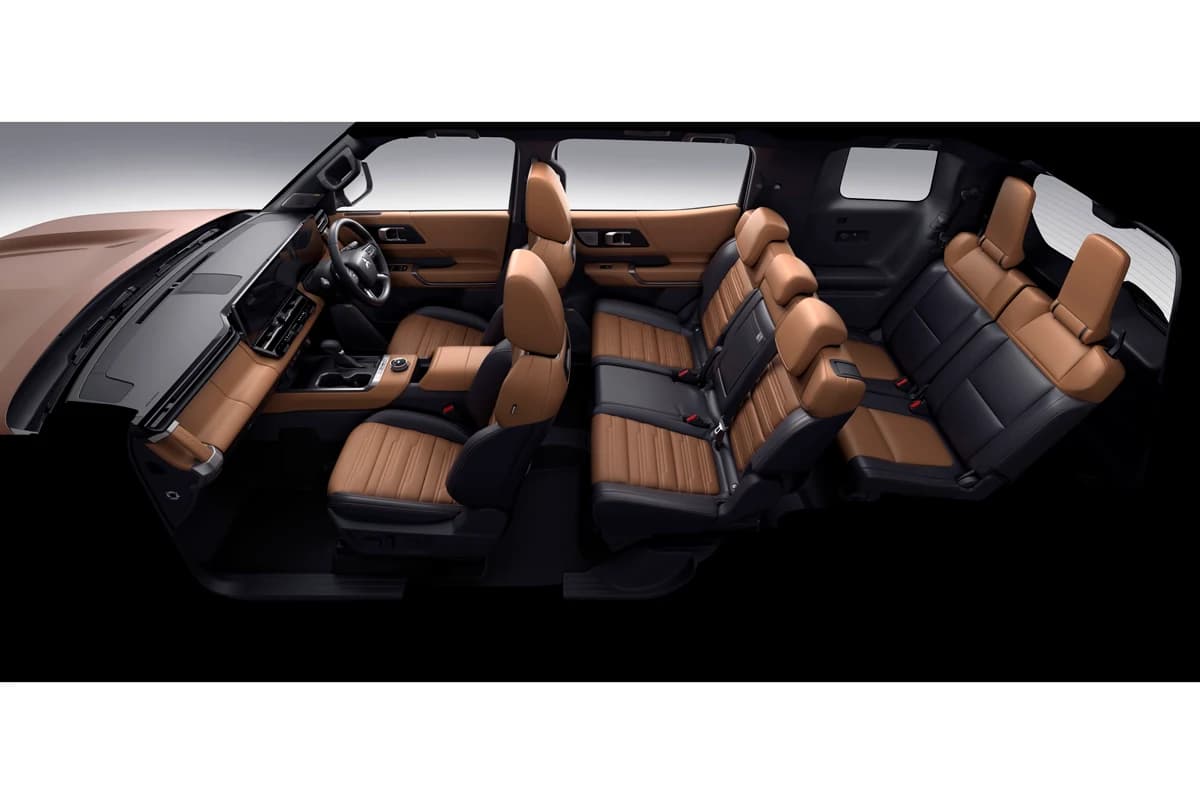
Image credit: Mitsubishi Motors
What it means for Australia
At 4,920mm long and 1,925mm wide on a 2,870mm wheelbase, the new Pajero parks almost exactly on top of the Toyota Prado and Ford Everest, and that is the fight Mitsubishi has picked. It is a crowded, lucrative corner of the market: ladder-frame seven-seaters that tow the caravan, do the school run and take the family beyond the bitumen at Easter. The Prado arrived in its new generation with enormous goodwill and a waiting list. The Everest has been the quiet achiever with its V6 diesel. The Isuzu MU-X undercuts both. Into that walks a nameplate with more off-road pedigree than any of them and a five-year absence to make up for.
Three numbers will decide how this goes. Power, because 480Nm is a healthy torque figure but the class conversation is framed in kilowatts. Towing, because 3,500kg braked is the ticket to entry for the caravan crowd and the old Pajero's 3,000kg rating was always the asterisk on its spec sheet. Mitsubishi's Australian page now lists 3.5-tonne braked towing, so that box is ticked. And price, because the Prado now starts above seventy thousand dollars and the word "Prestige" in Mitsubishi's own positioning suggested it would not be chasing the bottom of the segment. Australian outlets report the range opening at $68,490 before on-road costs for the GLS five-seat and topping out at $84,990 for the GSR, which puts the entry car under the Prado's starting price.
Those prices have not yet appeared on Mitsubishi's Australian Pajero page, which lists the grades without figures, so we are carrying them as reported rather than as Mitsubishi's published list. When Mitsubishi prints them, they go into the database. We have put the full on-paper comparison against the Prado, Everest and MU-X in a separate piece using only the specs Mitsubishi has actually published, and you can track the car itself on its CarSorted page, which we will keep updated from announcement to showroom. After five years without a flagship, Mitsubishi finally has one worth the badge. Now it just has to land the numbers.