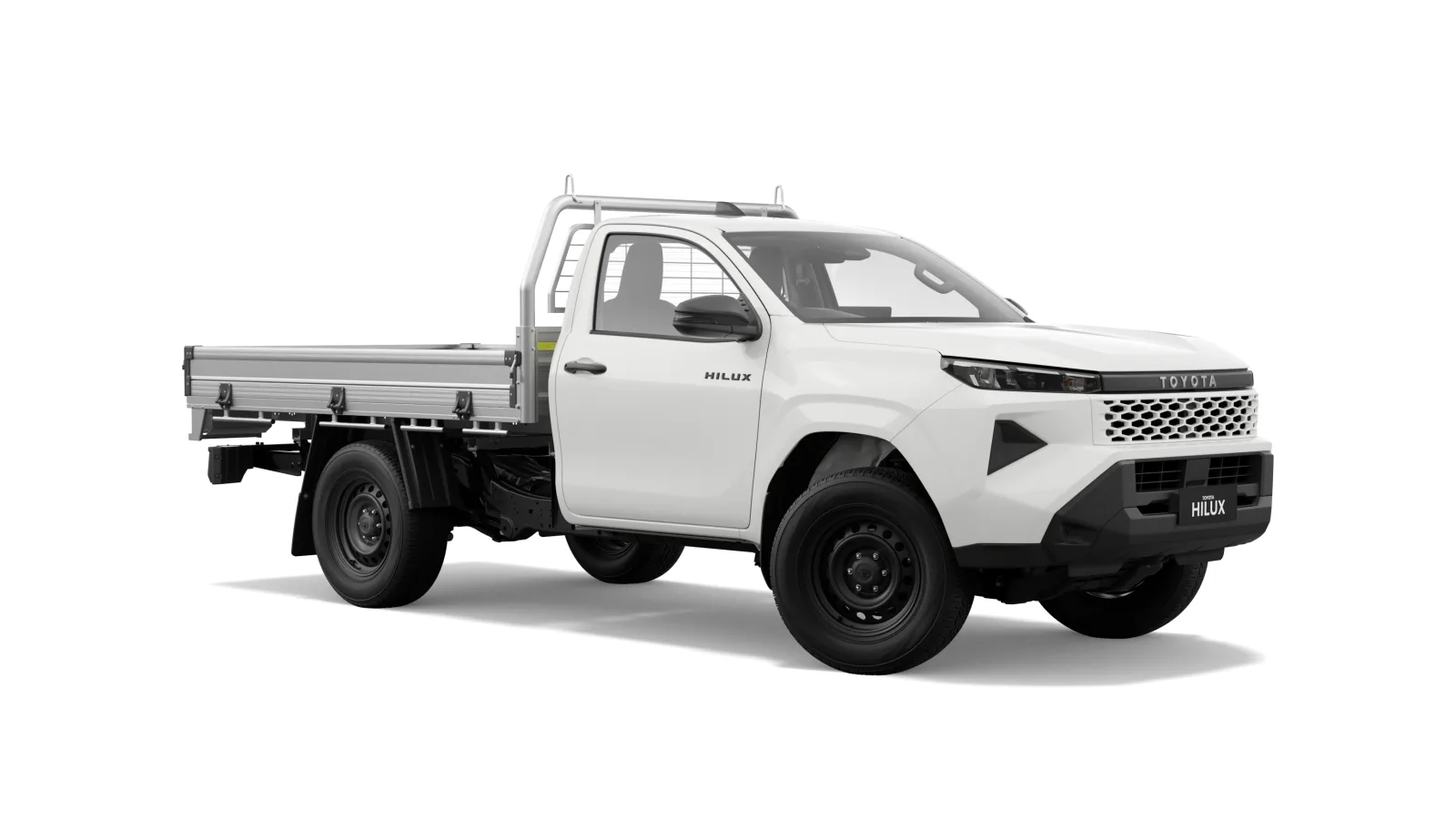
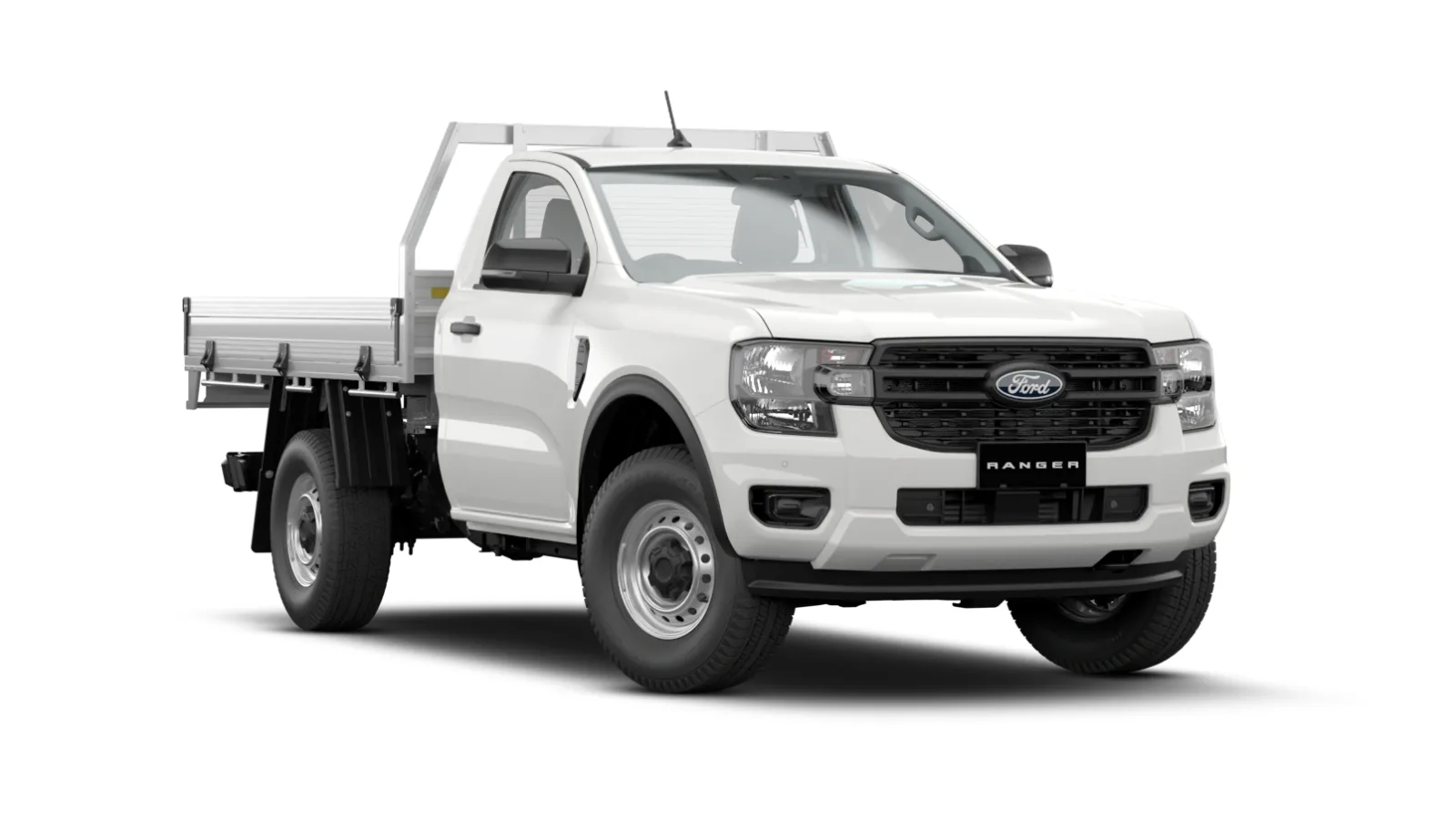
Toyota HiLux vs Ford Ranger
The ute rivalry that defines Australian motoring. HiLux brings bulletproof reliability and resale. Ranger brings class-leading refinement and tech. Which wins for 2026?
Data checked: specs 4 Aug 2026, price 6 Sep 2026
Comparison snapshot
Prices, scores and edges below update from our car data.
Cheaper by $3,140, 25kW more power
Lighter on fuel by 0.4 L/100km, tows 600kg more
Written 20 April 2026. The snapshot, tables, scores and verdict on this page update from our car data; figures quoted in the text are as at that date.
Price
The Ranger Sport lists at $65,640 compared to $63,260 for the HiLux SR5, a $2,380 gap. On paper that favours the HiLux, but you get a lot more ute for the Ranger's extra money: a 12-inch touchscreen, 10-speed automatic, bi-turbo engine, and the newer ANCAP rating. Factor in driveaway pricing and typical dealer discounts, and the real-world delta often shrinks to under $1,500.
Where the HiLux wins on cost is resale. Toyota utes consistently return the highest retained value in the segment, often 65-70% after 3 years compared to the Ranger's 60-65%. On a $63k ute that is a real $2,000-3,000 difference at trade-in time. If you cycle through vehicles every 3-4 years, the HiLux typically comes out ahead despite the slightly higher purchase price.
Fuel is a win for the Ranger. At 7.2L/100km vs 7.9L/100km, and 15,000km/year at $2.10/L diesel, the Ranger saves about $221 per year. Over 5 years that's $1,105, not enormous but meaningful.
Servicing is capped for both. Toyota's capped servicing program runs to 5 years/50,000km at $290 per service. Ford's Service Price Promise is similar at around $329 per visit. Neither is going to surprise you at the dealer.
Safety
Both are 5-star ANCAP rated, but the Ranger's rating is from 2022 against newer, harder criteria. The HiLux was rated in 2019 under an older protocol. In practical terms, the Ranger scored higher in more recent Adult Occupant Protection and Safety Assist testing because it offers more advanced driver aids as standard.
The Ranger Sport bundles Pre-Collision Assist with AEB (pedestrian and cyclist detection), lane-keeping system, blind spot monitoring, adaptive cruise control with stop-and-go, reverse brake assist, and a 360-degree camera on higher trims. The 10-speed auto also plays nicely with the adaptive cruise at low speeds, useful in stop-start traffic.
The HiLux SR5 gets Toyota Safety Sense with AEB (daytime pedestrian), lane departure alert, radar cruise, blind spot monitoring, and rear cross-traffic alert. It's a comprehensive package, but the lane-keep system is less intuitive than the Ranger's and the adaptive cruise doesn't handle low-speed stop-and-go as cleanly.
Both get 7 airbags. Both have trailer sway control. If active safety matters, the Ranger has the slight edge thanks to its newer hardware.
Features
The Ranger Sport's 12-inch portrait-orientation touchscreen with SYNC 4 is the class benchmark, fast, crisp, and paired with wireless Apple CarPlay and Android Auto. It also gets wireless phone charging, a digital instrument cluster, and FordPass connected services with remote start and vehicle tracking.
The HiLux SR5 has an 8-inch touchscreen with wired Apple CarPlay and Android Auto, analogue instruments with a small colour info screen, and no wireless charging or remote connectivity. The infotainment system works fine, but it feels a generation behind the Ranger's.
Interior materials are broadly similar, hardwearing plastics suited to workwear and muddy boots. The Ranger's cabin feels slightly more modern with softer-touch surfaces on the dash top, while the HiLux is more utilitarian. Both offer heated front seats on top trims (Ranger Sport standard; HiLux SR5 as part of a premium interior pack).
Climate control is dual-zone on both. Leather-accented seats are optional on both. Power-adjustable driver seat is standard on the Ranger Sport and available on the HiLux SR5.
Drivetrain
The HiLux SR5 uses Toyota's well-proven 2.8-litre single turbo four-cylinder diesel: 150kW at 3,400rpm and 500Nm from 1,600-2,800rpm. This engine has been refined over two generations and is now one of the most reliable diesel fours on the market. Toyota's engineering culture avoids complexity, and the 2.8 shows it: relatively old-school turbo layout, proven internals, excellent longevity.
The Ranger Sport gets Ford's 2.0-litre bi-turbo diesel: 154kW at 3,750rpm and 500Nm from 1,750-2,000rpm. It's a newer, more technical engine using two sequential turbos for a broader torque band. In the real world it feels more responsive than the HiLux when you roll onto the throttle from low revs, and it's quieter at highway speeds.
The Ranger's 10-speed auto is a genuine feature, not just a spec-sheet number. It keeps the engine in its sweet spot more often than the HiLux's 6-speed, and shifts smoothly in daily driving. For towing especially, the 10-speed is better at finding the right gear when you're working the engine hard on hills.
Reliability is where the HiLux pulls ahead. The 2.8 has a very low incidence of major issues. The Ranger's bi-turbo has a much better track record than the old 3.2 five-cylinder but is more complex than the HiLux's single-turbo unit. Over a 15-year ownership period the HiLux is statistically the lower-maintenance bet.
Cost to own
Warranty is identical: 5 years / unlimited km for both. Both manufacturers offer capped-price servicing programs. Toyota's is arguably more predictable, with flat rates across the first 5 services. Ford's Service Price Promise similarly caps service costs but varies slightly between services.
Parts availability is excellent for both, but Toyota's network is denser in regional and remote Australia. If you're in an outback town, there's almost certainly a Toyota dealer within 200km. Ford's network is also strong but not quite as deep in bush-country.
Accessories are enormous for both. Bull bars, drawer systems, canopies, suspension upgrades, secondary batteries, the aftermarket for both utes is thriving. The Ranger has a slightly bigger aftermarket due to its current best-seller status, but the HiLux has a deeper catalogue of older proven products with long-term runs.
Insurance falls in the same bracket for both. Expect $1,100-$1,800/year depending on your postcode, driver history, and level of cover. Neither is cheap to insure, but both sit below big-block V8 utes like the RAM 1500 or Silverado.
Resale is where the HiLux genuinely wins. Toyota utes hold value better than any other nameplate in the segment, consistently. If you're planning to sell after 3-5 years, that resale premium offsets a meaningful chunk of the purchase price.
Australia's Two Best-Sellers
The Ranger has been Australia's best-selling vehicle outright since 2023, overtaking the HiLux for the first time in years. That's a genuine reversal, the HiLux held the crown for most of the 2010s and early 2020s. What changed? The current-gen Ranger (launched 2022) is comprehensively more modern than the current-gen HiLux (2015 platform, last updated 2020). Ford invested hard in cabin tech, driver aids, and infotainment. Toyota has been slower to update the HiLux. The next-gen HiLux is due in 2026-2027 and is expected to close the gap.
What Each Ute Does Best
HiLux: reliability, resale, dealer network depth, fleet suitability. If you're buying with a 10+ year horizon, or you're regional, the HiLux is still the smart pick. Toyota's reputation for building utes that never die is earned.
Ranger: cabin experience, safety tech, driving refinement, towing drivability. If you spend hours in the cab every day or your ute doubles as a family vehicle, the Ranger is the more liveable choice. The 12-inch screen and 10-speed auto aren't just showroom bait, they genuinely make the ute nicer to live with.
Who Should Buy Which?
Buy the HiLux SR5 if: you plan to keep it 5+ years, cover a lot of outback kilometres, value the densest dealer network in Australia, or care about the strongest resale in the segment.
Buy the Ranger Sport if: cabin tech and safety kit matter, you commute in traffic regularly, tow on hilly terrain, or simply want the more modern driving experience. The 10-speed auto alone is worth serious consideration.
See also: Ranger vs HiLux vs D-Max three-way, D-Max vs Ranger, and our Best Utes in Australia 2026 guide.
Key details
A tick marks the better figure only where both cars have one and the gap is meaningful (3% or more; a whole star or year).
| Detail | Toyota HiLux | Ford Ranger |
|---|---|---|
| Price | From $33,990 RRP | From $37,130 RRP |
| Drive-away estimate | Calculating... | Calculating... |
| Body | Cab Chassis | Ute |
| Powertrain | Diesel, 2.8L 4-cyl turbo | Diesel, 2L 4-cyl turbo |
| Power / torque | 150kW / 420Nm | 125kW / 405Nm |
| Fuel use | 7.3 L/100km | 6.9 L/100km |
| 0-100km/h | 10.2s | 10.5s |
| Boot | No data | No data |
| Towing (braked) | 2,900kg | 3,500kg |
| ANCAP | 5 stars (2025) | 5 stars (2022) |
| Warranty | 5yr / unlimited km | 5yr / unlimited km |
At a glance
- Seats
- 2
- Boot
- No data
- Length x width x height
- 5,380 x 1,855 x 1,880mm
- Wheelbase
- 3,085mm
- Engine
- 2.8L 4-cyl turbo
- Power
- 150kW
- Torque
- 420Nm
- Drive
- RWD
- Transmission
- Manual
- Power-to-weight
- 89 kW/tonne
- Kerb weight
- 1,690kg
- Spare wheel
- Full-size steel
- Payload
- 1,260kg
- Towing braked / unbraked
- 2,900kg / 750kg
- Turning circle
- 10.8m
- Seats
- 2
- Boot
- No data
- Length x width x height
- 5,225 x 1,910 x 1,872mm
- Wheelbase
- 3,270mm
- Engine
- 2L 4-cyl turbo
- Power
- 125kW
- Torque
- 405Nm
- Drive
- RWD
- Transmission
- Automatic
- Power-to-weight
- 70 kW/tonne
- Kerb weight
- 1,783kg
- Spare wheel
- 16" Steel
- Payload
- 1,447kg
- Towing braked / unbraked
- 3,500kg / 750kg
- Turning circle
- 12.9m
CarSorted Score breakdown
The CarSorted Score is algorithmic: it is calculated from each car's data, not from a road test. How it works.
Safety
Fuel Economy
Value
Practicality
Technology
Performance
Reliability
The verdict
Toyota HiLux comes out ahead on the CarSorted Score (67 vs 66)
The deciding gaps
- Reliability:Toyota HiLux 67, Ford Ranger 59, Toyota HiLux ahead by 8
- Safety:Toyota HiLux 78, Ford Ranger 73, Toyota HiLux ahead by 5
- Fuel Economy:Toyota HiLux 70, Ford Ranger 74, Ford Ranger ahead by 4
The Toyota HiLux is also the cheaper of the two.
Same scorer as the live comparison of these two exact cars.
Our take (written 20 April 2026)
On paper, the Ranger wins this one. It has a more modern engine, a 10-speed auto, a much bigger infotainment screen, and marginally better fuel economy. The 2022 ANCAP rating is also newer than the HiLux's 2019 rating. But the HiLux closes the gap where it counts for a work vehicle: legendary reliability, the strongest resale value in the segment, and Toyota's unmatched service network. For most buyers, the Ranger is the better everyday ute. For farmers, fleets, and anyone who wants to hold onto it for 10+ years, the HiLux still has the edge.
Our written take favoured the Ford Ranger; on today's figures the score favours the Toyota HiLux.
Prices on this page move. Want the next verdict?
One short email when prices shift or a new comparison lands. No spam, unsubscribe anytime.
Questions buyers ask
Which holds its value better?
The Toyota HiLux WorkMate 4x2 Single Cab Manual is from $33,990 RRP; the Ford Ranger XL 4x2 Hi-Rider Single Cab Cab-Chassis is from $37,130 RRP. That makes the Toyota HiLux $3,140 cheaper.
Which tows better?
Braked towing capacity: the Ford Ranger at 3,500kg, against 2,900kg for the Toyota HiLux.
Is the Ranger's 2.0 bi-turbo reliable?
Yes. Early concerns have been resolved. It's still more complex than the HiLux's single-turbo 2.8 though, which matters for long-term ownership.
Which has the better safety kit?
The Toyota HiLux holds 5 stars (rated 2025), and the Ford Ranger holds 5 stars (rated 2022).
Which should a farmer buy?
The HiLux for reliability, dealer network coverage, and resale. For touring or family-first buyers prioritising cabin tech, go Ranger.
Which is cheaper to run, the Toyota HiLux or the Ford Ranger?
On the official combined cycle, the Toyota HiLux uses 7.3 L/100km and the Ford Ranger uses 6.9 L/100km.
Which has the better warranty?
The Toyota HiLux comes with a 5yr / unlimited km warranty; the Ford Ranger with a 5yr / unlimited km warranty.
Which comes out ahead overall?
On the CarSorted Score the Toyota HiLux comes out ahead (Toyota HiLux 67/100, Ford Ranger 66/100), mainly on reliability, safety. The score is algorithmic; the editorial above says who each car suits.
Related
Compare
In the news
- 2027 Mahindra Lifestyler Ute Confirmed for Australia: 3.5-Tonne Tow Target, Fresh Ladder-Frame Platform, Australian Suspension Tune
- VFACTS July 2026: Best July On Record, Toyota RAV4 Back On Top, and Half the Top 10 Now Built in China
- 2026 Toyota HiLux Gets a Factory GVM Upgrade From $4,000: Up to 435kg More Payload, Warranty Intact
- 13,907 Ford Rangers Recalled in Australia Over a Side Curtain Airbag That Can Snag the B-Pillar Trim
How to read this page. Prices, specs, ANCAP ratings, warranty, scores and the computed verdict come from our records for the two variants shown, sourced from manufacturer Australian documents, and update when those records change. RRP excludes on-road costs. Drive-away figures are estimates for the state you have selected unless marked as advertised. The editorial text was written on 20 April 2026. Always confirm price and specification with the manufacturer or dealer before you buy. CarSorted does not accept payment for recommendations.
Comments (0)
Sign in to join the conversation
No comments yet. Be the first!