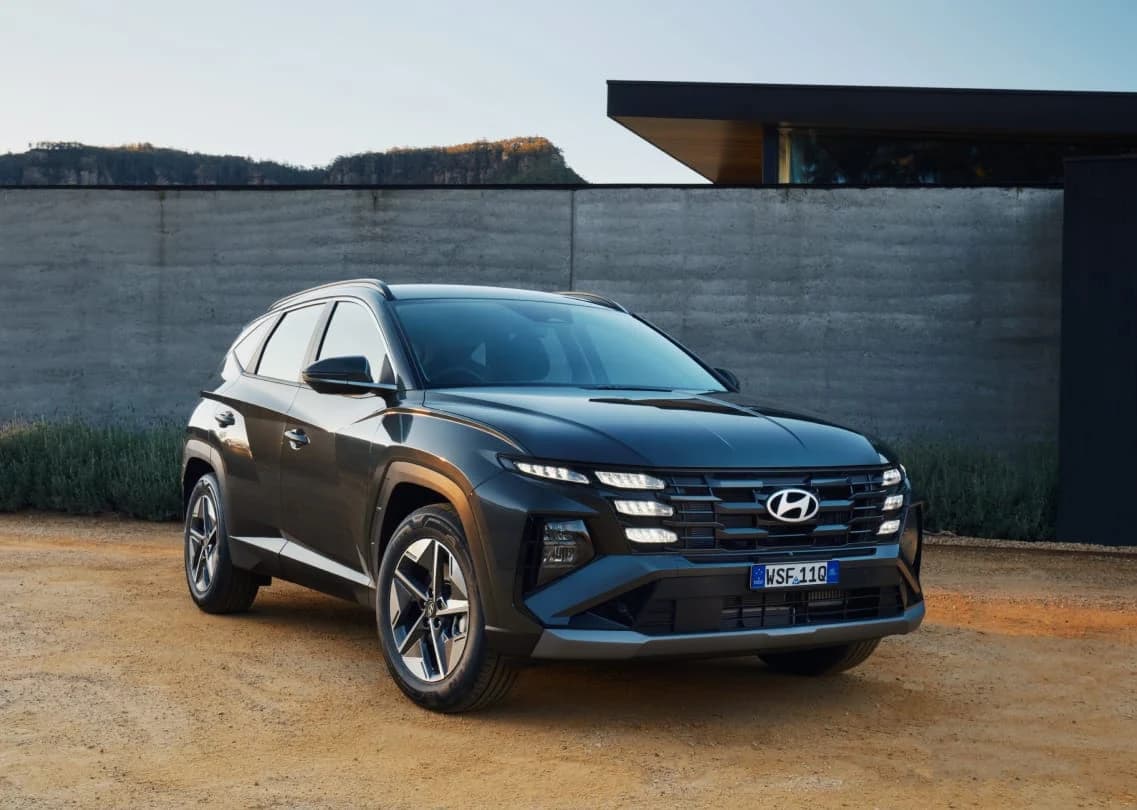
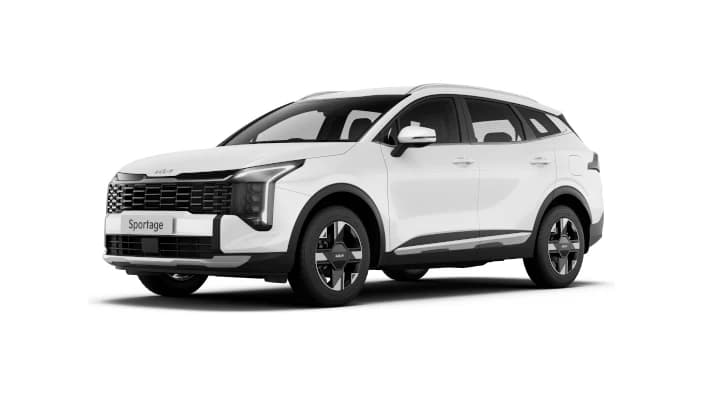
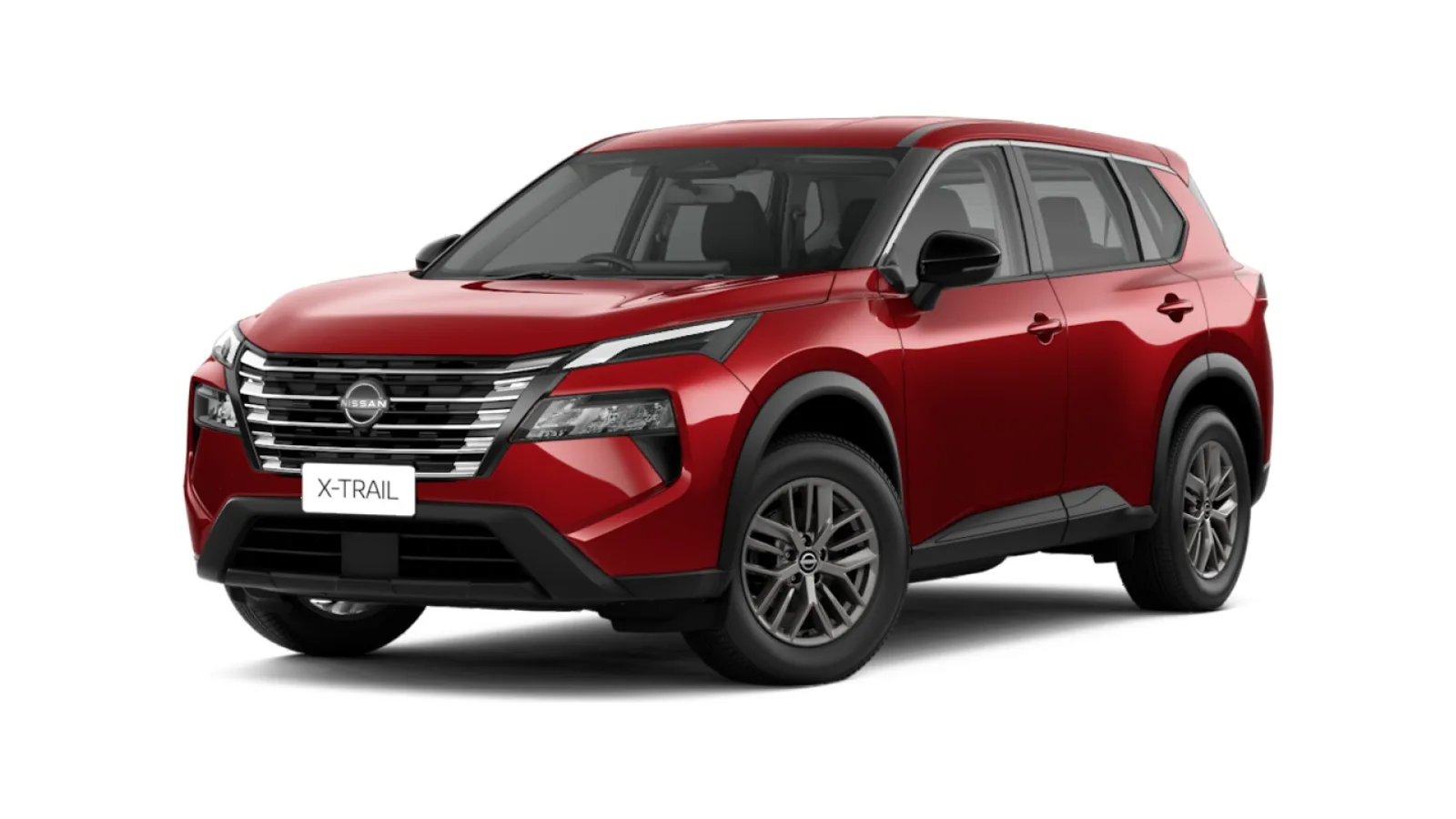
Kia Sportage vs Nissan X-Trail
A detailed look at how two of Australia's most popular SUVs compare on price, running costs, safety, and everyday livability.
Specifications and pricing correct at time of publishing. Prices are RRP before on-road costs unless stated otherwise. Always confirm with the manufacturer or dealer before purchasing.
Data checked: specs 28 Aug 2026, price 1 Oct 2026
Driver assistance, as the maker lists it
Swipe across. Tap a feature to see what it does and each car's source.
StandardOptional: printed price, +pack or NCO (no-cost)No, not offeredNo dataCounts beside each car use the same colours; ? is no option data.
From each manufacturer's Australian equipment list. No data means that car's document does not say. The drawings are our own illustrations of how each kind of system works.
$38,490RRP
- with the Nissan X-Trail's standard kit: $38,490 (nothing to add)
$38,305RRP
- no option data for this car
Printed option prices only. A pack is counted once and makes the figure a floor when it carries no printed price. Nothing is inferred from the other car.
Track the Kia Sportage & Nissan X-Trail
Get price-drop alerts on these models plus our free weekly new-car rundown. Unsubscribe anytime.
Price Breakdown
The Kia Sportage starts from $38,490 before on-road costs, while the Nissan X-Trail opens at $38,305. That makes the Nissan X-Trail the more affordable entry point by $185.
Once you factor in stamp duty, registration, CTP insurance, and dealer delivery, expect to add roughly 8-12% on top of the RRP depending on your state. That puts estimated driveaway prices in the ballpark of $42,339 and $42,136 respectively.
Over 5 years, the running costs favour the Nissan X-Trail by roughly $1,000 in fuel alone.
Safety Rundown
Both the Kia Sportage and Nissan X-Trail hold a 5-star ANCAP safety rating. Adult occupant protection scored 87% for the Kia Sportage and 91% for the Nissan X-Trail.
Where the two diverge is in active safety technology. We can confirm 6 of 10 key ADAS systems on the Nissan X-Trail, against 5 on the Kia Sportage.
Both include the essentials: autonomous emergency braking, lane keep assist, adaptive cruise control, a reversing camera. Airbag count is 7 in the Kia Sportage and 7 in the Nissan X-Trail.
Recalls on our record
Kia Sportage
- REC-006557 · published 6 Mar 2026Due to a software error, the Instrument Cluster may display a blank screen or may not operate as intended.Year range on the notice: 2025
- REC-006112 · published 9 Oct 2024The Hydraulic Electronic Control Unit (HECU), responsible for the Anti-lock Braking System, Electronic Stability Control System and Traction Control System, can remain live even when the vehicle is switched off.Year range on the notice: 2009
- REC-006109 · published 9 Oct 2024The Hydraulic Electronic Control Unit (HECU), responsible for the Anti-lock Braking System, Electronic Stability Control System and Traction Control System, can remain live even when the vehicle is switched off.Year range on the notice: 2013 - 2014
- 10 more on the model page.
Nissan X-Trail
- REC-006653 · published 9 Jul 2026Due to a software issue with the Lithium-ion Battery Controller (LBC) the vehicle may enter a fail-safe mode whilst driving or when the driver is using regenerative braking.Year range on the notice: 2022 - 2026
- REC-001095 · published 20 Sep 2012The bulkhead lower front insulator may warp and so the clearance to the turbocharger becomes insufficient.Year range on the notice: the notice prints no build range
- REC-003406 · published 28 Nov 2011Manufacturing defect in the power steering control unit, which can stop power assisted steering.Year range on the notice: the notice prints no build range
- 1 more on the model page.
A recall covers the builds its notice lists, not every car of a model. Check your VIN at vehiclerecalls.gov.au.
Feature Showdown
The Kia Sportage features a 12.3-inch touchscreen paired with a 4-inch digital dash, while the Nissan X-Trail gets a 8-inch display and 7-inch instruments. Apple CarPlay and Android Auto are standard across both.
Drivetrain
The Kia Sportage uses a Petrol producing 115kW and 192Nm of torque, sent through a automatic to a FWD layout.
The Nissan X-Trail lines up making 135kW and 244Nm, paired to a automatic driving the front wheels. It gets to 100km/h in 8 seconds.
The Nissan X-Trail has the clear power advantage at 135kW vs 115kW. For most buyers, the way each car feels day-to-day matters more than outright acceleration.
Space & Comfort
The Kia Sportage measures 4,685mm long on a 2,755mm wheelbase, 5mm longer than the Nissan X-Trail at 4,680mm (2,705mm wheelbase). The longer wheelbase on the Kia Sportage generally means more rear legroom.
Boot space is 543L in the Kia Sportage and 585L in the Nissan X-Trail, giving the Nissan X-Trail a 42L advantage.
For towing, the Nissan X-Trail leads with a 2,000kg braked capacity vs 1,650kg. That 350kg difference matters if you regularly hitch up.
Turning Circle
Kerb-to-kerb diameter. Smaller turns easier in tight carparks and U-turns.
11.1m to 11.4m
Based on 11.4m turning circle:
- U-turn on standard street (7m+ wide)
- Standard parking bay
- Tight carparks
- Narrow laneways
Based on 11.1m turning circle:
- U-turn on standard street (7m+ wide)
- Standard parking bay
- Tight carparks
- Narrow laneways
Turning circle ratings
Compare U-turns side by side
Turning Circle · U-turn compare
kerb-to-kerb, 2 cars0 of 2 clear a 7.0 m street in one sweep
Green cars complete the U-turn; amber need a 3-point turn. Drag the slider to test tighter streets.
Standard widths: AU local streets ~5.5–7 m; main roads ~9–12 m.
True Cost to Own
Based on 15,000km of annual driving, fuel costs roughly $2,309/year for the Kia Sportage and $2,109/year for the Nissan X-Trail. That is a $200 annual difference in favour of the Nissan X-Trail.
Warranty: 7 years / 999,999km (Kia Sportage) vs 5 years / 999,999km (Nissan X-Trail). The Kia Sportage has longer coverage.
Who Should Buy Which?
Buy the Kia Sportage if: You value a longer warranty, or prefer Kia's approach to design and ownership experience.
Buy the Nissan X-Trail if: You want the lower entry price, prioritise performance, need more boot space, want lower running costs, need stronger towing, or prefer Nissan's approach to design and ownership experience.
The Verdict
Nissan X-Trail: Level on the CarSorted Score at 75, ahead on the category wins
The Nissan X-Trail comes out ahead on the CarSorted Score (75 vs 75), taking 5 of 6 key spec rows below and coming in at a lower price. The deciding gaps: reliability (Kia Sportage ahead by 9), fuel economy (Nissan X-Trail ahead by 6), practicality (Nissan X-Trail ahead by 6). The Nissan X-Trail will save you roughly $200 a year in fuel. If boot space matters, the Nissan X-Trail has a clear edge. The Kia Sportage adds peace of mind with a longer 7-year warranty. The best pick depends on what you value most. Explore the full specs for each model below.
Common questions
Which is cheapest, Kia Sportage and Nissan X-Trail?
The Nissan X-Trail is the cheapest at $38,305 before on-road costs. That undercuts the Kia Sportage by $185.
Which is the most fuel-efficient?
The Nissan X-Trail uses the least fuel at 7.4L/100km on the combined cycle.
Which is safest?
They are evenly matched on crash rating: Kia Sportage and Nissan X-Trail all hold a 5-star ANCAP rating. Compare the active-safety features above to separate them.
Which has the most boot space?
The Nissan X-Trail has the largest boot at 585L with the seats up (782L with the seats folded).
Which can tow the most?
The Nissan X-Trail has the highest braked towing capacity at 2,000kg.
Which has the best warranty?
The Kia Sportage has the longest warranty at 7 years / Unlimited.
Which is the most powerful?
The Nissan X-Trail makes the most power at 135kW.
Stay across the market
Get our weekly new-car rundown of launches, price moves, deals and reviews, straight from the data.
- Weekly new-car rundown
- Price cuts and new deals
- New launches and reviews
No spam, unsubscribe anytime. By subscribing you agree to receive marketing emails.
Disclaimer: All information in this comparison was believed to be correct at the time of publishing (20 April 2026). Prices are manufacturer recommended retail prices (RRP) and may vary by state, dealer, and options. Driveaway costs include estimated on-road costs for Victoria. Fuel economy figures are WLTP/ADR combined cycle. Specifications can change without notice. Always verify with the manufacturer before making a purchase decision. CarSorted does not accept payment for recommendations.
Auto-generated from CarSorted's specification data · 20 April 2026
Comments (0)
Sign in to join the conversation
No comments yet. Be the first!