Key Takeaways
- JAC Motors Australia now lists a Hunter Pro Cab Chassis on its Hunter page, marked "Coming soon"
- No price, date or specification sheet from JAC yet. Timing of early 2027 is reported by Australian outlets, not printed by JAC
- The dual-cab it is based on makes 360kW, tows 3,500kg braked and carries 915kg, with a 6,430kg GCM, per JAC's spec sheet
- On the dual-cab's own published figures, towing 3,500kg leaves about 375kg for people, tools and body before the GCM is reached. That is the number to ask about on the cab-chassis
- Among the plug-in hybrid utes we list on sale, the only cab-chassis today is the BYD Shark 6 Dynamic Cab-Chassis
- ANCAP's five-star Hunter rating (2024 date stamp) predates the cab-chassis; whether it will cover that body is not yet confirmed
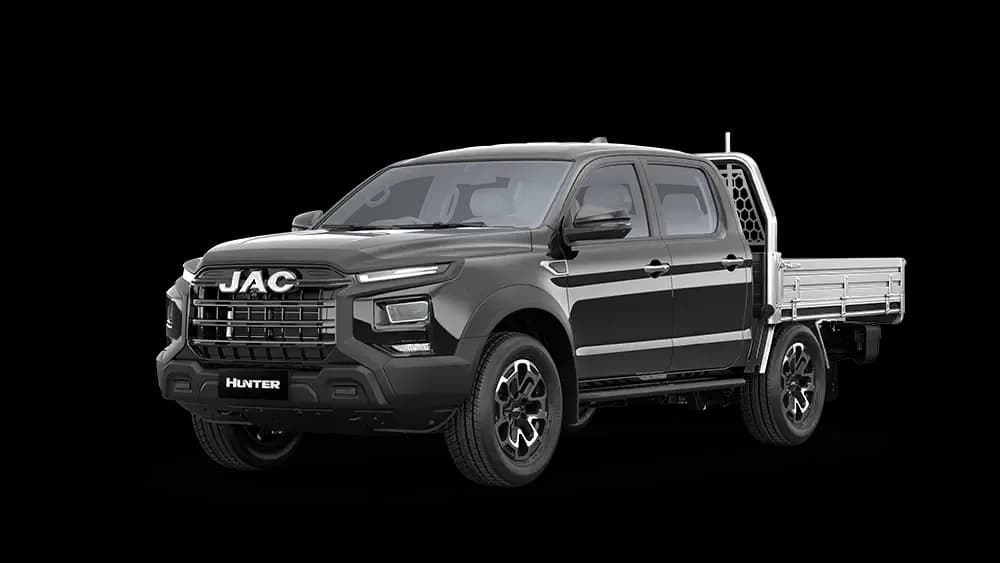
Image credit: JAC Australia. Studio image published on JAC's Hunter page for the Hunter Pro Cab Chassis; the final Australian tray and specification are not yet confirmed.
JAC's plug-in hybrid ute is getting a tray. JAC Motors Australia's Hunter page now carries a third card in its range line-up, below the Hunter Pro and Hunter X dual-cabs: the Hunter Pro Cab Chassis, with two words under it, "Coming soon." That is the whole of what JAC has put on its own site so far. There is no price, no date and no specification sheet.
Motoring outlets have filled in some of the gaps from interviews. They report the cab-chassis is due in early 2027, and they quote JAC Motors Australia managing director Ahmed Mahmoud as saying more than half of the prospective fleet customers JAC is talking to want a cab-chassis. That fits: a dual-cab with a tub is a lifestyle ute that also works, while a tray-back is a work ute first, and fleets are where plug-in utes have the most to prove. But until JAC prints those details, they stay as reported here, and this piece is mostly about what a trade or fleet buyer should be asking before anyone signs.
What JAC Has Actually Confirmed
Three things are on JAC's Australian site today. The model exists as a planned Australian variant, it is called the Hunter Pro Cab Chassis (so it sits under the Pro name rather than the better-equipped X), and JAC's range section opens with the line "Every Hunter delivers the same core performance. Power, towing, payload, all standard." That line sits above all three cards, but it is marketing copy, not a specification, and a cab-chassis with a different body cannot have the same payload figure as a dual-cab with a tub. We are not going to read it as a confirmed spec for the tray-back.
What is not confirmed by JAC: the price, the arrival date, the kerb weight and GVM, the tray options, whether JAC or its dealers will supply the tray, and whether the drivetrain and towing figures carry over unchanged. Outlets have reported that they do, and that trays, canopies, toolboxes and specialised bodies are all planned. Those are reasonable expectations, but they are expectations.
Pricing: Nothing Yet, and What It Sits Beside
JAC has not priced the cab-chassis. The only Hunter price JAC publishes is for the dual-cab, which it says starts from under $50,000 MSRP plus on-road costs. JAC does not print an exact figure for either grade on its site. The table below sets that against the double-cab cab-chassis utes whose prices we have checked against the manufacturer, so you can see the bracket the tray-back Hunter will land in.
| Model | Body | Price | Basis |
|---|---|---|---|
| Plug-in hybrid (2.0L turbo-petrol + two electric motors) | |||
| JAC Hunter Pro Cab Chassis | Dual-cab, tray | Not announced | Coming soon (JAC) |
| JAC Hunter Pro PHEV | Dual-cab, tub | From under $50,000 | MSRP + on-road costs |
| Electric | |||
| Toyota HiLux BEV SR Double Cab | Cab-chassis | $74,990 | RRP, before on-road costs |
| Diesel, for comparison | |||
| Toyota HiLux SR 4x4 Double Cab Manual | Cab-chassis | $54,990 | RRP, before on-road costs |
A tray-back normally costs the buyer a tray on top of the cab-chassis price, so the useful comparison, once JAC prices it, will be the cab-chassis plus a fitted tray against a rival plus the same tray. We have left the BYD Shark 6 Dynamic Cab-Chassis, the Ford Ranger XL 4x4 Double Cab Cab-Chassis and the Isuzu D-Max SX Crew Cab Chassis 4x4 out of the price table because we have not yet re-checked their prices against the manufacturers. Their listings show the figures we currently hold.
The Drivetrain It Is Built On
Everything below is JAC's published specification for the dual-cab Hunter Pro and Hunter X, which share the same figures in JAC's spec sheet. It tells you what the cab-chassis starts from, not what it will be.
| Dual-cab Hunter PHEV | As JAC Australia quotes it |
|---|---|
| Engine | 2.0L turbo-petrol, 160kW / 370Nm |
| Electric motors (peak) | Front 130kW / 300Nm, rear 150kW / 340Nm |
| System power | 360kW |
| Combined driveline torque | 1,010Nm (JAC calculated figure) |
| Battery | 31.2kWh lithium iron phosphate |
| Electric range / combined range | 100km / 1,005km (NEDC) |
| Fuel use / CO2 | 1.6L/100km / 38g/km (NEDC) |
| Charging | 11kW AC, 46kW DC |
| Fuel tank | 77L |
| Kerb weight / GVM / payload | 2,555kg / 3,470kg / 915kg |
| Braked towing / towball / GCM | 3,500kg / 350kg / 6,430kg |
| Rear suspension | Multi-link rigid axle |
Two details matter more on a work ute than they do on the brochure cover. First, the 1,010Nm is not a measured engine figure: JAC's own footnote says it is calculated from the engine and both motors through the driveline gear ratios, for comparison only. Second, the layout. JAC lists an electric all-wheel-drive system with a four-speed dedicated hybrid transmission, and the rear axle is driven by its own motor. JAC's spec sheet does not list a low-range transfer case, and outlets that have driven the dual-cab report it has none. For a site ute that never leaves the bitumen, that will not matter. For a tray-back on mine roads or farm tracks, where low range and a proper crawl ratio earn their keep, it is worth asking JAC how the Off-Road Crawl Control mode it lists stands in.
The electric range and fuel figures are NEDC results, which JAC's own footnotes describe as laboratory figures for comparison only. With a loaded tray and the battery run down, fuel use will be well above 1.6L/100km, and nobody should build a fleet running-cost model on that number.
The Number That Matters: What Is Left After You Hitch Up
A cab-chassis gets bought to carry things, so payload is the first question, and on the dual-cab's published figures it is the Hunter's weakest suit. JAC quotes 915kg for the dual-cab with its tub. The diesel double-cab cab-chassis rivals we list sit higher: we list 1,188kg for the Ranger XL double cab-chassis 2.0 BT and 1,185kg for the D-Max SX crew cab-chassis. JAC's own diesel tray-back is a useful reference too: JAC lists the JAC T9 TradePro Cab-Chassis at 1,165kg of payload, adding that the final mass depends on the body fitted, and 3,200kg of braked towing.
Towing is where the arithmetic gets sharper. The dual-cab Hunter's gross combination mass is 6,430kg. Hook up a trailer that weighs the full 3,500kg and the ute itself can weigh no more than 2,930kg. Take away the 2,555kg kerb weight and there is about 375kg left for the driver, passengers, tools and anything bolted to the back before you reach the GCM. That is on the tub-back dual-cab. On a cab-chassis, the tray, headboard, toolboxes and any canopy all come out of whatever the equivalent figure turns out to be, and a steel tray with boxes can weigh a lot of it on its own.
That is not a knock on the Hunter alone. Plenty of dual-cab utes cannot carry a full crew and tow their maximum at the same time. But it means the headline 3,500kg is only half the answer for a tradie who tows a plant trailer and carries a loaded tray. The cab-chassis could come in lighter or heavier than the dual-cab depending on how JAC rates it and what body goes on, so the numbers to ask JAC for are the cab-chassis kerb weight, its GVM, its GCM and the maximum body weight it allows for.
You can run the dual-cab's published figures yourself below. Put your trailer in, then add your tray and toolboxes as load, and watch what happens to the margin. When JAC publishes the cab-chassis masses, the same exercise will take a minute.
Payload 915 kg · GVM 3,470 · GCM 6,430 · Braked tow 3,500 · Tow-ball 350 kg
Passengers, accessories and the tow-ball all count against the vehicle's payload and GVM. The trailer adds to GCM.
Total weight of people and gear inside the vehicle
Fully-loaded trailer weight, not the dry tare
Assumed at 10% of trailer ATM
Enter both from a weighbridge / your compliance plate to add a rear-axle gauge. Nothing here is estimated.
How these are calculated
Payload = GVM − kerb weight. Passengers, accessories and the tow-ball download all count against it.
GVM used = kerb + passengers + accessories + tow-ball.
GCM used = kerb + passengers + accessories + trailer (ATM). The tow-ball isn't added twice: it's part of the vehicle load and comes out of the trailer's axle weight, so (kerb + load + tow-ball) + (ATM − tow-ball) = kerb + load + ATM.
Tow = trailer ATM vs the braked rating. Tow-ball is assumed at 10% of the trailer (a common rule of thumb) unless you enter your own.
When a vehicle's kerb weight isn't published but its payload is, we derive kerb = GVM − payload. Manufacturers usually quote payload off the lightest build, so a car with options already fitted will have a little less real-world payload.
Vehicle weights (kerb, GVM, GCM, braked-tow and tow-ball limits) are the manufacturer's published figures from our database. Figures are a guide, not independently verified. Confirm against the compliance plate and never exceed rated GVM, GCM, tow or tow-ball limits.
For a fuller rig, with a caravan or boat, trailer brakes and ball weight, use our TowingSorted planner.
Where It Would Sit Against the Tray-Backs We List
Among the plug-in hybrid utes we list on sale, the BYD Shark 6 Dynamic Cab-Chassis is the only cab-chassis, so the Hunter would give fleets a second choice rather than a first. On the figures we list, the Shark 6 cab-chassis makes 321kW with a 29.6kWh battery and is rated to tow 2,500kg braked. If JAC holds the Hunter's 3,500kg rating for the tray-back, that is the clearest difference between the two, and the one that decides it for anyone towing an excavator trailer or a heavy box trailer. Of the plug-in hybrid utes we list on sale, the dual-cab Hunter's 360kW is the highest power figure; that comparison is on our listed data and covers dual-cabs, not a cab-chassis JAC has not yet specified.
The fully electric option is the Toyota HiLux BEV SR Double Cab Cab-Chassis at $74,990 before on-road costs. It has no petrol engine to fall back on, so it suits fixed daily routes that return to a depot charger. A plug-in hybrid like the Hunter trades some of that zero-fuel running for the ability to do a country run or a long tow without planning around chargers.
Then there are the diesels, which is what most fleet managers will actually be comparing against. The HiLux SR 4x4 Double Cab cab-chassis is $54,990 before on-road costs, and the Ranger and D-Max cab-chassis both carry more on the payload figures we list. The Hunter's case against them will rest on fuel savings for short, chargeable runs, the power, and the ownership package, and it cannot be made properly until JAC publishes a price and a payload.
Pick two
Double-cab work utes, side by side
The dual-cab Hunter Pro PHEV the tray-back is based on, against the double-cab cab-chassis utes we list on sale. Tap any two.
| Spec | JAC Hunter Pro PHEV (dual-cab tub) | BYD Shark 6 Dynamic Cab-Chassis |
|---|---|---|
| Price from | No data | $55,900RRP, before on-roads |
| Electric-only range | 100 km | 100 km |
| Braked towing | 3,500 kg | 2,500 kg |
| Payload | 915 kg | No data |
| Fuel use | 1.6 L/100kmcombined cycle from a full battery | 2.0 L/100kmfrom a full battery, 7.9 once flat |
| ANCAP | 5 starstested 2024 | 5 starstested 2025 |
| Warranty | 7 yr150k km | 6 yr150k km |
The Hunter shown is the dual-cab with a tub; the Hunter cab-chassis is not in this comparison because we do not list it yet and JAC has not published its specifications. Prices and specifications are the ones listed on CarSorted and are not all on the same basis. Electric range figures can be on different test cycles. Figures come from our car database, which is built from Australian manufacturer documents. A blank field reads “No data” rather than a zero or a dash.
Safety, Warranty and Tax
ANCAP. ANCAP rates the JAC Hunter at five stars with a 2024 date stamp, applying to all variants. ANCAP says the rating is based on 2024 testing of the closely related JAC T9, with additional frontal offset and oblique pole tests on the Hunter to confirm the battery and high-voltage systems. It was published in April 2026, before the cab-chassis was announced. ANCAP has not said whether the rating will extend to a cab-chassis Hunter, and a fleet safety policy that requires a current rating should get that in writing before ordering.
Warranty. This is the part of JAC's pitch aimed squarely at fleets. JAC Motors Australia quotes a 7-year, unlimited-kilometre warranty including commercial use, an 8-year or 150,000km battery warranty, 7 years of capped-price servicing and roadside assistance, and a Ute-for-Ute warranty loan program. Unlimited kilometres with commercial use included is the detail a high-mileage fleet should read closely, because many warranties cap either one. JAC has not published separate terms for the cab-chassis.
FBT and luxury car tax. As general information for the 2026-27 financial year: plug-in hybrids lost the electric car fringe benefits tax exemption for cars first held on or after 1 April 2025, so the Hunter does not qualify for it. A separate work-vehicle exemption can apply to some utes depending on their design and how much private use they get, and a tray-back used for work is the kind of vehicle where that question comes up, so ask your accountant. Luxury car tax thresholds for 2026-27 are $80,809, and $91,661 for fuel-efficient vehicles; at the dual-cab's published starting point, LCT is not in play.
What JAC Has Not Told Us Yet
- Price, and whether a tray is included or bought separately.
- Arrival date. Early 2027 is reported, not published by JAC.
- Kerb weight, GVM, GCM and payload for the cab-chassis, and the maximum body mass it is rated for.
- Towing: whether the 3,500kg braked rating and 350kg towball download carry over.
- Tray and body options, and whether JAC supplies them or leaves it to dealers and body builders.
- Power outlets. JAC lists 3.3kW vehicle-to-load for the Hunter PHEV; where that power is available on a tray-back is not yet clear.
- Equipment. The name says Pro, but JAC has not published the cab-chassis equipment list.
Who Should Wait for It, and Who Should Not
Worth waiting for if you run utes on predictable daily routes that end at a charger, you want a tray rather than a tub, and you tow heavy but not every day. The plug-in drivetrain can do most short-run kilometres on electricity, and if the 3,500kg rating carries over it would out-tow the only plug-in hybrid cab-chassis we list today. The warranty covers commercial use for unlimited kilometres, which is not a small thing for a business.
Probably not for you if you load the tray to the limit every day, tow at the maximum with a full crew, or work off-road where low range matters. On the dual-cab's own figures, the combined margin is tight, and the diesel cab-chassis utes we list carry more. Buyers who need a ute this quarter should also look elsewhere: JAC has not given a date, and a reported early 2027 arrival is still a report.
We will add the Hunter cab-chassis to the CarSorted directory with full specifications when JAC Motors Australia publishes them. Until then, the dual-cab Hunter Pro PHEV and Hunter X PHEV listings show what the tray-back is built from.
Disclaimer: The Hunter Pro Cab Chassis "Coming soon" listing, the dual-cab Hunter's specifications, masses, towing figures, charging figures, warranty terms and the "from under $50,000 MSRP + on-roads" starting price are as published by JAC Motors Australia on its Hunter model page, its Hunter specification sheet, its fleet page and its newsroom, checked on 1 October 2026. Electric range, combined range and fuel figures are NEDC laboratory results. The early 2027 timing, the fleet-demand comments attributed to JAC's managing director and the planned tray and body fitments are as reported by Australian motoring outlets and not confirmed on a JAC page. The ANCAP rating is as published by ANCAP for the JAC Hunter. Rival prices are manufacturer RRPs before on-road costs that we list; rival payload, battery and towing figures are the ones listed on CarSorted at the time of writing. The towing arithmetic uses the dual-cab's published figures and is a guide only. Tax information is general information for the 2026-27 financial year, not tax advice. Confirm price, specification and availability with a JAC dealer before ordering.