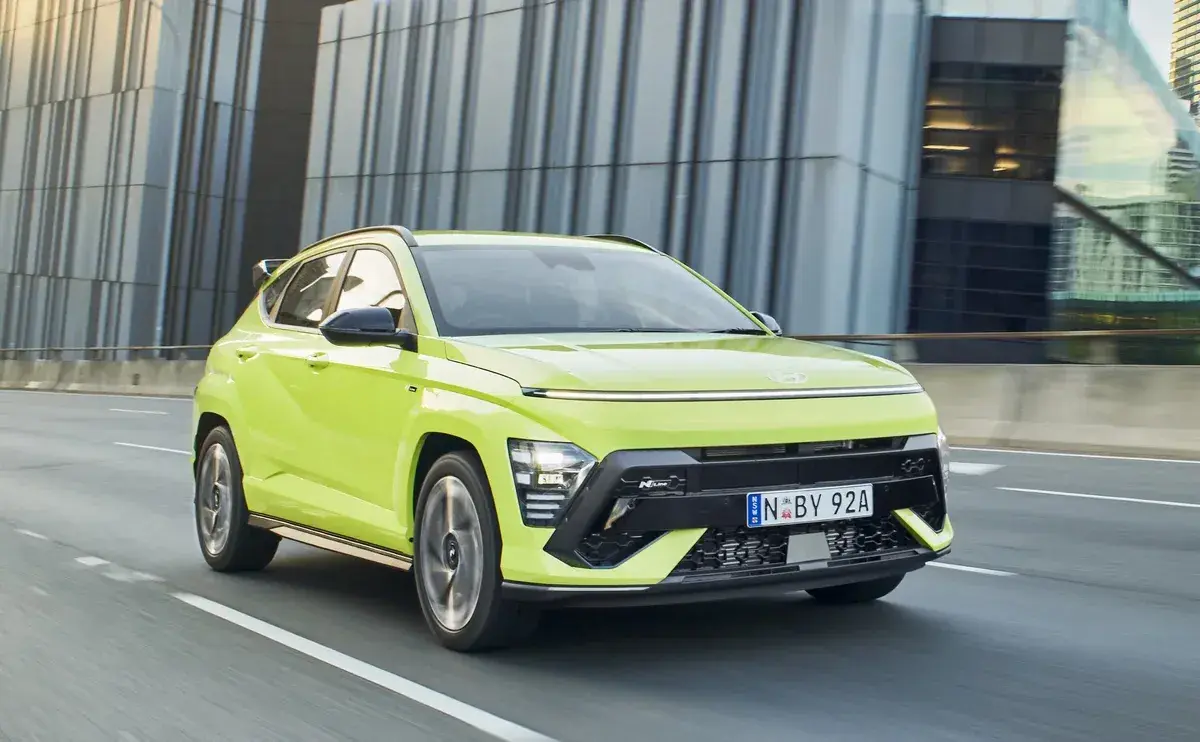
Image credit: Hyundai Australia
Safety recall at a glance
- Vehicle: Hyundai Kona (SX2) 2025-2026, petrol, hybrid and electric
- Vehicles affected: 14,551 in Australia
- Defect: rear centre seat belt buckle anchor did not meet specifications
- Hazard: rear middle seat belt may not operate as intended, increasing injury risk in a crash
- Interim action: avoid using the rear centre seat until the repair is complete
- Remedy: free buckle replacement at any authorised Hyundai dealer
- Register: REC-006734 on vehiclerecalls.gov.au, Hyundai campaign 61D282, published 28 September 2026
- Hyundai Customer Care: 1800 186 306
Hyundai Australia has pulled 14,551 current-generation Konas back in on a rear seat belt defect, and the first thing an affected owner should do this week is stop using the middle seat in the back. The recall covers the SX2 Kona built across the 2025 and 2026 model years, which captures the petrol, the hybrid and the fully electric cars sold since the current body landed here in 2023. If you bought a new or near-new Kona in the last 18 months, the VIN check is a five-minute job and the fix itself is free.
The defect sits in the anchor that bolts the rear centre seat belt buckle to the seat frame. Hyundai discovered during internal testing that a batch of those anchors did not meet specification. In a crash, an under-spec anchor can let the buckle move or fail, and a buckle that lets go of its tongue is no longer a seat belt. The register's wording is deliberately plain: in the event of an accident, a seat belt not operating as intended could increase the risk of injury or death. That is a hazard statement, not a theatrical one.
What is actually wrong
The rear centre seat belt in the Kona is the three-point lap-and-sash belt for the middle rear passenger. It feeds from the headliner, drops down the back of the seat and latches into a buckle that sits on a short stalk anchored to the seat pan. The stalk is where the problem is. The anchor at its base, the fitting that bolts the stalk to the frame, did not clear Hyundai's own strength tests on a defined batch of production.
That matters because the anchor is the point the whole belt pulls against in a collision. A seat belt only works if it holds a human against the seat as the car decelerates. If the anchor flexes, deforms or breaks, the buckle moves with the occupant rather than restraining them, and the belt loses its job. The front and outboard rear belts are not affected by this notice, and neither are the airbags, pre-tensioners or the car's structural crash performance. This is specifically the centre buckle anchor on the rear bench.
Hyundai identified the issue in its own testing rather than from a field incident. There is no customer complaint reference, no reported injury and no crash where the defect contributed to an outcome. That is how the modern recall framework is designed to work: a manufacturer finding a parts-tolerance problem on the production line and pulling the affected build range before the risk shows up on the road.
Which Konas are on the list
| Model | Powertrain | Build generation | Model years in scope |
|---|---|---|---|
| Hyundai Kona 2.0 FWD / N Line / Premium | 2.0L petrol, CVT, front-wheel drive | SX2 | 2025 and 2026 |
| Hyundai Kona 1.6T AWD / N Line / Premium | 1.6L turbo petrol, 8-speed DCT, all-wheel drive | SX2 | 2025 and 2026 |
| Hyundai Kona Hybrid / N Line / Premium | 1.6L hybrid, 6-speed DCT, front-wheel drive | SX2 | 2025 and 2026 |
| Hyundai Kona Electric Standard / Extended / Premium | 99kW or 150kW electric, single-speed, FWD | SX2 EV | 2025 and 2026 |
Not every VIN inside those model years is on the list. The 14,551 figure is the specific count of cars Hyundai believes were fitted with anchors from the affected production batch, so the VIN lookup is the only way to be sure for a given car. Earlier generations of the Kona, the OS and OS facelift sold here from 2017 through 2023, are not in this campaign at all.
If your Kona was delivered after the Kona Electric and Ioniq 5 EOFY price drop in June, there is a reasonable chance it falls inside the window: see our Hyundai Kona Electric and Ioniq 5 EOFY cut coverage for the delivery mix that was running through dealers in mid-2026. Hyundai Australia sold roughly 10,500 Konas in the first half of 2026 across all powertrains, so a mid-teens-thousand recall footprint lines up with about 14 months of local deliveries, consistent with the SX2 production range the notice covers.
What Hyundai is telling owners to do
The register is explicit on the interim step. Until replacement parts are available and the repair is complete, avoid using the rear centre seat. The two outboard rear seat belts and both front belts are unaffected and operate normally. For a family that uses the back row for one or two child seats on the outboard positions, nothing changes day to day. For a household that routinely runs three in the back row, this is the awkward couple of weeks: either rotate someone forward, or route the oldest child to the middle outboard seat and leave the centre position empty.
Replacement parts were not yet in Australia when the notice went live on 28 September. Hyundai Motor Company Australia will write to the registered owner of every affected VIN once parts land, with a prompt to book a dealer appointment. If you have moved since you bought the car, update your address with Hyundai Customer Care on 1800 186 306 before the letter chase begins. If you bought the Kona second-hand, the first owner's address is still what Hyundai has on file, so a direct call is faster than waiting on the post.
The repair itself is a buckle replacement: the dealer removes the rear bench cushion, swaps the centre buckle stalk for a correctly-specified part, torques the anchor bolt to the service figure and refits the cushion. Typical workshop time is under an hour. No parts beyond the buckle assembly are touched, the back row trim does not need to come out and the airbag and pretensioner wiring is not disturbed. The repair is free of charge, which is standard for a manufacturer safety recall in Australia under the Australian Consumer Law.
Safety and ANCAP
The SX2 Kona was ANCAP tested in 2023 and carries a five-star rating under the 2023 protocols that applies to the Australian range. The recall does not change the ANCAP outcome. ANCAP ratings are assessed on a car that meets its own manufacturing specification, and this notice is about a batch of cars that fell outside that spec. The fix returns the recalled Konas to the specification the ANCAP test was performed against.
A side note for buyers: a current ANCAP rating remains a strong signal of baseline occupant protection, but it never guarantees that every unit off the production line is perfect, which is exactly why the recall framework exists on top of it. We cover the stars and what they actually measure in our ANCAP safety ratings explained primer.
How this fits the Kona on CarSorted
On the CarSorted directory, the current Kona lineup starts at $33,700 before on-road costs for the Kona 2.0 FWD, moves to $36,950 for the Kona Hybrid FWD and climbs to $45,990 driveaway for the Kona Electric Standard Range after the EOFY cut. That is the exact slice of the range the recall sits across, so there is no clever way to swerve the issue by buying a different grade or powertrain within the SX2 Kona. Every variant of the current car is potentially inside the campaign if the VIN is on the list.
Cross-shopped against rivals we also track, the Kona on recall still stacks up on price. The Toyota Corolla Cross Hybrid opens at $37,440 before on-roads and the GWM Haval Jolion Hybrid sits lower. The MG ZS Hybrid runs beneath both. None of those rivals is on an open seat belt campaign today, so for a shopper mid-decision this week the recall is a factor on the Kona side of the ledger. It is not a reason to walk, but it is a reason to insist the buckle fix is done before delivery on any Kona you order out of 2025 or 2026 build stock.
For a shopper deciding between the Kona Hybrid and a straight small-SUV comparison, our Hyundai Kona vs Toyota Corolla Cross page carries the running-cost maths and the equipment deltas. If you are weighing the Kona Electric against a Chinese EV in the same money, the same directory links above sit next to the best Chinese EVs for 2026 guide for the alternative view.
If you are shopping a used SX2 Kona this weekend
Three practical rules while this campaign is open. First, use the VIN check as a condition of sale. A dealer stock SX2 Kona should already be stickered as recall-cleared or at minimum have the buckle swap scheduled with a parts ETA. A private seller can read the VIN down the phone to Hyundai Customer Care on 1800 186 306 and ask for a campaign status printout against REC-006734. If the seller refuses to run the check, run it yourself before you put a deposit down. It takes under five minutes.
Second, do not pay a premium for a car with the campaign still open. A 2025 or 2026 Kona with REC-006734 outstanding is worth marginally less than the same car with the buckle already replaced, because you are inheriting the workshop time and the parts wait. Fifteen minutes of negotiation is probably worth a hundred dollars off the sticker, maybe more if parts are still delayed when you buy.
Third, run every other campaign on the VIN while you are at it. The SX2 Kona has had earlier software and compliance campaigns through 2024 and 2025 that varied by variant. A seller who has not closed the earlier ones is telling you something about how often the car has seen a Hyundai dealer, and that pattern tends to repeat.
What this means for buyers
If you already own a 2025 or 2026 Kona, this is a short interim inconvenience and a free repair, not a reason to panic. Keep the rear centre seat clear until the buckle is swapped. Phone Hyundai Customer Care on 1800 186 306 if your VIN check comes up positive and the letter has not landed. Keep the stamped dealer completion slip for your records once the work is done, because an open REC against a VIN costs you money at trade-in time.
If you are shopping new, do not take delivery of a 2025 or 2026 build Kona until the dealer has run the VIN against REC-006734 and either cleared it as unaffected or booked the buckle swap into the pre-delivery schedule. Hyundai dealers already have the campaign flag on their systems. On a car with the campaign cleared, nothing about the ownership proposition changes: the five-star ANCAP, the five-year unlimited-kilometre warranty and the eight-year high-voltage battery coverage on the Electric all stand.
If you are cross-shopping outside Hyundai, this recall is one data point, not a verdict. Every mainstream manufacturer selling in Australia has had seat belt, airbag or structural campaigns across the past five years, and the modern recall apparatus is the reason problems like this surface before an injury rather than after one. For the full cross-shop context on the Kona's rivals, our best small SUVs Australia 2026 guide is the place to start, and the CarSorted directory covers the full lineup across petrol, hybrid and electric.
More on CarSorted: Kona vs Corolla Cross | Kona Electric specs and pricing | ANCAP safety ratings explained.
Hyundai Australia contact
- Hyundai Customer Care: 1800 186 306
- Recall and VIN lookup: hyundai.com.au/owning/safety-recall-information
- Official register: REC-006734 at vehiclerecalls.gov.au/recalls/rec-006734
- Hyundai campaign number: 61D282
Disclaimer: Recall details are sourced from the ACCC product safety recall notice REC-006734 (Hyundai campaign 61D282) published on vehiclerecalls.gov.au on 28 September 2026, and from Hyundai Motor Company Australia. Vehicle counts and the affected build range are accurate at the time of publishing and may change if the campaign is extended. Pricing and specification references for the Kona range reflect current list prices on the CarSorted directory and are before on-road costs unless otherwise stated. Always confirm the campaign status of your specific vehicle with Hyundai Australia (1800 186 306) or through the official recall lookup. Read our methodology for how we source and verify recall data.