Toyota bZ4X vs Toyota RAV4 PHEV
$55,990 vs $58,840 for the front-drive entry cars. Toyota now sells two ways to plug a mid-size SUV into a wall, and the two of them disagree about almost everything that matters.
Specifications and pricing correct at time of publishing. Prices are RRP before on-road costs unless stated otherwise. Always confirm with the manufacturer or dealer before purchasing.
Toyota bZ4X 2WD
From $55,990
Mid-size SUV
Single electric motor, 74.7kWh battery
167kW
138Wh/km (WLTP)
5★ ANCAP (2025)
452L
Toyota RAV4 XSE PHEV 2WD
From $58,840 plus $675 paint
Mid-size SUV
2.5L petrol plug-in hybrid, 22.7kWh battery
201kW combined
0.7L/100km, 154km EV (NEDC)
Unrated by ANCAP
Not published
Price Breakdown
Start with the two front-drive entry cars, because that is where most of this decision actually gets made. The bZ4X 2WD is $55,990 and the RAV4 XSE PHEV 2WD is $58,840, both recommended retail before on-road costs. A $2,850 gap, and the electric car is the cheaper one, which is not how this comparison used to go.
Then read Toyota's own footnote on the RAV4. Premium paint is a $675 option across the range and it is mandatory on XSE. There is no way to order an XSE PHEV without it. So the real gap at the front door is $3,525, not $2,850, and that is before anyone has talked about running costs. To be fair to Toyota, the bZ4X has a paint charge of its own at $575 on the 2WD and AWD. The difference is that Toyota lists that one as optional and the RAV4 XSE's as mandatory.
Move up a rung and the ranges cross over, which is the genuinely interesting thing about this pairing. The bZ4X AWD is $67,990, while the RAV4 XSE PHEV AWD is $63,340, or $64,015 with the compulsory paint. At that level the plug-in hybrid is nearly four thousand dollars cheaper and quite a lot more powerful. The electric car wins the cheap end of this fight and loses the expensive end of it.
Toyota bZ4X (battery electric)
| Grade | Drive | Price (RRP) | Range |
|---|---|---|---|
| bZ4X | 2WD | $55,990 | 591km WLTP |
| bZ4X | AWD | $67,990 | 517km WLTP |
| bZ4X Touring | AWD | $69,990 | 488km WLTP |
Toyota RAV4 plug-in hybrid (2.5L, e-CVT)
| Grade | Drive | Price (RRP) | EV range |
|---|---|---|---|
| XSE PHEV | 2WD | $58,840 + $675 paint | 154km NEDC |
| XSE PHEV | AWD | $63,340 + $675 paint | 144km NEDC |
| GR Sport PHEV | AWD | $66,340 | 144km NEDC |
One thing the bZ4X range has that the RAV4 range does not is a wagon. The bZ4X Touring is a separate model rather than a trim level, 140mm longer behind the rear axle with a more upright tailgate, which takes luggage volume from 452 litres to 603 litres. It runs two 167kW motors for 280kW total and 488km WLTP. Treat it as its own car, not a bZ4X with a bigger boot badge, because the dimensions, the weight and the range all move.
Offers are the other reason the numbers above are not the numbers you pay. When Toyota announced the Touring in April it also published a $5,000 deposit bonus on the bZ4X 2WD and $7,500 on the AWD for eligible private, Bronze and demonstrator buyers financing through Toyota Finance on Oct 2025 build onwards, plus novated lease discounts of $4,200 and $6,800, plus a choice of a Chargefox voucher or a complimentary 7kW home charger through the Toyota Go loyalty program for private buyers through 2026. We have seen no equivalent campaign on the RAV4 PHEV. Deposit bonuses move constantly and that announcement is now five months old, so treat it as a reason to ask rather than a number to budget on.
Safety Rundown
This is the cleanest separation on the page and it is worth being precise about, because the two cars wear the same badge and people assume the ratings travel with it.
The bZ4X holds a five-star ANCAP rating awarded in 2025, covering all variants, for cars built from October 2025 and on sale from December 2025. The scores are 88 percent adult occupant protection, 86 percent child occupant protection, 80 percent vulnerable road user protection and 82 percent safety assist. That October 2025 build date matters: it is the upgraded bZ4X, the one with the 74.7kWh battery and the longer range, so the rating and the car in the showroom are the same thing. An older 2022 record also exists on ANCAP's register, covering November 2023 to September 2025 builds, and it reads differently again at 88, 88, 79 and 93 percent. Check which record applies to the build you are looking at rather than reading the higher safety assist score off the superseded one.
The sixth-generation RAV4 is a different situation entirely. ANCAP lists the car built from March 2026 onwards as unrated. Not a poor score, not a provisional one, no score at all. That is an explicit entry on the register with no rating year against it, not a gap in the paperwork. The previous RAV4 earned five stars in 2019 with 93, 89, 85 and 83 percent, but that record closed in December 2025 with the old car and does not transfer to the one being sold now. We will not carry it across and neither should anyone else.
| ANCAP | bZ4X | RAV4 (XA60) |
|---|---|---|
| Rating | 5 stars | Unrated |
| Rated | 2025 | No data |
| Adult occupant | 88% | No data |
| Child occupant | 86% | No data |
| Vulnerable road user | 80% | No data |
| Safety assist | 82% | No data |
| Covers builds from | Oct 2025 | Mar 2026 |
What each car actually carries is much closer than that table suggests, and it needs saying, because "unrated" gets read as "unsafe" and that is not what it means. Both fit eight airbags. On the RAV4 Toyota itemises them as front, driver's seat front centre, front side, full length curtain and driver's knee. Both run the current Toyota Safety Sense package with autonomous emergency braking including pedestrian and daylight cyclist detection, emergency steering assist, active cruise control, lane trace assist, blind spot monitor, safe exit assist, rear cross traffic alert and road sign assist. Both of our matched cars get a panoramic view monitor, which on the RAV4 side only starts at XSE. The RAV4 adds front cross traffic alert across the range and downhill assist on the all-wheel-drive grades; the bZ4X adds a driver monitor camera and, on the AWD, intelligent parking assist.
So the honest summary is that the equipment is broadly equivalent and only one of the two has been independently crash tested in its current form. If a current ANCAP star rating is a hard requirement, for a fleet policy or just for your own peace of mind, the bZ4X has one today and the RAV4 does not. Check the RAV4's ANCAP record before you sign, because that can change at any time.
Feature Showdown
Both of these are upper-middle Toyotas rather than base models, so the equipment fight is close and the differences are specific rather than sweeping.
The bZ4X 2WD runs a 14-inch touchscreen with embedded navigation, wireless Apple CarPlay and Android Auto, digital radio, a 7-inch multi information display for the driver, two wireless phone chargers, four USB-C ports, dual-zone climate with Toyota's nanoe X air treatment, rear air vents, heated front seats, an eight-way powered driver's seat, a heated steering wheel, a power tailgate with kick sensor, roof rails and a six-speaker audio system. It also has a 1500W AC inverter for vehicle-to-load, so the car will run a fridge or a coffee machine off the traction battery.
The RAV4 XSE PHEV answers with a 12.9-inch touchscreen and a 12.3-inch fully digital instrument cluster, which is the better arrangement in front of the driver, plus inbuilt navigation, wireless CarPlay and Android Auto, five USB-C ports, an embedded drive recorder that turns the car's own cameras into a dashcam, a wireless charger, heated and ventilated front seats in three stages, eight-way power for both front seats, driver's seat memory, a tilt and slide moonroof, a power tailgate, 20-inch gloss black alloys and a six-speaker system. It gets the same 1500W inverter, mounted in the cargo area, replacing the 12V outlet the hybrid grades use.
Where the bZ4X 2WD genuinely goes without: no ventilated seats, no panoramic roof, no JBL audio, no memory seat and an auto-dimming rear view mirror rather than the digital one. Those are not unknowns, they are printed against the AWD column and left blank against the 2WD in the same Toyota table, so they are verified exclusions rather than missing data. Step up to the bZ4X AWD and all of them arrive, along with nine-speaker JBL, a fixed panoramic roof and the two-tone roof, which is an option and an all-wheel-drive-only one. Toyota does not price that roof on its own. It sells it bundled into a $1,350 paint option, against $575 for paint without it, so the two-tone look is the difference between those two numbers rather than a line item you can point at.
Two small things worth knowing. Both cars carry a temporary fix rather than a spare: the bZ4X gets a tyre repair kit, the RAV4 a space saver. And the RAV4 PHEV's only mechanical differences from its hybrid twin are larger disc brakes, water repellent front side glass and that inverter, so you are paying the plug-in premium for the drivetrain and nothing else.
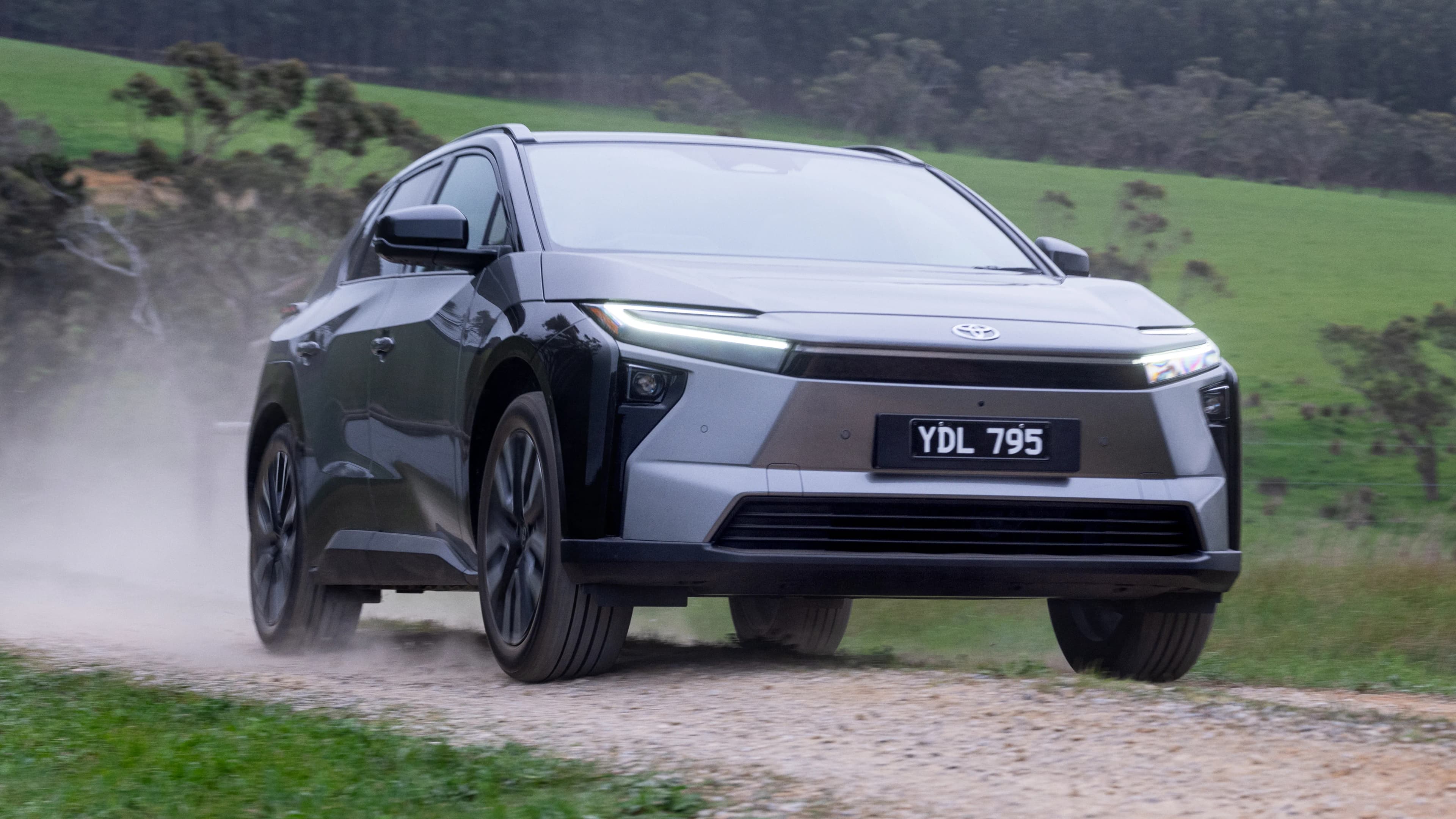
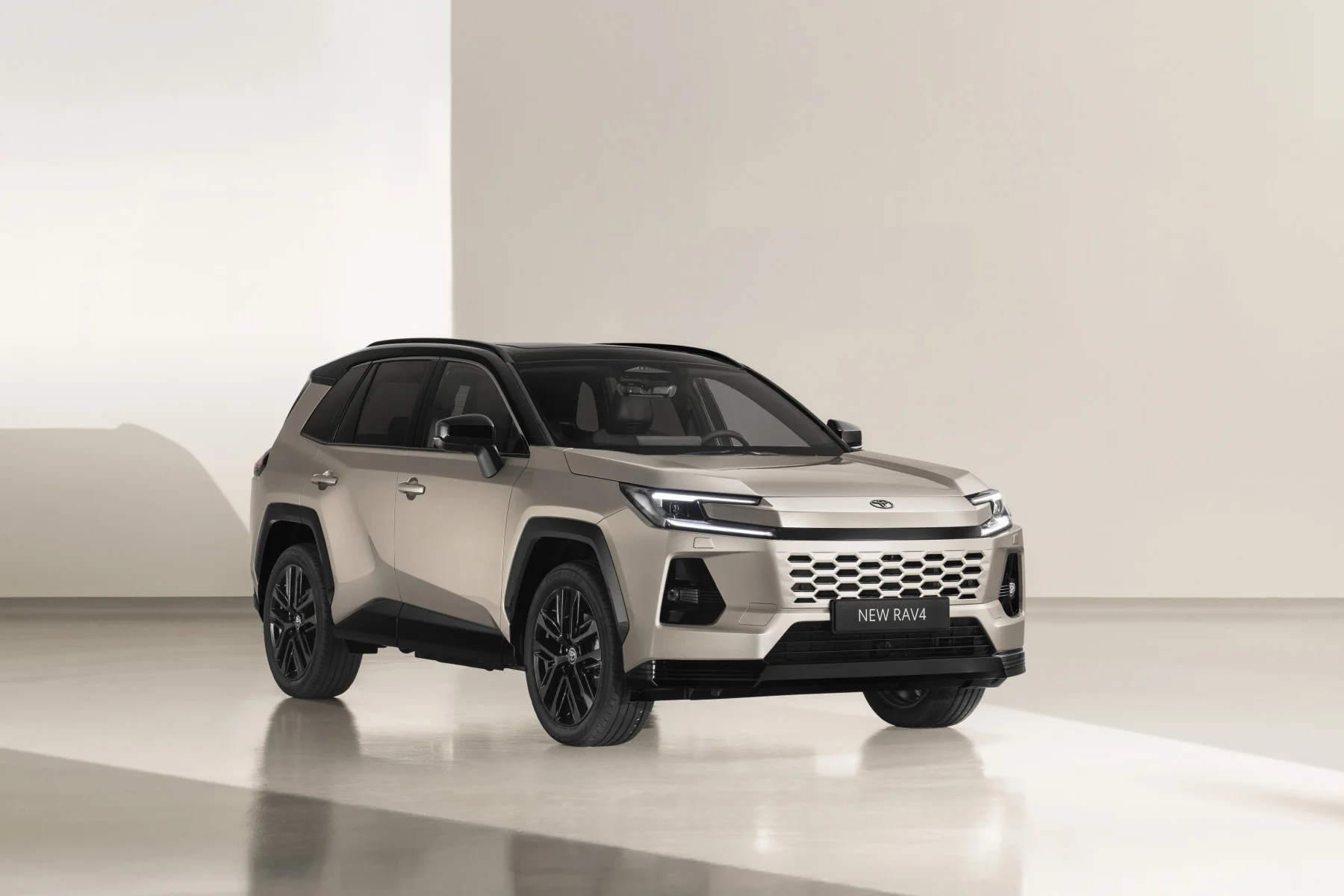
Drivetrain
Here is the part everyone gets wrong, and it is not anyone's fault, because Toyota publishes the two cars' range figures on two different test cycles and prints them the same size.
The bZ4X 2WD claims 591km on the WLTP cycle from its 74.7kWh lithium-ion battery, at 138Wh/km. The RAV4 XSE PHEV 2WD claims 154km on the NEDC cycle from 22.7kWh. Toyota labels both in its own specification tables, and the regulator's Green Vehicle Guide record for the PHEV confirms the test cycle as NEDC as well. NEDC is the older, gentler procedure and it flatters electric range against WLTP by a meaningful margin. So the honest version of "591 versus 154" is that the real-world gap is wider than the printed one, not narrower.
On power the RAV4 wins and wins clearly. The plug-in hybrid pairs a 2.5-litre naturally aspirated four with electric drive for a combined 201kW in 2WD and 227kW in AWD, which makes it the most powerful RAV4 Toyota has sold here. The bZ4X 2WD has a single 167kW front motor and 268.6Nm, good for 0 to 100km/h in 7.4 seconds. Toyota Australia does not publish a 0 to 100 time for the RAV4 PHEV in its specification table, so we are not going to print one. It also does not publish a single combined torque figure for the PHEV, listing 272Nm at the front axle and 123Nm at the rear separately, which is why any combined torque number you see quoted for this car is somebody's arithmetic rather than Toyota's.
Charging is the bZ4X's knockout punch and it is rarely discussed. The electric car takes 150kW on DC, doing 10 to 80 percent in about 45 minutes, and 22kW on three-phase AC, filling 10 to 100 percent in about three and a half hours. The RAV4 PHEV takes 50kW DC and 11kW AC. On our arithmetic against Toyota's own battery size and charger rating, its 22.7kWh pack needs a bit over two hours on an 11kW three-phase outlet. That is fine for an overnight top-up and it is not fine for a road trip, which is the point: the RAV4's answer to a long drive is the 55-litre petrol tank, not the plug.
And that is where the RAV4's headline number quietly falls apart. Its 0.7L/100km combined figure is a weighted result that assumes you start every trip with a full battery. Look at Toyota's own table and the urban and extra-urban cells for the PHEV columns read N/A, while the plain hybrid columns beside them carry real numbers. Toyota Australia publishes no figure for what the RAV4 PHEV uses once the battery is flat and it is running as an ordinary 2.5-litre hybrid on 95 RON premium. Nobody can tell you that number from an Australian manufacturer source, so nobody should pretend to.
What we can cost honestly is electricity. At 15,000km a year and 32 cents a kilowatt-hour, the bZ4X's 138Wh/km works out to about $662. Driving the RAV4 PHEV entirely on its battery, at the 184Wh/km the Green Vehicle Guide certifies, comes to about $883 for the same distance, before a drop of petrol. That is our arithmetic on their numbers, and it is the RAV4 paying for a heavier car dragging a petrol engine around. Our range estimator will do the same sum against your own commute and tariff.
Space & Comfort
On paper the bZ4X is the longer, lower, longer-wheelbase car and the RAV4 is the taller, boxier one. In practice that means the Toyota EV is better in the back seat and the Toyota SUV is better at everything involving a tailgate.
| Dimension | bZ4X | RAV4 |
|---|---|---|
| Length | 4,690mm | 4,600 to 4,645mm |
| Width | 1,860mm | 1,855 to 1,880mm |
| Height | 1,650mm | 1,680 to 1,685mm |
| Wheelbase | 2,850mm | 2,690mm |
| Boot, seats up | 452L | Not published |
| Ground clearance | 212mm | Not published |
| Kerb weight | 1,905kg | Not published |
| Fuel tank | None | 55L |
| Braked towing | 750kg maximum | 800kg |
160mm of extra wheelbase is the number that matters most here, because that is where rear legroom comes from, and it is a big gap in a class where 60mm is usually the argument. The bZ4X is also the longer car overall. The RAV4 is taller and, in its widest grades, fractionally wider, and it has a conventional upright tailgate where the bZ4X has a raked one.
On luggage we have to be blunt about an absence. Toyota publishes 452 litres for the bZ4X and 603 litres for the Touring wagon. For the sixth-generation RAV4 it publishes nothing. The current Australian specification table lists towing, seating and fuel tank capacity under weights and capacities and stops there. No boot volume, no kerb weight, no gross vehicle mass, no ground clearance. On a family SUV those are four of the numbers people shop on, and we would rather tell you they are missing than convert one from an overseas brochure or carry one over from the previous car.
Towing is a draw and neither car is the answer. Toyota rates the bZ4X 2WD at 750kg maximum and the RAV4 PHEV 2WD at 800kg braked. Go to all-wheel drive and both rise to 1,500kg braked, with 750kg unbraked. Neither specification table publishes a tow ball download limit, which is the figure that usually decides whether a caravan is actually on, so get it from the owner's manual and run the numbers through our towing and payload calculator before you commit to a trailer.
One practical note on parking. Toyota quotes a 5.6m minimum turning radius on tyre for the bZ4X and a 5.68m "kerb to kerb" figure for the RAV4, which at that size can only be a radius as well. Doubled, that is roughly 11.2m against 11.4m. The longer car is the easier one to turn around, which is the sort of thing you only find by reading the footnotes.
True Cost to Own
Same brand, same dealer network, same five-year warranty, and yet the ownership terms are meaningfully different. This is the section that decides the comparison for a lot of people and almost nobody reads it.
Both cars get Toyota's standard five years and unlimited kilometres, with engine and driveline extending to seven years if you keep logbook servicing at a Toyota dealership, and Toyota Emergency Assistance running five years and extending to seven on the same condition. Both also qualify for Toyota's traction battery cover, which starts at five years and extends a year at a time up to 10 years with an annual battery health check and routine logbook maintenance at a Toyota dealer. Toyota is explicit that this one covers hybrids, plug-in hybrids and battery electrics alike.
The split is the second battery warranty, and it is the one worth knowing about. Toyota separately offers eight years or 160,000km of cover against the traction battery's energy storage capacity falling below 70 percent of original, and its own warranty page states in terms that this battery warranty is applicable to battery electric vehicles, naming the bZ4X, only. The RAV4 PHEV does not get it. So on the expensive part, the electric car has a degradation guarantee and the plug-in hybrid has a component warranty, and those are not the same promise.
| Cover | bZ4X | RAV4 PHEV |
|---|---|---|
| Vehicle | 5yr / unlimited km | 5yr / unlimited km |
| Engine and driveline | 7yr, Toyota servicing required | 7yr, Toyota servicing required |
| Traction battery component | 5yr, to 10yr with annual health check | 5yr, to 10yr with annual health check |
| Battery capacity below 70% | 8yr / 160,000km | Not offered (BEV only) |
| Roadside | 5yr, 7yr if serviced to the book | 5yr, 7yr if serviced to the book |
The word doing the work in every row of that table is conditional. The seven-year driveline extension, the ten-year battery cover and the seven-year roadside all depend on servicing at a Toyota dealer to the book. Skip a logbook service at an independent and you are back to five years on everything. That is Toyota's bargain and it has been for years, and it is a reasonable one, but it should be priced in rather than assumed.
Then there is tax, which on these two cars is worth more than most of the equipment differences combined. A battery electric car under the luxury car tax fuel-efficient threshold is exempt from fringe benefits tax on a novated lease. Both bZ4X grades sit well under it. Plug-in hybrids lost that exemption for cars first held on or after 1 April 2025, so a RAV4 PHEV ordered today does not get it. If you are buying through salary packaging, that single line is worth several thousand dollars a year and it points one way. Current as of 23 September 2026; the electric car exemption itself narrows from 1 April 2027, so confirm the position for your own arrangement before you commit.
Servicing is the one place our evidence is thinner, and we will say so. Both rows in our database carry a 12-month or 15,000km interval and neither Toyota specification table we sourced for this comparison contains a servicing block at all, so confirm it against the service book rather than budgeting from this page. Resale is the other unknown and it runs the RAV4's way: the RAV4 is Australia's best selling SUV and used demand reflects that, while electric resale across the market is still finding its level. Our depreciation calculator is the quickest way to see what different retained-value assumptions do to each one over five years.
CarSorted Data Insight
Pull both ranges out of our database and the shape of this is clearer than any single pairing. Toyota sells three bZ4X variants from $55,990 to $69,990 and three RAV4 plug-in hybrids from $58,840 to $66,340, sitting inside an eleven-variant RAV4 range that starts at $45,990 for the plain hybrid. The two electrified ranges overlap almost exactly, and the one that is cheaper depends entirely on whether you want all-wheel drive.
The most useful thing we found is not on any spec comparison. Toyota prints the bZ4X's range as WLTP and the RAV4 PHEV's as NEDC, in the same typeface, in documents published five weeks apart. Almost every comparison of these two cars you will read puts 591 and 154 in adjacent columns as though they were measured the same way. They were not. The Green Vehicle Guide record for the RAV4 PHEV confirms the cycle as NEDC and certifies its energy use at 184Wh/km against Toyota's 138Wh/km WLTP for the bZ4X, which is the honest efficiency comparison and it is a bigger gap than the range figures imply.
The second thing is an absence that keeps recurring. Toyota Australia's current RAV4 specification table publishes no boot volume, no kerb weight, no gross vehicle mass, no ground clearance, no 0 to 100 time and no urban or extra-urban fuel figure for the plug-in hybrid. The bZ4X document publishes every one of those. Two cars, one brand, one market, and only one of them can be fully compared on the manufacturer's own numbers. We would rather flag that than fill the gaps in from somewhere else.
The Verdict
Buy the Toyota bZ4X if: you can charge at home, you want a current five-star ANCAP rating rather than a pending one, you care about charging speed on the odd long trip, you want the eight-year degradation guarantee on the battery, you are buying through a novated lease and want the FBT exemption, or you regularly carry adults in the back and want the 160mm of extra wheelbase. The 2WD at $55,990 is the value in the range, and the AWD at $67,990 is a lot of money next to what the RAV4 asks for all-wheel drive.
Buy the Toyota RAV4 PHEV if: you cannot charge where you park, one car has to do both the commute and the long weekend, you want the 201kW or 227kW rather than 167kW, you want all-wheel drive without paying $67,990 for it, or resale is a big part of your five-year maths. The XSE PHEV AWD at $63,340 is the grade that makes the strongest case against the bZ4X, and the GR Sport at $66,340 is the one to drive if you want the RAV4 to feel like something other than appliance transport.
If it were our money and there was a power point at the end of the driveway, we would take the bZ4X 2WD and spend the difference on a home charger. If there was not, we would take the RAV4 PHEV without hesitating, because a plug-in hybrid that never gets plugged in is still a perfectly good hybrid, and an electric car that cannot be charged at home is a daily negotiation. The frustrating part of this comparison is that the one piece of evidence that would settle the safety question, a current ANCAP result for the new RAV4, does not exist yet.
Compare both on CarSorted. See also: EV3 vs bZ4X | bZ4X vs Zeekr 7X | Sportage vs RAV4 | Sealion 6 vs Outlander PHEV. More from Toyota.
The Verdict
If you can charge at home, the bZ4X wins this on Toyota's own published numbers and it is not particularly close. It is $2,850 cheaper before you add the $675 of paint the RAV4 XSE cannot be ordered without, it holds a current five-star ANCAP rating where the new RAV4 holds no rating at all, it charges three times faster on DC and twice as fast on AC, it quotes a real boot figure where Toyota quotes none for the RAV4, it carries 160mm more wheelbase, and it is the only one of the two that gets Toyota's eight-year, 160,000km guarantee against the battery dropping below 70 percent of capacity. It is also still FBT exempt on a novated lease, which the plug-in hybrid stopped being in April 2025. The RAV4 PHEV's case is narrower and it is completely legitimate: 201kW against 167kW, a 55-litre petrol tank so a flat battery is an inconvenience rather than a problem, and an all-wheel-drive version that undercuts the bZ4X AWD by nearly four thousand dollars. Buy the bZ4X if you have a driveway and a power point. Buy the RAV4 PHEV if you do not, or if one car has to do the school run and the Easter drive to Bright.
Prices on this page move. Want the next verdict?
One short email when prices shift or a new comparison lands. No spam, unsubscribe anytime.
Disclaimer: All information in this comparison was believed to be correct at the time of publishing (23 September 2026). Prices are manufacturer recommended retail prices (RRP) and may vary by state, dealer, and options. Driveaway costs include estimated on-road costs for Victoria. Fuel economy figures are WLTP/ADR combined cycle. Specifications can change without notice. Always verify with the manufacturer before making a purchase decision. CarSorted does not accept payment for recommendations.
Published by CarSorted Editorial Team · 23 September 2026
Comments (0)
Sign in to join the conversation
No comments yet. Be the first!