Key Takeaways
- One variant, advertised from $50K drive-away, open to private buyers as well as business customers (Ford's conditions are below)
- 110kW / 260Nm, front-wheel drive, 56kWh LFP battery, 254km WLTP combined and 380km WLTP city
- 1,085kg payload, 6.4 cubic metres maximum load volume, three Euro pallets, one sliding side door
- No towing allowance: Ford lists the gross combination mass at the same 3,000kg as the gross vehicle mass
- A one-tonne-plus payload puts it outside the ATO's electric car FBT exemption (general information, October 2026)
- Top speed 120km/h, no charging cable in the box, and no ANCAP rating that we hold
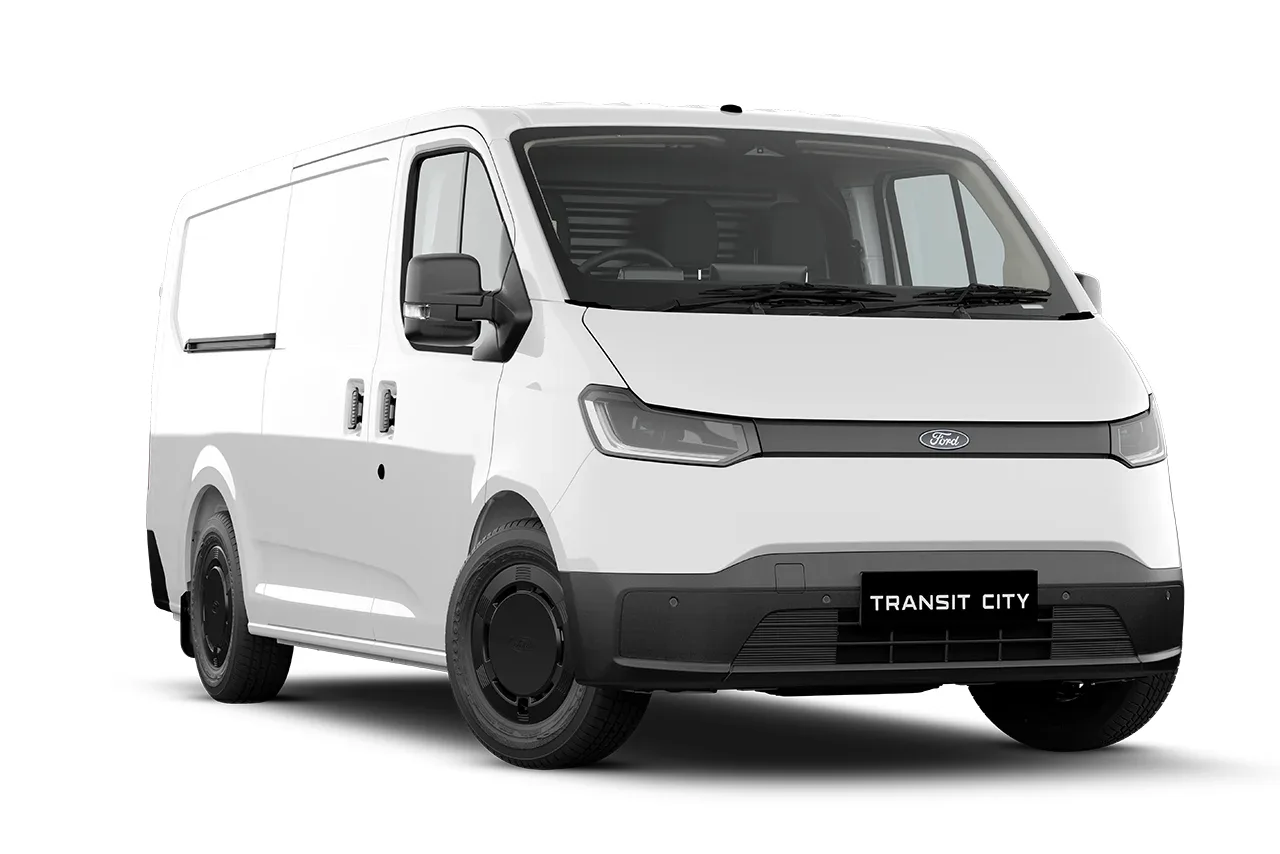
Image credit: Ford Australia. Overseas model shown; Ford says the Australian van will be right-hand drive.
Ford Australia has put a number on its smallest electric van, and it is a number built to be remembered: the Transit City is advertised from $50K drive-away. It is a single-variant, front-wheel drive, one-tonne van with a 56kWh lithium iron phosphate battery, 254km of WLTP combined range and a 6.4 cubic metre load space, and it slots in underneath the Transit Custom as the entry point to Ford's van range.
On paper that is a sharp price for a Ford-badged van. It is also a van with some very deliberate limits, and the price only makes sense once you know what they are. The range is modest, it cannot tow, it tops out at 120km/h, and the payload that makes it genuinely useful is the same thing that keeps it out of the electric car tax exemption most people assume every EV gets. Here is how it actually stacks up for someone who has to buy one and make it pay.
Pricing
There is one variant and one powertrain, so this is a short table. The price is the one thing here that is not a plain list price, so read the conditions under it.
| Variant | Drive | Power / torque | Price (drive-away) |
|---|---|---|---|
| Battery electric | |||
| Transit City (MY27, 56kWh) | Front-wheel drive | 110kW / 260Nm | From $50K |
| Options: Ingot Silver, Blue Panther and Panther Black paint, listed by Ford as factory options at additional cost. Frozen White is standard. | |||
Ford's fine print matters here. It describes the figure as the recommended drive-away price for the Transit City MY27 at participating dealers, while stocks last, available to private buyers and to its Blue, Silver, Gold and demonstrator customer categories, and it reserves the right to vary the offer at any time. Two things follow. You do not need an ABN to get it, because private buyers are named. And it is an offer, not a permanent list price, so if you are budgeting for a van next year, get the number in writing when you order. Ford has not published a separate before-on-roads list price. The colour option price has been reported at $790, but Ford's own documents only say "additional cost".
What $50,000 Actually Buys
This is a working van, specified like one. From Ford's specification sheet for the 2027 model year:
- 110kW and 260Nm front motor, one-pedal driving, Normal, Eco and Slippery drive modes, a 120km/h top speed
- 16-inch steel wheels with covers on 215/65 R16C commercial tyres, disc brakes all round
- Three seats (a six-way manual, heated driver's seat and fixed dual front passenger seats), cloth trim
- 12.3-inch touchscreen with Apple CarPlay and Android Auto, a 7-inch digital instrument cluster, DAB+ radio and two speakers
- Adaptive cruise with stop and go, autonomous emergency braking, lane keeping aid, intelligent speed assistance, driver impairment monitor, front and rear parking sensors and a rear-view camera
- Halogen headlights and tail-lights with LED daytime running lights
- A metal bulkhead without a window, eight tie-down loops, a load-area light, a kerbside sliding door and rear barn doors
Ford's sheet lists two airbags, for the driver and the front passenger. It does not list keyless entry, only keyless start, and it makes no mention of vehicle-to-load power outlets. If you were hoping to run site tools off the battery, that is not something Ford has said this van can do.
The Load Space, in Numbers That Matter
Ford quotes a 1,085kg payload, which is its 3,000kg gross vehicle mass less a 1,915kg kerb weight. The battery sits under the floor, so it does not eat into the cargo area. The detail that is easy to miss is how the volume is measured.
| Cargo spec (Ford) | Transit City |
|---|---|
| Maximum load volume (fine-grained fill method) | 6.4 cubic metres |
| Load volume (VDA block method) | 5.75 cubic metres |
| Load length to bulkhead / with load-through hatch | 2,620mm / 2,770mm |
| Width between wheel arches | 1,300mm |
| Floor to roof | 1,468mm |
| Side door opening (width x height) | 960 x 1,278mm |
| Rear door opening (width x height) | 1,445 x 1,235mm |
| Euro pallets (1,200 x 800mm) | 3 |
Ford explains that its headline 6.4 cubic metre figure is measured by filling the load space with a fine-grained material such as sand or rice, while the VDA figure of 5.75 cubic metres counts rectangular blocks. Boxes behave like blocks, not like sand. So when you line the Transit City up against another van's cargo number, check which method that brand used before you decide one is bigger. Ford also notes that its load area protection kit can reduce the usable dimensions.
Outside, it is 4,985mm long, 1,885mm wide without mirrors and 1,991mm high at kerb weight on a 3,060mm wheelbase, with a 12.6m kerb-to-kerb turning circle. Ford pitches it as a van that fits in multi-level car parks. At just under two metres tall, it will clear a 2.1m height bar with room to spare unladen, but a roof rack or ladder rack changes that sum, so measure before you fit one.
It Cannot Tow, and That Is Not a Typo
Ford's specification sheet lists the Transit City's gross combination mass at 3,000kg, exactly the same as its gross vehicle mass. Gross combination mass is the most the van and anything it pulls may weigh together, so when it equals the van's own maximum there is nothing left over for a trailer. Ford publishes no towing capacity for it.
That is a real line in the sand for trades who hitch up a box trailer or a mower trailer a few times a month. The diesel Transit Custom is listed on CarSorted at 2,800kg braked, and among the electric vans, we list the LDV eDeliver 5 and eDeliver 7 at 1,500kg. If a trailer is part of your week, this is not your van, however good the price looks. If you are working out what a trailer would do to a different van's payload, our TowingSorted planner does the sum.
Range and Charging: Enough for a Delivery Round, Not for a Road Trip
| Battery and charging (Ford) | Transit City |
|---|---|
| Battery | 56kWh usable, LFP |
| Range, WLTP combined / city | 254km / 380km |
| Energy use, WLTP combined / city | 238Wh/km / 159Wh/km |
| DC peak, and 10 to 80 per cent | 87kW, about 33 minutes |
| AC 7.4kW, 10 to 100 per cent | About 8 hours |
| AC 11kW, 10 to 100 per cent | About 5.5 hours |
The 254km combined figure is the one to plan around. The 380km city figure is real, but it comes from the low and medium speed parts of the test only, and Ford's own disclosure says the WLTP runs are done at 23 degrees with no climate or electrical load. A van with a tonne in the back, the air-conditioning on and a stretch of motorway in the day will see less than either number. Ford has not published a laden range.
Ford's argument is that most urban vans do not need more. Ford Pro has been reported as saying that, from the data of more than 2,000 Australian Transit Custom customers, up to 90 per cent drove less than an average of 76km a day. If that is your van, the battery is plenty and an overnight charge covers the day. If your round involves a regional leg, or a 120km/h stretch of highway, the numbers get tight fast, and the 120km/h top speed is a hard limit in its own right.
Two practical notes from Ford's fine print. First, the van does not come with a charging cable; Ford says it is sold separately, so budget for one, and for a home or depot wallbox if you do not already have one. Second, the running cost sum is simple enough to do yourself: at Ford's combined figure of 238Wh/km, 100km uses about 23.8kWh. On an illustrative home tariff of 30 cents a kWh that is about $7.14 per 100km before charging losses, and your own tariff decides the real number. Ford's reported service interval is 12 months or 30,000km.
The Tax Position: Why the Payload Changes It
This is the part that is easy to get wrong. The fringe benefits tax exemption that makes an electric car so cheap on a novated lease only applies to a zero or low emissions vehicle that is, in the ATO's words, "a car designed to carry a load of less than one tonne". Ford quotes the Transit City's payload at 1,085kg. On the face of it, that puts the van outside the electric car exemption, as at October 2026.
That does not mean a business will pay FBT on it. Work vans are treated under different rules, and a van used mainly for work, with limited private use, can be exempt on other grounds. But it does mean the Transit City is not a novated-lease EV bargain for someone who wants a cheap electric runabout that happens to be a van. Talk to your accountant before you assume either way. This is general information, not tax advice.
Luxury car tax is not a factor at this money. For the 2026-27 financial year the thresholds are $80,809, and $91,661 for fuel-efficient vehicles, and $50,000 is well under both.
How It Stacks Up Against the Vans We List
We do not hold a Transit City row yet, so it is not in the comparison below. What is in it are the electric vans it sits beside and the two diesels it will be cross-shopped against. Tap any two.
Pick two
The vans a Transit City buyer is weighing
Four electric vans and two diesels, all on sale now. Tap any two.
| Spec | LDV eDeliver 5 SWB | Farizon V7E |
|---|---|---|
| Price from | $47,990drive-away, not an RRP | $49,990drive-away, not an RRP |
| Driving range | 335 km | 329 km |
| Braked towing | 1,500 kg | No data |
| Payload | 1,200 kg | 1,338 kg |
| Fuel use | N/Abattery electric, no fuel figure | N/Abattery electric, no fuel figure |
| ANCAP | No data | No data |
| Warranty | 5 yr160k km | 5 yr200k km |
Prices shown are each van's listed price and are not all on the same basis: some are drive-away, some are before on-road costs. Range is the WLTP figure where the van has a plug. The Transit City will be added once we hold a verified row for it. Figures come from our car database, which is built from Australian manufacturer documents. A blank field reads “No data” rather than a zero or a dash.
Against the other electric vans, the Transit City's case is price and badge, not range. On the figures we list, the LDV eDeliver 5 SWB offers 335km WLTP and 1,200kg of payload, the Farizon V7E 329km and 1,338kg, and the LDV eDeliver 7 362km and 1,205kg. The Kia PV5 Cargo goes further again, at 416km WLTP, from a checked $55,990 before on-road costs. All four carry more range than the Transit City's 254km. The eDeliver 5 SWB has been reported at $47,990 drive-away for ABN holders and the V7E at $49,990 drive-away, so the Transit City does not undercut that pair on price. It sits alongside them, with less range, and asks you to value the Ford dealer network and the badge.
Against the diesels, the comparison is more flattering. The Toyota HiAce LWB Van auto is $53,880 and the Hyundai Staria-Load Van is $49,990, both checked, and both before on-road costs. The Transit City's $50K is drive-away. So a Transit City on the road costs less than a HiAce before you have paid its rego and stamp duty, with a payload in the same ballpark (we list the HiAce at 1,060kg and the Staria-Load at 1,072kg). What you give up is towing, range and the refuel-in-five-minutes flexibility. The Transit Custom diesel above it carries more (1,336kg on our figures) and tows 2,800kg, which is exactly the gap Ford is using to separate the two vans. Ford's bigger e-Transit is a different class of vehicle altogether.
What Ford Has Not Told Us Yet
- A delivery date. First deliveries in November 2026 have been widely reported, but Ford's model page and specification sheet do not give one.
- Where it is built. The van has been reported as built in China by Ford's joint-venture partner JMC. Ford's Australian pages say only that an overseas vehicle is shown and that the final production model will be right-hand drive.
- The battery warranty. An eight-year, 160,000km high-voltage battery warranty has been reported. The Ford pages we checked cover only the whole-vehicle warranty: five years with unlimited kilometres, rising to seven if the van is serviced on schedule and only at Ford dealers.
- An ANCAP rating. We hold none and Ford has not published one.
- A towing figure, a laden range or a vehicle-to-load outlet. None appears in Ford's documents.
Who It Suits, and Who Should Look Elsewhere
The Transit City makes the most sense for a courier, florist, cleaner, caterer or small trade business running a metro round of a known length, parking at a depot or at home overnight, carrying close to a tonne of stock rather than towing it. For that buyer the maths is straightforward: a Ford dealer network for servicing, a drive-away price that undercuts the diesel HiAce on the road, a payload that matches it, and electricity instead of diesel. Small operators in particular get the same advertised price as private buyers, which is not always how van pricing works.
It is the wrong van if you tow anything, if your days regularly run past about 200km, if a regional highway is part of the job, or if you were counting on a novated-lease EV discount. And if range per dollar is the priority, the PV5 Cargo, eDeliver 5 and V7E all go further on the WLTP cycle, and are worth pricing side by side before you sign.
We will add the Transit City to the CarSorted directory once Ford confirms the details still missing, and it will appear in the comparison above from then on.
Disclaimer: Price, outputs, dimensions, masses, range, charging and equipment are taken from Ford Australia's Transit City model page and its 2027MY Transit City specification sheet (issue date 8 September 2026), both checked on 1 October 2026. The price is Ford's advertised recommended drive-away price for the MY27 Transit City at participating dealers while stocks last, available to the customer types Ford names, and Ford may vary it at any time. Delivery timing, country of build, the battery warranty, the service interval, the paint option price and Ford Pro's customer data are as reported by Australian motoring media and were not on the Ford pages we checked. Range figures are WLTP test results and real-world range will vary. The FBT and luxury car tax information reflects the ATO's published position and the 2026-27 thresholds as at October 2026; it is general information, not tax advice. Rival prices and specifications are the ones listed on CarSorted at the time of writing. Confirm price, specification and availability with a Ford dealer before ordering.