Key Takeaways
- Two electric vans, Liftback and Twin Swing, both listed by Hyundai at $70,989.99, with an estimated drive-away price of $76,972.20
- That is $21,000 more than the diesel Staria Load at $49,990 and $17,500 more than the hybrid at $53,490 (list prices)
- 84kWh, 160kW and 350Nm, front-wheel drive, 450km WLTP, about 20 minutes from 10 to 80 per cent on a 350kW charger
- 1,005kg payload and 2,000kg braked towing. The hybrid, by Hyundai's own sheet, is not rated to tow at all
- Not ANCAP rated. The Staria-Load's rating covers the automatic diesel and hybrid only
- Registered ABN holders get a $2,000 bonus off the drive-away price on vans purchased and delivered by 31 December 2026
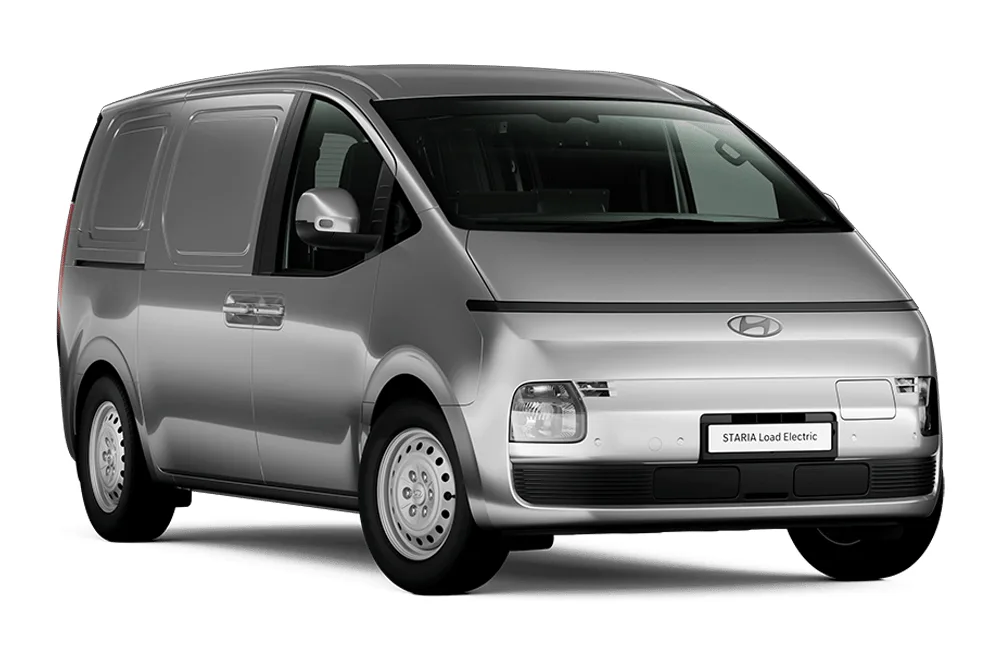
Image credit: Hyundai Australia. Shown in Shimmering Silver, a $750 option.
Hyundai Australia has put a price on the electric Staria Load, and with it the van range now comes three ways: diesel, hybrid and battery electric. The electric van is sold in one grade with a choice of two rear doors, a top-hinged Liftback or side-hinged Twin Swing barn doors, and Hyundai's online price calculator lists both at $70,989.99. Launch reports round that to $70,990 before on-road costs. The calculator's estimated drive-away figure is $76,972.20.
On paper it is a strong van. It has more WLTP range than any electric van we currently list as on sale with a published figure, a payload just over a tonne, and it tows two tonnes, which a lot of electric vans do not. It is also $21,000 dearer than the diesel it shares a body with, it has no ANCAP rating yet, and the tax break that makes electric cars cheap on a novated lease probably does not apply to it. Which of those matters depends entirely on how you use a van, so here is how it stacks up.
Pricing
Grouped by powertrain. List prices are the figures Hyundai's own price calculator returns, before any offer. There is no Premium grade of the electric van, and the five-seat Crew Van no longer appears in Hyundai's calculator.
| Variant | Rear door | Power / torque | List price |
|---|---|---|---|
| Battery electric, 84kWh, front-wheel drive | |||
| Staria Load Electric Van | Liftback | 160kW / 350Nm | $70,989.99 |
| Staria Load Electric Van | Twin Swing | 160kW / 350Nm | $70,989.99 |
| Hybrid, 1.6 turbo petrol, six-speed automatic | |||
| Staria Load Hybrid Van | Liftback or Twin Swing | 132.4kW / 265Nm (engine) | $53,490 |
| Staria Load Hybrid Premium | Liftback | 132.4kW / 265Nm (engine) | $61,240 |
| Diesel, 2.2 turbo, eight-speed automatic | |||
| Staria Load Van | Liftback or Twin Swing | 130kW / 430Nm | $49,990 |
The offers are where the gap widens. From 1 October to 31 December 2026, Hyundai is advertising the diesel van at $52,990 drive-away and the hybrid van at $55,990 drive-away on new stock at participating dealers, not for fleet, government or rental buyers and not with other offers. The electric van has no drive-away offer. What it does get, along with the rest of the range, is a $2,000 (including GST) ABN bonus for registered ABN holders, deducted from the drive-away price on new and demo stock purchased and delivered in the same window. Set Hyundai's $76,972.20 electric drive-away estimate against the $52,990 diesel offer and the real gap on the day is closer to $24,000 than $21,000.
What the Money Buys
Hyundai Australia's September 2026 specification sheet gives the electric van its own section, and the figures that matter for a working van are these:
| Spec | Electric | Diesel |
|---|---|---|
| Power / torque | 160kW / 350Nm | 130kW / 430Nm |
| Battery / fuel tank | 84kWh lithium-ion | 75L |
| Range / consumption | 450km WLTP, 207Wh/km | 7.0L/100km combined |
| Payload | 1,005kg | 997kg |
| Gross vehicle mass | 3,350kg | 3,060kg |
| Kerb weight | 2,268kg to 2,345kg | 2,009kg to 2,063kg |
| Braked / unbraked towing | 2,000kg / 750kg | 2,500kg / 750kg |
| Cargo space (VDA) | 4,935L | 4,935L |
| Cargo length / width / height | 2,607 / 1,640 / 1,436mm | 2,607 / 1,640 / 1,436mm |
| Rear suspension | Multi-link | Rigid axle, leaf springs |
The headline is that Hyundai has not traded load capacity for the battery. The electric van weighs around 260kg to 280kg more than the diesel, but its gross vehicle mass is 290kg higher, so the payload ends up slightly above the diesel's. The cargo box is identical: the same 2,607mm floor, the same 1,640mm width, with 1,254mm between the wheel housings, and the same 4,935L. You also get a 23.9L tub under the bonnet, which is the right size for charging cables and not much else, and a full-size steel spare.
The rear suspension is a genuine change rather than a detail. The diesel and hybrid ride on a rigid axle with leaf springs; the electric van has a multi-link rear end. We have not driven it, so we will not guess how it rides. It is simply worth knowing it is not the same van underneath.
Equipment starts from the base van, which already has the 12.3-inch touchscreen with wireless and wired Apple CarPlay and Android Auto. Like the hybrid, the electric van gets single-zone automatic climate control in place of the diesel's manual air. Over the base diesel and hybrid it adds built-in sat nav, a 12.3-inch digital instrument cluster, Smart Cruise Control 2 with stop and go in place of the base van's Smart Cruise Control, the upgraded Lane Following Assist 2, and paddles to set the regenerative braking. It keeps halogen headlights and bulb tail lights, and it misses the surround-view camera and blind-spot view monitor that the Hybrid Premium gets. The vehicle-to-load outlet is inside the cabin, a domestic three-pin socket rated at 250V and 16A, which is the most practical thing on the list for anyone who runs power tools off the van.
Range, Charging and Where 450km Comes From
The 450km figure is a WLTP laboratory number for an empty van, and Hyundai quotes combined energy use of 207Wh/km, or 20.7kWh per 100km. A tonne in the back, a steady 100km/h on the highway, or a trailer will all cut into it. Of the 20 electric vans we list as on sale, the closest on WLTP range is the Mercedes-Benz eSprinter with the 113kWh battery at 440km, a much larger and much dearer van, so 450km is the highest figure among them. One of the 20, the eVito panel van, has no WLTP figure in our listing, so that comparison covers 19.
Charging times from Hyundai's sheet, with the DC times from 10 to 80 per cent:
- About 20 minutes on a 350kW DC charger
- About 41 minutes on a 100kW DC charger
- About 81 minutes on a 50kW DC charger
- On AC, up to 10.5kW, with Hyundai quoting about 7 hours 35 minutes from 10 to 100 per cent
- The supplied emergency cable, running off a normal 10A power point, takes about 33 hours from 10 to 100 per cent
That last line is the one fleet managers should read twice. A van that goes home with the driver and plugs into a garage power point will not be full the next morning if it came home flat. For daily work use you want a wallbox at the depot or at home, and that cost belongs in the comparison with the diesel.
Does the $21,000 come back?
Only if you charge cheaply and drive a lot. The arithmetic is simple enough to do with your own numbers. The electric van uses 20.7kWh per 100km on the lab cycle, so every 10c you pay per kWh costs about $2.07 per 100km. The diesel uses 7.0L per 100km on its lab cycle, so every 10c per litre costs 70c per 100km.
As an example only, at 30c per kWh on home or depot power and $2.00 per litre for diesel, the electric van costs about $6.21 per 100km in energy against $14.00 for the diesel, a saving of about $7.80 per 100km. At that rate the $21,000 list price gap takes roughly 270,000km to recover, before servicing, registration or resale. Charge on public DC at 60c per kWh and the saving shrinks to around $1.60 per 100km, which never realistically pays the gap back.
Servicing narrows it a little. Hyundai's calculator lists pre-paid service plans of $1,394 for four years on the electric van against $2,180 for four years on the diesel. Check the kilometre limits of each plan against your own use.
Towing: the Quiet Advantage
This is the part of the spec sheet we think matters most, and it is not the electric van itself. Hyundai rates the electric van at 2,000kg braked and 750kg unbraked, with a 100kg maximum tow ball weight, using a Hyundai Genuine tow bar bought and fitted at extra cost. The diesel stays at 2,500kg. The same September sheet lists the hybrid at 0kg braked and unbraked. So if you tow a trailer for work, the hybrid is off the table entirely, and the electric van is the only low-emissions Staria Load that will pull one.
Among the electric vans we list, 2,000kg is at the top end: the Kia PV5 Cargo is listed at 750kg braked, the ID. Buzz Cargo at 1,200kg and the LDV eDeliver 7 at 1,500kg, while the Volkswagen e-Transporter is listed higher at 2,300kg. Those are the figures we list. What no spec sheet tells you is how far any of them goes with a trailer on, and it will be a lot less than 450km. Our TowingSorted planner works through the weights and the range hit before you hitch up.
Against the Other Electric Vans
The Staria Load Electric is not in the comparison below because we do not list it as on sale yet. What is in it is the diesel Staria Load and five electric vans you can buy now. Pick any two.
Pick two
Electric vans and the diesel Staria Load, side by side
The diesel the electric van sits beside, and five electric rivals already on sale. Tap any two.
| Spec | Hyundai Staria Load diesel | Kia PV5 Cargo |
|---|---|---|
| Price from | $49,990RRP, before on-roads | $55,990RRP, before on-roads |
| Electric-only range | N/Ano plug, cannot run on battery alone | 400 km |
| Braked towing | 2,500 kg | 750 kg |
| Payload | 1,072 kg | No data |
| Fuel use | 7.0 L/100km | N/Abattery electric, no fuel figure |
| ANCAP | 5 starstested 2021 | No data |
| Warranty | 5 yr160k km | 7 yrunlimited km |
Prices shown are each van's listed price and are not all on the same basis. Range is the WLTP figure where one is listed. The Staria Load Electric will be added here once we list it as on sale. Figures come from our car database, which is built from Australian manufacturer documents. A blank field reads “No data” rather than a zero or a dash.
The obvious cross-shop is the Kia PV5 Cargo S Long Range, which comes from the same group and which we list at $55,990 before on-road costs, checked against Kia Australia's price feed in September. That is $15,000 less than the Staria. For it, you get a 71.2kWh battery, 120kW and 416km of WLTP range on our figures, and 750kg of braked towing. The Hyundai answers with a bigger battery, more power, 34km more range and 1,250kg more towing. If you never tow and rarely leave the city, the Kia is the cheaper way to go electric. If you do either, the Staria is the one that was built for it.
On load space, be careful. Hyundai quotes 4,935L measured to the VDA standard. We list the LDV eDeliver 7 at 5,900L and the Peugeot E-Expert at 6,100L, but brands measure cargo volume in different ways, so treat those as a prompt to measure the load floor yourself rather than as a like-for-like result. What the figures do suggest is that the Staria Load is a mid-sized van with a compact-ish box, not a replacement for a long-wheelbase van.
Tax: LCT Is Not an Issue, and FBT Is Not What You Think
This is general information, not tax advice. For the 2026-27 financial year the luxury car tax thresholds are $80,809 and, for fuel-efficient vehicles, $91,661. At $70,989.99 the van sits under both, so luxury car tax does not come into it at list price.
Fringe benefits tax is the one to get right. The ATO's exemption for electric cars applies to a car, which for this purpose means a vehicle designed to carry a load of less than one tonne and fewer than nine passengers. The ATO works out carrying capacity as gross vehicle mass less basic kerb weight, and on Hyundai's own figures (3,350kg less 2,268kg to 2,345kg) that comes to more than a tonne, which matches Hyundai's quoted 1,005kg payload. So on the published figures, the novated-lease saving that makes electric SUVs cheap looks unlikely to apply to this van.
For most businesses that does not matter, because a panel van or goods van is already eligible for the ATO's separate exemption where private use is limited to things like travel between home and work and minor, infrequent private use. That exemption applies to diesel and electric vans alike, so tax is not a reason to pick one over the other. Confirm your own position with your accountant.
Safety: No ANCAP Rating for the Electric Van
ANCAP's Staria-Load rating was tested in 2021, expires in December 2027, and applies to automatic diesel and hybrid variants. ANCAP ran extra crash tests to extend it to the hybrid when that arrived. Nothing on ANCAP's record extends it to the electric van, which has a different battery, different rear suspension and a different mass, so we hold no ANCAP rating for it. If your business or your client's site rules require a rated vehicle, the electric Staria Load does not meet that today.
What it does have, per Hyundai's sheet, is seven airbags including a front centre airbag, autonomous emergency braking, blind-spot collision avoidance, rear cross-traffic avoidance, safe exit warning and a reversing camera, with front and rear parking sensors.
What Hyundai Has Not Told Us Yet
- Battery warranty. Hyundai Australia's Staria Load page says all its commercial vans come with a five-year, 160,000km warranty, whichever comes first. Launch coverage also reports an eight-year, 160,000km warranty on the high-voltage battery. We could not find that battery term on Hyundai Australia's pages, so treat it as reported until your dealer confirms it in writing.
- How the range holds up loaded or towing. Hyundai publishes the empty-van WLTP figure only.
- An ANCAP rating, as above.
- Whether the Twin Swing is a separate model or an option. Hyundai's specification sheet marks Twin Swing with its option symbol, while its price calculator lists it as its own variant at the same price. Either way it costs no more.
Who It Suits, and Who It Does Not
It suits a business that runs a mid-sized van on predictable daily routes, can charge at a depot or at home overnight on a wallbox, tows a trailer some of the time, and wants to drop diesel without giving up payload. The multi-link rear, the 250V power outlet and the 450km figure all point at the tradie who carries tools and a trailer rather than the courier doing 300 drops a day.
It does not suit a buyer who needs an ANCAP-rated vehicle today, who relies on public fast charging, or who does not tow and does not drive far enough to recover a $21,000 gap. For them the diesel Staria Load, the hybrid, or a cheaper electric van like the PV5 is the better call. And if you need more than about five cubic metres of box, you are shopping in the wrong size class.
We will add both electric variants to the CarSorted directory with full specifications, and the Staria Load Electric listing will be updated from Hyundai Australia's specification sheet.
Disclaimer: Prices and offers are from Hyundai Australia's online price calculator, checked on 1 October 2026; list prices exclude on-road costs, and the drive-away figure is Hyundai's estimate, which varies by state and dealer. Offers are valid 1 October to 31 December 2026 on Hyundai's stated terms and may change. Specifications are from Hyundai Australia's STARIA Load specification sheet dated September 2026; Hyundai describes weights and dimensions as approximate. Range and energy figures are WLTP laboratory results and real-world figures will vary. The ANCAP position is from ANCAP's Staria-Load record, checked on 1 October 2026. The five-year, 160,000km warranty is from Hyundai Australia's Staria Load page, checked on 1 October 2026; the battery warranty is as reported in launch coverage and not confirmed by us. Tax thresholds are for the 2026-27 financial year and change each 1 July; this is general information, not tax advice. Running-cost examples use example energy prices, not quotes. Rival prices and specifications are the ones listed on CarSorted at the time of writing. Confirm price, specification and availability with a Hyundai dealer before ordering.