2026 Toyota Camry Ascent Hybrid review
Australia's Most Sensible Sedan in 2026?
Data checked: specs 24 Jun 2026, price 6 Sep 2026
Review snapshot
Model reviewed
Toyota Camry Ascent HybridFrom $39,990 RRP
Excl. on-road costs
from $211/wk in VIC, excludes servicing and insurance (estimate)
75/100
CarSorted Score
- Fuel use
- 4 L/100km
- Boot
- 524L

This review is built from Toyota's published figures, ANCAP and our own calculators. We have not driven this car.
Written 7 April 2026. The snapshot, tables, prices and scores on this page update from our car data; figures quoted in the text are as at that date.
The Quick Verdict
The Camry doesn't set hearts racing and Toyota would probably admit that. What it does instead is deliver some of the lowest running costs of any mid-size sedan in Australia, fuel economy that rivals some of the best hybrids in the segment at 4.0L/100km claimed, a 524L boot, and a reliability track record that's measured in decades, not years. From $39,990 to $53,990, the hybrid-only Camry is the rational choice. And honestly? The latest generation looks good enough that "rational" no longer means "boring."
Design: Grown Up, Finally
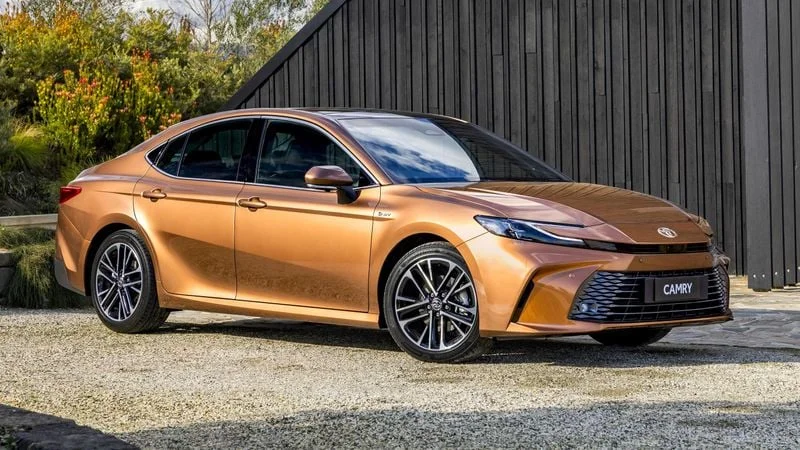
The current-generation Camry is the best-looking version Toyota has ever made. That's a low bar, admittedly. Previous Camrys were designed by committee and it showed. But the latest model has genuine presence. A wider, lower stance. Slimmer headlights with LED signatures. A fastback roofline that gives it more visual drama than a mid-size sedan has any right to possess.
The SL gets 18-inch alloy wheels that fill the arches properly. The Ascent Sport's 17-inch wheels look a touch small but it's a minor gripe. Colour options include a deep metallic blue and a genuinely attractive red that photograph well and stand out in car parks. The obligatory silver and white are there for people who want to blend in.
At 4,920mm long, the Camry is a sizeable sedan. It's 40mm longer than the Accord and 60mm longer than the Sonata. Despite the length, the proportions work. It doesn't look bloated or heavy. The drag coefficient of 0.28 is respectable for a sedan and helps its highway fuel use.
| Key details | 2026 Toyota Camry Ascent Hybrid |
|---|---|
| Engine | 2.5L 4-cyl |
| Power | 170kW |
| Torque | 221Nm |
| Drive type | FWD |
| Transmission | CVT |
| Power-to-weight ratio | 109 kW/tonne |
| Weight | 1,565kg (kerb) |
| Spare tyre type | Temporary spare |
| Tow rating | 1,200kg braked750kg unbraked |
| Turning circle | 11.2m |
| Fuel consumption | 4 L/100km |
| Boot | 524L seats up |
| ANCAP | 5 stars (2024) |
Key details for 2 other variants
| Key details | 2026 Toyota Camry Ascent Sport Hybrid |
|---|---|
| Engine | 2.5L 4-cyl |
| Power | 170kW |
| Torque | 221Nm |
| Drive type | FWD |
| Transmission | CVT |
| Power-to-weight ratio | 109 kW/tonne |
| Weight | 1,565kg (kerb) |
| Spare tyre type | Temporary spare |
| Tow rating | 1,200kg braked750kg unbraked |
| Turning circle | 11.2m |
| Fuel consumption | 4 L/100km |
| Boot | 524L seats up |
| ANCAP | 5 stars (2024) |
| Key details | 2026 Toyota Camry SL Hybrid |
|---|---|
| Engine | 2.5L 4-cyl |
| Power | 170kW |
| Torque | 221Nm |
| Drive type | FWD |
| Transmission | CVT |
| Power-to-weight ratio | 105 kW/tonne |
| Weight | 1,625kg (kerb) |
| Spare tyre type | Temporary spare |
| Tow rating | 1,200kg braked750kg unbraked |
| Turning circle | 11.2m |
| Fuel consumption | 4 L/100km |
| Boot | 524L seats up |
| ANCAP | 5 stars (2024) |
Is it good value?
What Does the Camry Cost in Australia?
Toyota has simplified the Camry lineup. Every variant is now a hybrid. No more choosing between petrol and hybrid. That decision has been made for you. Here's the current range:
The SL adds to the Ascent Sport Hybrid for the panoramic roof, head-up display, and premium leather. It's nice but not essential.
If you're considering whether a hybrid sedan or a full EV makes more financial sense for your situation, our EV vs Hybrid analysis breaks down the real numbers over five years.
Running Costs: This Is Where the Camry Wins
Let's run the numbers on the claimed figures, which is the only like-for-like way to do it. At 15,000km per year and the Camry's claimed 4.0L/100km, with regular unleaded at $1.95/litre, the fuel bill works out to roughly $1,170. A comparable petrol-only sedan claiming 7.5-8.0L/100km costs $2,193-2,340 on the same maths. Nobody matches a lab figure exactly and both cars will use more than their claim in practice, but the gap is the point, and it is worth close to $1,000 a year, or around $5,000 across five years.
Toyota's capped-price servicing for the Camry Hybrid runs between $220 and $380 per service, every 12 months or 15,000km. Over five years, total servicing costs sit around $1,500-1,800. That's cheaper than most rivals because the hybrid system means less brake wear (regenerative braking does most of the work) and the engine runs less frequently, so oil and consumables last longer.
Tyres on the SL with 18-inch alloys cost around $180-260 each for decent replacements. The hybrid battery is covered by Toyota's warranty for the full five years, and real-world evidence from millions of Toyota hybrids globally suggests these batteries routinely last 300,000km or more. Battery failure anxiety is not justified with Toyota's hybrid system.
Insurance group ratings are favourable. The Camry's theft rate is low, repair costs are reasonable, and it's a known quantity for insurers. Expect to pay $1,200-1,800 per year for comprehensive cover depending on your age, location, and driving history. For a full picture of what it actually costs to run, see our cheapest cars to run analysis.
Rivals: What Else Should You Cross-Shop?
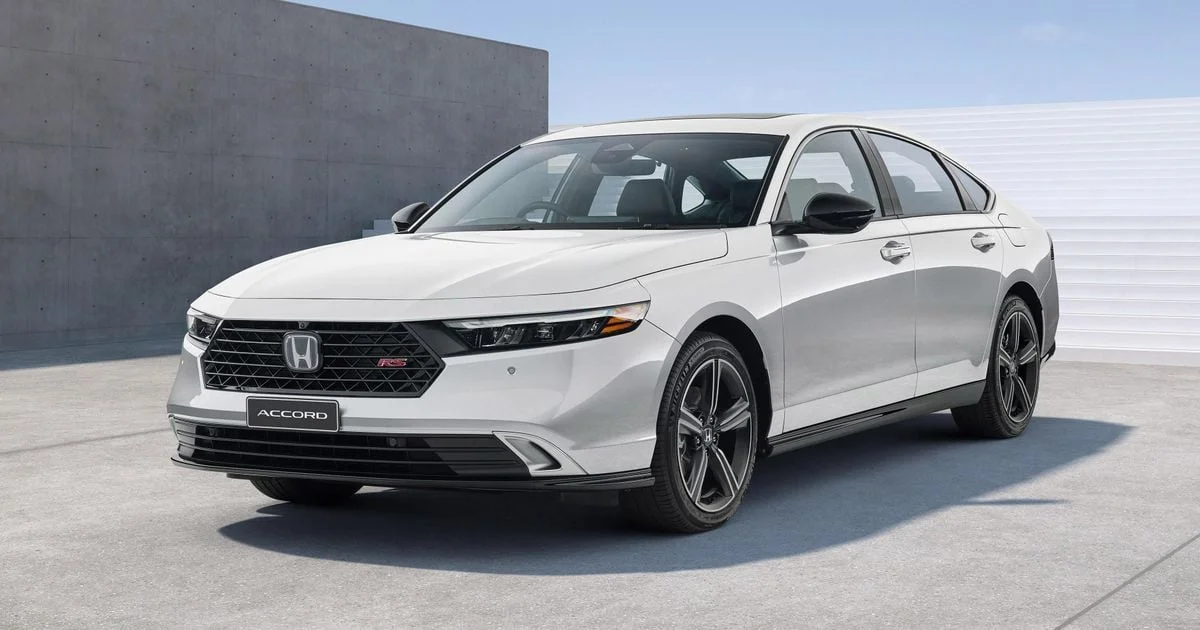
Honda Accord Hybrid (from $52,900)
The Accord is the Camry's most direct competitor and it's a genuinely excellent car. But it starts $11,260 above the Camry Ascent Sport and only comes in one specification level. The fuel economy is close (4.3L/100km claimed) but the Camry edges it. The Camry is the better value proposition. Full comparison in our Camry vs Accord head-to-head.
Hyundai Sonata (from $55,500)
The Sonata is a strong all-rounder with a striking design and a tech-heavy cabin with dual curved screens, but it is no longer a like-for-like Camry rival in Australia. Hyundai now sells it here in a single grade, the N Line, and it is turbo petrol only at 213kW: there is no Sonata Hybrid in the local range any more. So it is more powerful and better equipped than an Ascent Sport, but at $55,500 it costs $12,510 more and gives up the Camry Hybrid's whole running-cost advantage.
Mazda6 (no longer sold new in Australia)
The Mazda6 was the design-led choice in this segment, with a more premium look and cabin materials. Mazda has since withdrawn it from Australia, so it is a used-market proposition only. It never offered a hybrid here, so even as a used buy it runs 6.5-7.0L/100km against the Camry Hybrid's 4.0, which is roughly $3,000 more fuel over five years and 75,000km.
The Camry wins on fuel economy, boot space and value; the Accord wins on power, but costs $11,260 more. The comparison is short because the segment is: Mazda withdrew the 6 from Australia, and the Sonata is now sold here only as the petrol N Line, so the Camry Hybrid's only true mid-size hybrid sedan rival left is the Accord e:HEV. The nearest cross-shops are now electric sedans like the BYD Seal. For the full hybrid lineup, check our best hybrid cars in Australia guide.
| Key details: Toyota Camry Ascent Hybrid | |
|---|---|
| Price | From $39,990 RRPExcl. on-road costs |
| Drive-away estimate | Calculating... |
| Cost per week in VIC | from $211/wk in VIC, excludes servicing and insuranceRepayments, fuel or charging, rego and CTP, servicing, tyres and insurance where held. Estimate only, not a quote. |
| Body | Sedan |
| Powertrain | Hybrid, 2.5L 4-cyl |
| Towing (braked / unbraked) | 1,200kg / 750kg |
| Seats | 5 |
| Warranty | 5yr / unlimited km |
| Rivals | Honda Accord, Hyundai IONIQ 6 |
| The Toyota Camry range on sale | Price | Powertrain | Fuel or energy use |
|---|---|---|---|
| Ascent Hybrid | From $39,990 RRP | Hybrid, FWD | 4 L/100km |
| Ascent Sport Hybrid | From $42,990 RRP | Hybrid, FWD | 4 L/100km |
| SL Hybrid | From $53,990 RRP | Hybrid, FWD | 4 L/100km |
How much fuel does it use?
Efficiency: The Camry's Party Trick
Toyota claims 4.0L/100km on the combined ADR test cycle, which puts the Camry among the most efficient non-plug-in hybrid sedans sold in Australia. That is a laboratory figure measured on a standardised cycle, not a promise about your commute, so it is worth understanding what moves it.
A Toyota hybrid is unusual in that town driving is not the thirsty part. The test cycle spends a lot of its time at low speed, which is exactly where the electric motor does the work and the petrol engine can stay off, so stop-start suburban running is where the Camry tends to sit closest to its claim. Sustained highway speed pushes it the other way. Above about 90km/h the petrol engine is driving the car almost continuously, there is very little braking to harvest energy from, and the hybrid advantage narrows. Short trips that never let the engine warm up, a hot day with the air conditioning working hard, roof racks and a full boot all add to the figure as well.
The other half of the story is the tank. The Camry carries only 50 litres, which is small for a mid-size sedan, but a car sipping anywhere near its claimed figure still covers serious distance between fills. That is the kind of thing that matters if you are driving Melbourne to Adelaide rather than to the shops.
Running on standard 91-octane unleaded fuel is another advantage. No need for premium. At current prices around $1.90-2.00/litre, filling the 50-litre tank costs under $100. For more context on how hybrids stack up against EVs for running costs, our best hybrid cars guide has the full analysis.
| Fuel: Toyota Camry Ascent Hybrid | |
|---|---|
| Fuel use (combined) | 4 L/100km |
| Fuel type | Hybrid |
| Minimum fuel grade | No data |
| Urban / extra-urban | 4 L/100km / 4 L/100km |
| Fuel tank | 50L |
| Range on a tank (calculated) | 1,250kmTank divided by the combined figure |
| CO2 (combined) | 91 g/km |
| Measured fuel use (AAA, on the road) | 4.8 L/100km20% above the maker's ADR 81/02 claim of 4 L/100km. AAA test: this grade, 2025 model year, 17 July 2025. Source: Australian Automobile Association Real-World Testing Program (realworld.org.au). |
| Service interval | 12 months or 15,000km |
What does it cost to own?
| Warranty and servicing: Toyota Camry Ascent Hybrid | |
|---|---|
| Warranty | 5yr / unlimited km |
| Battery warranty | 10yr / 999,999 km |
| Roadside assistance | 3 years (renewed with dealer servicing) |
| Service interval | 12 months or 15,000km |
| Capped-price servicing | No data |
Cost per week in VIC: from $211/wk in VIC, excludes servicing and insurance
- Repayment estimate$162/wk
$5,000 deposit, 5yr loan at an assumed 7.5% p.a. on the RRP. Not an offer of credit
- Fuel$23/wk
4 L/100km combined at $1.95/L ULP 91, the site default
- Rego + CTP$18/wk
VIC typical: car, metropolitan (high risk) zone, 12-month renewal, $958.80 a year. As at July 2026, VicRoads
- ServicingNo data
No data: no servicing cost held for this car
- Tyres$8/wk
Typical tyre spend for this type of car, scaled to 15,000 km a year (not this car's tyres)
- InsuranceNo data
No data: no insurance estimate held for this car
Based on 15,000 km a year in VIC. Estimate only, not a quote.
How safe is it?
Safety: Five Stars, Comprehensive Suite
The Camry holds a 5-star ANCAP safety rating. Toyota's Safety Sense 3 package is standard across the range and includes:
- Pre-Collision Safety System with pedestrian, cyclist, and motorcycle detection (day and night)
- All-Speed Adaptive Cruise Control with stop-and-go functionality
- Lane Tracing Assist that centres the car in its lane on highways
- Lane Departure Alert with steering assist
- Road Sign Assist displaying speed limits on the instrument cluster
- Blind Spot Monitor with Rear Cross Traffic Alert
- Safe Exit Assist that warns if a car is approaching when you open the door
- Proactive Driving Assist that adjusts speed for curves and preceding vehicles
Eight airbags are standard, including a centre airbag between the front seats. The body structure uses Toyota's TNGA (Toyota New Global Architecture) platform, which provides excellent rigidity and crash energy absorption. In Euro NCAP testing, the Camry scored 96% for adult occupant protection. That's among the highest scores for any sedan.
Toyota's Proactive Driving Assist is worth highlighting. It reads the road ahead and subtly adjusts acceleration and braking to maintain safe distances and speeds through curves. It's not autonomous driving, just a background assist.
| ANCAP: Toyota Camry Ascent Hybrid | |
|---|---|
| ANCAP rating | 5 stars (tested 2024) |
| Adult occupant | 95% |
| Child occupant | 87% |
| Vulnerable road users | 84% |
| Safety assist | 81% |
| Airbags | 8 |
| Driver assists: Toyota Camry Ascent Hybrid | |
|---|---|
| Autonomous emergency braking | Standard |
| Adaptive cruise control | Standard |
| Blind-spot monitoring | Standard |
| Rear cross-traffic alert | Standard |
| Lane-keep assist | Standard |
| Speed sign recognition | Standard |
| Driver attention monitor | Standard |
| 360-degree camera | No data |
Standard, Optional (with the printed price), No (the maker's document says not fitted) or No data. 8 assists checked.
What is it like inside?
Interior: Physical Controls Stay
Toyota has lifted the interior quality significantly over the previous generation. The SL variant gets a 12.3-inch touchscreen running Toyota's latest infotainment system with wireless Apple CarPlay and Android Auto. It's not as flashy as Hyundai's curved dual-screen setup.
Physical controls remain for the climate system, volume, and tuning. Thank you, Toyota, for not burying everything in a touchscreen. You can adjust the temperature without taking your eyes off the road. This is how it should be done. The instrument cluster is a 12.3-inch digital display with configurable layouts. It shows hybrid energy flow if you're interested in monitoring efficiency.
The SL gets a leather and suede seat combination. The driver's seat has 8-way power adjustment with lumbar support. Rear passengers get decent-quality cloth or leather depending on the grade. The front seats are heated on the SL, which also adds ventilated front seats. Which is a genuine blessing during an Australian summer.
Materials across the dashboard are soft-touch up top and harder plastic lower down. It's not pretending to be a Lexus.
Storage is sensible. Large centre console bin, two front cup holders, a wireless charging pad on the SL, generous door pockets, a decent glovebox, and USB-C ports front and rear. The SL adds a JBL nine-speaker sound system.
Practicality: The Family Sedan Benchmark
The 524-litre boot is a competitive option in the mid-size sedan segment. It's competitive with the Accord and Sonata, and bigger than most SUVs in the same price range. The boot opening is wide and the lip is low. The rear seats fold in a 60/40 split, extending cargo capacity for longer items like flat-pack furniture or golf bags.
The rear floor is flat, which means the middle passenger's feet aren't straddling a transmission tunnel, which helps.
ISOFIX anchor points are fitted to both outer rear seats, with three top-tether anchors across the back row.
The Camry can tow up to 1,200kg braked, which covers a small box trailer, a jet ski on a trailer, or a lightweight camper. It's not a towing vehicle by any stretch, but having the option is handy for weekend trips or the occasional Bunnings run with an oversize purchase.
| Space and dimensions: Toyota Camry Ascent Hybrid | |
|---|---|
| Seats | 5 |
| Boot, seats up | 524L |
| Boot, seats folded | No data |
| Length x width x height | 4,920 x 1,840 x 1,445mm |
| Wheelbase | 2,825mm |
| Ground clearance | 130mm |
| ISOFIX | 2 points (2L, 2R) |
| Top tethers | 3 |
| Seat trim | Cloth |
| Spare wheel | Temporary spare |
Does it have good tech?
| Screens and audio: Toyota Camry Ascent Hybrid | |
|---|---|
| Touchscreen | 8 inches |
| Driver display | 7 inches |
| Audio | No data |
| USB | USB-C |
| Connected services term | No data |
| Connectivity: Toyota Camry Ascent Hybrid | |
|---|---|
| Apple CarPlay | Standard |
| Android Auto | Standard |
| Wireless CarPlay / Android Auto | Standard |
| Wireless phone charging | No data |
| Head-up display | No data |
| Built-in navigation | No data |
| Digital radio | Standard |
| Over-the-air updates | No data |
| Remote climate (app) | No data |
What the figures say about driving it
The Toyota Camry Ascent Hybrid has 109 kW for every tonne of kerb weight, 221Nm of torque, a claimed 0-100km/h of 8.1s. It weighs 1,565kg and turns in 11.2m. These are the figures that shape how quickly a car gets moving and how easily it parks.
| The figures: Toyota Camry Ascent Hybrid | |
|---|---|
| Power-to-weight | 109 kW/tonne |
| Power | 170kW |
| Torque | 221Nm |
| 0-100km/h (claimed) | 8.1s |
| Kerb weight | 1,565kg |
| Turning circle | 11.2m |
| Tyres | 215/55R17 |
| Drive | FWD |
| Transmission | CVT |
| Towing (braked) | 1,200kg |
We have not driven the Toyota Camry; these are Toyota's published figures.
Best deals
Get a great deal on a brand new car today
One enquiry, up to four cars. We ask local dealers for their best drive-away price and send them back to you, so you compare real numbers instead of list prices.
Free for you to use. If you buy, the dealer may pay us a commission. Your details only go to a dealer if you say so.
Find a new car dealShould I buy it?
Should You Buy the Toyota Camry?
Yes, if:
- Running costs are a top priority. nothing in this class matches the Camry's combination of fuel economy, servicing costs, and insurance affordability
- You want one of the largest boots in the mid-size sedan segment (524 litres)
- You do a lot of city driving. the hybrid system is at its most efficient in stop-start traffic
- You value reliability above all else and want a proven hybrid system with millions of examples globally
- Access to regional Toyota dealers matters. Toyota's network is the most extensive in Australia
Maybe not, if:
- You want the newest interior tech. the Sonata and Accord have more impressive cabin design
- You need serious towing capacity. 1,200kg is the Camry's limit
- You're considering an EV. if you can charge at home and your budget stretches to $55-60k, a Model 3 Standard Range costs less to run again
- You want more power and are willing to pay more for the Accord
The Camry Hybrid at $39,990-$53,990 is the most sensible car purchase you can make in Australia in 2026. It's not exciting, and Toyota would probably be the first to tell you that. But it does everything a family sedan needs to do. It's spacious, cheap to run, backed by Toyota's reliability record, safe, and it holds its value better than most. The Ascent Sport at $42,990 is the value pick. It covers the essentials well, while the SL adds the bigger screen, JBL audio and nicer seats if you want them.
If you're cross-shopping, start with our Camry vs Accord comparison. Or if you're deciding between a hybrid and an EV, our EV vs Hybrid analysis lays out the five-year numbers for both.
→ Compare all Toyota Camry variants on CarSorted (200+ specs)
CarSorted Score breakdown
The CarSorted Score is algorithmic: it is calculated from this car's published data, not from a road test. How it works.
Safety
Fuel Economy
Value
Practicality
Technology
Performance
Reliability
Questions buyers ask
How much does a Toyota Camry cost in Australia?
The Toyota Camry Ascent Hybrid is from $39,990 RRP, before on-road costs. The range table above lists every current variant.
What fuel economy does the Toyota Camry Hybrid get?
On the official combined cycle the Toyota Camry uses 4 L/100km.
Is the Toyota Camry a good family car?
Yes. The Camry has a 524-litre boot (one of the largest in the sedan segment), ISOFIX points on both outer rear seats, 5-star ANCAP safety, and running costs that are among the lowest of any family car. The hybrid system means cheap fuel bills and the 5-year warranty provides peace of mind.
What is the Toyota Camry Hybrid boot space?
The Toyota Camry has 524L of boot space with the seats up.
Does the Toyota Camry come in petrol only?
No. The current-generation Camry sold in Australia is hybrid-only. Every variant uses Toyota's 2.5-litre hybrid system. The pure petrol option was dropped from the Australian lineup in 2024.
Can the Toyota Camry tow?
The Toyota Camry Ascent Hybrid is rated to tow 1,200kg braked and 750kg unbraked.
How does the Toyota Camry compare to the Honda Accord?
The Accord Hybrid is the Camry's closest rival. It offers a slightly more powerful hybrid system in a single, higher-spec grade. The Camry counters with a lower starting price, better fuel economy, cheaper servicing, and Toyota's broader dealer network in regional Australia.
What's the difference between the Toyota Camry Hybrid and a true EV?
The Camry Hybrid uses both a 2.5-litre petrol engine and an electric motor that share driving duties. You fill it up at a regular petrol station; the battery charges itself from braking and engine load. There's no plug. A true EV (like the Toyota bZ4X or Tesla Model 3) runs only on battery and you plug it in to charge, no petrol involved. Hybrids like the Camry are cheaper to buy and have no charging anxiety; EVs are cheaper to run but need home or public charging. The Camry Hybrid is currently the only Camry powertrain available in Australia.
How to read this page. This is a review of the published figures: we have not driven this car. Prices, specifications, ANCAP ratings, warranty, equipment and the CarSorted Score come from our records for the variant shown, sourced from Toyota's Australian documents, and update when those records change. RRP excludes on-road costs. Drive-away figures are estimates for the state you have selected unless marked as advertised; cost per week is an estimate, not a quote. The editorial text was written on 7 April 2026. Always confirm price and specification with the manufacturer or a dealer before you buy. CarSorted does not accept payment for recommendations.
Comments (0)
Sign in to join the conversation
No comments yet. Be the first!