Key Takeaways
- A $3,900 cut across all four electrified Transit Custom vans has been reported for the 2027.25 update. Ford Australia has not yet published the new prices
- Reported, before on-road costs: PHEV Trend LWB $63,990, PHEV Sport SWB $66,390, E-Transit Custom Trend LWB $73,990, Sport SWB $76,390
- Each reported price is exactly $3,900 under what Ford's own configurator lists today for the 2026.50 model year van
- A 2.3kW vehicle-to-load outlet is reported as standard. Ford's current specification sheet does not list it
- On Ford's current sheet: 71.45kWh usable and up to 346km WLTP for the electric van, 53km WLTP electric range for the PHEV, and 2,300kg braked towing for both
- At the reported price the E-Transit Custom Trend sits $3,000 above the Staria Load Electric. Reported timing is March 2027 for the electric van and May 2027 for the updated range
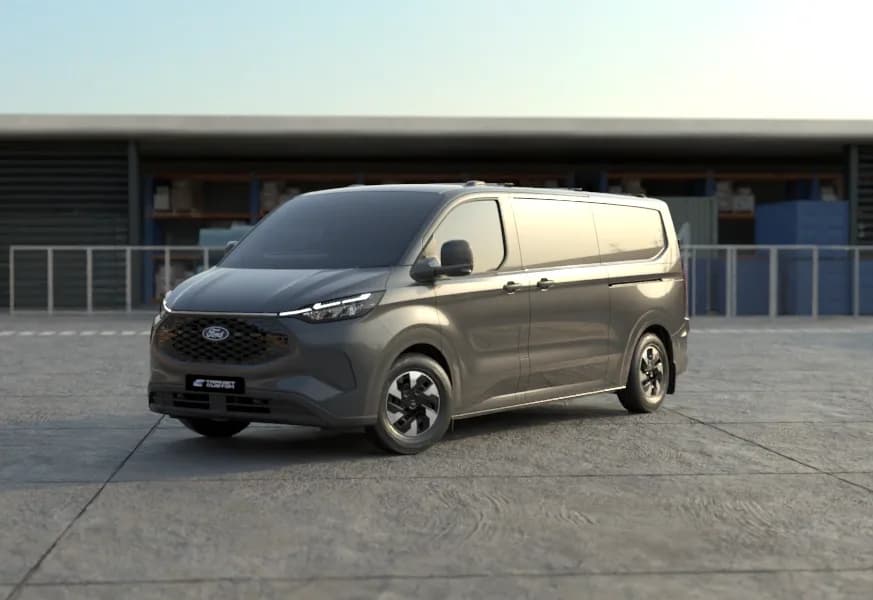
Image credit: Ford Australia. Current E-Transit Custom Trend LWB shown.
Ford's electrified mid-size vans are getting cheaper. Australian motoring outlets have reported that the 2027.25 E-Transit Custom and Transit Custom PHEV each drop by $3,900, and that all four variants pick up a 2.3kW Pro Power Onboard system with vehicle-to-load. The reported new prices run from $63,990 for the plug-in hybrid Trend LWB to $76,390 for the electric Sport SWB, all before on-road costs.
We want to be straight about the source. When we checked on 1 October 2026, Ford Australia had not put the 2027.25 prices or equipment on its own website. Its online configurator and its specification sheet still describe the 2026.50 model year van, and its model pages carry no 2027.25 prices or equipment. So the new prices in this piece are reported figures, and everything else (range, battery, towing, payload, charging) comes from Ford's current published documents, with the gaps marked. What we can say is that the reported prices line up exactly with Ford's current list: each one is $3,900 under the figure Ford's configurator shows today.
Pricing: Today and Reported
Grouped by powertrain. The "listed today" column is the price in Ford Australia's online configurator for the 2026.50 model year, which excludes on-road costs; Ford's pricing data holds dealer delivery ($2,995) as a separate item. The "reported 2027.25" column has not been published by Ford.
| Variant | Drive | Listed today (2026.50MY) | Reported 2027.25 |
|---|---|---|---|
| Plug-in hybrid (2.5L petrol + electric) | |||
| Transit Custom PHEV Trend LWB | Front-wheel drive | $67,890 | $63,990 |
| Transit Custom PHEV Sport SWB | Front-wheel drive | $70,290 | $66,390 |
| Battery electric | |||
| E-Transit Custom Trend LWB | Rear-wheel drive | $77,890 | $73,990 |
| E-Transit Custom Sport SWB | Rear-wheel drive | $80,290 | $76,390 |
| 2.0L turbo-diesel, for reference (no 2027.25 change reported) | |||
| Transit Custom Trend SWB | Front-wheel drive | $56,890 | Not reported |
| Transit Custom Trend LWB | Front-wheel drive | $57,890 | Not reported |
| Transit Custom Sport SWB | Front-wheel drive | $60,290 | Not reported |
Two things follow from that table. First, if you are ordering one of the electrified vans now, you are paying the 2026.50 price for the 2026.50 van, and the reported cut is for a later build. Ask the dealer which model year your order is, and whether any 2026.50 stock is being discounted to meet the new list. Second, the plug-in premium over the diesel shrinks. Today the PHEV Trend LWB is $10,000 more than the diesel Trend LWB on Ford's list; at the reported price it would be $6,100, assuming the diesel price holds, which nobody has reported either way.
What Ford Has Actually Published
These figures are from Ford Australia's 2026.50 model year Transit Custom specification sheet, dated August 2026. Ford has not published a sheet for the 2027.25 update, so read them as the current van, not a promise about the next one.
| Spec | PHEV Trend LWB / Sport SWB | Electric Trend LWB / Sport SWB |
|---|---|---|
| Power | 171kW system (2.5L 86kW + 111kW motor) | 160kW / 415Nm |
| Usable battery | 11.8kWh | 71.45kWh |
| Electric range (WLTP) | 53km / 53km | 340km / 346km |
| Combined fuel use (ADR 81/02) | 1.7L/100km | N/A (no engine) |
| Charging | 3.5kW AC, no DC listed | 11kW AC, 125kW DC |
| Kerb weight | 2,119kg / 2,080kg | 2,237kg / 2,198kg |
| Payload (based on kerb weight) | 1,106kg / 1,145kg | 1,113kg / 1,027kg |
| GVM / GCM | 3,225kg / 5,225kg | 3,350kg (Trend), 3,225kg (Sport) / 5,350kg |
| Max braked towing | 2,300kg | 2,300kg |
One detail worth flagging. The launch coverage describes the 2027.25 E-Transit Custom as getting a larger battery, quoted at 71.45kWh. Ford Australia's August 2026 sheet for the current 2026.50 van already lists 71.45kWh usable and 340km for the Trend, and so does Ford's electric Transit Custom page. So either the bigger battery is already in the van Ford is selling now, or the comparison in the reports is against an older build. Either way, you do not have to wait for 2027.25 to get those figures on paper. Confirm the battery on the actual build you are quoted.
The PHEV: Honest About Its 53km
The plug-in hybrid is the cheaper way into the electrified range, and at a reported $63,990 it is also the one with the smallest gap to diesel. It is worth understanding what it is, though. The 11.8kWh usable battery gives 53km of WLTP electric range, and Ford lists AC charging at up to 3.5kW with no DC fast charging. Ford's own sheet puts a full charge at about 4.15 hours on a 15-amp outlet and 7 hours on a standard 10-amp socket, so an overnight top-up at the depot or at home is the whole plan.
The 1.7L/100km combined figure is the official ADR 81/02 number, and like every plug-in hybrid figure it assumes the van starts with a full battery. It says very little about a day of 250km on the highway, where the 2.5-litre petrol engine does most of the work. The PHEV suits a van that does short urban runs, can be plugged in every night and spends a lot of time idling or crawling, which is where a diesel is least happy. It does not suit a van that covers big country kilometres, and on a long day the diesel's 8.0L/100km official figure is the known quantity.
The E-Transit Custom: 340km, and 29 Minutes on a Fast Charger
The electric van is the more capable machine: 160kW and 415Nm to the rear wheels, 71.45kWh usable, and up to 346km WLTP on the Sport SWB. Ford's page puts a 10 to 80 per cent DC charge at about 29 minutes at up to 125kW, and a 10 to 80 per cent AC charge at about 4.7 hours on an 11kW wallbox. Ford's sheet lists energy use of 240Wh/km for the Trend LWB.
WLTP range is measured in controlled conditions at 23 degrees, with no climate or electrical load, and Ford says so in its own footnotes. A van loaded close to its tonne, running the air-conditioning in a Queensland summer, will not see 340km. For a metro courier or trade van doing 150km to 200km a day with an overnight charge, there is plenty in hand. For a regional run that regularly clears 250km, it is going to rely on public DC charging, and our range estimator is a quick way to see how much margin your own route leaves.
What vehicle-to-load would change
If the reported 2.3kW Pro Power Onboard outlet arrives as described, it matters more on a work van than on a family car. 2.3kW is roughly what a 10-amp household socket supplies, which is enough for battery tool chargers, a small compressor, a work light or a laptop, and not enough for a large welder or a big air compressor. It would save a lot of tradies carrying a separate generator. Just remember that it is reported, not yet printed by Ford: the current specification sheet does not list it, so get it written on the order.
Towing: 2,300kg on Paper, Less Once You Load It
Both electrified vans are rated at 2,300kg braked towing on Ford's sheet, against 2,800kg for the diesel Trend and 2,500kg for the other diesels. Ford also notes that its own genuine towbar for the Transit Custom is rated to 2,500kg only, which does not bite here but does for the diesel Trend.
The more useful sum is the gross combination mass, because it caps van plus trailer together. Taking Ford's published figures for the E-Transit Custom Trend LWB: a GCM of 5,350kg, minus a 2,300kg trailer, minus a 2,237kg kerb weight, leaves about 813kg for people, cargo and the towball download combined. That is well short of the 1,113kg payload the van has when it is not towing. Run the same arithmetic on the PHEV Trend LWB (5,225kg GCM, 2,119kg kerb) and you get about 806kg. So a van that tows its maximum is carrying roughly 300kg less than its headline payload. That is not a fault, it is how every van and ute works, but it is the number to plan around. Put your own trailer through the TowingSorted planner or the towing and payload calculator before you commit, and remember that towing near 2,300kg will cut the electric range hard.
Against the Other Electric Vans
We do not yet hold rows for the E-Transit Custom or the Transit Custom PHEV, so they are not in the comparison below. What is in it are the electric vans we list on sale, plus the diesel Renault Trafic for reference. Pick any two.
Pick two
Electric vans on sale, side by side
The Staria Load Electric, Kia PV5 Cargo, Peugeot E-Expert, LDV eDeliver 7 and Mercedes eVito, plus a diesel Trafic. Tap any two.
| Spec | Hyundai Staria Load Electric | Kia PV5 Cargo Long Range |
|---|---|---|
| Price from | $70,990RRP, before on-roads | $55,990RRP, before on-roads |
| Driving range | 450 km | 400 km |
| Braked towing | 2,000 kg | 750 kg |
| Payload | 1,005 kg | No data |
| Fuel use | N/Abattery electric, no fuel figure | N/Abattery electric, no fuel figure |
| ANCAP | No data | No data |
| Warranty | No data | 7 yrunlimited km |
Prices shown are each van's listed price on CarSorted and are not all on the same basis. Range figures can be on different test cycles. Where a cell reads No data, we do not yet hold that figure. The E-Transit Custom and Transit Custom PHEV will be added once we list them. Figures come from our car database, which is built from Australian manufacturer documents. A blank field reads “No data” rather than a zero or a dash.
The obvious head-to-head is the Hyundai Staria Load Electric, which Hyundai Australia lists at $70,990 before on-road costs. At the reported $73,990, the E-Transit Custom Trend LWB would sit $3,000 above it, down from a $6,900 gap at today's Ford list price. That is the real story of this price cut: it puts Ford back within reach of a rival that arrived cheaper.
The Kia PV5 Cargo S Long Range is a different proposition at $55,990 before on-road costs on Kia's price list. It is a smaller van, and on the figures we list it is rated to tow 750kg braked against the Ford's 2,300kg, but we also list a 416km WLTP range and a 3.6kW vehicle-to-load outlet. If you do not tow and your loads fit, it is $18,000 less than the reported E-Transit Custom Trend.
On specification only, the Peugeot E-Expert is listed with a 330km claimed range, a 1,001kg payload and 1,000kg braked towing, and the LDV eDeliver 7 with 362km WLTP, a 1,205kg payload and 1,500kg towing. The Mercedes-Benz eVito Panel Van is listed with an 826kg payload. Of those with a towing figure in our data, neither matches the Ford's 2,300kg rating, and we hold no towing figure for the eVito. We have not quoted prices for those three because we have not yet checked them against the manufacturers; the comparison tool shows the figures we currently list.
And for a reality check against diesel, the Renault Trafic SWB Pro is listed by Renault Australia at $52,990. Even at the reported price, the electric Ford Trend LWB would be $21,000 more than that mid-size diesel van. Fuel and servicing savings can close some of that for a high-kilometre urban van, but it depends on your electricity tariff and your running pattern, so we are not going to put a payback period on it.
Tax, Safety and the Fine Print
Tax. As general information for the 2026-27 financial year: every price here, reported or current, sits below both luxury car tax thresholds ($80,809, and $91,661 for fuel-efficient vehicles), so LCT is not a factor. On fringe benefits tax, the electric car exemption is written for vehicles that meet the tax law's definition of a "car", and that definition excludes goods vehicles designed to carry a load of one tonne or more. Ford quotes payloads above 1,000kg for all four electrified vans, so a business owner should not assume the electric car exemption is the relevant rule; work vans are generally assessed differently, and limited private use can be exempt on its own terms. Plug-in hybrids first held on or after 1 April 2025 do not qualify for the electric car exemption in any case. This is general information, not tax advice; talk to your accountant.
Safety. We hold no ANCAP star rating for the E-Transit Custom or the Transit Custom PHEV. Ford's Transit Custom page cites a Platinum result in ANCAP's 2024 Commercial Van Safety Comparison, which is a separate programme from ANCAP's star ratings. If your fleet policy requires a star rating, check the ANCAP site for the exact variant before ordering.
What Ford Has Not Told Us Yet
- The 2027.25 prices themselves. Ford's configurator still shows the 2026.50 van.
- A 2027.25 specification sheet, including whether any mass, range or towing figure changes.
- The vehicle-to-load outlet: its location, whether it runs with the van switched off, and whether it is on the PHEV as well as the electric van, as reported.
- Timing. March 2027 for the electric van and May 2027 for the updated range have been reported, not published by Ford.
- Battery warranty terms for the 2027.25 vans, which we have not confirmed with Ford.
Who It Suits, and Who It Does Not
The E-Transit Custom suits a metro trade or delivery business that parks at a base with a charger, covers under about 200km a day, and occasionally tows a trailer. At the reported price it is close enough to the Staria Load Electric that towing capacity and the Ford dealer network could decide it.
The PHEV suits a van that mostly does short runs but cannot rule out a long day without a charger, and a buyer who wants a smaller step up from diesel. It suits less well anyone who cannot plug in overnight, because without that it is a heavier petrol van.
Neither suits a van that tows near its limit every day or does long regional runs; the diesel tows more and carries more. If you are about to order, the practical advice is simple: ask which model year you are getting, ask whether the reported cut is already being applied, and get the vehicle-to-load outlet named on the order. We will add all four electrified variants to the CarSorted directory once Ford Australia publishes the 2027.25 specification, and current offers are on our deals page.
Disclaimer: The 2027.25 prices, the $3,900 reduction, the 2.3kW vehicle-to-load outlet and the March and May 2027 timing are as reported by Australian motoring outlets and had not been published by Ford Australia when we checked on 1 October 2026. Current prices are from Ford Australia's online configurator for the 2026.50 model year, checked on 1 October 2026, and exclude on-road costs. Specifications, masses, towing, range and charging figures are from Ford Australia's 2026.50MY Transit Custom specification sheet (dated August 2026) and its electric Transit Custom page; range is WLTP and fuel consumption is ADR 81/02. The GCM arithmetic is our own, from Ford's published figures. Rival prices are the manufacturers' listed prices as recorded on CarSorted; other rival figures are the ones listed on CarSorted at the time of writing. Tax information is general information for the 2026-27 financial year, not tax advice. Confirm price, specification and availability with a Ford dealer before ordering.