BYD Atto 2 DM-i: The Spec Sheet, Read Properly
Written by Uzzi · 6 August 2026
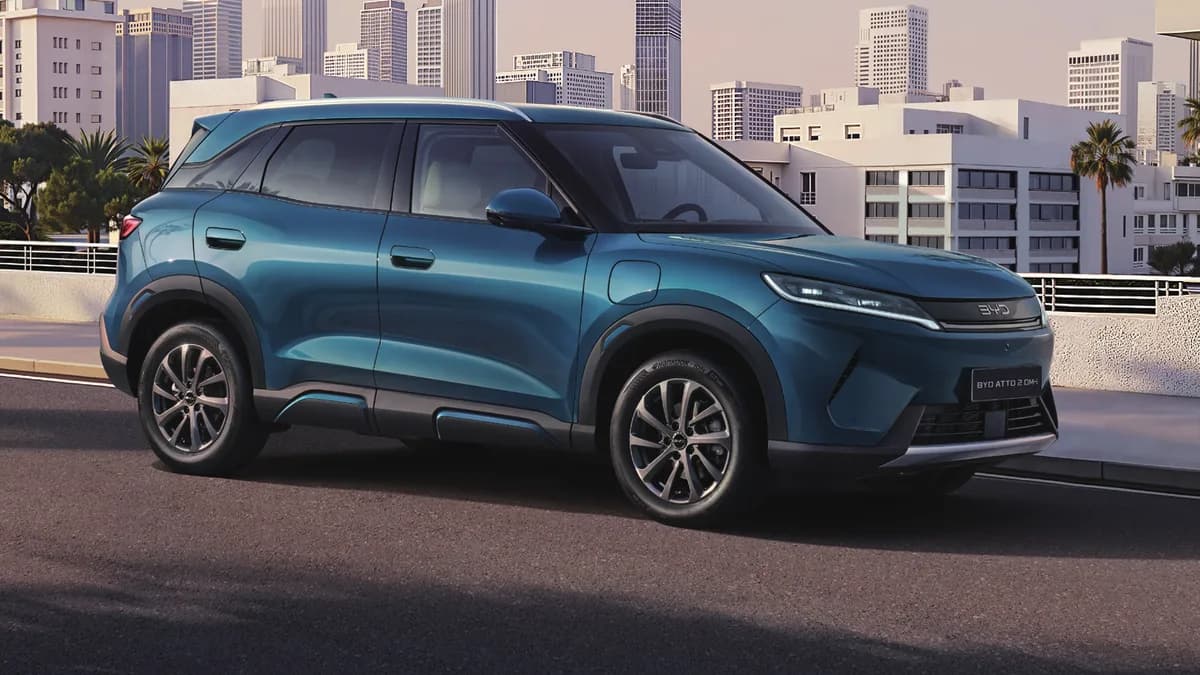
BYD has a habit of turning up in a segment, undercutting everyone, and then quietly moving the goalposts a year later. The electric Atto 2 did it to the small EV class at $31,990. The Sealion 5 DM-i did it to the plug-in hybrid class at $33,990. Now there is a plug-in hybrid version of the Atto 2, and on paper it looks like the car that finally drags PHEV pricing under thirty grand.
Two things before we start, because they matter more than usual with this car. First, we have not driven it. Nobody in Australia has, because it is not here yet. Everything below comes from BYD's own specification document and from our own database of what it will be competing against, and we will say clearly when something is a projection rather than a fact. Second, the figures BYD has published are European. Australia certifies fuel consumption and emissions under ADR 81/02, Europe uses WLTP, and the two produce different numbers for the same car. Treat every figure here as a very good indication rather than the final word.
With that said, the spec sheet is genuinely interesting, and there are a couple of numbers in it that have been reported incorrectly elsewhere. Let us go through it.
The number everyone gets wrong
If you have read anything about the Atto 2 DM-i already, you have probably seen a fuel consumption figure of 1.4L/100km, or even 0.6L/100km. Those numbers are not on BYD's specification sheet. What is on it, for both grades, is 5.1L/100km combined.
The gap is not a typo, it is two different tests. A plug-in hybrid gets measured two ways. The weighted combined figure assumes you start every trip with a full battery and drive a certain average distance, so a big chunk of the test happens on electricity and the petrol number collapses to something absurd. The charge-sustaining figure is what the car uses once the battery is flat and it is working as an ordinary hybrid. On BYD's sheet, the weighted combined row is printed as TBC for both grades. BYD has not published one. The 5.1L/100km is the honest, battery-depleted number, and it is the one worth planning your fuel budget around.
This matters because it is the single biggest way plug-in hybrids mislead buyers. If you have a driveway, a power point and a commute under 40km, you will genuinely use almost no petrol and the tiny advertised number will feel about right. If you live in an apartment, park on the street, or regularly drive further than the battery lasts, you are driving a 1,600kg hybrid that uses 5.1L/100km. Both of those are fine outcomes. They are just wildly different, and the advertised figure only describes one of them. We have written more about how to read these numbers in our guide to the cheapest PHEVs in Australia.
Two grades, and they are not split the way you would expect
In Europe the Atto 2 DM-i comes as the Active and the Boost. BYD tends to rename for Australia, and given the Sealion 5 uses Essential and Premium here, that is the likely local naming.
Here is where the reporting has gone astray. The two grades are widely described as having different electric motors, 121kW in the base car and 145kW in the upper one. BYD's sheet does not say that. The electric motor row is a single merged value of 145kW spanning both columns. Both cars get the same motor. What differs is the system output, 122kW against 156kW, and the reason is the battery. The Active's 7.8kWh pack physically cannot discharge fast enough to feed the motor everything it can take. The Boost's 18.0kWh pack can get closer.
That is a more useful thing to know than a motor spec, because it tells you the Active is not a decontented car so much as a power-limited one, and the limit is the battery rather than the hardware.
| Plug-in hybrid | Active | Boost |
|---|---|---|
| System output | 122kW / 300Nm | 156kW / 300Nm |
| Petrol engine | 1.5L four-cylinder, 72kW / 122Nm | |
| Electric motor | 145kW / 300Nm, permanent magnet | |
| Battery (Blade LFP) | 7.8kWh | 18.0kWh |
| Electric range, combined | 40km | 90km |
| Electric range, city | Not published | 150km |
| Total range | 930km | 1,000km |
| Fuel use, battery flat | 5.1L/100km | 5.1L/100km |
| CO2 | Not published | 41g/km |
| 0-100km/h | 9.1s | 7.5s |
| Max AC charging | 3.3kW (2.7h) | 6.6kW (3.0h) |
| DC fast charging | Not available | |
| Kerb weight | 1,510kg | 1,620kg |
| Payload | 490kg | 490kg |
| Wheels | 16-inch | 17-inch |
| Australian price | Not confirmed by BYD | |
Charging is the catch, and it is a real one
The Atto 2 DM-i has a Type 2 AC port and nothing else. No CCS, no DC fast charging, no exceptions. The Active takes 2.7 hours to go from 15 to 100 percent at 3.3kW; the Boost takes 3.0 hours at 6.6kW because the pack is more than twice the size.
For a car built around home charging that is a defensible engineering decision, and it saves cost and weight. But it does close off a use case. You cannot pull into a fast charger on a road trip and put 60km of electric range back in while you get a coffee. Once the battery is done, it stays done until you are somewhere you can plug in for a few hours, and you are driving a 5.1L/100km hybrid until then. If your living situation does not include off-street parking with a power point, this car loses most of its point and you should be looking at a straight hybrid instead.
Worth knowing too: the Active does not get vehicle-to-load, so you cannot run a kettle or a camp fridge off the battery. That is a Boost feature.

Space, and the boot number that beats the electric car
The DM-i is 4,330mm long, 1,830mm wide and 1,675mm tall on a 2,620mm wheelbase. That puts it right in the middle of the small SUV class, a touch longer than a Chery Tiggo 4 and shorter than an MG ZS.
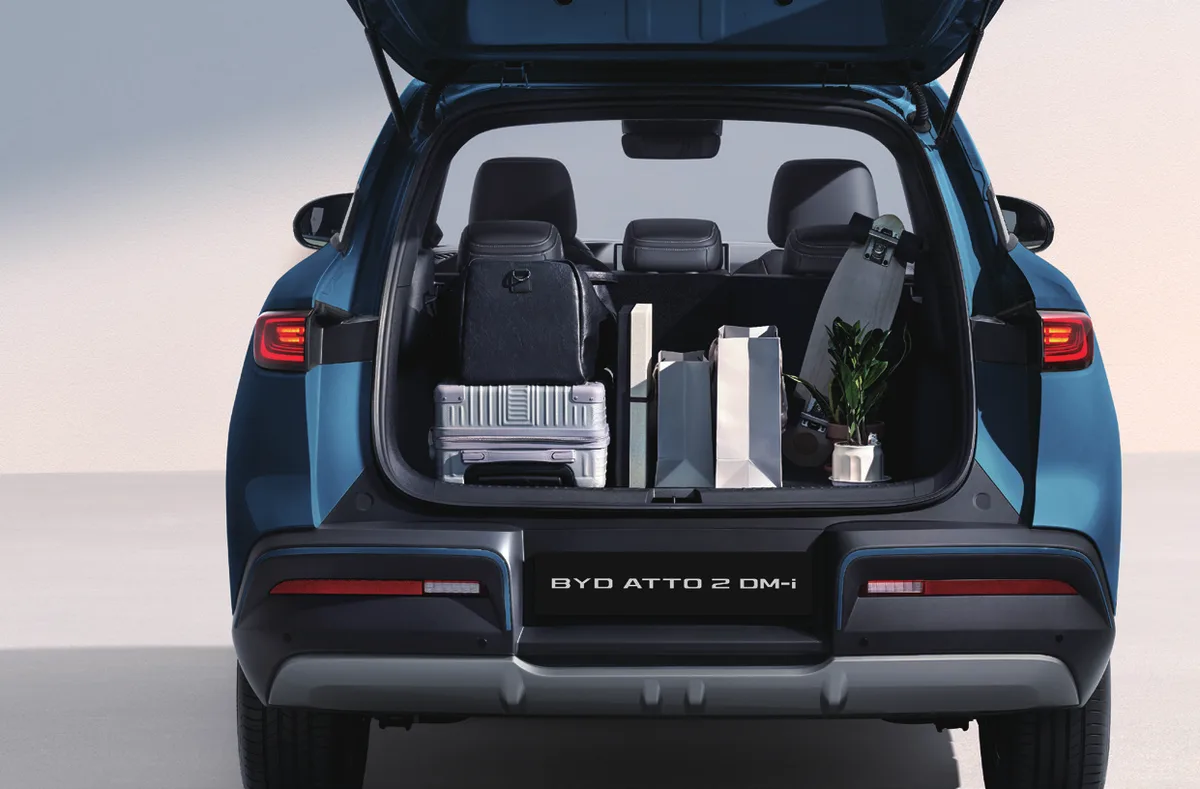
The interesting bit is the boot. BYD quotes 425 litres with the seats up and 1,335 litres folded. The Australian electric Atto 2 is listed at 380 litres. Normally a plug-in hybrid loses space to the petrol tank and the exhaust, so a PHEV out-booting its own EV sibling is unusual. Part of it is the 20mm of extra length, part is likely a different measuring method between the European and Australian sheets, and we would not bet the house on 425 litres surviving translation to the local brochure. Still, it is not a small boot for the class, and it comfortably beats the 255 litres in a Haval Jolion Hybrid.
Towing is 750kg braked and unbraked, with a 75kg roof limit and a 5.3 metre turning radius, so a hair over 10.6 metres kerb to kerb. Payload is 490kg on both grades, which is five adults and not much luggage, or four adults and a proper load. That is normal for the class rather than a criticism.
Safety kit is generous. The rating does not exist.
The standard driver assistance list on both grades is long, and unusually for a budget car there is very little held back for the upper grade. Autonomous emergency braking, adaptive cruise, lane departure warning, emergency lane keeping, blind spot detection, rear cross traffic alert and brake, traffic sign recognition, driver monitoring, door opening warning, forward and rear collision warning, hill descent control and auto hold are all listed as standard on the Active as well as the Boost. The 360-degree camera is the notable exception, and it is Boost-only.
What does not exist is a crash rating. Neither ANCAP nor Euro NCAP has tested the Atto 2 in any form. BYD's recent record is good and the equipment list suggests it should do well, but a rating on a Seal or a Sealion tells you nothing about this car's structure. If a five-star rating is a hard requirement for you, this is a wait-and-see, and in the meantime the MG ZS Hybrid+ holds a five-star rating from 2025 testing.
What it should cost, and why we are not putting a number on it
BYD has not confirmed Australian pricing. What we can do is show you the box it has to fit inside, because BYD's own range constrains it fairly tightly.
| Model | Powertrain | Price |
|---|---|---|
| BYD Atto 2 Dynamic | Electric | $31,990 |
| BYD Atto 2 Premium | Electric | $35,990 |
| BYD Sealion 5 Essential | Plug-in hybrid | $33,990 |
| BYD Sealion 5 Premium | Plug-in hybrid | $37,990 |
| Atto 2 DM-i | Plug-in hybrid | Not announced |
The Sealion 5 is a mid-size SUV at $33,990 and the electric Atto 2 is a small one at $31,990. A small plug-in hybrid that costs more than either has no reason to exist, which is where the widely quoted sub-$30,000 expectation comes from. That reasoning is sound. It is still reasoning, and BYD has surprised the market in both directions before. We will publish a price the day BYD does, and not before.
One thing you can plan for: BYD Australia covers its cars with a six year, 150,000km warranty and eight years or 160,000km on the battery. Servicing on the electric Atto 2 runs to $1,414 across the first five years at 12 month or 20,000km intervals. A DM-i has an engine, oil and filters to look after, so expect its servicing to land somewhat higher than the EV's.
So should you wait for it?
Wait if you have off-street parking and a power point, drive under about 40km a day, and want to stop buying petrol without giving up the ability to drive to Melbourne on a whim. That is exactly the brief this car was built for, and on paper it does it for less money than anything else currently does.
Do not wait if you cannot charge at home. Without a plug, the Atto 2 DM-i is a 5.1L/100km hybrid carrying around 100kg of battery it never gets to use, and a conventional hybrid like the Chery Tiggo 4 Hybrid or MG ZS Hybrid+ will cost you less and do the same job. Also do not wait if you need a five-star ANCAP rating on the paperwork, or if you tow anything meaningful, because 750kg is not a lot.
And if you want the electric version of this exact car, it is already here and already sharp. Our cheapest electric cars guide covers where the Atto 2 EV sits, and we have put the DM-i head to head with the five cars it will actually be cross-shopped against in Atto 2 DM-i vs its rivals.
We will update this guide the moment BYD Australia confirms local specification and pricing. The specifications above are BYD's European figures and are labelled as such on the Atto 2 DM-i Active and Boost pages in our directory.
Compare these picks side by side
Stack 6 of them on 200+ specs, price, safety and running cost in one view.
Compare all 6 nowFrequently Asked Questions
When is the BYD Atto 2 DM-i coming to Australia?
How much will the BYD Atto 2 DM-i cost in Australia?
How far does the BYD Atto 2 DM-i go on electricity?
What fuel economy does the BYD Atto 2 DM-i really get?
Can the BYD Atto 2 DM-i DC fast charge?
Does the BYD Atto 2 DM-i have an ANCAP rating?
Is the Atto 2 DM-i bigger than the electric Atto 2?
How much can the BYD Atto 2 DM-i tow?
New cars, real prices, straight to your inbox
Join the CarSorted mailing list for new-model launches, price drops and drive-away deals, honest reviews, and founding-member pricing on the upcoming CarSorted Pro Report.
- New-model launches
- Price drops & deals
- Honest reviews
No spam, unsubscribe anytime. By subscribing you agree to receive marketing emails.
Disclaimer: All information in this article was believed to be correct at the time of publishing (6 August 2026). Prices are manufacturer recommended retail prices (RRP) and may vary by state, dealer, and options. Specifications, government incentives, and rebates can change without notice. Always verify details with the manufacturer or relevant authority before making a purchase decision. Running cost estimates are based on average Australian driving conditions at 15,000 km/year. CarSorted does not accept payment for recommendations or rankings.
Written by Uzzi, CarSorted Editorial Team · 6 August 2026 · how we research
Comments (0)
Sign in to join the conversation
No comments yet. Be the first!